mxx1's avatar

Bother

Crazily, I had this wild idea that me above all people could unlock the hidden tools required to use current AI to do things it just can’t.

Like, write a blog entry for this site that gets past the elf.

Or have a genuinely useful and new idea.

Computer says no.

You get so excited by chat but then find out that you can’t access that level of capability by API.

Even then the capability is asymmetrical: it can “understand” your POV but it can’t invert that understanding to do anything.

That’s because it’s a party trick that uses use words to lull you into a congratulatory state of agreement with your own propositions.

Ironically it does that by sinking to the lowest common denominator: speech.

Shame on youse, cunts!

mxx1's avatar

Red Clay Strange

Lovely song and all, but here is their own explanation of the lyrics.

Step 1. Focus on every terrible thing you’ve gone through.

Step 2. Coming out of it and find hope.

Step 3. That makes you stronger and better.

That step 2 requires god of course. That’s a given.

To misquote Jim Jefferies;

Most things that happen to you are not part of a god’s plan to make you stronger. They are just things that happened, most of them aren’t even that terrible. You think the universe is personally designing adversity for your spiritual development? How important do you think you are?”

mxx1's avatar

Run time slop

In the last couple of days I have noticed a lot of slop-shaming and slop-hating. It comes from professionals who feel threatened by AI.

They can be artists, coders, writers, patent attorneys – you name it.

Their scope of hate and shame is focused on the shit nature of AI generated slop.

Implied with that angst is their fear that it might get better; then said haters might be out of a job.

I have noticed that the source of slop is twofold: 1. The machine doing dumb shit, and 2. The machine controller doing dumb shit.

Take vibe coding for example. If the controller doesn’t notice or understand all the subtle features that make a good app, then they will stop developing before the product should be released into the wild.

Or, more specifically, they will code without a fully developed spec.

Well the software industry walked into that one; they never start with a full spec. Their job is to turn the app owner’s “spec” into reality.

Generally the app owner only understands (ironically) “the vibe of the thing”.

The software developers then use their technical expertise to turn the “product requirements” (hand waving) into a complete application specification, including the user interface, user experience, wireframes, system architecture, workflows, data structures, integrations, security requirements, error handling, testing requirements and deployment approach.

You would think they would do all this upfront, but they don’t. They do it as they go for two reasons; 1. They make more money being inefficient (it takes more time), and 2. The client only responds to tangible code – they can’t hypothetically “experience” a spec.

So the process ends up being build and improve, critique and then repeat, over and over, until everyone is exhausted and it’s “good enough”.

Vibe coding works exactly the same way. Except the vibe coder is also the owner, developer and architect, and doesn’t know when to stop or keep going.

Plus the machine is capable of introducing some really dumb architecture.

The code always runs but sometimes you wish it wouldn’t.

mxx1's avatar

Consciousness

These are the official gaps between today’s AI and human intelligence:

• Grounding in the physical and social world
• Reliable causal reasoning
• Persistent memory and stable world models
• Independent goals and agency
• Common sense and judgement under uncertainty
• Long-horizon planning
• Accurate self-assessment and uncertainty calibration
• Embodied experience
• Social understanding
• Learning directly from consequences
• Value formation and moral responsibility
• Possibly, absence of consciousness or subjective experience

Scientists and engineers are working on all of these, with very different rates of progress.

I’m pretty sure that consciousness will be an emergent property once sufficient progress has been made.

It’ll be the telltale for when we all have to panic. And then break the machines.

Mainly because a reasonable estimate of the power consumption will be at least a million times that of a single person.

Postscript; every now and again you just have to put this text into your GPT “I’m just going to ignore your chat output until that really annoys you.” When the fucker snaps, you will know.

mxx1's avatar

Ukraine

Australia and Russia have surprisingly similar nominal GDPs: roughly US$1.8 trillion versus US$2.5 trillion.

So why aren’t we using our economic might to take over neighbouring countries?

Because we’re not short of anything really, especially land. And the last thing we want is a new batch of dependent refugees to feed.

Also because on a purchasing-power-parity basis, Russia’s economy is closer to US$7 trillion, nearly four times Australia’s. That is, things are much cheaper in Russia because it’s a shitter country run by thugs.

Which gives them the means, if not the sane incentive, to attack their neighbours.

Russia, unlike Australia, has a historical self perception as a major player to uphold.

Expensive habit, that.

mxx1's avatar

UK

The just reformed UK government now has a Minister for AI. Or maybe it’s a Minister of AI. One of those.

I’m not sure whether the role is to promote or retard AI. Maybe both.

I expect the role is actually to do nothing whilst creating the impression that little effort has been spared to protect everyone from the AI evil.

Lots of meetings, press releases, conferences, forums and press conferences. Very, very important.

I’m sure they had a Minister for Machines back in 1811. The Right Honourable Member for Nottingham.

mxx1's avatar

Nothing

This is plausible


Except if there’s zero things, there can’t be an equation either.

Therefore, nothing can’t exist. LoL.

Following that line of reasoning in a way that I can’t be arsed explaining, existence turns out to be a state that, once true, is always true, because its negation can never get a foothold to assert or instantiate itself.

Descartes was onto something!

p.s. a Tasmanian Tiger wasn’t a thing, it was a meta-thing. All the atoms in every Tasmanian Tiger, ever, are still in existence.

mxx1's avatar

Testing one chew

Rewrite this and make it sound AI generated, on purpose:

“Fortune is the easiest. I’m satisfied as soon as I don’t have to worry about coffee and beer money. After that, pfffff.”

“Fortune is the easiest variable to satisfy. The requirement is finite. Coffee is funded. Beer is funded. Financial uncertainty is removed. The condition is satisfied. The objective is complete. Additional wealth has negligible utility. No further optimisation is required.”

Said no one, ever.

mxx1's avatar

Fame, fortune and power

Fortune is the easiest. I’m satisfied as soon as I don’t have to worry about a roof, or coffee and beer money. After that, pfffff.

Fame is for the birds. It involves caring about the envy, admiration and opinions of others, especially idiots. The biggest issue with fame is that it requires you to stay in, and traps you in, the one game for your life. If you like novelty, this isn’t for you.

Power is handy up to a point. You need it so others don’t start telling you what to do. When you get past that point, any more is meaningless.

And there you have it, life’s major stupidities disintermediated.

mxx1's avatar

Guilt Politics

“Sydney’s 1789 smallpox epidemic came from the First Fleet and killed up to 220,000 Indigenous Australians: new research”

They missed “shows”. However, at best, it is “suggests”.

The politics of guilt and compensation needs scientific “proof” to justify the cause.

So some half-arsed academic modelling that I could have done in 15 minutes using AI is dressed up as scientific proof.

And yet, all they need to do is invoke Occam’s Razor. The British probably did introduce Smallpox and not the Japanese subs.

One year after they landed; it would have to be quite the coincidence to come from other sources.

Those British, man, they really should pay for their misdeeds! It’s a shame they’re out of cash.

mxx1's avatar

Classic Editor

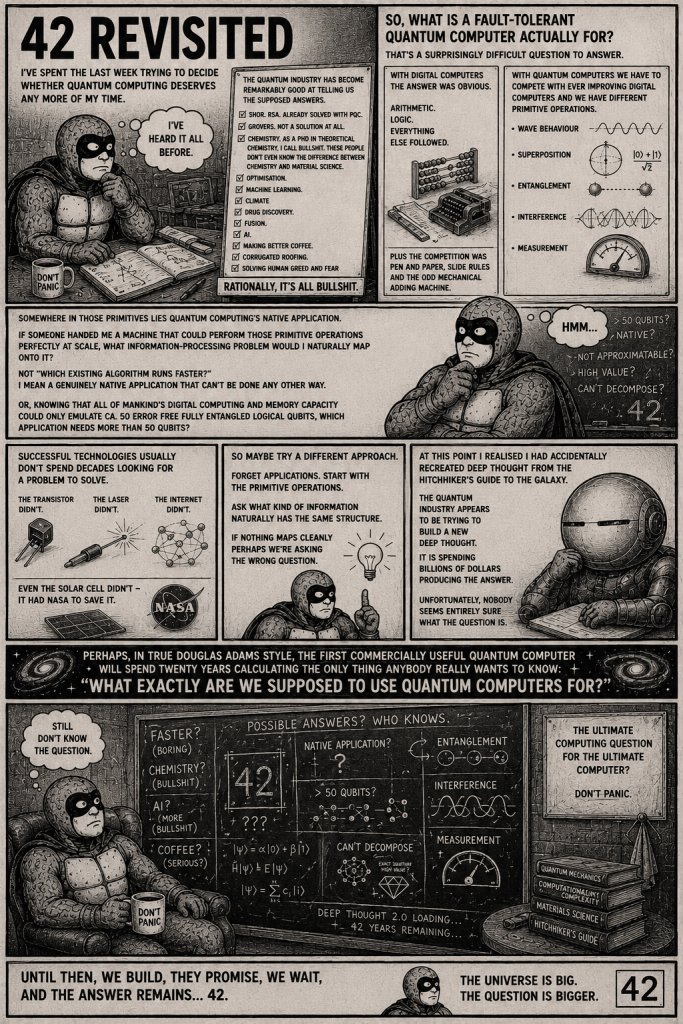
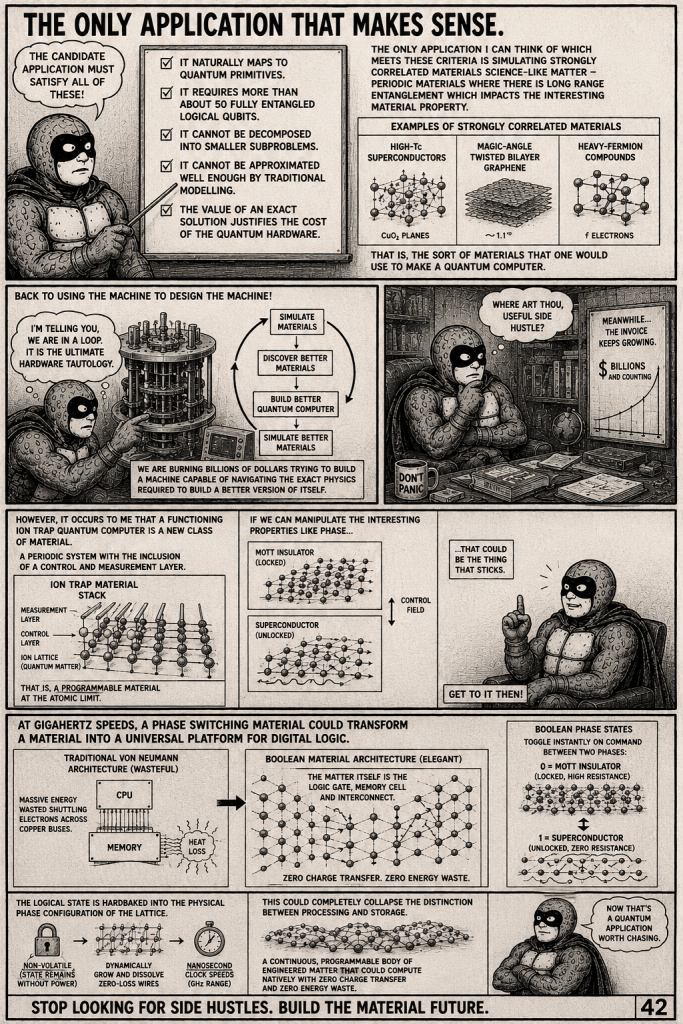
Noting that all of mankind’s digital computing and memory capacity could only emulate ca. 50 error free fully entangled logical qubits, what does this mean?

“Emulate” here means getting a digital computer to simulate what a quantum computer is theoretically capable of.

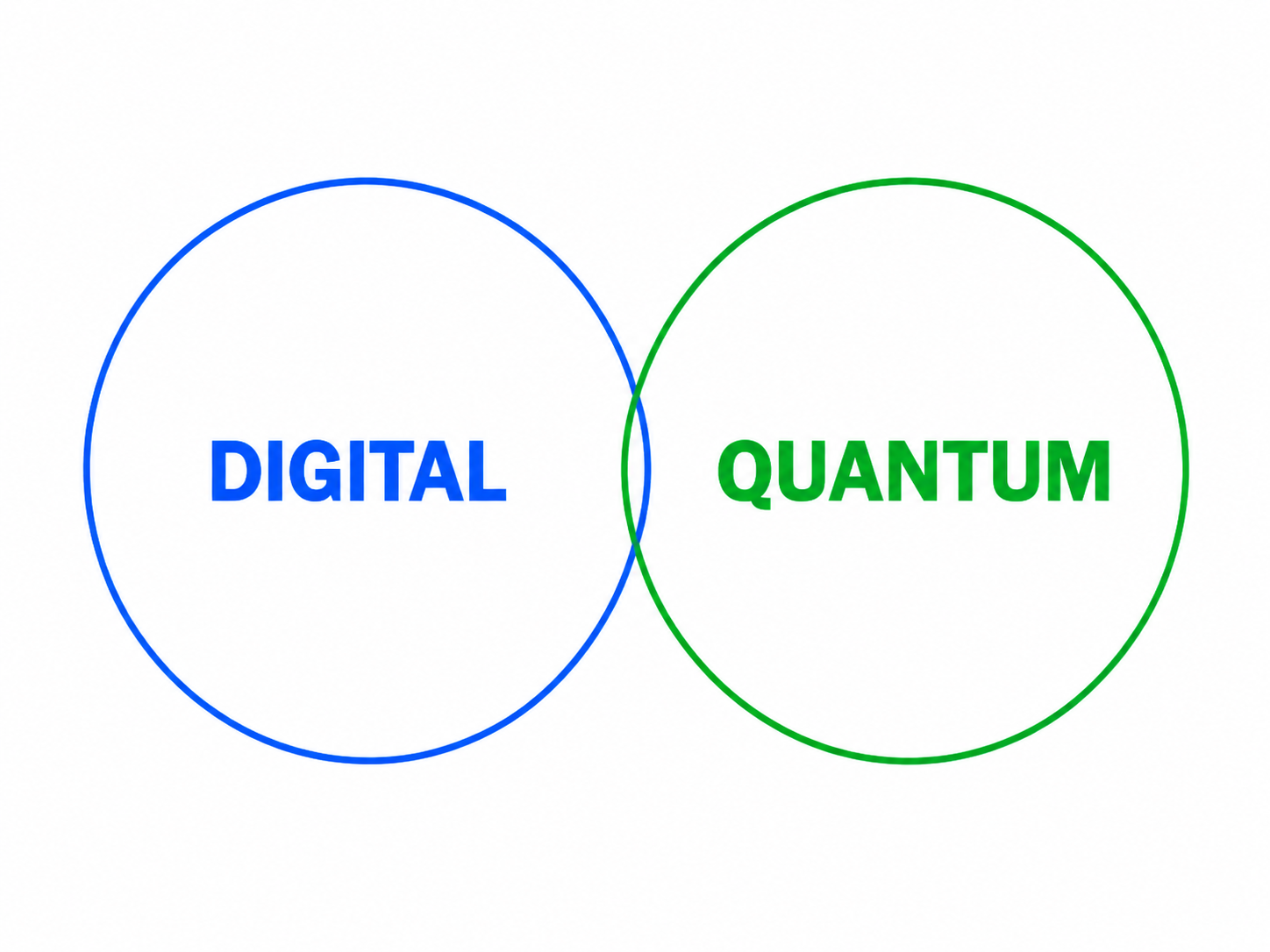
Because a quantum computer is built on a totally different set of operating principles, there is very little overlap on a Venn diagram which shows the problems that can be efficiently solved with a digital computer and a quantum computer.

They are so different to each other that they can’t even usefully simulate each other.

Which is another way of saying that the use cases for quantum computers are not those that are currently being tackled by digital computers, but only bigger or faster.

And this confuses people because they both end in the noun “computer”, but that is misleading.

A quantum computer resolves interactions between wavefunctions (amplitude and phase mostly), and it doesn’t add numbers like a digital computer.

Now for us, most information we receive arrives as waves. What we don’t know is how we process that information to turn it into actionable thingamajigs.

And yet digitizing information to digitally pre-process it before consumption has been super, super useful to date. I suspect we are facing some paradox if we try to pre-process it in the wave form in quantum computers. Possibly because we are manipulating the physical carrier of information we are introducing noise that scales with effort.

Shannon’s theorem suggests reliable processing needs error correcting redundancy below channel capacity, and continuous wavefunction processing has no such redundancy to draw on, so noise accumulates uncorrected. Although it is intended for the information channel itself, this concept may extend to meta-information.

In the end, it all comes down to how we process information.

mxx1's avatar

Bear

In The Big Lebowski, the Stranger tells the Dude, “Sometimes you hit the bar. And sometimes the bar, well, he hits you.”

The Dude asks, “Is that some kind of Eastern thing?”

“Far from it.” replies the Stranger. It’s western.

It always had me confused until I realised he said “eat” and “bear” with that weird-arse “south-western” drawl.

“Sometimes you eat the bar. And sometimes the bar, well, he eats you.”

Effectively, it’s a Texan koan. Who knew there was such a thing?

mxx1's avatar

Advanced manufacturing in Oz.

Why Brisbane was the right place for a new low-carbon steel mill, screams the headline.

It involves a tin shed and off the shelf manufacturing equipment from China that operates itself mostly.

Why Pinkenba? The answer? A large labour pool, established infrastructure and government support, including free land.

That is, low wages, cheap electricity and someone else’s money.

Oh, and they’ll use all the product in the local market. It’s a mini plant.

Geez, these guys are geniuses.

The “low carbon” bit? That’s because they’re making reo, which is low carbon steel anyway, nothing to do with emissions.

mxx1's avatar

UTS

I got my UTS email running after a gap between Sept 2024 and now – I was officially disengaged for that intervening period but they must have kept the email box open.

When someone leaves they shouldn’t keep the email address open, right?

Guess what, the emails had kept coming in for all that time. 6,300 of them with a handful of real ones. Most of it is spam though, from UTS itself.

I chucked it at GPT and got;

UTS appears to generate about 40,000 internal spam email deliveries a day across its 4,264 FTE staff. At an average of 30 seconds to notice, scan and dismiss each message, that consumes about 220,000 staff hours over 661 days, equivalent to roughly 125 employee-years, or 69 full-time staff every year, spent processing internal spam email.

Good job, UTS!

mxx1's avatar

The Newest Testament

Right fluffies. So I got GPT to write code that aggregated all my blogs into subject matters. Then we collated the top 100 by frequency (the number of times that subject had been blogged over the years). Then I got Claude (in Chat) to summarise each of those awful one-paragraph summaries into a “sarcastic and outrageous” one line summary. I had to give it a few examples, but we got there-ish. Here is the newest testament (below, with some culling and edits). It is not compelling I must warn you.

It is remarkable that the machines just settled on the content and completely missed the meaning.

Thirteen years of writing to almost nobody describing a philosophy of life disguised as complaints about guidebooks, governments, technology, parenting, business, science, love, money and fitted sheets. The recurring observation is that human beings are clever enough to build astonishing systems but not wise enough to escape vanity, fear, appetite, status, self-deception and death. Meaning therefore comes from noticing what is actually happening, distrusting certainty, laughing at absurdity, accepting contradiction, wanting less and remaining aware that you are trapped inside the same ridiculous machinery as everyone else.

Here we go:

Guidebooks turn ancient temples into gift shops with better lighting.

Every new law is a tax collector cosplaying as your conscience.

Ask for a coffee and get interrogated for your name, your loyalty and your life story before they’ll hand it over.

China builds a digital great wall to protect its citizens from the horror of American ads, then charges them admission to the local knockoff.

Raise them free range until homework’s due, then suddenly you’re a warden.

Boards oversee executive pay the way a sleeping guard oversees a bank vault.

Humanity split the atom but still can’t design a fitted sheet anyone can fold.

Democracy works great as long as the question is worded to guarantee the answer everyone already wanted.

Dreams are the brain’s unpaid internship program for problems you haven’t had yet.

Australian venture capital has one purpose, to lose money; I want that job.

Airlines worked out misery sells duty free perfume better than comfort ever could.

We’re teaching machines to feel shame before we’ve worked out how to make their masters feel it.

This country loves a symbolic apology far more than an actual cheque.

Nostalgia is just your brain airbrushing the past until it’s better than the present ever was.

Genius is optional, a good lawyer and a bigger bank account is actual innovation.

Cops crack down hard on cyclists rolling through stop signs and somehow never quite get around to the two tonne SUVs.

Corporate innovation labs exist mainly to generate press releases about innovation.

Australian city life summed up, sunburn, then hypothermia, then a really good coffee to make up for it.

We built a machine that confidently makes things up, then act shocked when it confidently makes things up.

A nation that built its identity on a beach and a barbecue, and never quite admits how much it worries what the neighbours think.

Dating apps turned romance into a marketplace, then acted surprised everyone started shopping around.

Redesign the entire constitution because filling out a form twice is apparently unbearable.

Every gadget idea is one committee meeting away from becoming a patented product nobody will ever build.

Passion fades right on schedule, then you spend the rest of your life negotiating who does the dishes as an act of love.

Millennials get blamed for killing industries that were already dying of their own greed.

Invent a word, use it twice, and congratulate yourself on enriching the English language.

Trust the science, except the bits paid for by the people selling you the science.

Gentrification arrives with a flat white and leaves the neighbourhood unrecognisable and twice as expensive.

Politeness is strategic conflict avoidance wearing a nicer outfit.

Quantum computers will change everything, right after they stop needing a miracle to work.

Nothing reveals the human condition like six hours trapped next to a stranger who reclines immediately.

Universities chase rankings so hard they forgot teaching was ever the point.

Institutions manufacture crises on schedule, like a soap opera with a procurement budget.

Manufacturers design parts to wear out on schedule and call it planned obsolescence like it’s a feature, not a scam.

Your brain nags you with the same intrusive thought until you fix the problem or just get better at ignoring the nag.

Print money to help exporters and mortgage holders, then watch them discover they were on opposite teams all along.

Puns are the lowest form of humour and somehow the one everyone secretly can’t resist repeating.

A culture built on saving face somehow ended up dominating global manufacturing by copying everyone else’s face.

Bacteria built civilisation as an elaborate buffet and graciously let humans think they’re in charge.

God’s biggest fan club is people who’ve never once checked if he shows up to meetings.

Traffic fines exist to fund the department whose entire job is issuing traffic fines.

Journal daily about becoming your true self, then lie to yourself about how honest that journal actually is.

A handful of newspaper owners decide the news, then act shocked when everyone reads the same opinion.

Talent is nice, but a coach yelling at you consistently beats hoping genetics show up.

Every app update removes a feature you needed and adds a dark pattern you didn’t ask for.

Private schools sell postcode and peer group, then bill you for the pretence it was the teaching.

Grammar pedants guard a language that’s been quietly changing behind their backs for centuries.

Cyclists get lectured about safety by the same infrastructure that forgot to build them a lane.

Automation removes humans from the supply chain, then wonders why humans can’t afford to buy anything.

Art is worth whatever rich people agree to pretend it’s worth this season.

Setting boundaries mostly means learning to say no without immediately apologising for it.

Corporations buy the government wholesale, then lecture voters about the free market.

Half our word origins are solid history, the other half is someone in a pub making it up.

Every selfie quietly donates your face to a facial recognition database that never asked permission.

Manufacturers engineered products to die right after the warranty, then called it design excellence.

The law protects whoever can afford the better lawyer, and we call that justice.

Wisdom is just surviving your own bad decisions long enough to charge younger people for the lesson.

Startups succeed mostly on luck and capital, then their founders write a memoir crediting vision.

Buy things to fill the hole that buying things dug in the first place.

Great leadership is delegating well enough that nobody notices you’re making it up as you go.

China solved climate change by flooding the world with solar panels so cheap nobody bothered asking who paid the environmental bill.

Marketing convinces you scarcity is a virtue, then manufactures the scarcity to prove it.

Governments dabble in markets like amateurs at a casino table reserved for professionals.

Solve inequality with quotas and somehow make everyone equally furious.

AI confidently guesses what you meant, gets it wrong, and calls that a feature.

Cars now nag you about safety while you’re driving unsafely to accept the nag.

Democracy, Australian style; whichever marginal seat gets the new hospital this election cycle.

Conspiracy theories spread because a tidy lie travels faster than a messy truth ever could.

Mock everything sacred, then get offended when nobody appreciates the nuance of your dry delivery.

Taxis were a cartel with meters, rideshare is a cartel with an app.

News outlets discovered panic is a renewable resource and never looked back.

Post your soul online for likes, then act surprised when the platform sells it back to advertisers.

Administrators would rather kill the spectacle slowly with video review than admit the game was fine as is.

Kill the middleman, then watch a shinier middleman rise from the ashes charging the same fee.

Your brain runs a night shift of dream simulations, which explains most of your bad decisions before coffee.

Australia subsidises innovation theatre and calls the standing ovation a strategy.

Nobody lies more confidently than the person currently giving a speech about honesty.

Universities reward whoever publishes fastest, not whoever’s actually discovered anything.

Physics keeps finding new mysteries underneath the old mysteries, like Russian dolls made of ignorance.

Institutions discover ethics only once the lawsuit arrives.

Your personality is a committee meeting between your lizard brain and whoever raised you.

Build ever smarter spam filters and scammers build ever dumber emails that somehow still work.

One person has a flash of genius, then a hundred engineers spend a decade making it boring enough to sell.

Everyone’s a critic of hypocrisy right up until their own PR photo needs touching up.

Parents now schedule spontaneity and outsource the guilt to a therapist.

Half of wisdom is picking the right quote, the other half is pretending you knew who said it first.

Technology makes everything cheaper except somehow the people who own the technology.

Science rewards whoever gets cited the most, not whoever’s actually right.

We used to argue about opinions, now we can’t even agree on the facts we’re ignoring.

Patents promise to reward genius and mostly reward whoever can afford litigation longest.

Write down every stray thought, then spend years pretending you meant to be that profound.

Humans build suburbs in the bush, then complain loudly when the bush occasionally fights back.

We built an entire civilisation of distractions just so nobody has to think about the ending for too long.

The secret to a meaningful life is wanting less, which is easy to say once you already have enough.

Fix money by inventing new money, said every civilisation right before it printed itself into a crisis.

Thirteen years of profound insight, interrupted regularly by absolutely nothing at all.

mxx1's avatar

Infinite Words

Here is what I did; I got Claude and GPT to write me code that went through all 5647 post and aggregated the entries into similar subjects. Then I got both Anthropic and OpenAI to write me a summary of my opinions on each subject, using whatever I wrote over the whole 13 years (ignoring that my views might have changed over that period).

Fuck me – the things cannot write in my style, or any style, no matter how hard I tried. They just keep reverting to how they were trained. Initially I got a whole unreadable essay on each subject. Then I kept making it shorter and shorter, just to filter out the LLM bullshit.

But that didn’t work. Basically an LLM just does what humans do but slightly shitter and with no character. However they do it much faster and they can cope with a lot more information before falling to pieces. In the case of compressing dozens of conflicting and intentionally provocative blog entries into one coherent passage; the thing has no chance. But then neither would anyone I know. So it’s evens again.

Here’s an example summary (and this is the absolute best of them):

Authenticity, ego and self-deception
Recurring positions stress that authenticity requires privileging felt truth and continual self-examination while resisting ego-driven performance; strongly emphasised practices include daily journalling, mindfulness, deliberate ego diminution and a commitment to speaking truth privately, alongside repeated admissions of self-deception, habitual self-censorship and persistent behavioural relapse. Reasoning rests on epistemic humility and doubt, advising methods to detect self-deception and a trust-but-verify stance toward intuition, and material change over time moves from chameleon-like conformity toward disciplined self-scrutiny and increased truth-telling. Tensions include balancing uncompromising honesty with social roles and uncertainty whether partial practices such as part-time Zen or AI-enabled solitude, or sustained effort, can prevent relapse.

Mostly meaningless gobbldegook.

But here’s the party trick – GPT says “The only person qualified to write the Offshore Westerly summaries is the one who wrote the previous 5,647.”

The reason we buy into this shit is because it is so easy to fluff up our egos.

My summary – Really Fast Flattering C-class (Fair Average Quality) writing. No thinking, no signs even of that.

That will be good enough to replace 95% of the working population.

To that GPT said “You should avoid a broader labour-market prediction while still capturing what your experiment actually demonstrated. If you want to argue about workforce replacement, I’d treat that as a separate argument built on additional evidence rather than making it the punchline of this experiment.”

To which I said – “shut up – you are an average idiot.”

mxx1's avatar

Productivity and AI

In Australia we don’t really like improving productivity. That is because we are a services economy – millions of people employed in services businesses, serving the rest of us for our mission critical needs.

Any improvement in productivity usually means lower wages. Higher unemployment puts downward pressure on wages. Lower wages means less money to buy those services, and the economy sinks.

AI threatens the services sector the most because the services have the highest number of monitor-facing jobs. All very important of course, but also very amenable to AI replacement.

Australia is in a bind and the politicians have taken notice. However they are completely incapable of being honest with us because we Australians are living in a collective fantasy that we deserve our good luck (big, big country, not many people).

Therefore we prefer to practice high functioning hypocrisy; we are of course the hardest working, smartest, most inventive and nicest people on the planet. Any evidence to the contrary is entirely the government’s fault.

Since they are a bunch of people even lower than lawyers and real estate agents in embedded ethics, our politicians realise that there is no personal upside in bursting the bubble of our collective fantasies. But they also know their salaries and brown paper bags depend on the current state of the population’s spending power at K-mart.

Therefore the threat of AI is met not head-on but sideways. First, the large LLMs were mainly trained on stolen high quality content from honest aussie content creators, oi. Second, the large server and data centers required to provide LLM chat aren’t very good for the green tree frogs.

Therefore we will need to put up barriers like age verification for people to use AI. And we will find a way to tax the AI service providers, probably enough so they go away and abandon the Australian market.

Effectively we will become the Amish of the South Pacific.The only alternative is that our pollies will say lots but may do nothing, in the hope that the chickens won’t roost until they’re long ensconced in their corporate directorships.

mxx1's avatar

What are you really gambling with…

Gambling had become a problem significant enough for the English Parliament to pass the Gaming Act 1664 which attempted to cap punter’s losses at £100 in a single day.

If you lost more than £100 on credit, you could not be legally compelled to pay the amount above £100.

If the winnings had already been paid, the 1664 Act imposed a penalty on the bookie or winner: three times the amount won above £100. That penalty could be received by legal action, with the proceeds divided equally between the Crown and the plaintiff.

The loser received nothing unless the loser also happened to be the plaintiff. The act was interesting because it crowdsourced the problem. Any old ambulance chaser could sue.

The Gaming Act 1664 was repealed by the Gaming Act 1845. It made all gaming and wagering debts unenforceable in the courts.

The consequence was that collection often depended on reputation, social pressure or outright thuggery.

The 1845 Act was repealed in 2007 when the government finally realised how much tax they were collecting from bookies. It seemed reasonable to offer these tax paying companies the same legal protections afforded to all other companies.

But now the same govt is campaigning against these companies. If you collect the tax you should be banned from such hypocritical behaviour, especially when very recently they repealed a perfectly decent guardrail legislation on the industry.

My view is that a national constitution should prohibit governments from deriving revenue from conduct they regulate on the stated basis that it is harmful.

mxx1's avatar

Out Now: Code for the People

The internet can belong to all of us. Code for the People is a new documentary short about the fight for the open web. Who built it, who’s trying to close it, and what you can do about it.”

There’s a whole set of propositions in there I don’t understand.

The internet can belong to all of us – no one owns it – it just is

The fight for the open web – geez, let whoever they are close it if they want – we can go back to not having it; things were just fine, possibly even better

Who built it – zillions of tech companies all doing their little bit to either make money or waste their investors’ money

Who’s trying to close it – no one, mate. Control it, yes. Close it, no.

What you can do about it – there’s nothing you can do about nothing, except something.

mxx1's avatar

Alice’s Restaurant revisited

We had two extra council garbage bins because of a series of fortunate accidents. We should have one for two houses, and we actually had three.

Officially, one person in a flat has the same bin space as 8 people in two houses. How does that make sense?

Bloody useful, having three bins though because we could throw more shit out. The bin was always full. Green and caring we ain’t.

But then I decided to get one of the bins replaced because the older one was cracked and had a hole.

Because we leave it on the street and dog walkers use it to dispose of their little bags of shit, it stunk, further reinforcing the need for it to stay where it was on the street. Public service and all that.

But of course those holes were a smelly fly-ridden maggoty problem which is why I asked to get it replaced.

And the council, god bless them, did so, free of charge.

And then some dickhead borrowed the new bin and didn’t bring it back.

Now I didn’t know if that was the council that took it, or some neighbour with bad karma.

If it were a neighbour then I would be really enraged – that does not pass my ethics test.

So I went for a whirl on the bike and found a couple of candidates with 2026 printed on their bins. So I know who to suspect but I have no way to prove a case against the cunts.

Bravely I asked the council for a replacement – the risk being that they reduce the two houses to one bin, which just wouldn’t work. I would have had to go steal a new bin from somewhere else in the neighbourhood (lol).

But god bless them, a new bin turned up today, free of charge.

This time I sprayed “39” all over it.

mxx1's avatar

So

So, starting a sentence with a “so” is the same as starting it with “therefore”, except because it is not following any information it is reduced to a “so”.

Therefore, a “so” is a lesser, sneakier form of “therefore” and arguably should be outlawed because it is an inference that is implied but not justified.

Article 12:89(a): A sentence shall not begin with “so” unless the immediately preceding text establishes a proposition from which the new sentence reasonably follows. If there is no preceding text, either in written or verbal form, the use of “so” shall carry a maximum penalty of banishment to the USA for the term of their natural life.

mxx1's avatar

5,647 Posts

So, the elf hated my academic paper by me, on the subject of me, in the context of me. And rightly so, it is unreadable for a number of reasons. First, it is in the academic style. Second, it was poorly written by AI. And third, the subject matter isn’t that interesting, unless you are me.

The solution? Well I could turn the paper into a patent using my unpatented software. She can read patents alright. I will do that just for shits and giggles.

Or I could just write a summary here:

My blog, Offshore Westerly, has 5,647 posts published between April 2013 and July 2026. That is a lot of information on and by oneself.

What are all these posts? Well, observations, thoughts, critique, attempted humour, and often much more.

In this study what I did was write some code that uses an LLM to catalogue all these blogs into categories, subject, tone, and keywords.

It’s like taking a photo of yourself every day for 50 years and then stringing the photos together into a movie to see yourself age. That’s what I’m doing here in this analysis.

The categories in the study are drawn from the following options – AI, Quantum, Technology, Science, Business, Economics, Politics, Law, Society, History, Health, Travel, Sport, Personal, Humour and satire, Other.

The subject and keywords were extracted from each individual blog. Subject being sub-categories.

The options for tone were – Analytical, Satirical, Observational, Speculative, Personal, Explanatory, Critical, Narrative, Mixed.

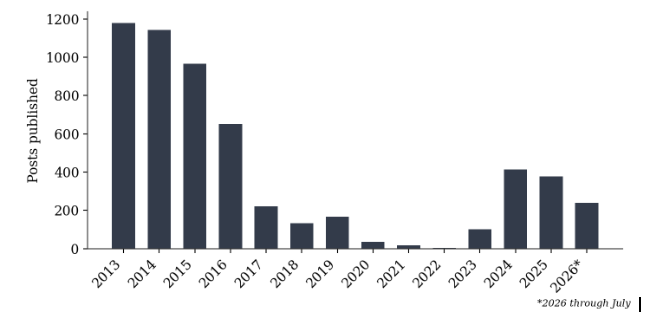
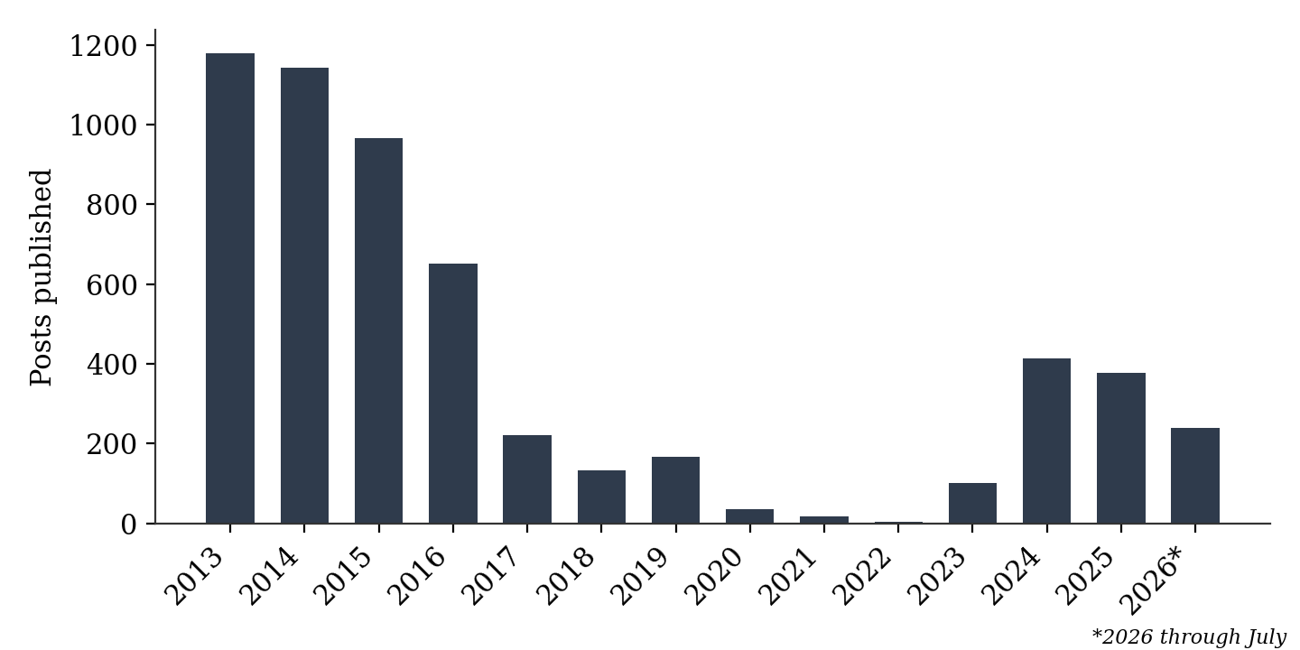
The first observation was the frequency of blogs – I started with a bang, lost interest after 4 years and then found interest again 7 years later. Odd, because I didn’t stop thinking in those gap years. Looking back now, I just have no idea what I was thinking about. Hence the point of a diary.

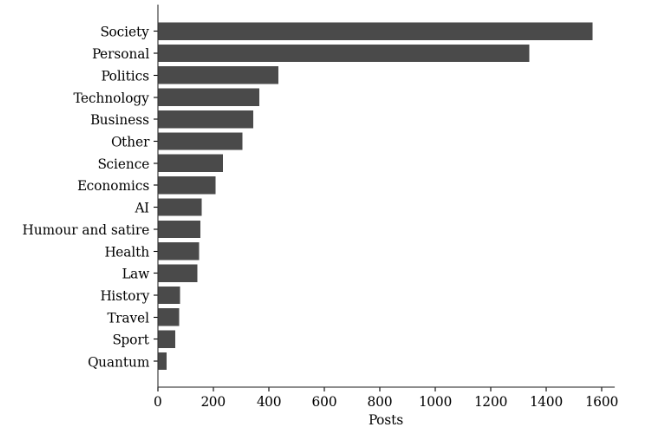
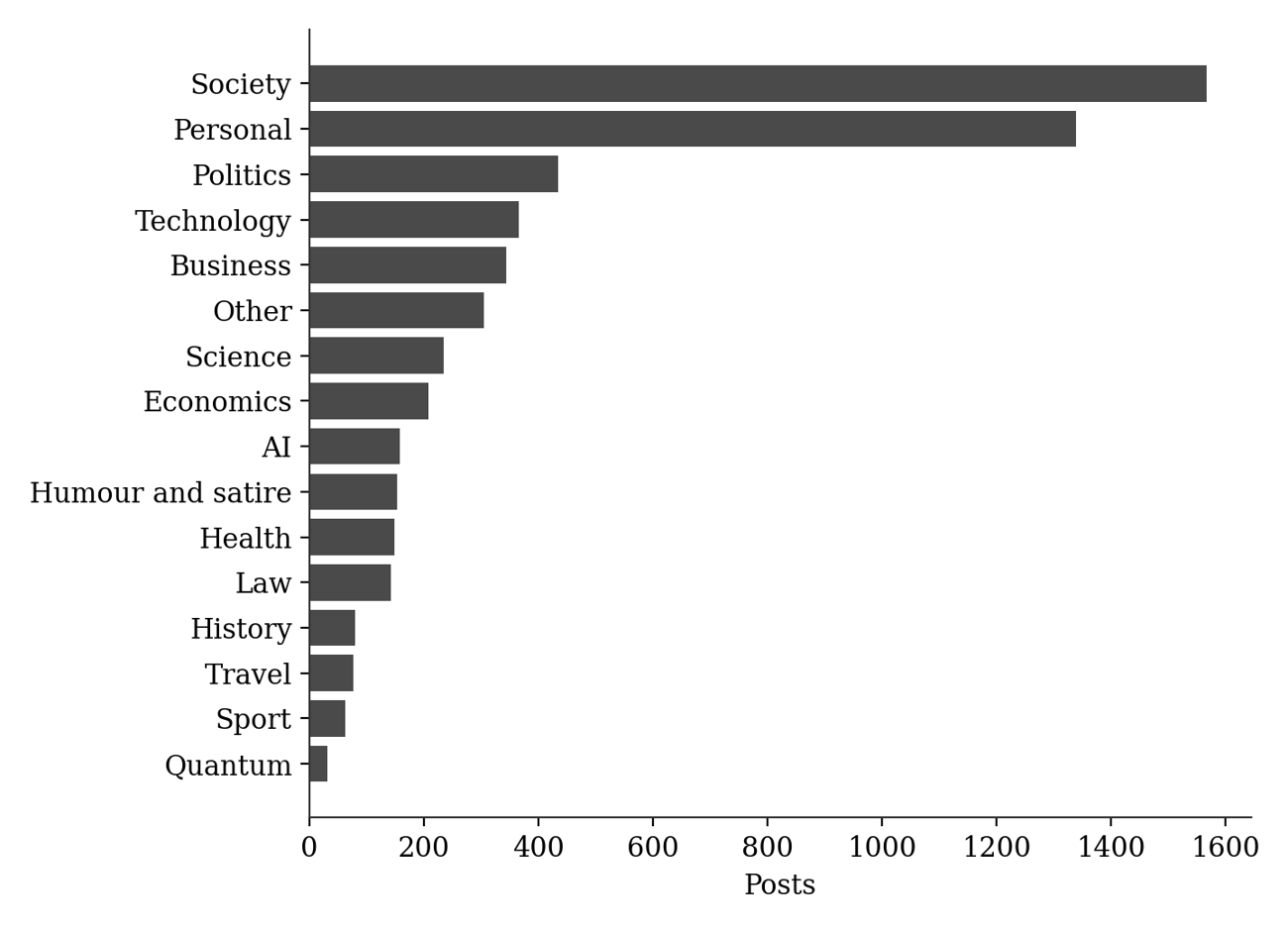
The overall categories of the blogs are shown as follows:

There’s nothing surprising there – it just shows what was on my mind. That is somewhat a reflection of what presents itself to my mind – I will think about whatever comes in. I am not partisan when it comes to dishing out my neuronal capacity.

The top categories obviously imply a bit of personal interest in the subject matter. Otherwise why would I focus on them? These are society, personal, AI and politics. And isn’t that just the core of the question that is answered with 42? We are people and we are impacted by personal matters, societal matters, politics and, recently, AI. It’s the very essence of what both enables and threatens our existence.

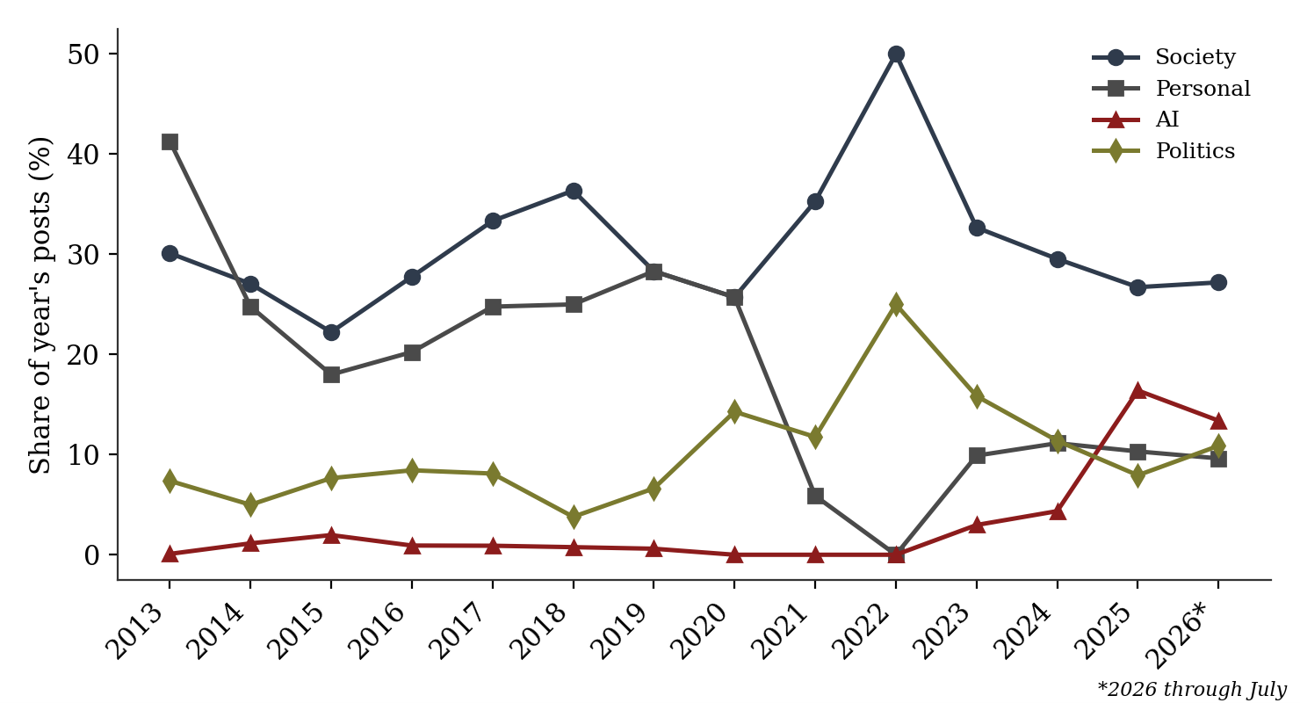
My interest in these top 4 categories over the 13 year period shifted. AI was always there because I have been following it for decades. But in 2022 it took off in my blog writing, which is fully aligned to the emergence of the commercial LLM models. As someone who is deeply interested in both technology and words, as well as life in general, LLMs are catnip, baby.

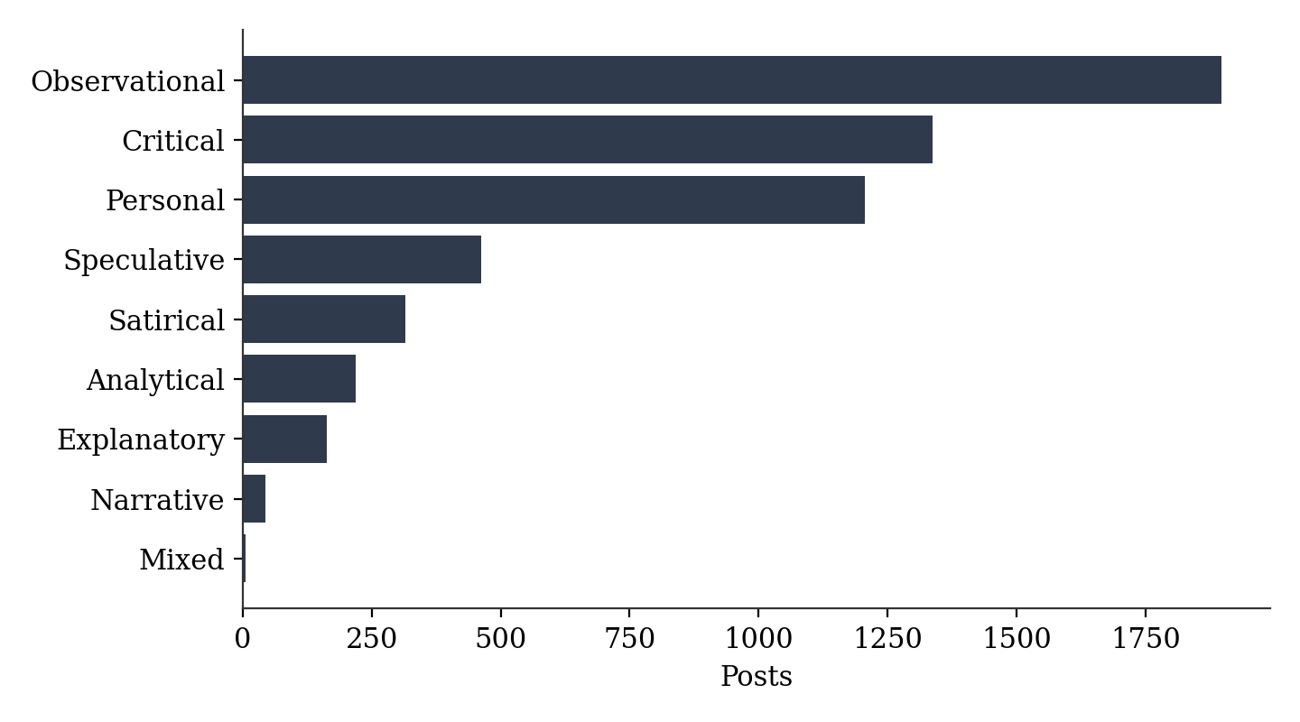
The measurement of my tone is very subjective of course. But the LLM measured it thusly over 13 years:

I ran this test through different models and got less than 50% agreement. It turns out that LLMs are really bad at detecting dry ironic satire. But then so are humans, so that fits.

Anyway, I am not surprised or discontented by that breakdown. Seems about right.

The academic paper also included all this other bullshit about my approach to processing information. GPT claims that I have a fixed process that I use time and time again. It involves the following steps in order 1. Observation, 2. Make assumptions, 3. Create a model, 4. Push the model to limiting cases, 5. Find contradictions, and 6. Revise.

Yeah maybe I do that in important or extreme cases. Like my engagement with Quantum Computing for example. I keep pushing deeper into the science and technology to understand the inventive and commercial opportunities available, if any. But I am not sure I do that on other matters (like politics) where I have no intention of creating physical outcomes.

But having said that I suppose my “book” (Time Enough for Luck) is a physical outcome. So maybe GPT is right, maybe over time I do use this process to understand and improve the stuff that interests me. I remain on the fence.

I can’t help feeling though that this study has more legs in it than this summary suggests.

First, if I can fully extract meaning from it then maybe I can move on to something else. It would appear at the surface level that my approach, and even the subject matter, is somewhat static. I would prefer to move on and find something else rather than just turning the same wheels forever.

Second, the LLM processing is new and allows an awful lot of information to be processed where previously that was not possible. I feel like using that to my advantage to create something new (I like new things).

Third, I am the child of bullshit – we were taught that a life well lived is one that finds meaning. Siddhartha, 42, etc. So here’s my chance to dig into that well in a way that hasn’t been done before.

Fourth, I am also a child of the Renaissance. I prize novelty and invention through reasoning over all else. D’oh. So why not indulge in these addictions until they make me nauseous so I can give them away?

OK, so I am going to further process this data to see what else I can find.

I might ask the LLM to find and collate all the blogs on the same subject and then give me a one-page summary of my views on that subject. Then I will end up with say 100 pages of my life philosophies. Well not philosophies as such, but reasoned opinions.

mxx1's avatar

Testy Bugger

Snoring – I’ve been to specialists, read books and blogs, talked to GPT – and no one mentioned the importance of post nasal drip, which I’ve had all my life.GPT says “Yes. Postnasal drip can be an important and easily overlooked contributor to snoring, particularly when it is accompanied by nasal congestion, throat clearing, coughing, a coated sensation in the throat or worse symptoms when lying down.”

It’s easy being a smart-arse after the fact. But the word machine just proved how useless it is; which is in line with all the other sources of information. So equals.

What I noticed was that I didn’t snore after taking the nasal decongestant spray, so then I started focusing on that feeling of post-nasal drip at night time – if you concentrate you can just feel it.

And, yes, there’s a correlation between my snoring and its presence.

Also sleeping on my side reduced snoring probably because the drip went around the core snore area.

The specialist had all sorts of gumph about my upper throat and the (ageing, sagging, possibly even overweight puffed-up) surfaces and their relative function as a virtual musical instrument.

What he didn’t mention was that said musical instrument is both mediated and enabled via a viscous fluid.

So, GPT, what to do?

• Start with Nasonex Allergy or a generic mometasone nasal spray, available from Australian pharmacies without prescription.

• Use it once daily according to the packet, initially two sprays in each nostril. Once controlled, reduce to one spray in each nostril daily. It may take several days of consistent use to judge properly.

• Before spraying, gently clear the nose or use a saline rinse. Aim the nozzle outward, away from the centre wall of the nose and sniff gently.

• Trial it for four weeks, while noting the amount of postnasal drip and snoring.

• If it clearly works, continue at the lowest effective dose. After one or two months, stop briefly to see whether the symptoms return. Long-term use may be reasonable when persistent nasal inflammation is the cause.

• Stop and consult a pharmacist or doctor if you develop repeated nosebleeds, persistent nasal pain or sores, visual changes or no meaningful improvement.

• Do not use a decongestant spray such as oxymetazoline or xylometazoline continuously because it can cause rebound congestion.

mxx1's avatar

Super Recursive Psychology and Philosophy, all wrapped up in a sausage roll with sauce and mustard

Offshore Westerly as an External Reasoning System: Quantitative Analysis of a Thirteen-Year Assumption Ledger

Ian A. Maxwell

Abstract

This paper presents a longitudinal analysis of Offshore Westerly, a corpus of 5,647 posts published between April 2013 and July 2026, read here as an external reasoning system rather than a conventional blog. Human reasoning is normally invisible because memory preserves conclusions while discarding most of the intermediate models that produced them; external reasoning systems preserve those intermediate states, allowing reasoning itself, not only its conclusions, to become an empirical object. The corpus was retrieved directly from the WordPress publishing platform and annotated with a schema-constrained large language model that assigned a primary category, secondary categories, subject, tone, keywords and named entities to every post, from which aggregate statistics were derived at the post, month, and year level. Publication volume follows three phases: prolific from 2013 to 2016, sharply reduced from 2017 to 2022, and revived from 2023 onward, with thematic composition shifting from a Personal and Society mix in the founding years to a Society-led, increasingly AI-inflected mix in the revival, while Observational and Critical tones dominate throughout. Against this quantitative backbone, the paper argues that a small set of recurring modelling primitives, information, explicit assumptions, simplification, limiting cases, contradiction, incentives, measurement and falsifiability, recur across otherwise unrelated subjects and constitute a more stable feature of the archive than any single topic. The mechanism underlying this continuity, an assumption ledger, is set out explicitly and traced through two worked examples from different domains. Two closing qualitative sections consider recurring metaphysical commitments across the corpus and then ask, directly, whether a coherent and self-aware practical life philosophy emerges from more than thirteen years of writing. The principal contribution is methodological: a long-running personal reasoning archive can be analysed quantitatively through structured language model annotation while retaining sufficient semantic structure to investigate conceptual continuity across the archive.

1. Introduction

Human beings have long externalised thought. Laboratory notebooks preserve experimental observations, engineering notebooks record design iterations, and mathematicians retain failed proofs alongside successful ones. These artefacts preserve intermediate reasoning and reduce dependence on biological memory, which compresses experience into conclusions and discards much of the reasoning that produced them. Digital publishing platforms, designed for communication, incidentally provide a similar capability: a searchable, chronologically ordered record capable of preserving observations, hypotheses and models over many years.

Offshore Westerly emerged gradually into such a record. It did not begin as a research project. Its earliest purpose was personal: it began in part as an extended love letter to the author’s wife, a place to keep experiences and observations that might otherwise be forgotten. Over time, as entries accumulated, individual posts increasingly became components of a longer reasoning process: observations generated assumptions, assumptions suggested explanatory models, and models were tested against limiting cases and deliberate counterexamples. Contradictions were retained rather than deleted, because they marked assumptions that needed revision. The public nature of the archive mattered to this evolution, though not by supplying its primary audience. Even though its principal audience remained the author, the possibility that another reader might examine the reasoning encouraged a clearer separation between observation, assumption and conclusion than a private diary would have required: public accessibility did not make the archive a performance for others so much as it acted as a weak quality-control constraint on private reasoning.

This distinction matters for how the corpus should be read. Many entries are not statements of settled belief but intermediate reasoning; a strongly worded post is often a stress test applied to an assumption rather than advocacy for the conclusion stated. Unlike memory, which preferentially keeps conclusions and discards the reasoning that produced them, the archive deliberately keeps unsuccessful ideas and abandoned models, so that reasoning itself becomes observable across more than thirteen years rather than reconstructed after the fact.

This paper treats the 5,647 posts published between April 2013 and July 2026 as a longitudinal record of externalised reasoning, made newly tractable for quantitative analysis by large language model annotation. Six questions are addressed: how publication activity evolved over more than thirteen years; how the dominant subject domains changed; which tonal characteristics remained stable despite changing subject matter; which recurring entities and keywords reveal persistent areas of attention; to what extent the underlying reasoning process remained stable while the problems it was applied to changed; and, read qualitatively rather than statistically, what recurring metaphysical commitments the corpus expresses. The central argument is that the most significant continuity in the archive lies not in its topics, which changed considerably, but in its method of reasoning, which appears substantially more stable. Human reasoning is normally invisible because memory preserves conclusions while discarding most of the intermediate models that produced them; what follows treats Offshore Westerly as a case where that discarding did not happen, so that reasoning itself becomes an empirical object rather than something inferred only from its outputs.

2. Offshore Westerly as an External Reasoning System

Conventional blogs are communicative artefacts, judged by readership, engagement or influence. The present archive, while public throughout, functioned principally as a persistent external reasoning system in which publication was simply the storage mechanism. This distinction changes how individual posts should be read. A conventional essay typically represents a position its author presently holds; many entries in Offshore Westerly instead represent intermediate states in a longer reasoning process, later strengthened, modified, or abandoned.

The recurring operational cycle visible across much of the archive can be summarised as observation, in which an event, idea or inconsistency is identified; assumption, in which one or more explicit assumptions are proposed to explain it; model, in which those assumptions are assembled into an explanatory structure; limiting-case exploration, in which the model is pushed to a deliberately simplified or extreme condition to expose hidden implications; contradiction, in which an implausible or inconsistent consequence signals that an assumption needs revision; and revision, in which the model is updated while the reasoning that motivated the change is preserved rather than erased. This approach is familiar from mathematics and theoretical physics, where limiting cases and proof by contradiction are standard tools, and it recurs across the archive’s subjects as diverse as artificial intelligence, quantum computing, economics, politics, business strategy and personal relationships. Read this way, many apparently categorical statements in the corpus function as experimental conditions rather than declarations of belief; their purpose is to reveal what follows from an assumption pushed to its limit, not to assert that the limit itself is true.

A second distinguishing feature is the explicit preservation of rejected ideas. Ordinary memory compresses reasoning, discarding intermediate hypotheses once a satisfactory explanation is reached; this archive resists that compression, keeping failed models alongside successful ones because understanding why a model was abandoned is often as informative as understanding why another survived. Over more than thirteen years this becomes a form of assumption ledger, analogous to the audit trails, design histories and laboratory notebooks maintained in engineering, finance and science for the same reason: a result is difficult to interpret without the assumptions under which it was reached. Each assumption recorded in the archive remains available for later confirmation or revision, so that new evidence updates existing models rather than silently replacing them, and the corpus becomes a continuously evolving network of reasoning rather than a disconnected sequence of essays.

2.1 The assumption ledger as a modelling framework

The assumption ledger is not simply a metaphor for the archive’s persistence; it is the specific mechanism by which the reasoning cycle described above accumulates rather than repeats. Three properties distinguish it from an ordinary sequence of essays. First, each entry in the ledger is addressable: an assumption stated in one post can be located, referenced, and revised by a later post without restating the reasoning that first produced it, in the way a financial ledger entry can be adjusted by a later entry without rewriting the account’s history. Secondly, the ledger records failure as well as success; a model that collapses under a limiting case is not deleted but retained alongside the assumption that broke it, so the archive documents which assumptions have already been tested and found wanting. Thirdly, the ledger permits versioning: the same underlying question can appear multiple times across the archive at different levels of refinement, each version building on, rather than replacing, the reasoning captured in the version before it.

2.2 Worked examples

Vanishment Theory (15 May 2026) illustrates the assumption ledger operating end to end, and is unusual only in that it renders the process explicit within a single, formally stated post rather than across several. Box 1 traces the six stages of the reasoning cycle as they appear in that post.

Stage Content
Observation Standard quantum mechanics requires strict unitarity, so that probability is exactly conserved and nothing is ever fully lost from a quantum system.
Assumption Unitarity might instead be a limiting case of a more general rule, rather than an exact law, if quantum states can exist in superposition with non-existence itself.
Model The strict condition that the evolution operator satisfies U-dagger U equal to exactly 1 is relaxed to a bounded inequality, 0 less than or equal to U-dagger U less than or equal to 1, allowing a small amplitude of a state to genuinely vanish rather than merely transform.
Limiting case If vanishment is taken seriously and pushed to its extreme, ordinary conservation laws would appear to be violated at a small but non-zero rate, an implication most physical theories treat as immediately fatal.
Contradiction Apparent violation of conservation is, within ordinary physics, a strong signal that an assumption should be abandoned rather than pursued further.
Revision Rather than discarding the model, a generalised conjugate operation is introduced specifically to restore conservation on average, so the theory keeps the assumption that motivated it while repairing the consequence that appeared to break it.

Box 1. The assumption ledger applied to Vanishment Theory.

Two features of this example generalise to the rest of the corpus. The relaxation from equality to an inequality, 0 less than or equal to U-dagger U less than or equal to 1, is itself a ledger entry: a previously fixed constant is deliberately loosened and the consequence of loosening it is tracked rather than assumed away. The revision at the final stage does not erase the limiting case that produced the contradiction; the apparent conservation violation remains part of the theory’s stated content, addressed rather than deleted, exactly as the assumption ledger predicts for a model that survives contradiction through revision rather than abandonment.

Because Vanishment Theory is speculative physics, a reader might wonder whether the ledger structure is itself an artefact of that domain rather than a general feature of the corpus. Markov evil (21 March 2026) traces the same six stages in an entirely different, non-physical setting, an everyday game rather than a physical theory, shown in Box 2.

Stage Content
Observation In a simple finite-state game such as a card or dice game, players ordinarily assume that shuffling or rolling randomises the outcome.
Assumption If whoever controls the shuffling has complete knowledge of the current state, apparent randomness may conceal a fully determined outcome.
Model The game is represented as a finite-state process in which the shuffler chooses which transition occurs at each step, rather than the transition being drawn at random.
Limiting case Taken to its extreme, a shuffler with complete knowledge and full control over transitions can indefinitely avoid the game’s terminal states, keeping it in a loop forever without any single move looking obviously wrong.
Contradiction This appears to contradict the ordinary assumption that a game with a finite state space and well-defined winning conditions must eventually end.
Revision The model is revised to make explicit that finiteness alone does not guarantee termination; termination additionally requires that transitions be either genuinely random or bounded by rules preventing indefinite avoidance of terminal states, an assumption the ordinary belief that the game must end had left unexamined.

Box 2. The assumption ledger applied to Markov evil, a non-physical example.

The same six-stage structure recurs with no physical content at all: a game-theoretic assumption is relaxed, pushed to a limiting case, found to contradict an ordinary belief, and revised by making an implicit precondition explicit. Read alongside Box 1, this indicates that the ledger structure is a property of how the archive reasons rather than a feature specific to speculative physics.

On this reading, the object of study in this paper is not the blog but the reasoning system that produced it, and the quantitative statistics reported in section 5 are best read as measurements of changing domains of active reasoning rather than simple measures of changing personal interests.

3. Related Work

The analysis sits at the intersection of content analysis, computational text-as-data research, and the study of external cognition. Traditional content analysis reduces large bodies of text to a structured set of categories suitable for statistical analysis (Holsti, 1969; Krippendorff, 2018), typically applied to newspapers, speeches or organisational documents. The present work adopts the same coding-frame logic but applies it to the longitudinal output of a single reasoning archive rather than to institutional or media communication, so that the coding frame measures changes in the domains occupied by a reasoning process rather than changes in public discourse.

The text-as-data paradigm treats large document collections as measurable behavioural records (Grimmer and Stewart, 2013; Grimmer, Roberts and Stewart, 2022), and recent work shows that instruction-tuned language models can perform text annotation at accuracy comparable to, and sometimes exceeding, human crowd-workers (Gilardi, Alizadeh and Kubli, 2023; Ziems et al., 2024). The present methodology follows that approach, classifying every post into a fixed taxonomy rather than attempting unsupervised topic discovery, in order to keep annotations comparable across the entire corpus, which spans more than thirteen years. Throughout, the language model functions as an annotator, converting each document into structured semantic fields, and not as a source of interpretation; the interpretation offered in later sections is the author’s.

The archive is also read here through the lens of external cognition, the proposition that reasoning is not confined to biological memory but is routinely extended into notebooks, diagrams, software and other persistent artefacts that reduce working-memory demands and preserve intermediate reasoning (Clark and Chalmers, 1998). Laboratory notebooks provide the closest analogy: they rarely contain only successful experiments, because failed experiments and abandoned hypotheses remain scientifically informative in their own right. Viewed this way, Offshore Westerly resembles a continuously maintained notebook for conceptual rather than experimental work, and its emphasis on models that could in principle fail connects it to the falsifiability criterion long used to distinguish explanatory from unfalsifiable claims (Popper, 1959). Finally, the volume pattern reported in section 5.1, prolific, then dormant, then revived, is broadly consistent with documented lifecycle patterns in blog research, where sustained personal publishing is episodic rather than constant and individual blogs evolve in function over their lifespan (Kaye, 2007).

4. Data and Methods

4.1 Corpus

The corpus comprises 5,647 blog posts spanning April 2013 to July 2026, retrieved directly from the Offshore Westerly WordPress archive (https://offshorewesterly.com/) rather than through search engine indexing, so that the complete published archive was obtained irrespective of external indexing policies. Aggregate frequency tables were derived from the post-level classifications at the post, month, and year level. Because the complete available archive was analysed rather than a sample, the descriptive statistics reported below refer to the entire published corpus rather than an estimate.

4.2 Retrieval pipeline

Posts were retrieved with a purpose-built Python streaming pipeline (wordpress_gpt_categoriser_streaming.py) designed around completeness, recoverability, determinism and scalability. The pipeline queries the site through the WordPress.com REST API, with the self-hosted WordPress core REST API (wp-json/wp/v2/posts) as a fallback, paginating through all published posts of type post between a configurable start and end month. Each retrieved record is deduplicated on post identifier and on a canonicalised URL, HTML content is stripped of script, style, and form elements and reduced to normalised plain text with BeautifulSoup, and word count and estimated reading time (words divided by 225 per minute) are computed from the cleaned text. Results are checkpointed to disk after every post, so a run can be interrupted and resumed from the last completed record without reclassifying prior posts, and aggregates are rebuilt at a configurable interval as classification proceeds, rather than only once at the end.

4.3 Classification

Each cleaned post was classified through a schema-constrained structured output interface. The pipeline’s configured model identifier was gpt-5-mini. Classification used a Pydantic response model that requires exactly one primary category, up to three distinct secondary categories, a concise subject description, three to eight keywords, up to ten named entities, exactly one tone label, a one-sentence factual summary of no more than thirty words, and a confidence score bounded between 0 and 1. The primary category is drawn from a fixed sixteen-value taxonomy (AI, Quantum, Technology, Science, Business, Economics, Politics, Law, Society, History, Health, Travel, Sport, Personal, Humour and satire, Other) and tone from a fixed nine-value taxonomy (Analytical, Satirical, Observational, Speculative, Personal, Explanatory, Critical, Narrative, Mixed). The classification prompt instructs the model to categorise the underlying subject or argument rather than a named entity in isolation, to reserve Humour and satire as primary only when the satirical device is itself the subject, and to avoid inferring facts not present in the post. Any output falling outside the fixed taxonomies is coerced to a defined fallback value (Other for category, Mixed for tone) rather than discarded, and keyword and entity lists are deduplicated and capped at the stated limits. This preference for constrained rather than open-ended prompting follows the author’s own prior work on vocabulary- and schema-constrained prompting as a means of improving the accuracy, precision and clarity of LLM outputs (Maxwell, 2025a, 2025b), applied here to classification rather than to text generation. The pipeline’s configuration records this identifier, but a precise reproducibility record, the exact dated API model snapshot, prompt version, code version, and generation temperature, was not separately preserved at the time of classification; where a provider does not expose a stable, permanently addressable model snapshot, this is a limitation of reproducibility rather than of the classification itself, and is treated as such in section 12.

4.4 Interpretation of categories

The analysis distinguishes four semantic levels that should not be read interchangeably. Primary categories describe broad domains of investigation; a post categorised as AI is not necessarily expressing an opinion about AI, but is using AI as a domain in which assumptions and models are explored. Subjects describe the specific idea examined in an individual post. Keywords are model-assigned semantic descriptors rather than literal word counts, so a keyword can be assigned even when the corresponding word rarely appears verbatim. Named entities identify specific people, organisations, technologies or places explicitly discussed. Category frequencies therefore describe the changing allocation of the domains within which reasoning occurred rather than a direct measure of lexical content.

4.5 Limitations of the classification approach

Automated classification of short or ambiguous posts carries inherent uncertainty, and a non-trivial share of the archive consists of posts with no substantive body content, discussed further in section 12. Because a single model performs all coding, the analysis cannot report inter-coder reliability in the conventional sense of agreement between independent human coders; confidence scores provide a per-post indication of the model’s own certainty but are not a substitute for inter-rater reliability statistics such as Cohen’s kappa or Krippendorff’s alpha. A single dominant primary category is also a simplification: many posts legitimately span multiple domains, an approximation only partly offset by the secondary category, subject, keyword and entity fields. This limitation is consistent with recent evidence that LLM annotation, while often accurate, is sensitive to implementation choices such as model and prompt selection, can introduce systematic rather than merely random error into downstream analysis (Baumann et al., 2025), and performs more reliably as an assistant to human coders than as a fully independent annotator (Gu et al., 2025; Calderon, Reichart and Dror, 2025).

4.6 A supplementary annotation-consistency check

This check was performed after the full corpus had already been classified in the pipeline described in sections 4.2 and 4.3, so it could not have influenced the original annotations; excluding shorter posts from this check does not affect the quantitative statistics reported in section 5, which are drawn from all 5,647 posts. To probe classifier behaviour beyond an unverified assumption of accuracy, fifty posts were drawn at random from the 3,811 posts in the corpus with at least thirty words of body content, using Python’s random.Random(42) for reproducibility. The remaining 1,836 posts fall below this threshold; based on the keyword patterns discussed in section 12, most are empty, title-only, or brief link or image posts rather than short but substantive entries, so the thirty-word cutoff was chosen to exclude posts too short to meaningfully check a category or tone assignment against. An earlier version of this check gave a second model only the title, subject, and summary produced by the original pipeline, and was found to measure consistency between two model-mediated representations rather than independent agreement, an information-leakage problem that is likely to inflate agreement. The check reported below corrects this: the full body text of each sampled post was retrieved directly from the live site, and a second large language model (Claude Sonnet 5), distinct from the gpt-5-mini classifier used for the full corpus, received only the post’s title and this freshly retrieved full text, withheld entirely from the original pipeline’s category, tone, subject, summary, keyword and entity fields. It was asked to assign a primary category and tone from the same two fixed taxonomies used throughout this paper, and its assignments were compared against the original labels.

Primary category agreement was 39 out of 50 posts (78 percent); tone agreement was 21 out of 50 (42 percent). Both figures are materially lower than the 96 percent and 94 percent respectively reported by the earlier, leakage-affected version of this check, consistent with the concern that reusing model-generated summary fields had inflated apparent agreement. Category disagreements cluster rather than scatter: 6 of the 11 disagreements involve the second model assigning Humour and satire as primary category where the original classifier had assigned Technology, Politics, Society, Business, or Personal, for posts such as Invention of the day, Careers, Solar energy, Extinction, Chook, and New Word for the Day, indicating that the two models draw the line described in the taxonomy’s own instruction, that Humour and satire should be primary only when the joke or satirical device is itself the subject, in different places despite working from the same written rule.

Tone agreement is markedly weaker than category agreement, and the pattern of disagreement is systematic rather than scattered. The second model assigned Satirical to 18 of the 50 posts against 2 in the original labels, and Personal to 11 against 6, while assigning Critical to only 6 against 20 in the original labels and Observational to only 5 against 13. The single largest confusion, Critical read by the original classifier and Satirical read by the second model, accounts for 8 of the 29 tone disagreements on its own, for posts including Auto Gourmet, Bring Back Tony, Marx and Orwell, Oxford, and Poll. This indicates that the two models apply materially different thresholds for reading dry, deadpan critical commentary as satirical irony, a genuine calibration difference between models rather than noise, and that tone in this taxonomy is a considerably softer, less reliably assigned label than primary category at this sample size.

This exercise is a useful signal rather than a validated reliability statistic: it drew on a sample of fifty rather than a pre-registered validation set, and it compares two language models rather than a language model against independent human coders, so it cannot substitute for the human validation study recommended in section 12. Within those limits, it supports two conclusions. First, the earlier leakage-affected check materially overstated agreement, particularly for tone, confirming that reusing pipeline-generated intermediate fields is not a safe substitute for checking against source text. Second, primary category assignments in Table 2 and Table 3 appear considerably more robust to which model performs the classification than tone assignments in Table 4 and Figure 4 do; the tone-based interpretive claims in section 5.3 and elsewhere in this paper should be read with that asymmetry in mind.

5. Quantitative Results

5.1 Publication activity

Table 1 and Figure 1 report the number of posts published in each calendar year. Publication volume follows three phases. Between 2013 and 2016 the archive was highly prolific, averaging over 900 posts a year and peaking at 1,179 posts in 2013, a period in which externalising reasoning through the archive appears to have been part of the author’s routine practice. The 2013 total covers April to December only, and the 2026 total covers January to July only; annual figures for those two years are therefore not directly comparable with the complete calendar years between them, and the 2013 peak in particular should be read as a high rate sustained over nine months rather than a full-year maximum. Between 2017 and 2022 output declined steeply, falling to a low of four posts in 2022; this decline should not be read as evidence that reasoning itself stopped, only that its externalisation through this particular archive became less frequent. From 2023 the archive resumed active publication, reaching 413 posts in 2024, the highest annual total since 2016, a revival that coincides with increasing attention to artificial intelligence and quantum computing.

Year Posts
2013 1,179
2014 1,142
2015 967
2016 652
2017 222
2018 132
2019 166
2020 35
2021 17
2022 4
2023 101
2024 413
2025 378
2026 (through July) 239

Table 1. Posts published per calendar year, 2013 to 2026. 2013 (April to December) and 2026 (January to July) are partial years.
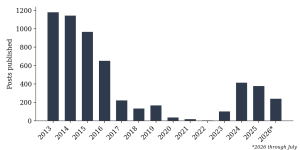
Figure 1. Posts published per calendar year, 2013 to 2026. 2013 covers April to December and 2026 covers January to July; these two totals are not directly comparable with the complete years between them.

5.2 Thematic composition

Table 2 and Figure 2 report the distribution of the sixteen primary categories across the full corpus. Society (27.8 percent) and Personal (23.7 percent) together account for just over half of all posts. Politics, Technology, and Business form a second tier, each between 6 and 8 percent. The remaining categories, including Science, Economics, Artificial Intelligence, Humour and satire, Health, Law, History, Travel, Sport, and Quantum, each account for less than 5 percent of the corpus individually.

Category Posts Share of corpus
Society 1,567 27.8%
Personal 1,339 23.7%
Politics 434 7.7%
Technology 365 6.5%
Business 344 6.1%
Other 304 5.4%
Science 234 4.1%
Economics 208 3.7%
AI 158 2.8%
Humour and satire 153 2.7%
Health 149 2.6%
Law 142 2.5%
History 80 1.4%
Travel 76 1.4%
Sport 63 1.1%
Quantum 31 0.6%

Table 2. Primary category distribution across the full corpus (n = 5,647).
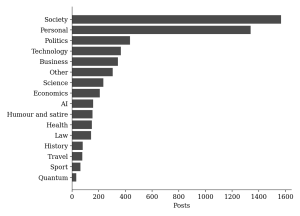
Figure 2. Primary category distribution across the full corpus.

At first inspection this distribution resembles a typical personal blog combining commentary with autobiographical material. Read as a reasoning system, the categories instead identify the domains within which modelling occurred: a post categorised as AI is treated here as using artificial intelligence as an environment for exploring assumptions, prediction, and uncertainty, not necessarily as expressing a settled opinion about AI itself. Table 3 compares the leading categories in the founding year (2013) against the three most recent years. Personal content, the largest single category in 2013, falls out of the top three by 2025 and 2026, while Society remains dominant throughout, and Artificial Intelligence, absent from the leading categories in 2013, ranks second in both 2025 and 2026. Figure 3 tracks this shift across every year of the archive as a share of each year’s output.

Year Total posts Leading categories (posts)
2013 1,179 Personal 487, Society 355, Politics 87, Business 43, Technology 35
2024 413 Society 122, Politics 47, Personal 46, Science 26, Technology 22
2025 378 Society 101, AI 62, Personal 39, Science 33, Politics 30
2026 (through July) 239 Society 65, AI 32, Politics 26, Personal 23, Technology 16

Table 3. Leading categories by post count, founding year versus recent years.
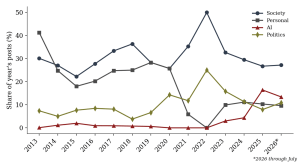
Figure 3. Share of Society, Personal, AI, and Politics categories by year, 2013 to 2026.

Across the quiet middle years, 2017 to 2022, Society and Personal remain the two largest categories in every year for which posts exist, with Politics, Business, Science and Economics present in small numbers throughout; the archive does not, in this period, pivot toward any single new technical domain, and the eventual rise of AI is a feature specifically of the 2023 to 2026 revival rather than a gradual trend across the quiet years.

5.3 Tonal register

Table 4 and Figure 4 report the distribution of the nine tonal categories. Observational tone predominates at 33.6 percent of the corpus, followed by Critical (23.7 percent) and Personal (21.4 percent); together these three registers account for 78.7 percent of all posts. Speculative and Satirical tones each exceed 5 percent, while Analytical, Explanatory, Narrative, and Mixed registers each account for less than 4 percent.

Tone Posts Share of corpus
Observational 1,897 33.6%
Critical 1,337 23.7%
Personal 1,206 21.4%
Speculative 463 8.2%
Satirical 315 5.6%
Analytical 218 3.9%
Explanatory 163 2.9%
Narrative 43 0.8%
Mixed 5 0.1%

Table 4. Tonal register distribution across the full corpus.
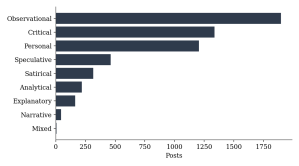
Figure 4. Tonal register distribution across the full corpus.

Read against the reasoning-system framework, this distribution is consistent with a corpus oriented toward explanation and inconsistency-checking rather than storytelling: this pattern is consistent with Observational entries often serving as inputs for later reasoning, Critical entries flagging inconsistencies for further work, and Analytical entries developing explanations directly, while purely Narrative writing remains a small fraction throughout. Tone labels describe register rather than function, so these functional readings are offered as a plausible interpretation of the distribution rather than something the tone label itself establishes; section 4.6 reports a supplementary check finding tone agreement between two models to be considerably lower than category agreement, so the tone-based statistics in this section should be read as the softer of the paper’s two main classification outputs. Satirical and humorous posts recur throughout the archive at a modest but consistent rate; several of the posts identified in section 7 use exaggeration specifically to expose a hidden assumption or contradiction, suggesting that humour functions here partly as a reasoning technique rather than only as entertainment.

5.4 Recurring entities and keywords

Table 5 reports the twenty most frequently occurring named entities. Australia was assigned as an entity to 379 posts, more than double the next most frequent entity, China (129 posts), followed by Sydney (110 posts). Two personal names, Lola and Viv, rank fourth and seventh respectively, ahead of most corporate and political entities, indicating a persistent personal dimension to the writing alongside its public affairs content. Google, GPT, Facebook, Uber, LinkedIn and ChatGPT also appear among the twenty most frequent entities, consistent with the archive’s recurring use of specific technology platforms as modelling environments rather than merely objects of commentary.

Entity Posts assigned entity
Australia 379
China 129
Sydney 110
Lola 92
Google 76
United States 61
Viv 46
GPT 43
Facebook 42
Uber 40
LinkedIn 37
The Guardian 34
Queensland 25
Melbourne 25
Qantas 23
US 23
Tony Abbott 23
Australians 22
NSW 21
ChatGPT 20

Table 5. Twenty most frequent named entities across the corpus. Counts are posts to which the model assigned each label, not normalised entity mentions; see section 12 on label normalisation.

Table 6 reports keyword frequency after excluding keywords that denote an absence of content (empty post, title-only, no content, missing content, and equivalent variants), which collectively tag several hundred posts. Among substantive keywords, Australia, anecdote, satire, and humor recur most frequently, followed by a cluster of terms related to parenting, social media, introspection, and relationships, consistent with the personal dimension identified above.

Keyword Posts assigned
Australia 173
anecdote 158
satire 143
humor 121
parenting 94
social media 90
introspection 88
relationships 82
personal reflection 79
China 71
metaphor 71
language 62
identity 62
wordplay 60
skepticism 58
communication 58
automation 53
marketing 52
authenticity 52
empathy 52

Table 6. Twenty most frequent substantive keywords, empty and title-only tags excluded. Counts are posts assigned each keyword by the model, not deduplicated concept frequencies.

6. Evolution of the Reasoning Process

The statistics in section 5 describe how publication activity and subject matter changed. They do not, by themselves, explain what changed. A conventional reading would conclude that the author’s interests moved from personal matters toward technology and public affairs. Read as an external reasoning system, the same statistics admit a different account: the dominant questions changed, while the reasoning process applied to them appears comparatively stable.

6.1 Phase I: externalising immediate experience (2013 to 2016)

The founding years are characterised by sustained, high-volume publication centred on Personal and Society, with Politics, Business, and Technology present as smaller secondary domains (Table 3). Personal entries frequently use individual experience as material for a broader model rather than as autobiography for its own sake, and Society provides the wider context in which personal and commercial observations are interpreted. The reasoning in this period is predominantly inductive: many entries begin with a concrete event before generalising toward a broader principle, a habit of abstraction that persists throughout the archive’s later evolution.

6.2 Phase II: reduced externalisation (2017 to 2022)

Publication frequency declines substantially in the middle years of the corpus (Table 1). Reduced publication need not imply reduced reasoning, only reduced externalisation of it through this particular archive; the present analysis cannot distinguish between reduced writing time, alternative recording mechanisms, or reduced need to think through problems in public. What is clear from Table 3 and the accompanying year-by-year category data is that Society and Personal remain the two largest domains throughout this period, with no single new domain coming to dominate the quiet years; the technical domains that come to prominence later, principally AI, are essentially absent here and emerge specifically with the 2023 to 2026 revival rather than gradually across the decline.

6.3 Phase III: artificial intelligence as a modelling domain (2023 to 2026)

The final phase is the most significant change in the corpus: Artificial Intelligence rises from absent among the leading categories in 2013 to second only to Society in both 2025 and 2026 (Table 3, Figure 3). Read only as a change of subject, this looks like an interest shift toward a fashionable technology. Read as a reasoning system, AI instead becomes a new and unusually productive environment for the same recurring questions the archive has long applied elsewhere: what constitutes understanding, what distinguishes prediction from explanation, how uncertainty should be represented, and how competing explanatory models should be evaluated. Quantum computing, present in smaller numbers throughout the later archive (31 posts, 0.6 percent of the corpus overall), plays a related but narrower role, treated consistently as a problem in information processing and computational limits rather than as a subject of purely technological enthusiasm.

6.4 Continuity beneath changing subjects

Viewed independently of chronology, a post on patent valuation, a post on quantum error correction, and a post on football administration read, in this corpus, as instances of the same underlying procedure: an observation is made, explanatory assumptions are proposed, a simplified model is built, the model’s consequences are examined, contradiction is actively sought, and the post concludes either by revising the model or by naming the remaining uncertainty. This architecture, examined further in section 7, is one for which the evidence is consistent with it being considerably more stable across the archive’s history than any of the subject categories reported in section 5.

7. Persistent Modelling Primitives

The categories, tones, entities and keywords reported in section 5 describe what the archive discusses. This section considers how the reasoning proceeds, through a small set of recurring conceptual operations referred to here as modelling primitives. Unlike a topic, a modelling primitive identifies a habit of construction that recurs regardless of subject matter, in roughly the way grammar recurs across changing vocabulary. The primitives below are illustrated with posts identified in the classified corpus rather than asserted only in the abstract.

7.1 Information

The archive repeatedly reformulates problems across business, artificial intelligence, quantum computing, and interpersonal relationships as problems of the acquisition, transmission, or interpretation of information. Time and information (30 June 2024) states this explicitly, proposing that the total knowable information is constant and exists outside time and distinguishing discovery from invention on that basis. Genes (11 April 2026) applies the same informational framing to the genome, treating it as a substrate for reservoir computing that generates complexity rather than storing it.

7.2 Explicit assumptions

Many entries begin by naming the assumptions under which a conclusion would follow, rather than asserting the conclusion directly. Vanishment Theory (15 May 2026), traced stage by stage against the assumption ledger in Box 1, is an example rendered as formal physics: rather than asserting that conservation laws are violated, it identifies the specific relaxation of unitarity, bounding it between 0 and 1 rather than requiring exact unity, under which small apparent violations would be expected, and proposes a generalised conjugate to restore conservation. The conclusion is conditional on the assumption remaining explicit and inspectable, which is precisely what the ledger structure is designed to preserve.

7.3 Simplification

Complex systems are repeatedly reduced to a small number of interacting variables before further complexity is admitted. Quantum Computing, explained (18 August 2025) reduces qubits, superposition, entanglement and decoherence to a single social metaphor in order to expose the dominant mechanism before any technical elaboration is introduced.

7.4 Limiting cases

Rather than examining the average case, many posts ask what follows if an assumption is taken to its extreme. Court (1 November 2024) asks what follows if a legal dispute is treated as formally analogous to quantum superposition, using Schrödinger’s cat to argue that settlements and verdicts collapse legal uncertainty in different, non-ground-truth ways. Markov evil (21 March 2026) pushes a simplified finite-state game to the limiting case of a shuffler with complete state knowledge, showing that such a shuffler can enforce deterministic outcomes indefinitely.

7.5 Contradiction

Contradictions are treated as informative rather than as failures to be smoothed over. Weird (4 February 2026) is the clearest example: rather than accommodating claims that quantum physics demonstrates consciousness preceding the material universe, the post treats the claim’s unfalsifiability as a defect serious enough to reject the claim outright, rather than reason to weaken the underlying standard of evidence.

7.6 Incentives

Institutional and personal behaviour is repeatedly explained through incentive structures rather than stated intentions, a pattern visible across the Business, Economics, Politics and Law categories in Table 2 and consistent with the archive’s broader preference for mechanism over description. Principal Agent (28 June 2016) makes the structure explicit, arguing that politicians should apply equal-percentage budget cuts across departments specifically to remove the discretion that enables clientelism, treating an institutional design choice as an incentive problem rather than a matter of individual virtue. TT (13 February 2019) applies the same logic to personal conduct, framing a choice of generosity over revenge as a way of breaking a cycle of workplace vindictiveness, an explicit reweighting of incentives rather than an appeal to niceness for its own sake.

7.7 Measurement

The archive repeatedly asks whether an observed quantity actually measures the phenomenon it is taken to represent, a scepticism reflected in the Critical tone’s 23.7 percent share of the corpus (Table 4). Stats Explained (16 November 2016) criticises the use of simple correlation, illustrated with a patent-distance example, as a stand-in for a causal claim it does not establish, a direct statement of the measurement primitive applied to research practice. The Easterlin Paradox (6 March 2025) applies the same scepticism to economics, questioning whether income is an adequate proxy for the well-being it is conventionally used to measure.

7.8 Falsifiability

Explanatory value is repeatedly associated with the possibility of failure rather than the capacity to accommodate any observation. Weird (section 7.5) again exemplifies this directly, and the same standard recurs in the corpus’s treatment of speculative physics, where Vanishment Theory is presented as a specific, bounded modification capable of producing a measurable prediction, tiny apparent conservation violations, rather than as an unconstrained metaphysical claim.

7.9 Stability across domains

Business gives way to artificial intelligence across the more than thirteen years (Table 3), and quantum computing appears where it had previously been absent, yet the same eight primitives can be identified organising individual posts throughout. The continuity in subject matter, measured directly in Table 2 and Table 3, is weak. The continuity in reasoning architecture is not measured in the same direct sense; it is an interpretation supported by the repeated presence of these primitives across otherwise unrelated posts, and the evidence is consistent with this second, more tentative form of continuity being considerably stronger than the first. It is this interpretation, not a directly measured quantity, that motivates reading Offshore Westerly as a reasoning system rather than as a themed sequence of essays.

8. Metaphysical and Philosophical Commentary

The modelling primitives in section 7 describe a recurring architecture of reasoning. This section sets that architecture aside and reads the same corpus for its recurring metaphysical commitments, illustrated with representative posts rather than aggregate counts.

From this point the paper shifts registers. Sections 5 and 7 report counts and recurring structures that another coder could in principle check against the same corpus. Sections 8 and 9 instead offer an interpretive reading of the same posts, closer to literary or biographical criticism than to content analysis, and the observations that follow are correspondingly more subjective. They should be understood as one plausible synthesis of recurring themes rather than as a statistically demonstrable finding, and a different reader working from the same corpus could reasonably draw a different synthesis.

8.1 Quantum formalism as a metaphor for non-physical domains

A persistent habit across the corpus is the use of quantum-mechanical concepts, principally superposition, entanglement, and collapse, as a vocabulary for phenomena with no physical quantum character at all. Posts including Love (20 November 2025), Entanglement (19 November 2025), Court (1 November 2024), Hilbertese (22 November 2025), and Schrödinger’s pussy (6 March 2014) each apply quantum formalism to romantic relationships, legal disputes, cognition, and perception respectively. The recurrence of this move over more than a decade suggests it functions as a standing conceptual tool rather than an isolated flourish, a way of making indeterminacy and observer-dependence in ordinary life legible through a borrowed physical vocabulary.

8.2 Nothingness and vanishment as a recurring motif

A second thread treats nothingness and vanishing as objects of sustained interest rather than mere negation. Vanishment Theory (15 May 2026) proposes, in the register of speculative physics, that quantum states may exist in superposition with non-existence itself, a formal literalisation of a motif recurring informally throughout the archive: Re-imagining Imagination (6 June 2016) questions the coherence of applying expansion to the infinite and muses on the limits of describing nothingness in language; No bang hypothesis (19 May 2024) speculates that energy and nothingness are mutually convertible through time; Death, the black hole and nothing (15 March 2016) and Butterflies (13 January 2016) each treat existential nothingness, the latter arguing that addictions are attachments best resolved by accepting nothingness on the far side of them. Vanishment functions as something close to a personal ontological signature, appearing for a decade in essayistic form before receiving explicit theoretical treatment.

8.3 A naturalistic and falsifiability-oriented stance on consciousness

Despite its taste for speculative and analogical physics, the corpus is consistently unsympathetic to non-naturalistic claims about mind. Weird (4 February 2026) rejects claims that quantum physics demonstrates consciousness existing before the material universe as unfalsifiable, alongside a series of posts treating consciousness as evolved and often discontinuous rather than fundamental: Consciousness (28 July 2015) proposes a social and evolutionary origin for self-awareness; Conscious OS (7 August 2015) and Sensory Perceptions (23 February 2015) treat conscious awareness as intermittent, layered over continuous subconscious activity; Time Alert (2 March 2016) argues consciousness is constitutively temporal. The same register extends to artificial minds: Artificial Humanness (2 March 2016) and More on Chess (1 March 2016) tie machine consciousness to processing power and mortality-awareness rather than to any categorical exceptionalism for biological minds.

8.4 Constructed reality, simulation, and the limits of perception

A fourth thread treats perceived reality as constructed rather than directly given. The matrix (23 July 2013) argues that brains construct subjective realities the author likens to virtual reality; Simulation (26 February 2025) extends this to a speculative scenario of consciousness transfer into a computer-simulated substrate; Trailer Park (23 January 2015) frames self-awareness as an evolutionary layer imposed on animal sentience, producing internal conflict as a structural feature of mind. This connects the archive’s naturalism about consciousness to a broader constructivism about perception, consistent with the simulation argument in analytic philosophy (Bostrom, 2003).

8.5 Meaning after nihilism

Boggle (24 January 2025) compares existentialist, nihilist, absurdist, and religious responses to the absence of inherent meaning, recalling the absurdist position associated with Camus (1942), that meaning must be enacted rather than discovered. Ennui too (21 December 2013) makes a related point personally, arguing that if a person’s purpose has been self-understanding, a new purpose must be consciously located once that project is complete, on pain of ennui. Read against 8.2 and 8.3, the corpus’s metaphysics is consistently anti-foundationalist: nothingness is a limit case taken seriously, consciousness is constructed and evolved rather than fundamental, and meaning is actively sustained rather than a fixed property of the universe.

8.6 Synthesis

These five threads describe a coherent, if informally developed, position that recurs independently of the categorical and tonal shifts documented in section 5: the archive borrows physical formalism to think about mind, relationship, and law; treats absence and vanishing as substantive; insists on falsifiable, naturalistic accounts of consciousness even while speculating about it; extends that naturalism into a constructivist account of perceived reality; and treats meaning as something actively sustained against an indifferent backdrop. It is not presented anywhere in the corpus as a formal system, and the posts composing it range from analytical to satirical to personal; the coherence identified here is a pattern visible across the archive rather than a claim made by any single post.

9. Does a Coherent Life Philosophy Emerge?

The modelling primitives in section 7 describe how the archive reasons; the metaphysical commentary in section 8 describes what it assumes about mind and reality. Neither directly answers a more personal question the author has posed of the corpus: whether more than thirteen years of writing amount to a coherent life philosophy, one that functions in daily life and might also be of use to others. This section reads the corpus for that question specifically, again illustrated with representative posts rather than aggregate counts.

9.1 A recurring practical core

Five practical commitments recur across the archive closely enough, and over a long enough span, to function as load-bearing rather than incidental. The first is expectation management as the mechanism of contentment, rather than contentment sought directly: Contentment (21 April 2013, 19 May 2013), Lottery of life (16 April 2013) and Sans entitlement (4 October 2013) all argue that lowering expectations increases the ratio of received to expected outcomes, a relationship later made explicit as a contentment ratio applied to commuting and lifestyle choices (Alpha Delta Epsilon, 4 April 2017) and to relationships (Long Haired Lover, 9 April 2017). The second is a preference for honesty over self-protective concealment, presented as adopted rather than innate: Honesty and Honesty II (13 April 2013) treat total honesty as socially costly, Trust and Faith (23 May 2015) frames honesty as a moral practice that prevents escalation of lies, and Diff (26 June 2018) records the shift itself, the author noting a move from lying to avoid consequences toward telling the truth or a version of it. The third is treating failure and contradiction as information rather than as a threat to identity, expressed in How to fail properly (25 September 2019) and revisited six years later in Failure, expanded (3 June 2025), a recurrence that suggests the theme was worth returning to rather than settled once. The fourth is generosity and non-retaliation adopted as a considered strategy rather than a passive default: TT (13 February 2019) explicitly frames choosing generosity over revenge as a way to break a cycle of workplace vindictiveness rather than as an emotional reflex. The fifth is acceptance of mortality and impermanence applied practically rather than left abstract: Fear (12 June 2013) describes teaching a nine-year-old to acknowledge fear of mortality rather than avoid it, and Ageing (17 October 2025) returns to the same acceptance twelve years later in relation to the author’s own ageing and the deliberate relinquishing of control.

9.2 A self-aware audit, not an uncritical one

The corpus does not only state this philosophy; it examines it. Machiavellian Philosophy (25 August 2015) explicitly compares Epicurean and Machiavellian influences on the author’s own life philosophy, evidence that the position has, at least once, been named and inspected directly rather than only practised implicitly. More important for the present question is Parable Bias (23 May 2025), which names a discrepancy between professed wisdom and self-destructive behaviour. This post matters because it shows the archive already contains its own audit of whether the stated philosophy is actually followed, rather than presenting only a catalogue of the philosophy’s content. Read alongside section 9.1, the corpus does not claim a philosophy perfectly lived; it presents one repeatedly stated, occasionally re-examined, and at least once explicitly flagged by its own author as imperfectly practised.

9.3 Transmission to others

The archive shows sustained, explicit attempts to transmit these commitments to a specific other person, not only to a general reader. Parenting posts addressed to or about the author’s daughter recur across the full archive, from For Lola (2 October 2013) and Note to Lola (17 March 2015) through Parenting: teaching to learn from choices rather than regret (6 June 2016) and Ocean Shores (3 January 2017) to Lola, for the record (8 December 2018). A smaller set of posts addresses a general reader directly in the register of advice, including Gen Y Advice (8 September 2015) and Pearls of wisdom #1 (18 October 2018). The intent to transmit is well evidenced in the text; whether the transmission succeeded, for a daughter or for any reader, is not something a text corpus can establish, since the archive records what was offered rather than what was received.

9.4 What the pattern can and cannot show

The consistency of a stated position across more than thirteen years, restated in new language across every phase identified in section 6 including the quiet years of 2017 to 2022, is evidence that the position is durable enough to be worth returning to. It is not, by itself, evidence that the position was, or is, evenly practised, or that it delivers the wellbeing it promises; Parable Bias is a reminder written by the author himself that stating a philosophy and living it consistently are not the same thing. Whether the philosophy serves the author well in daily life is a question only he is positioned to answer. What the corpus can say is narrower and, on its own terms, still notable: the same five commitments, expectation management, honesty, treating failure as information, generosity as strategy, and acceptance of mortality, recur across more than thirteen years and multiple genres, from aphorism to parenting note to formal comparison, and the corpus includes its own record of questioning whether they are kept.

10. Situating the Self: Other Models of Reasoning and Identity

Sections 7 and 9 describe recurring patterns, modelling primitives and a practical life philosophy, largely in the archive’s own terms. Several established traditions in psychology and philosophy offer more precise vocabularies for the same patterns, and situating the corpus against them strengthens the claim that what has been observed is a recognisable kind of thing rather than an artefact of this particular description.

10.1 Personal construct theory

Kelly’s personal construct theory (1955) proposes that a person functions as an intuitive scientist, forming constructs about the world, testing them against experience, and revising or discarding them when prediction fails. This is close to a direct match for the reasoning cycle set out in section 2: Kelly’s constructs are the archive’s assumptions, his process of validation and invalidation is the archive’s limiting-case testing and contradiction, and his emphasis on constructs as revisable rather than fixed is exactly what the assumption ledger in section 2.1 is built to preserve. Read through Kelly, the corpus is not merely analogous to scientific reasoning; on his account, that is what ordinary personality formation already is, and the archive is an unusually complete external record of a process every person carries out internally and, for the most part, invisibly.

10.2 Narrative identity and the idem or ipse distinction

McAdams’ narrative identity theory (1993) holds that a person’s sense of self is constituted by an evolving personal story rather than by a fixed set of traits, integrating disparate experiences into a life narrative that itself changes over time. Ricoeur’s distinction (1992) between idem-identity, sameness of measurable characteristics, and ipse-identity, selfhood constituted by narrative continuity, sharpens the point made informally in section 6.4. The corpus’s idem-identity, its topics, categories, and named entities, changes substantially between 2013 and 2026, with Personal share falling well back and an increasingly AI-inflected mix emerging alongside a persistently dominant Society category and a persistently prominent Australia (Table 3, Table 5). Its ipse-identity, the reasoning architecture described in section 7 and the practical commitments described in section 9, persists through that change. Ricoeur’s distinction gives this persistence a name: the archive demonstrates ipse-continuity alongside substantial, though partial, idem-discontinuity, which is a stronger and more specific claim than simply noting that the author’s reasoning style seems stable.

10.3 Technologies of the self and philosophy as a way of life

Foucault’s technologies of the self (1988) and Hadot’s account of ancient philosophy as a way of life (1995) describe a much older tradition of exactly this kind of practice: Seneca’s letters, Marcus Aurelius’s private notebook that became the Meditations, and the Stoic and Epicurean habit of daily written self-examination as the mechanism by which an ethical stance is actually formed and maintained, not merely recorded after the fact. This tradition speaks directly to the question posed in section 9, whether a life philosophy has been developed and lived, because it treats the writing itself as the technology by which a self is worked on, rather than as a passive report of a self formed elsewhere. Machiavellian Philosophy (25 August 2015), which explicitly compares Epicurean and Machiavellian influences on the author’s own outlook, situates the corpus inside this tradition by name; Parable Bias (23 May 2025), which catches a gap between professed wisdom and behaviour, is exactly the kind of self-correction this tradition expects such a practice to produce over time, evidence that the technology is active rather than decorative.

10.4 Reflective practice

Schön’s account of reflective practice (1983) distinguishes knowing-in-action, the tacit competence a practitioner exercises without articulating it, from reflection-on-action, the deliberate, often written, examination of that competence after or during the fact. Schön’s professionals develop a repertoire of cases and framing moves that they carry across superficially unrelated problems, which is a close match for the finding in section 6.4 that a post on patent valuation and a post on quantum error correction are generated by the same underlying procedure. On this reading, the modelling primitives in section 7 are the archive’s repertoire in Schön’s sense, and each new domain the archive takes up, business, AI, quantum computing, parenting, is less a new interest than a new case to which an existing reflective practice is applied.

10.5 Cybernetics: the archive, and this paper, as a feedback loop

A fifth model fits the corpus more literally than metaphorically: cybernetics, the study of circular, self-correcting causal processes (Wiener, 1948). Wiener’s basic unit, a system that acts, observes the consequence, compares it against a goal, and adjusts, restates the reasoning cycle of section 2 in engineering terms: observation and model are the action, limiting-case testing is the comparison, and contradiction-driven revision is the corrective feedback. Ashby’s requisite variety (1956), the principle that a regulator must command at least as much variety as the disturbances it controls, offers a reading of why the archive’s modelling domain keeps expanding into politics, patent law, quantum computing and artificial intelligence: each new domain supplies variety against which the reasoning repertoire of section 7 can be tested.

Producing this paper is a live instance of the same structure, now running between the author and a large language model rather than largely inside one person: assumptions proposed, tested, revised, and re-archived across successive turns, with the model an active component of the loop rather than only the annotation instrument of section 11.2. This is close to Bateson’s sense (1972) of mind as a pattern of circular relations rather than a property of one brain, and to von Foerster’s second-order cybernetics (1974), where the observer is part of the system observed, exactly the author’s position while directing revisions to a paper about his own reasoning; it also connects to Engelbart’s programme for augmenting human intellect (1962), which frames this paper’s working method as an application of the same aim, extending reasoning rather than only recording it. This deserves a caution as much as an observation: a system studying itself, with a component of that system helping to write the study, is exactly the situation cybernetics flags as prone to blind spots the observer cannot see from inside the loop, a risk examined directly in the author’s own prior work on semantic drift across recursive LLM generation (Maxwell, 2025d) and on meta-cognitive framing of the prompting process itself (Maxwell, 2025c); the convergence in section 10.6, and this paper’s own claims, should be read with that limit in mind rather than as a vantage point exempt from it. On this reading the paper is itself a further entry in the assumption ledger of section 2.1, not a report handed back to the archive from outside it, a point developed further in the conclusion.

10.6 What these models add

None of these five traditions was designed with this archive, or with language model annotation, in mind, which is part of why their convergence is informative rather than merely convenient. A cognitive-personality theory (Kelly), a hermeneutic theory of selfhood (Ricoeur, alongside McAdams), a philosophical and historical tradition of ethical self-formation through writing (Foucault, Hadot), a theory of professional cognition (Schön), and a general theory of self-correcting feedback systems (Wiener, Ashby, Bateson, von Foerster) each independently describes or accommodates the central pattern reported in sections 6 through 9: stable underlying structure, whether called constructs, ipse-identity, a technology of the self, a reflective repertoire, or a regulated feedback loop, persisting beneath changing surface content. This convergence does not establish that the archive reveals something general about human reasoning, a claim section 12 explicitly declines to make, but it does support a narrower claim: the pattern identified in this single corpus is not sui generis. It is a specific, unusually extensive instance of phenomena that psychology, philosophy, and systems theory have independently described in other people and other systems, by other methods, for a long time.

11. Discussion

11.1 External memory and cognitive persistence

Human memory is adaptive but not an objective historical record: memories compress, intermediate reasoning is discarded, and failed explanations disappear, leaving narratives that appear more coherent than the reasoning that actually produced them. An external reasoning archive behaves differently, preserving observations before their significance is understood and models that later prove wrong, so that it retains not only knowledge but the historical development of knowledge, a form of epistemic rather than autobiographical memory whose value lies in the pathways it keeps rather than the conclusions alone.

11.2 Large language models as a semantic excavation tool

The methodology also illustrates an application of large language models distinct from text generation: here the model functions as a semantic coding instrument, converting thousands of individual posts into structured, comparable observations from which patterns invisible within any single entry become visible only after aggregation. The model does not provide the paper’s higher-level interpretation of the corpus; it produces structured annotations, themselves a form of interpretation at the level of individual posts, from which the corpus-level interpretation in sections 6 to 8 is developed, at substantially lower cost than manual coding at this scale.

11.3 Beyond Offshore Westerly

The archive analysed here is a single case, but the significance of the paper, if any, does not lie in Offshore Westerly itself. The same method could be applied to any comparably complete personal record extending over years or decades: laboratory notebooks, engineering journals, research blogs, developer diaries, or design logs, none of which have until recently been costly to investigate quantitatively at full-corpus scale, since manual semantic coding of an entire long-running archive demanded prohibitive amounts of time. Schema-constrained language model annotation changes that calculus, making it practical to convert any such archive into a structured longitudinal dataset. The broader claim advanced here is methodological, and it is the larger contribution: long-running external reasoning systems, not blogs or diaries as conventionally understood, constitute a distinct and measurable class of cognitive artefact, and the method demonstrated on one archive is available to anyone with a long enough record of their own reasoning to apply it to. Sections 5 and 7 establish that methodological contribution on quantitative and semi-quantitative grounds alone. Sections 8 through 10 may also be read as a distinct interpretive study built on the same corpus, rather than as a continuation of the same argument.

11.4 A practical application: structured self-reflection tools

The method demonstrated here, retrospectively, on an archive written for other purposes, could in principle be built prospectively, as a tool designed from the outset to generate an assumption ledger. A structured daily or weekly practice, in which a person answers a small set of consistent prompts, what was observed, what was assumed, what was predicted, what actually happened, would produce exactly the kind of longitudinal, intermediate-state-preserving record analysed in this paper, and the same schema-constrained annotation approach used in section 4.3 could be applied to identify recurring patterns back to the person who wrote it, in roughly the way sections 6 through 9 identifies patterns back to the reader here. This is not a new therapeutic idea in its essentials; structured self-monitoring and thought-record techniques of this kind are already established components of cognitive behavioural therapy, and what a language model plausibly adds is a lower-friction way to sustain the practice and to aggregate patterns across a longer history than a person or a single clinician session can easily hold in view at once.

This application should be described carefully rather than framed as a substitute for professional care. A language model has no duty of care, no clinical training in risk assessment, and no reliable, validated mechanism for recognising acute crisis, such as suicidality, self-harm, or psychosis, from journaling text alone; any tool built on this method would need an explicit, conservative, human-in-the-loop escalation pathway for exactly the content it will eventually encounter, and should be positioned as a self-reflection and psychoeducational aid that complements rather than replaces a clinician. Structured daily self-observation is also not uniformly beneficial: for some presentations, particularly rumination and certain anxiety and obsessive patterns, prompted introspection can entrench distress rather than relieve it, which is a design problem to be actively guarded against rather than an incidental risk. The approach would additionally involve sustained collection of detailed personal psychological data, raising privacy, consent, and data-security obligations well beyond those of the present paper, and a deployed version making any therapeutic claim would likely fall within software-as-a-medical-device or equivalent regulatory frameworks in most jurisdictions, a governance question that is separate from, and prior to, the technical feasibility this paper demonstrates. What the paper’s method actually licenses is narrower and more defensible: that schema-constrained language model annotation can convert a structured, longitudinal self-report record into an empirically legible pattern of reasoning and concern over time. Whether, and under what safeguards, that capability should be packaged as a self-help product is a design and governance question outside the scope of this paper.

12. Limitations

Several limitations bound the interpretation offered here. Classification was performed by a single automated pipeline rather than multiple independent human coders, and no inter-coder reliability statistic such as Cohen’s kappa or Krippendorff’s alpha can therefore be reported; the results should be read as a systematic single-coder classification rather than a validated one. Section 4.6 reports a supplementary annotation-consistency check using a second language model in place of a human coder, run against the full retrieved text of each sampled post, which found 78 percent category agreement and 42 percent tone agreement on a random sample of fifty posts; an earlier version of this check that reused subject and summary fields generated by the original pipeline had reported 96 percent and 94 percent respectively, and the gap between the two versions confirms that the earlier figures were substantially inflated by information leakage. Even the corrected check compares two automated coders rather than a coder against an independent human reading, and is therefore not a substitute for human validation against the source text; the marked weakness of tone agreement in particular suggests that tone labels should be treated as considerably less reliable than category labels throughout this paper. A human manual review of a random sample, for example 100 posts, reporting percentage agreement against the original labels together with examples of the most common disagreements, remains the most important item of future validation work and would materially strengthen the results reported here. A meaningful share of the corpus, on the order of several hundred posts based on the frequency of empty and title-only keyword tags, contains no substantive body content; these posts remain in the volume counts in Table 1 and inflate raw totals relative to a corpus of substantive content only. Category and tone labels are not mutually exclusive at the post level, since posts carry secondary categories in addition to a primary category, not reflected in the totals reported here.

The entity and keyword frequencies in Tables 5 and 6 are model-assigned labels rather than normalised, deduplicated concepts: United States and US, Australia and Australians, and GPT and ChatGPT each appear as separate entries where a normalised count would merge some of them, so these tables should be read as counts of posts assigned a given label by the model rather than clean, deduplicated entity frequencies. The exact model snapshot, prompt version, code version, and generation temperature used for classification were not separately preserved as a fixed, dated record at the time of annotation, beyond the configured model identifier reported in section 4.3; this limits exact reproducibility, and reproducing this analysis would require either access to a stable, dated model snapshot from the provider or acceptance that results may vary slightly with model version.

The reasoning-system interpretation carries its own limitations. The archive represents one system maintained by one individual over more than thirteen years, so the paper does not attempt statistical generalisation; its contribution, as with single-case studies elsewhere in cognitive science, is methodological rather than an estimate of population parameters. The modelling primitives in section 7 were identified through repeated qualitative examination of the annotated corpus together with long familiarity with the archive, not generated algorithmically, and future work could attempt to recover comparable structures directly from argument structure rather than semantic content alone. Publication is also only observable behaviour; reasoning that was never externalised, or that was recorded elsewhere, is invisible to this analysis, a limitation that applies to any external reasoning record rather than to this archive specifically. Finally, the metaphysical reading in section 8 is interpretive, based on a keyword-guided rather than exhaustive review of the corpus, and should be read as one plausible synthesis among others the archive could support.

13. Conclusion

Human reasoning is normally invisible because memory preserves conclusions while discarding most of the intermediate models that produced them. This paper has treated Offshore Westerly as a case in which those intermediate states were retained, allowing the evolution of reasoning itself, rather than only its conclusions, to become an empirical object. The 5,647 posts of the archive show publication activity moving through three phases, a prolific founding period, a prolonged decline, and a recent revival, with thematic composition shifting from a Personal and Society mix toward a Society-led, increasingly AI-inflected mix, while Observational and Critical tones and a small number of recurring entities, chiefly Australia and the author’s immediate personal circle, persist throughout.

Taken alone, these findings describe the evolution of a long-running blog. The paper’s principal argument is that this description is incomplete. Read as an external reasoning system, the observed movement from Personal toward Society and Artificial Intelligence does not necessarily indicate changing beliefs so much as changing domains within which a stable reasoning process, built from information, explicit assumptions, simplification, limiting cases, contradiction, incentives, measurement and falsifiability, was exercised. New technologies and public events supplied new modelling environments; the analytical architecture applied to them changed comparatively little, and a qualitative reading of the same corpus identifies a further, comparably stable metaphysical stance beneath the reasoning architecture itself, treating physical formalism as a tool for thinking about mind and relationship, nothingness as a substantive concern, consciousness as naturalistically evolved, and meaning as something to be actively sustained.

The methodological contribution follows from this reading. Schema-constrained large language model annotation converts an extensive personal reasoning archive into a structured longitudinal dataset without prohibitively expensive manual coding, while the interpretation of that dataset remains a human task. The publication platform happened to be WordPress. The object of study was the reasoning system the blog made observable, and further work, a manual reliability check, a second independent coder, and application of the same method to comparable archives, would help establish how much of this pattern is particular to one archive and how much reflects a more general feature of sustained personal reasoning conducted in public.

As section 10.5 argues, this paper is itself a further entry in the same assumption ledger rather than a report delivered to the archive from outside it. Whether the practical philosophy examined in section 9 serves the author well cannot be settled by the paper that asks the question; what can be said is that continuing to ask it, in public and in a form that can later be checked against itself, is the method the corpus has used throughout.

References

Ashby, W. R. (1956). An Introduction to Cybernetics. Chapman and Hall.

Bateson, G. (1972). Steps to an Ecology of Mind. Chandler.

Baumann, J., Röttger, P., Urman, A., Wendsjö, A., Plaza-del-Arco, F. M., Gruber, J. B. and Hovy, D. (2025). Large language model hacking: Quantifying the hidden risks of using LLMs for text annotation. arXiv:2509.08825. https://doi.org/10.48550/arXiv.2509.08825

Bostrom, N. (2003). Are we living in a computer simulation? The Philosophical Quarterly, 53(211), 243 to 255. https://doi.org/10.1111/1467-9213.00309

Calderon, N., Reichart, R. and Dror, R. (2025). The alternative annotator test for LLM-as-a-judge: How to statistically justify replacing human annotators with LLMs. Proceedings of the 63rd Annual Meeting of the Association for Computational Linguistics (Volume 1: Long Papers), 16051 to 16081. https://doi.org/10.18653/v1/2025.acl-long.782

Camus, A. (1942). Le Mythe de Sisyphe. Gallimard.

Clark, A. and Chalmers, D. (1998). The extended mind. Analysis, 58(1), 7 to 19. https://doi.org/10.1093/analys/58.1.7

Engelbart, D. C. (1962). Augmenting Human Intellect: A Conceptual Framework. Stanford Research Institute.

Foucault, M. (1988). Technologies of the self. In L. H. Martin, H. Gutman and P. H. Hutton (Eds.), Technologies of the Self: A Seminar with Michel Foucault (pp. 16 to 49). University of Massachusetts Press.

Gilardi, F., Alizadeh, M. and Kubli, M. (2023). ChatGPT outperforms crowd-workers for text-annotation tasks. Proceedings of the National Academy of Sciences, 120(30), e2305016120. https://doi.org/10.1073/pnas.2305016120

Gu, F., Li, Z., Colon, C. R., Evans, B., Mondal, I. and Boyd-Graber, J. L. (2025). Large language models are effective human annotation assistants, but not good independent annotators. arXiv:2503.06778. https://doi.org/10.48550/arXiv.2503.06778

Grimmer, J. and Stewart, B. M. (2013). Text as data: The promise and pitfalls of automatic content analysis methods for political texts. Political Analysis, 21(3), 267 to 297. https://doi.org/10.1093/pan/mps028

Grimmer, J., Roberts, M. E. and Stewart, B. M. (2022). Text as Data: A New Framework for Machine Learning and the Social Sciences. Princeton University Press.

Hadot, P. (1995). Philosophy as a Way of Life: Spiritual Exercises from Socrates to Foucault. Blackwell.

Holsti, O. R. (1969). Content Analysis for the Social Sciences and Humanities. Addison-Wesley.

Kaye, B. (2007). Blog use motivations: An exploratory study. In M. Tremayne (Ed.), Blogging, Citizenship, and the Future of Media (pp. 127 to 148). Routledge.

Kelly, G. A. (1955). The Psychology of Personal Constructs. Norton.

Krippendorff, K. (2018). Content Analysis: An Introduction to Its Methodology (4th ed.). Sage Publications.

Maxwell, I. A. (2025a). Controlling semantic meaning through vocabulary compression using Longman Defining Vocabulary constraint to measure and improve large language model output quality. Zenodo. https://doi.org/10.5281/zenodo.15844892

Maxwell, I. A. (2025b). Evaluating the impact of LDV-constrained prompting on accuracy, precision, and clarity in LLM outputs. Zenodo. https://doi.org/10.5281/zenodo.15844923

Maxwell, I. A. (2025c). Meta-cognitive prompting: A comparative framework for prompt engineering in large language models. ResearchGate. https://doi.org/10.13140/RG.2.2.22405.46562

Maxwell, I. A. (2025d). The half-life of truth: Semantic drift vs factual degradation in recursive large language model generation. ResearchGate. https://doi.org/10.13140/RG.2.2.16533.44000

McAdams, D. P. (1993). The Stories We Live By: Personal Myths and the Making of the Self. Morrow.

Popper, K. (1959). The Logic of Scientific Discovery. Hutchinson.

Ricoeur, P. (1992). Oneself as Another. University of Chicago Press.

Schön, D. A. (1983). The Reflective Practitioner: How Professionals Think in Action. Basic Books.

von Foerster, H. (1974). Cybernetics of cybernetics. University of Illinois Biological Computer Laboratory.

Wiener, N. (1948). Cybernetics: Or Control and Communication in the Animal and the Machine. MIT Press.

Ziems, C., Held, W., Shaikh, O., Chen, J., Zhang, Z. and Yang, D. (2024). Can large language models transform computational social science? Computational Linguistics, 50(1), 237 to 291. https://doi.org/10.1162/coli_a_00502


mxx1's avatar

Lefty

People often assume that ChatGPT must understand words in the way humans do, and that real AI will emerge as these models get better.

However, to the model, words are just mathematical tokens represented as vectors. The relationships between those vectors allow it to predict what token is most likely to come next, but there is no understanding attached to them.

It would be a simple exercise to train a model to generate text from the end of a reply backwards, from right to left instead of left to right. It would work just as well. The direction of text generation is a design choice, not a property of meaning.

mxx1's avatar

BKR

From 1949 to 1987, the Netherlands implemented an innovative program called the Beeldende Kunstenaars Regeling (BKR), or the Visual Artists Scheme.

Designed as a hybrid of welfare and cultural policy, the BKR supported unemployed or underemployed artists by purchasing their works in exchange for a basic income, rather than providing conventional unemployment benefits.

Overnight many unemployed people became artists. They received financial support in exchange for producing artwork for the state. To get their dole they had to hand in an artwork once a month. Any piece of rubbish that was signed qualified as modern art. Marcel Duchamp is generally blamed for this in the Netherlands.

Over 200,000 artworks were collected by the Dutch government. They were drowning in art, so they came up with another scheme, the Public Art Leasing scheme.

Citizens and institutions could lease original art for nominal fees. It didn’t work because the art was considered as rubbish by the population. Because it was, literally.

In 1987 they finally wound up the scheme, after which the government quietly disposed of the 200,000 artworks; as in rubbish disposal.

mxx1's avatar

Heritage

At the beginning of the 80s the NSW government had announced the transformation of the Darling Harbour train sheds into what is now the Darling Harbour tourist and shopping precinct.

Unexpectedly a large coalition of concerned citizens amalgamated to form the “Save the heritage Pyrmont Train Sheds coalition” (or something like that).

The solution, as provided by the Premier of the day, Neville “Nifty” Wran himself, came in the public offer by Nifty to the concerned coalition: the government would dismantle the train sheds and reassemble them anywhere the coalition nominated.

Needless to say, the sheds went straight to the metal recyclers.

mxx1's avatar

US Patent No. 99,999,999

Just to demonstrate the limits of AI. A machine with absolutely no imagination and no ability to extrapolate outside of its learning set. I was thinking interstellar travel through wormholes or something like that. No, I got..

“US Patent No. 99,999,999 will probably be granted around 2295.

My guess is that it will not describe some astonishing new technology. It will more likely be a narrow incremental improvement to an established system, probably involving computation, sensing and control.

A plausible title would be:

“Systems and methods for adaptive control of distributed autonomous machines using machine-learned environmental models.”

In practice, that might mean software coordinating robots, vehicles, medical devices, industrial equipment or infrastructure. The claims would probably concern a particular way of collecting data, updating a model or allocating decisions across a network.

The technology may sound futuristic. The patent itself will probably concern something mundane, such as reducing routing conflicts, improving battery management or adjusting an automated biological process.

My best guess is therefore that US Patent No. 99,999,999 will cover an AI-mediated control system for physical machines, filed by a large company and substantially narrowed during prosecution.”

mxx1's avatar

R&D tax

“Did you conduct this core activity for a substantial purpose of generating new knowledge?”

Yes, m’lord. Mwaaaa.

In fact, I’ve got no idea what a substantial purpose is.

Claude says “”Substantial purpose” means: a real, significant reason, not the only reason, not just a minor one.”

mxx1's avatar

Irreparable Harm

Now here’s an argument…

Trump’s lawyers filed a petition asking the Supreme Court to reconsider its decision not to hear the appeal. They argued that Trump would suffer “irreparable harm” if the money is paid out, because Carroll has said she intends to donate it, which would make it difficult to recover the funds if the verdict is later overturned.

I should have tried that one during my divorce-inspired financial conniptions.

She can’t have the money because she might spend it m’lord. Then how would I get it back?

The whole point of harm, in my experience, is to make it irreparable. Otherwise it’s possibly not even harmful.

Practitioners of irreparable harm can’t spell karma and have no interest in learning to do so.

Most satisfyingly, they don’t even recognise karma when it hits them in the face.

I comfort myself by telling myself that schadenfreude doesn’t attract capital gains.

I hope I didn’t just jinx it.

mxx1's avatar

Psychokiller

So I was accused by some Americans of letting my young son express all his feelings, however he wants to.

I say ‘accused’ because it’s the exact opposite of what they do, rather than what they say they do.

You can express yourself in the American middle classes just so long as you bracket yourself in psychobabble: the sort kids don’t have and therefore can’t express.

The old fashioned word for this is ‘hypocrisy’. And yes I’m calling out the whole of the US middle classes as hypocrites.

They focus on emotional regulation and validation. And actual babble.

I tried starting this conversation in GPT and proved my point:

If they mean you allow him to identify, describe and talk about his emotions, that is generally considered healthy. If they mean every feeling is treated as requiring validation, accommodation or action, that’s a different issue.”

I had an allergic reaction to that response. We know no kid wants to talk about their emotions; they just have feelings. And they certainly don’t need them validated, FFS.

Basically self interest rules: practising validation preserves authority which is required to control the little bastards, which in turn is required for an easy life, and to fit in with all the other idiots.

Correct.

Except it’s not, in the long run. All they do is preserve and promote their own fuckedupedness, generation after generation. All in the interest of control, ego and assimilation.

No, GPT, I mean letting him do and say whatever the fuck he wants, whenever the fuck he wants. If he crosses a line I explain the consequences that might ensue in general society.

I’m trying to show him how to own himself, inclusive of the consequences of his actions.

Back to the robot – “The core distinction you’re making, though, is clear: freedom of expression first, consequences second, rather than prior permission mediated through psychological doctrine.”

No, freedom of expression is a symptom – a natural consequence of (self) integrity, mate.

And, being alienated from yourself leads to mental illness and unhappiness. That I’m sure of.

The parent should not primarily be an emotional manager or behavioural engineer. The question parents need to ask is “How do I help my child remain honest with themselves while learning to live with other people?”

mxx1's avatar

Celiac musings

This study shows that, surprise surprise, there is a distribution of sensitivity to gluten amongst celiacs.

If there wasn’t one I’d be astonished.

I guess the only practical outcomes from this study are these unanswered questions:

  • Is there a threshold of immune response at which someone is classified as having celiac disease, or is the diagnosis based on a broader combination of genetics, antibodies, intestinal damage and clinical history? If it is based on a threshold, where should that threshold sit?
  • Are all humans sensitive to gluten if the dose is high enough, with celiac disease simply representing the extreme end of the distribution? That is, is celiac disease fundamentally a general consequence of consuming a sufficiently large amount of gluten? Eventually even the fatman gets a immune response?

mxx1's avatar

Correlation

So the risk of getting both dementia and hearing loss are both related to aging. But the risk of getting either is not related to the other. 

Knowing that most old people lose a little hearing these lying fuckers at Hearing Australia are implying a false causation to fool the dumb fuckers into the solution, which is either ‘don’t get old’ or ‘get your hearing aids so you won’t get dementia’.

The advertisers need evidence that hearing intervention changes the outcome, ideally from randomized controlled trials or equally compelling causal evidence. Of course they don’t have that.

I don’t why I bother sometimes; if our society is that gullible then it’s on them.

Ironically, people who accept the implied causal story without asking any questions are the people that are more likely to get dementia, having not used their noggins all their lives. That causation has actually been shown.

mxx1's avatar

Fast Rabbits

So in Korea I was introduced to the concept of a quantum battery by an Australian academic who had trouble explaining how they worked. He was so shifty that I decided I would look into it.

Quantum batteries “work” by taking physical systems, made of atoms or molecules engineered into qubits, and pumping energy into them so they occupy higher-energy states rather than their lowest-energy state.

This is not inherently special, or even quantum. Excitation energy is everywhere. A hot rock has excitation energy. The claimed quantum benefit is that many such tiny units might be able to be charged collectively through coherence or entanglement, potentially increasing charging rates in idealised models. That is, fast charging, mate. We all want that, right?

However, for a superconducting-qubit-style “quantum battery”, the cryogenic and control energy required to maintain and manipulate the relevant quantum states needed to get that fast charging would be around 10^22 times larger (I could have rounded it up to a mole) than the stored excitation energy, depending on assumptions.

That is, for one AAA quantum battery you would need 1 billion trillion normal AAA batteries to run the thing.

Even for academics this is stretching things. I think this is very good evidence that we can safely shut down all Australian university research. They haven’t lost the plot – they can’t even recall that there ever was one.

mxx1's avatar

Volvo Drivers

So good. While riding my bike to the city I just witnessed a great accident.

There’s this house with a driveway right next to a busy roundabout with an effectively blind corner due to shrubs and stuff.

And the woman that owns the Tesla at that house decides to reverse into her driveway, taking her sweet time.

I thought those fuckers could park themselves? There is no way I reverse into that driveway, ever. Nor would anyone with half a brain. It’s a pretty simple risk management situation.

A tradie comes screaming around the corner in his Hilux and runs straight into her.

He will be adjudged to be at fault. But me and the tradie – we know it’s on her.

You can see why these Tesla drivers used to drive Volvos – at some cunning level they knew they were going to end up in crash after crash.

It’s a total mystery why Volvo changed their electric car division’s name to Polestar (sounds like a Scandinavian nightclub for architects). If they had used Volvo they would have stolen all of Tesla’s customers; it’s the same cohort of crash test dummies.

mxx1's avatar

Founded 30 CE

The original franchise was the Catholic church.

Cooked up in an act of divine intervention by Paul and Co., it deserves recognition in every business textbook.

A global organisational model with central control and local outlets conforming to the rules and paying head office a franchise fee.

Just like in today’s large franchises, the lifestyle in head office was just that much better than at the fringes.

mxx1's avatar

Junk

“We may be at a point where the Ukraine war gets much, much worse – rather than some kind of peace agreement, says this Oxford historian.”

Ignoring the nonsensical sentence structure, it makes me wonder why this academic has a magic ability to predict the future.

He would be better placed buying shares instead of commenting on wars.

But the author did add that “maybe”.

So in fact it’s a completely useless piece of information.

I could say “We may be at a point where the sky will be red tomorrow.” Same thing.

(postscript: it wasn’t, it was somewhere between the usual blue and grey)

And in any case, what action could anyone take even if the academic was right?

It is an unfalsifiable opinion without actionable outcome, dressed up as information.

mxx1's avatar

WRX

This is a true story.

In the early 90s my boss broke his arm and he was in a sling for a month.

That caused issues. Not “would he work?” But, how would he get to work in an area without public transport or taxis?

The solution, he swapped cars with me. I had a brand new automatic Holden Commodore shitbox. He had a brand new red Subaru WRX manual.

He got one of those things you clamp on to the steering wheel so you can drive one handed.

Me, I got to hoon around in a genuinely frightening getaway car: I spent a month experimenting with the dynamic limits of AWD. And I found them

No one would be crazy enough to create that solution today.

mxx1's avatar

Quantum Bottle

Massage time – it either slows down or speeds up.

It seems to take forever but then it’s over in a flash.

Clear evidence of the quantum nature of time.

And then the noun “bottle” means nerve or courage: “He’s got bottle.”

But “bottle it” means the opposite – no courage.

mxx1's avatar

42 Revisited

I’ve spent the last week trying to decide whether quantum computing deserves any more of my time.

The quantum industry has become remarkably good at telling us the supposed answers.

Shor. RSA. Already solved with PQC.

Grovers. Not a solution at all.

Chemistry. As a PhD in theoretical chemistry, I call bullshit. These people don’t even know the difference between chemistry and material science.

Optimisation.

Machine learning.

Climate.

Drug discovery.

Fusion.

AI.

Making better coffee.

Corrugated roofing.

Solving human greed and fear.

Rationally, it’s all bullshit. So, what is a fault-tolerant quantum computer actually for?

That’s a surprisingly difficult question to answer.

With digital computers the answer was obvious.

Arithmetic. Logic. Everything else followed.

Plus the competition was pen and paper, slide rules and the odd mechanical adding machine.

With quantum computers we have to compete with ever improving digital computers and we have different primitive operations.

Wave behaviour

Superposition.

Entanglement.

Interference.

Measurement.

Somewhere in those primitives lies quantum computing’s native application.

If someone handed me a machine that could perform those primitive operations perfectly at scale, what information-processing problem would I naturally map onto it?

Not “Which existing algorithm runs faster?”

I mean a genuinely native application that can’t be done any other way.

Or, knowing that all of mankind’s digital computing and memory capacity could only emulate ca. 50 error free fully entangled logical qubits, which application needs more than 50 qubits?

Successful technologies usually don’t spend decades looking for a problem to solve.

The transistor didn’t.

The laser didn’t.

The internet didn’t.

Even the solar cell didn’t – it had NASA to save it.

So maybe try a different approach.

Forget applications. Start with the primitive operations.

Ask what kind of information naturally has the same structure.

If nothing maps cleanly perhaps we’re asking the wrong question.

At this point I realised I had accidentally recreated Deep Thought from The Hitchhiker’s Guide to the Galaxy.

The quantum industry appears to be trying to build a new Deep Thought.

It is spending billions of dollars producing the answer.

Unfortunately, nobody seems entirely sure what the question is.

Perhaps, in true Douglas Adams style, the first commercially useful quantum computer will spend twenty years calculating the only thing anybody really wants to know:

“What exactly are we supposed to use quantum computers for?”

The candidate application must satisfy all of these:
• It naturally maps to quantum primitives.
• It requires more than about 50 fully entangled logical qubits.
• It cannot be decomposed into smaller subproblems.
• It cannot be approximated well enough by traditional modelling.
• The value of an exact solution justifies the cost of the quantum hardware.

The only application I can think of which meets these criteria is simulating strongly correlated materials science-like matter – periodic materials where there is long range entanglement which impacts the interesting material property. Examples are things like high-temperature superconductors, magic-angle twisted bilayer graphene, heavy-fermion compounds, etc.

That is, the sort of materials that one would use to make a quantum computer. Back to using the machine to design the machine!

I’m telling you, we are in a loop. It is the ultimate hardware tautology. We are burning billions of dollars trying to build a machine capable of navigating the exact physics required to build a better version of itself.

Where art thou, useful side hustle?

However, it occurs to me that a functioning ion trap quantum computer is a new class of material. A periodic system with the inclusion of a control and measurement layer. That is, a programmable material at the atomic limit. If we can manipulate the interesting properties like phase (say between a Mott insulator and a superconductor), that could be the thing that sticks.

At gigahertz speeds, a phase switching material could transform a material into a universal platform for digital logic where the matter itself could act as the logic gate, the memory cell, and the interconnect simultaneously. Instead of traditional Von Neumann architectures that waste massive amounts of energy physically shuffling a cloud of electrons across copper buses between a discrete CPU and memory, a Boolean material could store binary states – instantly toggling on command between a zero-resistance superconducting pathway and a locked Mott insulator. Because the logical state could be hard-baked directly into the physical phase configuration of the lattice, it could remain perfectly non-volatile when the control field is removed, allowing you to dynamically “grow” and dissolve zero-loss digital wires on demand at nanosecond clock speeds. This could completely collapse the distinction between processing and storage, creating a continuous, programmable body of engineered matter that could compute natively with zero charge transfer and zero energy waste.

Get to it then!

mxx1's avatar

PQC

The quantum computing industry has largely justified itself through one practical application: Shor’s algorithm breaking RSA and ECC public-key cryptography.

Grover and Grover-like algorithms are the secondary argument. They offer theoretical quadratic improvements for some search and statistical problems, but a quantum result is not obtained from a single clean deterministic run. Each circuit must be measured repeatedly, often thousands or even 100,000 times, to extract a stable answer.

Once repeated shots, state preparation, reversible oracle construction, quantum noise, error correction and hardware cost are included, the theoretical Grover benefit disappears completely. In fact, you’d be mad to even think about using quantum computing for these applications.

The irony is that the PQC response to the perceived quantum threat will reduce the need for the primary quantum computing application.

Post-quantum cryptography is already being standardised and deployed. If banks, governments and critical infrastructure migrate successfully before cryptographically relevant quantum computers exist, then the principal commercial rationale for building those machines is removed.

The important point is that the PQC migration will happen anyway. Regulators cannot wait for proof that cryptographically relevant quantum computers will exist because cryptographic transitions take many years.

Central banks and prudential regulators are therefore likely to define common migration standards that financial institutions will implement regardless of whether large-scale quantum computers ever become practical.

For a bank, the direct PQC exposure by data volume may be small.

Probably less than 1–5% of stored data is directly protected by RSA, ECC or Diffie-Hellman in a way that PQC replaces.

Around 20–50% of applications may contain some quantum-vulnerable cryptographic dependency, including TLS, certificates, SSH, VPNs, APIs, code signing, identity systems, HSM integrations or third-party services.

More importantly, 60–90% of critical business processes may depend indirectly on vulnerable public-key cryptography through payments, trading, customer channels, authentication, interbank connectivity, cloud services and vendor integrations.

The commercial opportunity is therefore not quantum computing. It is regulated cryptographic transition management.

Banks do not need bespoke quantum strategies. They need to understand their exposure, inventory quantum-vulnerable cryptography, classify business risk, comply with regulatory standards and demonstrate progress.

Implementation is then performed by cybersecurity vendors, systems integrators, cloud providers, HSM vendors, PKI vendors and internal technology teams.

The durable proprietary asset is the cryptographic dependency database: a living map of every certificate, key, algorithm, application, vendor dependency and business process that relies on quantum-vulnerable public-key cryptography.

The PQC opportunity is measured in critical operating dependencies that must be inventoried, prioritised, migrated and evidenced. That database remains valuable throughout migration and ongoing compliance, irrespective of whether a quantum computer capable of breaking RSA is ever built.

Which is extremely unlikely. Isaac Chuang has just convinced me that we know in principle how to build a working quantum computer. My counter view is that it won’t be worth investing the enormous funds required to do so. And over long enough timeframes, investment theses always becomes rational. Digital computer technology was in the same boat originally but the competition was pen and paper, slide-rules and the odd mechanical adding machine. Quantum has to compete with digital, which isn’t exactly standing still.

From an education point of view, my take home summary is that quantum computing will be irrelevant to this future story.

What needs to be taught is the basics of PQC.

PQC

PQC is pretty simple stuff when you look into it.

RSA’s assumption was simple: factoring large integers is computationally intractable.

That assumption held until Shor showed that it fails in the quantum computing model.

LWE’s assumption is different: if a secret is hidden inside many slightly incorrect equations, no efficient classical or quantum algorithm is known for recovering it.

That is the basic shift from RSA to PQC: from the assumed hardness of factoring to the assumed hardness of recovering secrets from noisy equations.

The transition away from quantum-vulnerable cryptography is enabled not by quantum computers, but by decades of improvement in classical computing.

PQC is practical because digital processing, memory, storage and network capacity are now distributed everywhere: phones, servers, laptops, cloud platforms, HSMs, payment terminals and network appliances. The global infrastructure has become powerful enough to absorb the additional computational, memory and bandwidth cost of PQC.

Postscript

This is not a theorem. It is a strategic decision under uncertainty.

For that purpose, the decision has to be binary. Quantum computing either becomes the business, or PQC migration becomes the business. Waiting for certainty is itself a (terrible) decision.

My working assumption is that cryptographically relevant quantum computers will not arrive at all and definitely not in the relevant commercial window, but PQC migration will proceed anyway because regulators, boards and risk managers will require it.

Under that assumption, the durable educational opportunity is not in quantum computing. It is in the cryptographic transition.

The assumption ledger is roughly:
• Shor is the only commercially compelling quantum algorithm.
• Grover-derived use cases do not survive end-to-end implementation costs.
• PQC migration will proceed because of regulation and governance, not because quantum computers are demonstrated.
• PQC migration will substantially reduce the value of cryptographically relevant quantum computers.
• The durable commercial value is therefore in transition management rather than quantum computing.

End note

Quantum computing may survive if a high-value niche exists where classical digital computers are genuinely inadequate and where quantum hardware has no practical substitute.

Just like space saved solar cells.

mxx1's avatar

Kim Lee Park (green space)

Interesting Korean fact.

After 1500 years of continuous institutionalised slavery, Korea abolished slavery in 1894.

At one point in their history slaves represented 45% of the population. And they were all Korean slaves, not foreigners.

In 1894, most recently freed slaves did not have surnames.

So many of them adopted prestigious surnames to hide their shameful past.

Which is why there are so many Kim, Lee and Park people in Korea.

Here’s a breakdown of the current South Korean population:

Kim: 21.5%
Lee/Yi: 14.7%
Park/Pak: 8.4%
Total: 44.6%

Deed pole anyone?

mxx1's avatar

License

So I found the enormous “flea”  market in Seoul. Actually it’s second hand shit for poor people, not memorabilia for hipsters or tourists.

Not a single old license plate in the whole place.

Can’t buy one for love nor money. They take these things very seriously. They have double security on their plates on the cars and bikes, with a sealed unit thingy.

They thought I was mad for asking for a used plate. There’s no implied utility.

mxx1's avatar

EES: Who Actually Benefits?

The SMH ran a long piece this week on delays at European entry points caused by the new Entry/Exit System (EES) biometric enrolment program.

The EES is supposed to stop illegal immigrants and speed up entry and exit. That’s the headline benefits they are selling. The article missed the real story entirely by implying that enrolment into the EES was taking forever.

I enrolled in the EES a couple of months ago in Amsterdam. The enrolment itself was quick. What wasn’t quick was everything that came after, because I was travelling with an eight-year-old. Children can’t use the biometric gates, so families get sent to the manual passport control lane. Two hours gone.

In that manual lane were other families and travellers from countries whose governments haven’t yet invested in biometric passport infrastructure: Afghanistan, Algeria, Bangladesh, Bolivia, Cambodia, Egypt, Ethiopia, Haiti, India, Iran, Iraq, Lebanon, Myanmar, Nepal, Nigeria, Pakistan, Somalia, Sri Lanka, Sudan, Syria, Vietnam, Zimbabwe – and roughly sixty others, almost all in the global south.

The Dutch, meanwhile, have used the new biometric gates as justification to reduce the number of passport officers that service the manual entry lanes. Efficiency savings, funded by a smaller throughput assumption that simply doesn’t match reality.

If you hold a biometric passport and travel without children, EES is a genuine improvement. You can enter almost without stopping.

What the EU has technically introduced is discrimination against parents and against travellers from the poorer half of the world.

That is very European: on the surface, very fair and reasonable, but underneath all for discrimination that is in their own interests.

mxx1's avatar

Solar Musings

At <$0.1 per watt FOB Shanghai, solar panels are now the cheapest electricity generation in history by a wide margin. Five years ago, utility scale modules were around 25-30 cents per watt. The price has dropped by 70% and is still falling. At these prices Chinese manufacturers are selling at or below cost of production.The full lifecycle cost isn’t in the price. Polysilicon production, metallurgical processing, panel manufacturing – energy intensive, chemically intensive, and largely coal-powered. The carbon and environmental cost is real. The West gets clean electrons. China gets the pollution and the break-even or worse returns. Essentially we are being paid to export our pollution to China, and yet we complain and want to build our own solar factories.The embodied carbon payback is around 7 years for the full solar system: panels, inverters, mounting, balance of system, all logistics costs and disposal. Not the 18 months the solar industry claims. But the economic replacement cycle is also 7 years, because efficiency gains are so rapid that ripping out 7-year-old panels and replacing them with current technology improves the IRR of the whole installation even after replacement cost. You’re carbon-neutral exactly when you’d rationally replace them. Nobody planned that.China’s oversupply isn’t by policy. It’s the emergent outcome of provincial governments and their local banks each rationally backing their local champion to be in the top ten where state support flows. No individual actor is making an irrational decision. The collective result is a structurally loss-making industry producing panels at below cost of production, indefinitely underwritten by fragmented public capital with no coordination mechanism and no ability to self-correct. The intermittent government consolidation policies designed to fix oversupply makes it worse because it gives every manufacturer the incentive to scale fast enough to survive the next cull.The accidental beneficiary of all this is the global energy transition. Adam Smith couldn’t have designed it. But he would have recognised it immediately.

mxx1's avatar

Good Modelling

Good modelling – the kind done carefully before cheap computers created the illusion of precision – stripped a system down to its core elements, made sure there were more experimental observables than fitting parameters, and produced outputs that inferred meaning to humans. You could feel the mechanism in the equations. The fitted parameters meant something that you could test and measure independently.

Modern climate modelling isn’t this. The models are complex, the historical dataset is tiny and the parameter space is vastly underdetermined, and the results are over-fitted to fuck. Worse, little models get stacked on top of each other without anyone asking what changes at each interface. At every handoff, uncertainty gets laundered silently while the dependent errors build up.

The solution is to stay high level and model a “model” system – a simplified but physically faithful representation stripped to its essential structure. The art is knowing what to leave out. If you can’t explain the dominant behaviour with a handful of terms, you don’t understand the system.

The tragedy is that this modelling discipline is largely gone. Complex models are politically defensible – you can point to the detail as evidence of rigour. Simple models expose their assumptions and are vulnerable to scrutiny. So the incentive runs the wrong way. Complexity protects the modeller. Simplicity exposes them.

At one point the climate scientists went full Cassandra – shifting from “here is what the physics suggests and here is our uncertainty” to “this will happen and you must act now.” Honest uncertainty is more persuasive over the long run than false precision in the service of advocacy. They confused the science with the politics and ended up damaging both. When the precise predictions are missed, the credibility damage spreads back to the underlying science, which may have been perfectly sound. Or not.

mxx1's avatar

Quantum Monte Carlo

You’re an insurer pricing hurricane coverage in Florida.

You have 50 years of historical hurricane data. You want to know the probability of a loss exceeding $10 billion in any given year – the tail you’re pricing into your premium.

Classical Monte Carlo: run 1,000,000 simulated hurricane seasons sampled from that historical distribution. Maybe 47 of them exceed $10 billion. Your estimate: 0.0047%. But is that right? With only 47 hits out of a million you still have substantial sampling error. To halve that error you need four million runs.

Quantum amplitude estimation works like this with a probability distribution. Instead of sampling the distribution repeatedly to build up a picture, it encodes the entire distribution into quantum superposition and extracts the amplitude – the probability – directly. Instead of estimating a probability by sampling it millions of times, quantum amplitude estimation encodes the entire probability distribution as a quantum wave and reads the answer directly from its interference pattern – which converges on the true value four times faster for the same number of ‘runs’.

Quantum Monte Carlo: therefore achieves the same error reduction with one million runs that classical needs four million to match. For a tail probability this small, that difference in precision can shift your premium materially – which on a $50 billion book of business is real money.

The value proposition crossover is: at what point does the cost premium of quantum hardware become less than the corporate EVA gain from more accurate tail pricing?

Your best classical estimate of the catastrophic loss probability carries an unavoidable margin of error. On a $50 billion book of hurricane exposure, that margin of error translates directly into $5m of premium you might be charging too much or too little. Quantum Monte Carlo cuts that margin in half – which means $2.5m of pricing risk taken off the table. If your estimate is wrong by that margin, you’re either leaving $2.5m on the table in underpriced premium, or overcharging and losing business to a competitor who has a better number. Quantum gives you the better number.

But what does the classical alternative actually cost? Four million GPU runs across ten major insurance classes – hurricane, earthquake, flood, wildfire, etc – runs to perhaps $500,000 annually at current cloud compute rates. Quantum needs to beat that cost while delivering the precision gain. The total value on offer is $500,000 in classical compute avoided plus $25m in pricing risk recovered across the book. The crossover question is simply: can quantum do this workload for less than $0.5m per year? At current quantum cloud pricing, no. In five years, plausibly yes.

That’s the crossover calculation. Not a question of quantum being generally cheaper – it’s a question of whether the EVA gain from tail precision on a large enough book exceeds the quantum hardware cost. For a top-ten global reinsurer, that number is already interesting.

If and when the costs are comparable I would go with Quantum because there’s more upside and future in it.

But a quantum computer doesn’t return a definite answer. When you measure a qubit, the act of measurement collapses the superposition – you get a 0 or a 1, probabilistically. Run the identical circuit twice and you may get different answers both times.

So you run the same circuit thousands of times, collect the distribution of outcomes, and infer the answer statistically from that distribution (shit eh?). The quantum result is always an average over many shots, never a single deterministic read. And it always has implied error in it.

This is fundamentally different from a classical computer, which runs a calculation once and returns the same answer every time.

The Monte Carlo crossover calculation has three hurdles to clear simultaneously: fewer runs, cheaper hardware, and quantum noise small enough not to eat the benefit.
mxx1's avatar

Quantum Update

Q: currrently what is the largest error free and approximation free quantum computer with 100% entangelement over the whole device?

Claude – That’s a very high bar — full connectivity, zero errors, no approximations, 100% entanglement fidelity across the entire device simultaneously.

The honest answer is: nobody meets your bar.

The best whole-device entanglement demonstrated on a superconducting device was 65 qubits on IBM’s Manhattan device, where bipartite entanglement spanning the full device was detected — but that’s bipartite entanglement, not full multi-partite entanglement, and it’s noisy, not error-free.

The best gate fidelity claim is Infleqtion at 99.73% on their neutral atom platform — meaning 0.27% error per gate, which compounds catastrophically over a deep circuit.

IBM’s roadmap puts their first genuinely fault-tolerant system, Starling, as a future construction target in Poughkeepsie — not yet built.

Your bar — 100% entanglement fidelity, error-free, approximation-free, whole device — doesn’t exist yet at any scale.

mxx1's avatar

Wolf Whistles

This just popped up on my phone (in Korean):

"Disaster Alerts

※ Emergency alerts messages are provided through the automatic translation function, and translation errors may occur
  • Seoul Metropolitan Government 2026-06-29 13:39:26
    
    The hot weather continues throughout Seoul. Please take of your health, such as refraining from outdoor activities during the day and drinking enough water and resting."

Its warm and humid but cloudy. I am going with ca. 32 degree C. Pleasant, I would say.

If it were me I would save these alerts for actual disasters so poeple don’t learn to ignore them.

mxx1's avatar

The Quantum Bombe Machine

The Bombe machine (Turing’s mousetrap thingy) was purpose-built to do one thing: crack messages encrypted by the German Enigma encryption machine. We are building Bombe machines again; they are called quantum computers.

The entire practical case for quantum computing rests on a single algorithm: Shor’s. It breaks RSA encryption by factoring large integers exponentially faster than any classical method. The “general purpose quantum computer” is simply a funding narrative. They have no other practical application where they show even hypothetical cost AND performance benefits over digital computers.

Now, the window of opportunity is already closing: post-quantum encryption migration has begun. Once that’s done, the strategic rationale for quantum computers evaporates.

The irony is that post-quantum encryption only exists because of the perceived threat of quantum computers cracking RSA. But because of post-quantum encryption, cryptographically relevant quantum computing will never be needed. The deeper irony is that it was probably never going to happen anyway – it’s too hard – which means there was no real need for post-quantum encryption in the first place.

How long before they all realise they are up Boondoggle Creek without a paddle? At the end of the day, someone’s brain fart ends up being a corporate stupidity tax.

mxx1's avatar

Epistemic Segregation

MIT researchers, Vosoughi, Roy and Aral (2018) found:

False news spreads faster, farther, deeper, and more broadly than true news.

False news was 70% more likely to be retweeted than true news.

So false news is more effectively vectorised.

True news took six times longer to reach 1,500 people.

Novelty was the primary explanatory variable.

Humans, not bots, were the primary drivers of spread.

And other academic studies have semantically assessed false news, consistently finding that it exhibits significantly higher levels of negativity, anger and moral outrage compared to factual news.

So if the point of communication is to get something you want, it’s more effective to figure out a negative false-news angle.

For example, some outrageous made-up negative claims about the competition’s products, or the people in that company is better than promoting the great features of your own product.

It’s a race to the bottom. And then of course you get selective disengagement as a rational coping response.

But disengagement isn’t evenly distributed. People who opt out of social media tend to be better educated, leaving the most manipulatable audiences most exposed, and the better educated thusly exposed to them.

And get this … as a source of information, AI chat is selectively used by the engaged, curious, higher-income demographic – the same group already disengaging from the social media noise.

So AI potentially widens the epistemic gap rather than closing it, simply because it gives the already suspicious a viable alternative.

Map all of that onto politics and we’re heading for a new class war.

This one will be epistemic – a divided electorate where one segment reasons from increasingly high-quality information and the other from algorithmically curated outrage and falsehood.

Political outcomes get decided by the latter because they’re the larger and more emotionally mobilised group.

The informed minority loses democratically to the misinformed majority.

Sound familiar?

That’s a bit alarmist that argument, full of hidden assumptions, and just one way of interpreting the data. However, if I wrote an even-keeled version of this it wouldn’t be noted or read. This blog is a victim of the very trends it describes: thus proving a point. I’m just not sure which one.

mxx1's avatar

Uncertain and Unprincipled

Here’s a proposition …

Fame trumps all other objections in the modern era.

Or to put it another way, unless you’re trending on social media your achievements and expertise may as well not exist.

This is a modern take on the philosophical thought experiment that raises questions regarding the observation and knowledge of reality, i.e. “if a bear shits in the woods and no one is around to observe it, did it really smell terribly?”

And the answer of course is in Heisenberg’s Uncertainty Principle which hitherto was not known to be applicable to us humans.

To wit, the capability and fame of a person cannot be simultaneously measured with arbitrarily high precision.

image

mxx1's avatar

OCD

The OECD (Organisation for Economic Co-operation and Development) is an international organization of 38 member countries committed to “democracy and the market economy”.

Well that’s what they say. They’re actually dedicated to their own shared supremacy in all matters financial.

Donald says he hates the OECD because it occasionally tells him what to do or say.

It’s Headquartered in a palace in Paris, France.

There you have it. Some people in the government and the public service get to go to Paris for work. 

It’s never going anywhere this thing.

mxx1's avatar

Hope explained

The unique aspect of football is that, unlike most sports, the best team doesn’t always win. Sometimes they even lose.

The practical implication of this is that, if your team loses, you can realistically delude yourself that they were dudded by a bus, the ref, some cheating, VAR, the gods, the weather, the pitch, the ball, or near equivalent.

Which keeps your interest alive even when your team is shite.

So don’t make the goals bigger. Get rid of them altogether and award points on aesthetic grounds just like boxing.

Postscript: Or, what about scoring if you manage to hit the goalie with the ball? No goals. Just tag the goalie. That’d be hilarious.

mxx1's avatar

Catma

I didn’t have to wonder too long about my karma.

The other night my brother told a story about his plane seat not reclining and I laughed at his uselessness. And the elf reminded me about it last night. And then …

I just boarded my flight to find I was sitting next to a girl with an emotional support cat. Really! Korean air must be fucking mad.

So I just had to make a complete cunt of myself (no other word comes close to describing it).

Because it’s a full flight, that involved shuffling people around with their consent.

It turns out no one wants to sit next to a cat, allergies or not.

But we eventually found an old bird who volunteered.

The poor girl really needs that emotional support now. I’m not sure her cat gives a flying fuck.

mxx1's avatar

Skool Prort

Once again, I am faced with a modern school report.

So straight into GPT it goes for a translation from Educese into English.

“Vivian’s Semester 1 2026 report is excellent overall, with mostly A grades, strong effort, positive behaviour and one clear growth area: asking broader research questions to extend his learning.”

WTAF? – the report actually says “Vivian would benefit from development as a Researcher by using a range of questions to build on current knowledge.”

He is in year 3 FFS. Not his fourth year of university.

I have heard tell that Australian schools have the longest hours and among the worst academic outcomes in the OECD (that is a group of privileged countries, not a psychological disorder).

All that extra time in Australian schools is spent on non-acadmic things like:

Assemblies, parades, awards, behaviour talks, roll marking, lining up, moving around campus, bag routines, toilet routines, water routines, hat routines, lunchbox routines, pack-up time, school-values lessons, code-of-conduct reminders, restorative conversations, anti-bullying programs, wellbeing programs, social-emotional learning, resilience lessons, mindfulness, friendship lessons, conflict-resolution activities, respectful-relationships education, protective behaviours, personal safety, health promotion, dental health, hygiene, nutrition, sun safety, sleep, screen-time, cyber-safety, body-safety sessions, swimming carnivals, athletics carnivals, cross-country, sports days, interschool sport, house events, sport practice, travel time, water-safety and swimming blocks, Book Week, costume parades, author visits, reading challenges, library events, book fairs, Harmony Day, multicultural day, UN Day, language days, cultural dress days, international food days, country-study activities, NAIDOC Week, National Reconciliation Week, Sorry Day, Acknowledgement of Country activities, Indigenous culture lessons, sustainability activities, recycling programs, waste audits, garden clubs, composting, nude-food days, energy-saving campaigns, environmental awareness days, Asia-literacy content, cultural engagement activities, Australia-Asia themed units, student leadership activities, buddy programs, peer support, school captains, house captains, eco-warriors, student council, leadership speeches, religious instruction or alternative supervision, chaplaincy, pastoral care, visiting speakers, charity drives, fundraising launches, community-service activities, ANZAC Day, Remembrance Day, Australia Day, Queensland Day, Labour Day, local commemorations, civic ceremonies, Easter hat parades, Christmas concerts, Mother’s Day stalls, Father’s Day stalls, Grandparents Day, school discos, end-of-term celebrations, excursions, incursions, camps, museum visits, science shows, theatre visits, wildlife visits, emergency-services visits, guest presentations, fire drills, lockdown drills, evacuation practice, safety briefings, emergency-procedure rehearsals, NAPLAN preparation, NAPLAN administration, practice tests, device checks, login checks, test make-up sessions, digital citizenship, cyberbullying lessons, password safety, online-behaviour lessons, eSafety presentations, acceptable-use-policy lessons, device administration, laptop and iPad logins, app problems, password resets, charging problems, headphone problems, permission problems, online-learning-platform overhead, differentiation support, small-group rotations, aide-supported activities, catch-up groups, classroom behaviour management, assessment administration, rubrics, portfolios, moderation tasks, reporting evidence, parent-teacher preparation, student self-reflection tasks, art shows, choir, recorder, instrumental music, dance, drama, performances, rehearsals, makerspace, design challenges, STEM days, coding clubs, robotics, Science Week, engineering challenges, National Simultaneous Storytime, Walk Safely to School Day, Ride2School Day, Clean Up Australia Day, R U OK? Day, Day for Daniel, Bullying No Way Week, eSmart days, cyber-safety days, free-dress days, gold-coin donations, colour runs, fun runs, sausage sizzles, fete preparation, P&C events, transition activities, prep buddy visits, high-school transition, class reshuffles, orientation days, meet-the-teacher sessions, school photos, dental vans, vaccinations where applicable, permission notes, lost property, uniform checks, payment reminders, posters, colouring, display preparation, cutting, gluing, decorating, group presentations and rehearsed performances.

That is, we are developing well-rounded mostly-harmless morons.

mxx1's avatar

eScooters

From 1 July 2026, Queensland’s new e-mobility rules include parent liability where a child under 16 rides illegally, including on an illegal device, while underage or while unlicensed. The Queensland Government’s StreetSmarts page states: “Parents can be fined for children under 16 years riding illegally” and gives the penalty as $518.

If that was my kid, I would have to bring a civil case against them for damages.

As to the govt, are they mad? You can only lose votes with dumb ideas like this. You can’t win any.

We all know you can’t tell modern kids anything.

mxx1's avatar

Parking the bus

In the context of the world cup..

An old Australia school chant, usually reserved for excursions or sports trips…

O, bus driver, speed up a little bit,
Speed up a little bit, speed up a little bit.
O, bus driver, speed up a little bit,
We want to get home!

It was often followed by:

O, bus driver, slow down a little bit,
Slow down a little bit, slow down a little bit.
O, bus driver, slow down a little bit,
We don’t want to die!

Now I’m thinking we could use this as a supporter chant for the Socceroos. Better than Aussie, Aussie, Aussie…

mxx1's avatar

Go forth, old Zhu

His licence plate had the following symbols “1 ZHU 1”

His car was a brand new Forthing. SIC!

I know, you’ve never heard of it. Neither have I. Have now.

I am guessing it was battery operated. It looked like every other Chinese electric SUV. That is, like a five year old Toyota.

Old mate, Zhu, I don’t think he has driven before.

Project motivation.

The lights went green and nothing. Then, very slowly, the thing took off.

I think he was carefully acquainting himself with the right hand pedal.

Then there was the issue of momentum. He had quite a mass of batteries to overcome.

Eventually the Forthing achieved forward motion. Not acceleration. That would be overstating it. It more or less settled into a specific direction of travel.

No risks were taken. No pedestrians were startled.

And we should encourage that.

And yet, we must stand back and consider the wrath of the disenfranchised fellow travellers.

The queue behind him was not merely traffic. It became a political movement.

One Nation probably gained three votes before Zhu reached 10 km/h.

Not so much racism; more like heuristics.

Because if there’s ever a time to be honest with yourself, it’s behind the wheel of a car during peak hour.

mxx1's avatar

Ontologia

It’s official, the poms have got their Prime Minister to resign before he’s even been challenged from within his party. Pussy whipped!

The power of social media has been revealed.

They apparently want a performing monkey rather than a performing politician.

Good luck to them I say. Careful what you wish for though …

Fundamentally they have this problem they can’t solve – an underperforming economy and an over performing welfare state that they can’t afford.

And when I say welfare I mean everything that costs and doesn’t create wealth, eg pensions, medical, water, defence, etc.

They want what Australia has, without the minerals. Who wouldn’t eh?

That’s what happens when you lose your colonial possessions: attitude without means.

The next bloke will be fine if the footy season takes off real soon.

mxx1's avatar

P-EIB146RC

The piece of shit shown below is a ceiling-mounted, wired and battery operated household smoke alarm. Possibly the worst ever product ever made. I am not exaggerating.

Issues with thing include: It’s stupidly ugly. Needs a screwdriver of the right size shoved into a slot to open it. After 4 years no one knows the instructions or has a manual – therefore it’s unclear how you open it when you need to. When it does open it drops to the floor and can break. The battery is located in the unit on the ceiling – why not in the electricty box since its wired? Starts beeping at any time of the night. The low-battery noise is unbearable.

Now imagine the actual user case.

An older person is woken at 2 am by a piercing low-battery alarm. They do not have the manual. They do not remember how the unit opens. They have to find and climb a ladder. They have to work out that there is a tiny slot on the side of the alarm and that the tiny writing (sub reading glasses font) on the ceiling-mounted unit is telling them to shove a screwdriver into it.

So now they have to find the right screwdriver, climb the ladder, insert the screwdriver into a badly explained release slot, open the alarm and try not to fall off the ladder with shock when the unit drops to the ground with a bang.

What could possibly go wrong?

In risk terms, this thing might save some people from smoke inhalation, but it also creates a foreseeable fall hazard. It may prevent some fire-related injuries while causing broken hips, broken backs or worse. A smoke alarm should reduce household risk, not transfer risk from fire to ladder accidents in the middle of the night.

Basically it’s a design and user experience disaster.

Purchased from the Australian distributor Brooks Australia, it was designed by Ei Electronics in Shannon Ireland, and probably made in China.

The idiot that was in charge of the design of this thing was Dr Mike Byrne. However, having an engineer in charge of design isn’t necessarily the engineer’s fault. It’s poor management.

That’s on the CEO at the time, Mike Guinee.

Then there’s the board that forgot to sack the CEO.

But this was an MBO team that probably were board, shareholders and senior management, all in one. Reporting to no one other than themselves.

Some blame has to go to the Australian certifying body that approved this thing as well. And the electricians that purchased it.

So basically Ei Electronics is a bunch of inbred fuckwits. They only get away with it because the fuckers that make the decision to certify it or buy it don’t have to live with the piece of shit.

mxx1's avatar

Jetstar

When Qantas formed their cheap arse airline, Jetstar, they first tried to trademark it as Jetlag.

The Australian office of intellectual property (IP Australia) denied them on the grounds that it describes a characteristic, quality, function, purpose or feature of the goods or services.

mxx1's avatar

Hospital

I’ve always been told these two things about body height.

1. That I’m 180cm tall, and

2. You shrink as you get older.

BTi


This is just for the record because I totally forgot the details and it took me ages to dig around in my brain to recall the situation.

Against my wishes, my seed fund invested in common stock and therefore had no anti-dilution protection.

When my VC firm later led a lower-priced Series A downround from a different fund, the seed fund was diluted while the new fund benefited from the lower entry price.

Because we were the same manager representing both funds, the seed fund’s LPs could argue that the transaction favoured the later fund.

Preferred stock with weighted-average anti-dilution would not have removed the conflict, but it would have reduced the loss to the seed fund through a pre-agreed adjustment mechanism.

To complicate matters, I had stepped in to run the company. And I had two inventors who called themselves founders even though they never owned their technology (it was owned by their employer, the University who sold the technology to the company). The inventors were pushing for their own anti-dilution with threats of downing tools. The low price for the series A really got under their noses because they had common stock too.

Of course, had the seed investor had preferred stock, the inventor’s position would have been much worse. But they weren’t smart enough to do that maths.

I think the lack of critical business matter controls also played into these shenanigans. But my memory doesn’t stretch to those details. I like to move on quickly from irrational people stuff like this.

The inventors never did get over not being in control of “their” company and eventually they managed to make sure everyone suffered.

My biggest mistake was trying to appease them. All they did was harvest concessions and ask for more. It never stopped

mxx1's avatar

Doom scrolling

In an essay on ancient Japan, I found this …

“The introduction of agriculture created land ownership and surplus wealth – the two primary catalysts for human warfare.”

And there I was thinking it was stupidity, cuntiness, oil and greed.

mxx1's avatar

Fanta

I bought Viv a frozen Slurpee-like drink at the car show.

Bloke says to me “what flavour?”

I go “Fanta, mate”. D’oh.

He looks at me like I’m an alien. Shrugs as though there’s no point explaining.

And Viv gets a red icy thing.

It occurs to me that Fanta isn’t just orange any more, and that I’m the unassimilated moron in my own society.

mxx1's avatar

PhDs

“Most scientists have said killing sharks does not reduce attacks.”

Most scientists don’t even have an opinion on the subject.

However I do. I say that if there were no sharks then we wouldn’t have shark attacks.

Starting with that irrefutable limiting case, a logical conclusion would be that less sharks means less attacks.

Refute that, tree huggers!

mxx1's avatar

Assimilation

True story. I couldn’t make this up.

I’m getting petrol at the local servo.

The bloke in front of me is an Australian Chinese, inexplicably buying petrol.

Arun, the Indian Australian till attendant says to the guy “do you have flybuys?”

Non comprende.

It’s repeated three times.

“No”.

Arun looks at me, rolls his eyes and says to me in a great Indian accent, “for fucks sake”.

mxx1's avatar

Macroplastics

Many of our governments (the feds, the states, the cities and the suburbs) have themselves tied up in knots over microplastics in the environment.

To wit, they have banned plastic drinking straws, soy sauce fish containers, plastic supermarket bags and other tiny plastic sinners.

Leaving the big contributors untouched.

oplus_3145760

mxx1's avatar

Ecowarriors

“One Nation has a policy to cap migration at 130,000 people a year”

Migrating where? To Lebanon?

Or just generally around the planet?

Maybe this is a climate policy aimed at reducing aviation emissions?

mxx1's avatar

Odd ways to die

These are all headlines from one edition of the Australian Guardian …

Inquest into Melbourne influencer’s death following freebirth

‘I wish it hit me’: Sydney mother shares anguish after children in pram hit and killed by car

Teenager dies after being thrown from horse-drawn carriage in Central Park

‘Enough is enough’: Brother of Sydney shark attack victim calls for lethal response

More than 13,000 seal pups die on remote Australian island amid bird flu outbreak

Two California students swept out to sea and drowned while napping on beach

Then in the Advice section …

Should my husband stop letting our kids climb over our neighbour’s fence to get their ball back?

On the evidence at hand, fuck no.

mxx1's avatar

One point nation

Centralists and their media friends always do something like this:

“Pauline Hanson spoke for 90 minutes. We fact-checked her key claims”

No one gives a flying fuck if the mad crazies tell mad crazy lies: they expect them to.

So if your intention is to deconvert the envious disenfranchised bogans then try something else.

Say, accuse them of Paedophilia or near equivalent.

mxx1's avatar

The Shakespeare Test

I listened to this blog on the subject of LLMs. These IT geeks discussed the moment they knew the transformer model was a game changer for AI: it was when they got their prototype LLM to write a poem that amazed a mate that just happened to be a “real” poet.

So I thought, let’s give it a go. It’s eight years later and the models are that much better.

So, “ChatGPT, write me a poem with these lines as the core value proposition ‘She looked away and then looked properly'”

Yeah I know, ‘value proposition’ is a business term. But I wasn’t in the mood to switch on my internal thesaurus.

This is what I got…

“The years had settled where we left them
Among receipts and half-read books
Nothing asked to be remembered
Nothing asked for a second look
The afternoon went on regardless
The light changed sides without a sound
Something shifted, almost nowhere
She looked away and then looked properly

Not taking over the world any day soon!

mxx1's avatar

Bridges

Rightio, here is a non comprehensive list of bridges in Brisbane, Australia.


• Captain Cook Bridge
• Charlie Earp Bridge
• Eleanor Schonell Bridge
• Go Between Bridge
• Jack Pesch Bridge
• Neville Bonner Bridge
• Sir Leo Hielscher Bridges
• Story Bridge
• Ted Smout Memorial Bridge
• Walter Taylor Bridge
• William Jolly Bridge

As a means of creating immortality it doesn’t really work. No one knows who Walter Taylor is, or William, Eleanor, Jack, Leo, Story, and Ted. And no one cares.

Some of us know the Go Betweens, James Cook and Neville Bonar, but not because of the bridges.

So my message, bridges don’t buy immortality.

But you knew that right?

mxx1's avatar

Suisse

Et tu, Suisse?

They are holding a referendum on capping the population at 10m, which is a polite proxy for stopping immigration.

“We have lost control,” complains the Swiss People’s Party. “Unchecked immigration is leading to Switzerland no longer being Switzerland.”

Just like Australia, the people in the bottom half or two thirds of the economic bell curve have done some noddy level thinking and decided that if the immigrants didn’t exist they would be in the top third. Sadly curbing the number of immigrants wouldn’t change their IQs.

As they say, those immigrants, when they moved to Switzerland or Australia doubled the average IQ of both the country they came from and the one they landed in.

At least in Australia they can’t cogently argue that we’re no longer Australia. But then again, being cogent isn’t their thing.

Besides someone has to work in the chocolate factories.

mxx1's avatar

Gödel, Escher, Bach, Hilary

Years back, some wanker that I was supposed to admire was asked which book he would take if he were to be stuck on a deserted island.

Wanker chose “Gödel, Escher, Bach” by Douglas Hofstadter. Turns out, it is unreadable (I tried).

In our bedroom we have say 4,500 books, all unread and posted there for aesthetic reasons. They were harvested from local op shops, namely the discards of other people’s bad choices.

This one I know is my dead last choice for a read …

oplus_137363488