mxx1's avatar

Culpability

A person is culpable if they cause a negative event and

(1) the act was intentional;
(2) the act and its consequences could have been controlled (i.e., the agent knew the likely consequences, the agent was not coerced, and the agent overcame hurdles to make the event happen); and
(3) the person provided no excuse or justification for the actions.

Culpability descends from the Latin concept of fault, culpa.

The concept of culpability is intimately tied up with notions of agency, freedom, and free will. All are commonly held to be necessary, but not sufficient, conditions for culpability.

A lack of control is the usual defence against a charge of culpability.

Or in the converse, if someone acts purposely, they also act knowingly. If someone acts knowingly, they also act recklessly and can be culpable.

Just occasionally someone might argue that they they become less reckless when they are not in control.

Which is to say, the good person is aware of their lack of control and purposefully and knowingly becomes less reckless as a means to avoid becoming culpable.

image

mxx1's avatar

Pyschopath

A sure sign that you’re part of the problem is deciding that someone else is the problem.

Indeed, my muse tells me that any outward projection of negative energy is a sign of a refusal to look in the mirror.

The solution is within and not without.

This is worth remembering when dealing with former spouses and double agents.

image

mxx1's avatar

Chuck-ra

I have just boned up on the Chakras.

These appear to me to be the medico-psychological equivalent of the horoscope, developed before we, the people of the planet, had any understanding of medical or psychological mechanisms.

For example, a blocked Root Chakra is described thus:

“When one feels that there is no support system in one’s life or there is a lack of nurturing (or just a perceived lack), low back pain is usually the first symptom (can include sciatica). There can be blockages in the body, including varicose veins, tumours or polyps in the rectal region, depression, immune-related disorders, mental or emotional problems, a lack of self- esteem, attachment to family background and beliefs and behaviours learned from them, superstitions, kidney problems, pain in the legs, feet, and everything that flows down from the lower back into the toes.”

And this is just the start of it … the list goes on for another few pages on conditions and causes.

The cure for a blocked Root Chakra?

Some prefer healing visualizations and meditations.

That is, if you believe that what you are doing will work then it has as much chance as any medical or psychological intervention, probably due to the impact of the mind on things like the effectiveness of the immune system (and the like).

Combined with any medical or psychological intervention you’d have to think things are improved, so long as you can suck it up and believe this stuff.

Others note that any physical activity can help unblock the Root Chakra, from walking to doing chores around the house, and even yoga and dancing. The key they say is to be present in the moment and aware of your movement.

My issue with the Chakras is that they are so few in number that the breadth of conditions associated with each is also very broad.

This results in proposed responses to issues in the Chakras that are also quite vague and generic (basically all issues in all Chakras are dealt with in the same manner).

I suppose this has the benefit of leaving open some wriggle room for the practitioners when the process doesn’t work.

And there is no use in going to see a practitioner for advice. Being poor hippies they are predisposed to sell you their specific therapy which happily can be applied to all Chakra problems. There’s no money back guarantee.

This reminds me of the issues related with going to see a GP about a condition. Based on a description of your symptoms the GP will prescribe a treatment based on their best guess, independent of whether that guess has, say, only a 20% probability of being correct.

My personal view is that an educated person would be well placed to rule out any specific medical conditions in the first instance.

If there are none, then any psychological or spiritual process that can be used to get one’s mind off the issue will help it go away.

If there are specific medical issues that can be identified then all the usual Chakra healing stuff can be used in conjunction with the proposed medical solution in order to help it’s effectiveness by harnessing the power of the mind over the body.

image

mxx1's avatar

Long Tail Money Printing

It strikes me that at a high level, any country that prints a lot of money (faster than the rate of economic growth) has three possible objectives.

First, by devaluing the currency, to temporarily increase the export efficiency of that country relative to other countries that aren’t printing as much cash.

Secondly, to prime liquidity in their financial markets often in response to credit freezes based on the fear of defaults. Again a short term measure.

Noting that wealth is neither created nor destroyed by printing money – the value of everyone’s existing currency is just depreciated proportionally – money printing probably aids and abets the redistribution of wealth in favour of the few and especially those with non-currency assets.

So, if I were a conspiracy theorist I might argue that financial crises are good for the wealthy and insiders that are generally closer to the central bank that prints the money.

The proportional benefit of new money must be very positive for those who first handle it.

As it goes through multiple hands the benefit that sticks probably decreases quite non-linearly.

Eventually, towards the bottom of the pyramid there would be recipients worse off than they were before the printing.

image

mxx1's avatar

Alice

‘When I use a word,’ Humpty Dumpty said in rather a scornful tone, ‘it means just what I choose it to mean — neither more nor less.’

‘The question is,’ said Alice, ‘whether you can make words mean so many different things.’

That is their purpose Alice!

image

mxx1's avatar

Home Economics

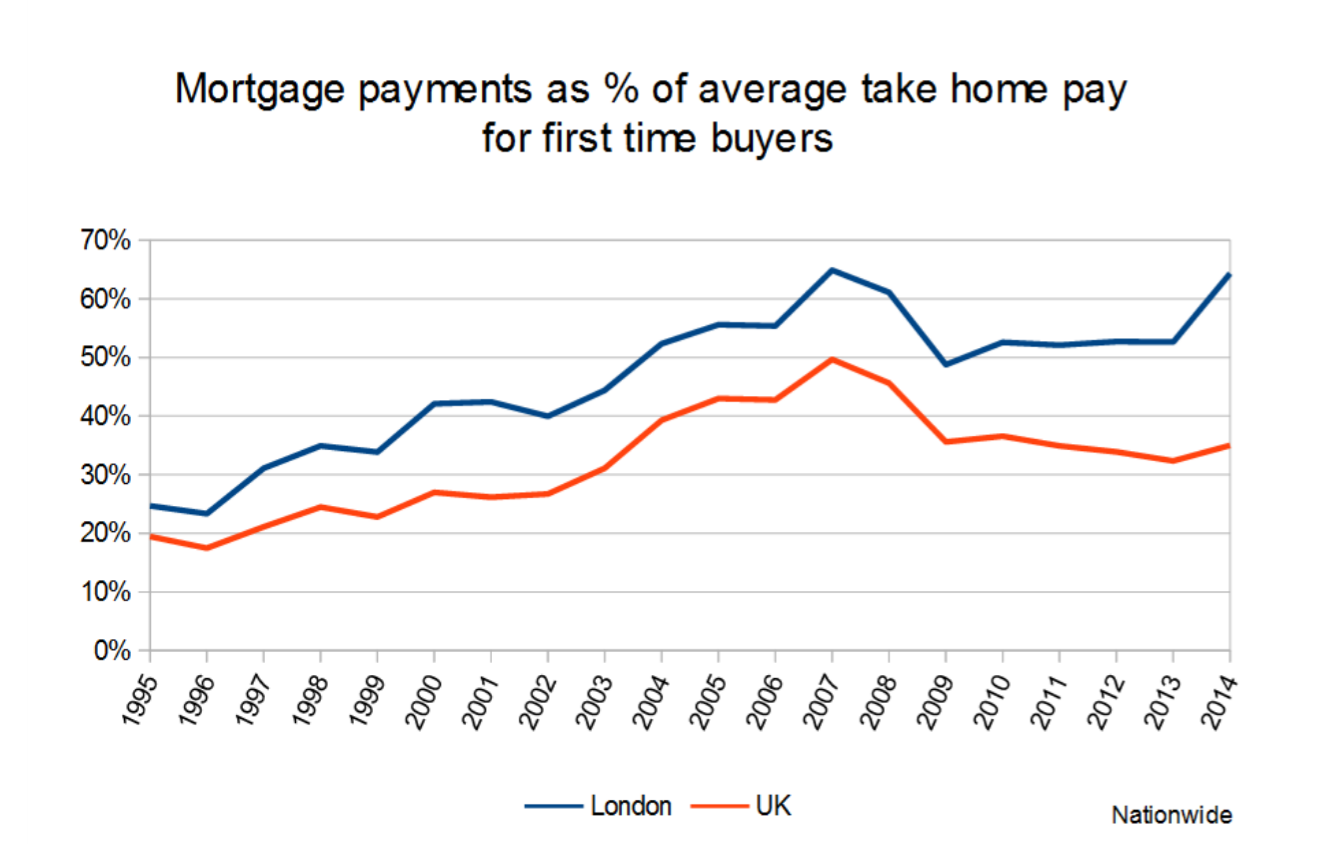
Shocking news from the rock of the Hunter; the affordability of housing is terrible in the UK and getting worse.

See the plot below which shows the percentage of average salaries used to service mortgages in the UK and London.

The odd thing, not recognised by many, is that the purchasing power of the income not spent on housing has also gone up in the same time despite the fact that it has shrunk as a proportion of total expenditure.

This, due to increased productivity in the manufacturing of goods and services.

All the angst that people feel is related to the fact that their desire to own stuff and have an exciting lifestyle has gone up faster than productivity.

So they have to get the house and then suffer increasingly because this causes an unwanted trade off in lifestyle.

There’s no plot for this effect but its very much related to the improvements in the effectiveness of marketing.

Technology and psychology, a powerful mix.

image

mxx1's avatar

A.D.D.

Attention Deficit Disorder is no such thing.

These kids always have their attention on something; just not what the labeller has in mind.

The condition is better known as PTOCD (parents and teachers with obsessive compulsive disorder).

image

mxx1's avatar

A Rocketgram

Human nature would usually have us wanting more than our fair share.

In days gone by there was, broadly speaking, two groups of self interested travelers, the church and state, that have ganged up for power with great success.

And then we had the industrial revolution and the enlightenment.

What happened next was either natural progression, or if you are so wired, a multi century long game/conspiracy theory.

By increasing the material wealth of the masses the wealthy actually increased their own wealth and slowly destabilised the authority of the religions.

The end game is no religions, just materialism.

Once achieved the usual control mechanisms can be (and are being) used to distort the relative wealth distribution in favour of a few.

They’ll probably overdo it.

Religious authorities in countries retarded in their development of a materialist culture see all of this as a threat.

You’d expect them to go for a preemptive strike to protect their patch. Hence they could reasonably become the bad guy and be wiped out quick smart.

Sound familiar?

As Bertrand said, life is but a race to be the criminal rather than the victim.

image

mxx1's avatar

Materialism v. VQSV

Of every 10 people in the world 3 are Christian, 2 are Muslim, 2 Hindu, 1.5 non-religious and 1.5 are something else.

The non-religious group is by far the fastest growing category.

Up from zero a hundred years ago the category is accelerating in it’s penetration of market share.

There are three major categories of non-religious types; atheists, humanists and materialists.

However all the growth is occurring in the materialism category.

Religion, even in its mildest forms, seems to get in the way of fully enjoying all the benefits of our Western materialism.

And as materialism spreads to the second world so does religion decline.

Atheists and humanists are a product of the enlightenment; rational people reasoning themselves away from fairy tales.

As we progress further into the post-enlightenment era these categories are fading.

My question is this; if we ever need to curb materialism because of global pollution or diminishing resources, will that cause a contraction of the non-religious category?

Just as an aside, one commentator claims that the jihadists of ISIS are more motivated by preventing the growth of materialism at home and less by converting the rest of the world to their faith.

Last year the Saudis introduced a law defining atheism as a terrorist offence. Now that must sit pretty hard with all their material wealth bartered from oil exports

It just goes to show that religion has always been about the control of power structures.

The Saudis just haven’t figured out that materialism is also a religion of sorts but one that is easier to control because there is no central religious authority to contend with.

Indeed, as materialism has spread in the West so has the need or motivation to question and understand. This is what I mean by the post-enlightenment era.

If pressed, I would call materialism a religion. Lacking a creator and a book of fairytales, this statement might seem sacrilegious.

But materialism requires the adoption of beliefs that aren’t questioned and that are slavishly obeyed.

It even goes one step further, to deny the mandate of other religions in the tradition of all good Abrahmic religions.

On this basis I reject it and exile myself to a shrinking minority of humanists slash atheists.

I’d better start being quiet about all this because the chief vendors of materialism will eventually get around to persecuting non-adherents in the non-religious categories after they are done with the religious categories.

In fact, the trick will be to just pretend that I’m a crap materialist. That shouldn’t be too hard.

image

mxx1's avatar

Post Enlightenment Era

A clear sign that we are in a post enlightenment era is that intelligent people in positions of significant influence simply can’t be arsed trying to improve society. And in fact that can be quite attracted to the idea of the trailer park solution, in its broader context.

image

mxx1's avatar

Transistor Fail

Now here’s a catchy title for a talk that I was just invited to; “Active electronic impurity doping of silicon nanovolumes: Failure and alternatives.”

This reminds me of another tech dream that I had the other night.

This time I imagined a new way to make an organic transistor.

Rather than having a material that is generally an electronic semiconductor I dreamt of creating a conductive path only at the interface of two phases of molecules.

Applying a voltage (or any other driving force) would cause the normally mixed molecules to separate into two phases with that resulting clever conductive interface allowing for current flow.

Imagine two largish molecules or two phases of smaller molecules of say 2-4 nm in radius disentangling and separating due to an applied voltage. Phase separation.

Then at the interface, a previously non existent conductive path. Hey presto, a transistor.

Which makes me realise that nature has all the tools it needs in order to build a binary computer.

Of course the applied voltage could be anything. Thermal energy, pressure, or just about any energy input.

And the conductive path could be diffusive, where molecules flow rather than electrons.

Ah, if I was a mad academic I’d build one of these transistors and claim a Nobel prize. I could even power it with an organic solar cell using organic conductors to get an all organic computer.

Fortunately I have more sense than that.

image

mxx1's avatar

Mantra

Here’s the Bill Ferris, AO, story.

Bill is an old mate of my former aging venture capital business partners, Roger & Roger. He formed the first venture capital fund in Australia back in 1970 before quickly switching to private equity.

Yep 1970, six years after I was born.

So he is as old as Gough Whitlam or thereabouts. But still alive, just.

Bill looks preserved in the bottling sense. Like those old dudes running around St Tropez with the acquired wisdom that a tan hides all wrinkles.

False economy, I call that.

Anyway, being a 45 year veteran of Sydney’s business functions and charity events, Bill is well connected to the other veterans of the business functions and charity events in this fair city of ours.

One of these is the current prime minister, the master of eloquence, the saviour of the chattering classes, Malcolm the Second.

Malcolm has just appointed Bill as the Chair of Innovation Australia, yet another of the scourge of oxymoronic federal government advisory boards with dyslexic monikers.

Last week The Conversation asked me to pen an article on the subject of Bill and his chair. I momentarily forgot my mantra (‘It doesn’t matter, leave it alone’) and emailed Bill’s pitbull of a personal assistant to line up a coffee chat.

Before I had a reply I managed to read some of Bill’s ‘big’ ideas. More STEM education, ‘no liability’ corporations for the tech sector, more tax breaks, a ‘patent box’, and more university research funding. All of these are recycled headlines that either make no sense at all, or no sense without a previously unvoiced context.

And most puzzling, “Mr Ferris also said governments should make it easier for companies to access capital for high-risk, high-reward investments. Companies should also be given much greater access to government data to experiment with, he said, with appropriate privacy and security safeguards.”

To the first one I say, how exactly? Another white collar welfare handout? And “no!” to the second one.

Just when I was having major second thoughts about writing this article, Toni, the pitbull, gets back to me saying that The Conversation had doubled up; they had asked both Michelle Grattan and myself to do a piece on the wrinkly subject. Toni seemed outraged at such duplicity and inefficiency.

I took this as divine intervention and I have extracted myself from a process that could only be described as a hiding to nothing.

It’s clear to me that Bill has no genuine subject matter expertise which is not surprising given his age and the fact that he has been in Private Equity his whole life.

Private Equity is not a bastion of innovation. It’s all about using capital to clean up established companies that are poorly managed and/or poorly owned, for profit.

So it seems that Bill’s insights into converting Australia into an innovative exporting nation have been gleaned from the media where 30 years of self serving whining from the recipients of government handouts has framed the discussion.

Chestnut central, doomed to fail, constructed on a scaffolding built with a complete lack of rational critique.

And it all survives because it is a very complex economic issue understood by very few. Just for the record, any plan that doesn’t have at its core a blueprint to drag our large oligarchical corporations in the services sector into the development and export of high tech solutions is a furphy.

Back to my Mantra.

I have discovered, no matter how eloquently or diligently I express myself, that a comprehensive and thorough review of the subject (of how to fix Australia’s lack of high tech exporters) falls on deaf ears.

Why? For some the subject is simply too complex. For others the discussion too long. A large grouping finds that the truths sit uncomfortably with their arguments for further government handouts. Many of those interested in the subject are experts in some other aspect of business but just don’t know what they don’t know – the scourge of the Australian business sector, this. Many others don’t give a shit.

I decided some time back to get myself into this latter category as a means of maintaining a higher degree of personal contentment.

It’s a tough transition to pull off. I am genuine child of the enlightenment living in the post-enlightenment era. I just have to suck it up and move on.

I will get there! I always achieve my goals eventually.

image

mxx1's avatar

New word

Imaginate. A verb related to the act of imagining, another verb.

Imaginate, as per masturbate, meditate, assassinate, innovate or cogitate.

I struggled to get my head around this grammatical black hole. ‘Imagining’ is either a transitive or intransitive verb as would be ‘imaginate’.

It’s as though the verb ‘imaginate’ doesn’t exist because imagining is not seen as a routine task done the same way by many people and certainly not something that can be planned.

As per:

I am going to meditate
I am going to imaginate

Compare this to:

I am going to imagine …

The latter implies an intention to do a specific task which by common consensus can’t be planned ahead of time. Let’s call ‘imagine’ a transient or ephemeral verb. Which is why we don’t imaginate.

I do though.

image

mxx1's avatar

Varoufakis

Here are some deluded comments from another well meaning economist … the first paragraph is spot on. The second, displaying a complete absence of subject matter expertise.

“Echoing the call for innovation by new prime minister Malcolm Turnbull, Varoufakis said Australia should redirect its economy from “rent” in the shape of selling commodities to “entrepreneurial profit” in the form of greater innovation.” Here he’s correctly identified a problem and suggested a viable hypothesis for a solution.

“Australia has excellent pockets of innovation such as CSIRO. But there is a glass ceiling where they usually have to sell up and move to the US in order to progress.” Here we have one untrue statement followed by a non sequitur.

So in order; we get a truth, a hypothesis, an untruth, and a non sequitur. Next up would be an unintelligible noise followed by a death gargle, and then silence.

image

mxx1's avatar

Tendency

“The nanoscale biocompass has the tendency to align itself along geomagnetic field lines and to obtain navigation cues from a geomagnetic field”

This from an article implying that we the animals have built in bio compasses.

The inclusion of the words ‘tendency’ and ‘cues’ worries me. It implies an alpha technology that works every now and again.

Just like the GPS in this phone.

wpid-img_20150105_133732_20150105144759083.jpg

mxx1's avatar

Innovation Council, Harper Review & IP

Most lucid observers note that our economy is too dependent on the export of resources and that it is also 70% in the services sector by GDP. In the services sector we have relatively few exporters and certainly no major providers of technology platforms, primarily because our companies have been and are operating in a protected oligarchical environment to the extent that they are not innovative and would not survive open global competition.

Ian Harper wants to get rid of the oligarchies by removing the hidden barriers to competition from foreign players and new entrants in the Australian services sector. Inexplicably he also wants to water down our already weak IP rights which would further reduce the incentives for our services companies to invest in IP creation.

This big stick of removing the hidden barriers to foreign competition, he argues, would force our companies to compete more aggressively to keep their market share to the point that they would be competitive enough to export their services.

I think that this is a fallacious argument.

Firstly, they would fight the changes and collectively they would win such a battle.

Secondly, even if by some miracle these changes came to pass, our oligarchies would simply lose out to foreign service providers well before they could change their cultures sufficiently to compete in a truly open market.

Australia would be worse off.

My personal preference is to go for the carrot and not the stick. I argue that government can give the same lazy oligarchies a strong incentive to invest in (a) innovation in the areas of their core revenues using substantial tax breaks for both foreign income and income related to innovation (through the patent box scheme) and (b) invest their cheap capital (while they have it) overseas, again through tax breaks.

Any such increased profits must align with senior management incentives and, if so, management would find a way to take advantage of these measures while they still had all that lazy capital to do it with. Indeed, we could even reduce the personal income tax rate for long term senior management incentives related to such increases in export incomes and income derived from genuine innovation.

And then, once this transition is well on it’s way, of course we could open up the Australian services markets with some surety that our companies had the skills to defend their local patch, based on their already successful foreign ventures.

On the subject of “innovation” I would note that it is not an outcome of any sort by itself. It is a habit of individuals and companies that is required to flourish in the modern era.

I would argue that any government policy should not attempt to create an “innovative culture” – that is the wrong approach. All that government can do is give the right people and companies the correct incentives to be innovative and successful. And we should also introduce changes to make IP enforcement simple, easy and lucrative for those whose IP rights have been infringed.

My current fear is that the certain measures, like the patent box, will be introduced in the wrong fashion and this will just result in the local service providers gaming it for the tax breaks as they currently do the R&D tax incentive.

For a complete view please see my article one the subject at https://www.academia.edu/8093846/How_Australia_can_Invent_a_Thriving_Technology_Export_Sector

image

mxx1's avatar

Odd Idea

Here’s an odd thought I had in a meeting today….

I think professional CEOs should gang up into groups of 5-10 and share their income and long term incentives.

This would give them portfolio protection of their income and upside.

Also it would create a ‘personal board’ for each CEO in a partnership model which would ensure they perform to their peak.

Indeed such a system would lower the risk to investors in these companies safe in the knowledge that the CEO partnership would moderate bad behaviour and enhance performance.

Indeed they could eject a poorly performing member and be responsible for replacement.

They could even create greenfield groups with an initial investment by the members into a fund for co-investment into the companies they pick.

I suspect that such a model would align CEOs more closely with the risk-return profile of professional investors such as VC and PE.

image

mxx1's avatar

Hate

She now hates me. Why?
Because I am not the ‘me’ she thought I was, and I have removed the ‘me’ from her presence entirely. This is very inconvenient and she depended upon and loved (well sometimes hated as well) a version of ‘me’ that was in her head. As well, for some reason it’s emotionally harder to be left than to do the leaving – this is probably due to a lack of emotional preparation and pride.

Who did she think I was?
She had an image of me that wasn’t really me, that’s what she had in her mind. What was in her mind I couldn’t say for sure but I would guess a doting husband that shared her mind space on all matters, often fucked up (a value judgement highlighting the differences) as they are.

Whose fault was that?
Well, everyone’s.

How did it occur?
Two unformed people editing themselves over the years to make everyday life less stressful.

Where did the stress come from?
A form of Pavlovian dog training where one spouse gets what they want but they aren’t very careful to be careful of what they want.

Why would they do such a thing?
Because this is what people do. They want something and they get it, much the same way that people keep eating that  sugar even as they get fatter and fatter. They get positive reinforcement of a kind that certain behaviours get results. And they get practised in these arts. 

So what happened?
I started thinking and questioning and then the dissonance between the morphing me and the edited me got too great.

But couldn’t you have tried to bring her along this journey of change?
I did but she not only resisted the journey, she denied it’s very existence and condemned it’s basic principles.

What was so bad about the journey?
All I have ever wanted was to understand myself and the world around me. I know I am heading in the right direction because as I travel I feel more and more at peace within myself. I guess the questioning that is required to begin and commute on this journey leads to some very uncomfortable personal reflections; many baulk at this, even subconsciously.

So now you have left and she thinks you are a pathological so-and-so and will learn to hate you?
Yes.

How does that make you feel?
Terrible. I was either brought up to, or am congenitally designed to empathetically feel the pain in others that I cause. In an earlier version of me I have therefore avidly avoided causing pain in others. Having said that, I now know that pain that is deferred is pain multiplied. And also, that without pain there is no gain. And finally, that pain must be felt, whether that is mine or that of others; it is the price of love and freedom.

What can you do now?
Nothing. I have changed my path and made my choices. There is nothing I can do other than feel her pain, draw it into me and blow it back out. She now has to wear it herself after I am done with it. 

If you could advise her?
I would not. It’s time she faces her own reality. She cannot continue to blame the world and others for the predicament that she finds herself in. That is hiding, hiding, hiding. A path to nowhere, which is exactly what she has achieved with my complicitness. I have done her no favours by waiting so long.

And is that all?
Yes, anything else is Hollywood sentiment of very little value and no authenticity.

image

mxx1's avatar

Lex Parsimoniae duo

Of course Raymond Carver made the same point but much more eloquently … let’s call it the artistic form of Occam’s Razor applied to our connective psychology.

“And did you get what you wanted from this life, even so?

I did.

And what did you want?

To call myself beloved, to feel myself beloved on the earth.”

And there’s so much water so close to home …

image

mxx1's avatar

Lex Parsimoniae

If I were stuck in a stalled elevator by myself for the rest of my life (one with a magic pudding fridge and a toilet) would it matter who I thought or felt I was?

I doubt that I’d even give it a thought after a month or two.

Which is to say, much of our psychological energy is spent on filling in the gaps and defects in ourselves, defined by interactions with other people.

To this I would note, be very careful who you spend your time with.

And also, coinciding with all the other folks is much harder than coinciding with yourself.

On the positive side of the ledger, it’s also much more interesting.

I just reckon that applying a psychological form of Occam’s Razor to our social interactions makes for a more content life.

“Among competing hypotheses for self improvement (read social improvement), those with the fewest psychological bypassing contortions should be selected.”

image

mxx1's avatar

Jet Lag

Jet lag got me last night, so I spent a good fraction of the night awake and thinking about what I would usually do while asleep.

Somewhere in there I got to thinking about my current approach to not communicating much with people that (a) are hostile to me, and (b) don’t use logic to arrive at opinions.

Whilst my position is unassailable from a rational point of view, that might just be the issue.

All that most people want to see is that someone else is sharing their pain and bugger the facts.

This also got me imagining a bunch of conversations where I to get to speak my mind, or vent my feelings, or speak my truths.

The issue is that I would have to recall all of these in real time – I am getting better and better at this.

But I do have to remember the trick of calling a time-out whilst I collect my inner cohort of bouncing madness balls to share with my adversary.

Just the one thing to remember – time-out – I should write that on my hand.

Time enough for truth.

image

mxx1's avatar

Investment Thesis – note to self

I was chatting to an old colleague last night who just happens to run the Asia-Pac division of a large medical equipment company.

He was telling me that they are very profitable and grow at a very reliable rate every year despite what the economy is doing, because people continue to get sick and prioritise their health over other expenditure.

Their company stock is well covered by the analysts so there it is as steady as a rock, slowly rising with the market size and slightly enhanced by the company’s tendency to spend excess cash on share buy-backs.

There is little chance that they will be the subject of a take-over because that would cost an unjustified premium to market cap (the stock is fully priced) and being extremely technical, there are little synergies to made from a merger.

However there is activity by activist shareholders. Rather than taking over a stock these guys just get a minority position and hassle the board and management through every trick in the book.

What they are after is an increase in net profit from 20% to 25% by cost cutting measures like moving the finance department to India or cutting R&D.

Once their goals are achieved they sell their stock for a premium and move on, leaving the company a stressed entity because all those cost savings probably destroy the company’s ability to compete in the long term.

So my opinion is that a fool proof investment plan would be to identify these companies and activist shareholders and then invest in derivatives, on the upside when they just start and on the down-side when they are just about done.

Given that the underlying asset has such rock solid value this is a very low risk profile derivative play.

I will share the idea with some innovative investor mates and see what they think.

image

mxx1's avatar

Hamlet indeed

What means this, Polonius?

“This production contains thetraical smoke, haze and loud sound effects”

image

mxx1's avatar

Rasta Dreams

Well I had this very odd dream last night.

It was all about quantum chemistry.

I had this realisation in my dream world that all those approximations used to do quantum chemistry calculations lead to results that differ from ‘reality’ that are actually skewed to one side and not randomly distributed.

What this meant in my dream world is that the disconnection between the quantum and Newtonian worlds is itself of a quantum increment.

I had the realisation that this actually wasn’t a 3D issue but really represented an unrealised time slip.

This time slip, it was spoken to me (by who, I know not) is the original sin of mankind.

Our task, if we choose to accept it, is to find it and then figure out how to deplete it.

It’s never boring in there, the dream world … and for some reason, in my sleep, I kept saying to myself, over and over, you have to remember and blog this one. It’s important!

Now that I am back in my Newtonian world I’m not so sure.

image

mxx1's avatar

Maxiato

I haven’t had one bad macchiato since landing in Italy and they all cost exactly one euro.

One dollar and fifty cents – less than half of what I pay in Australia. And they always give me a free bowl of chips (crisps) with my beer before sundown.

The Italians might treat the rules as just guidelines but this is proof positive that their approach works.

Now to fix the macchiato problem in Australia, on the subject of quality we’d have to introduce barista tertiary degrees with mandatory licencing, coffee police and regular retesting of the licenced practitioners. And maybe some ‘dob a coffee slob’ and a ‘keep Australia wired’ campaigns on television.

But that would send the price up, not down, since the cost of all that bureaucracy would be passed onto the consumers.

Somewhere a plot was lost.

In any case I am proud of the fact that, no matter how hard I try, I can never remember how to spell bureaucracy. It’s word checker to the rescue every time.

Basically I am barely an Australian. I had better not get a second passport because eventually they’d use the proposed new terrorist laws to annul my Australian one.

image

mxx1's avatar

Tattoo You

Sometimes you read a story that is so stupid that you knows it’s true.

Some union official is in trouble for getting a tattoo on union dollars.

So screamed the headline.

My initial thought was that if he had had the union logo tattooed on his arm then I could live with it.

In fact all corporates should offer this a free perk and sack all the takers.

The union guy though had a tattoo of his parent’s wedding photo scribbled onto his leg.

It’s easily the worst tat ever, and that’s saying something.

In his defence he stated that (a) he loves his parents, and (b) his dad was a union leader, and (c) when he went to pay for his tat his personal account was maxed out.

Clearly a moron, I think he’s been punished enough for now though.

He has the tat and now everyone has seen it.

But you have to admire the sleuthness of the royal commission into union corruption for uncovering such rubbish. $500 of worth of entitlement!

If that ran that ruler over the corporate world Australia would be out of CEOs tomorrow. And anyone with a title over ‘manager’.

Why for is corporate corruption of the personal expenses nature left to self (non) policing?

image

mxx1's avatar

Secular Progressive Ridicule

I did some research on the scriptures of the Abraham religions and discovered that they all preach tolerance.

The Mosaic Covenant states that Israel could be a “holy nation” but only if its people behaved well, and play well with other nations. 

Jesus of Nazareth was a pacifist who advised “shaking the dust from your feet” and to simply depart from those who are not receptive to your beliefs. And he said love even your enemies, and resist not evil but love good.

Muhammad wrote very clearly in the Qur’an that there should be no coercion in matters of faith, and a Muslim is to say, “To you your moral law, and to me, mine.”

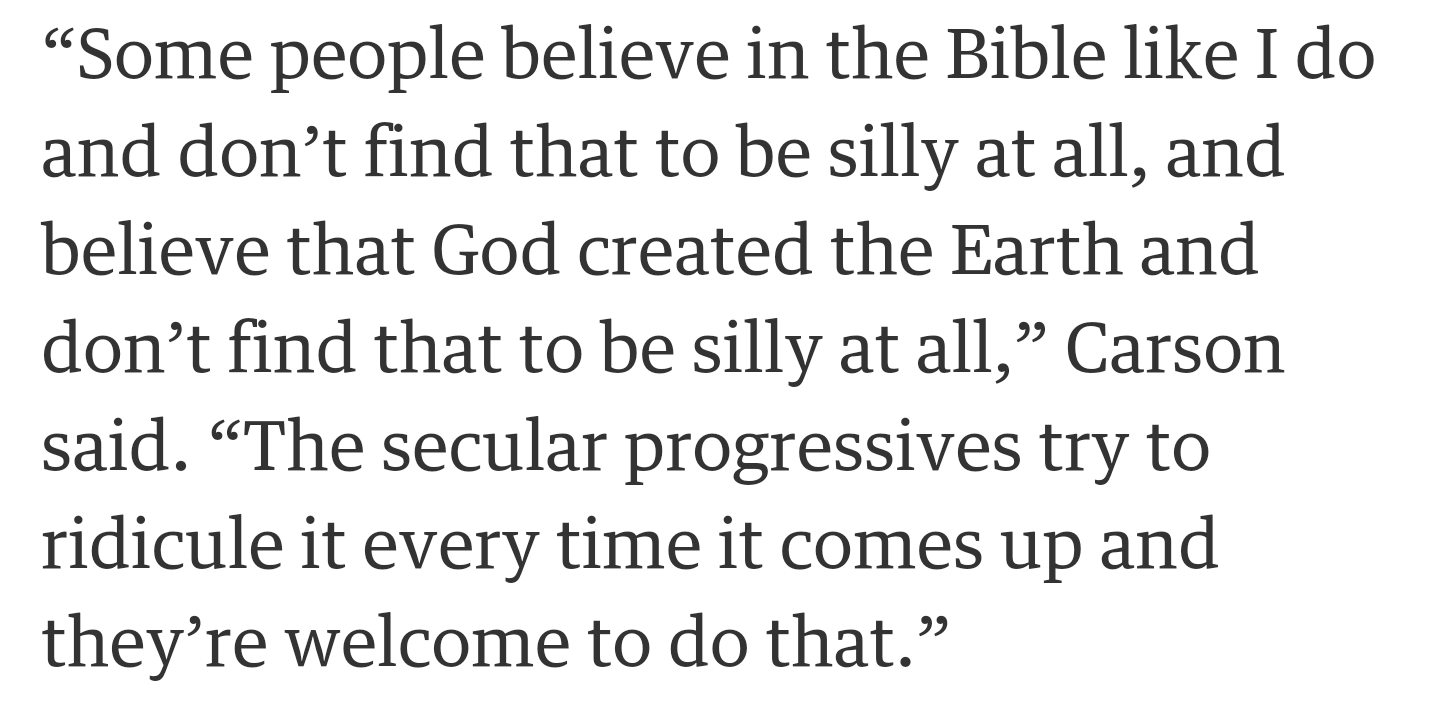
Where therefore comes the current plague of moronic holy crusaders? The settlers of Israel, the ISIS caliphates and Ben Carson, the co-leader of the current Republican Nomination race (see quote below).

I suspect they all interpret their scriptures pretty much like I treat the buffet at the the Albury Commercial Club.

That is, take all you want but eat all you take. And some of them go exclusively for the sugar whereas I prefer the protein and fat.

That is, they just look for the sweet bits that suit their loopy self-serving intolerance and happily ignore the harder-to-digest tolerance messages.

In this process of selective blindness they treat rational thought as just one amongst many of the categories of their occasional departures from their usual mania.

Thus their sweet-arsed dissonance doesn’t result in tooth aches or any other sort of dichotomatic head pressure.

Perhaps there is an evolutionary benefit in their ways; maybe they are like human cockroaches and are best placed to survive the holocaust that they are collectively hell-bent on creating.

Armakidden!

image

image

mxx1's avatar

Alice in Wonderland

[from the http://mupatents.com/ webblog]

The Alice v Banks (Alice) decision has changed the landscape of software patenting in the US. The Supreme Court provided a powerful negation of business method patents but with little guidance on where the line can be drawn for valid subject matter in the area of software and intangible computer inventions. The Court reaffirmed the Mayo test and brought it into the forefront. One thing is certain – USPTO Examiners are issuing 35 U.S.C. § 101 objections at the faintest scent of a generic computer concept.

The Alice decision applies the two-part Mayo test: i) determine whether the claims at issue are directed to a patent-ineligible concept (abstract idea), and ii) if so, is there an inventive concept sufficient in transforming the patent ineligible abstract idea into a patent-eligible application (usually referred to as “significantly more”). Where computer inventions are involved, if the claims are not directed to an abstract idea, then the analysis stops and the claim is patent-eligible subject matter.

The definition of an “abstract idea” by The Court is as follows: “a fundamental economic practice long prevalent in our system of commerce”, and a “building block of the modern economy.” The Court in Alice provides examples of ineligible claims of abstract ideas. Consider the following examples below:

– An algorithm for converting binary-coded decimal numerals into pure binary form
– A mathematical formula for computing alarm limits in a catalytic conversion process
– A method for hedging against the financial risk of price fluctuations
– The concept of intermediated financial settlement.

What ties these ideas together? If it’s not long-standing, i.e. something only possible because of the advanced computerized world, and it’s not related to the economy or finance, then it may very well be patent-eligible.
It’s crucial when filing a patent to keep these examples in mind to ensure the functionality of the invention is a truly new innovation. Then tweak the language to be as specific as possible.

Now that it’s clear what an ‘abstract concept’ is and how it applies to an ineligible patent, let’s discuss how to transform this lacking concept to patentable matter.

Obviously, adding a generic computer to carry out the steps of the abstract idea does not make it patent-eligible. Similarly, stating the abstract idea while adding the words “apply it with a computer” won’t fly. “Significantly more” is required to enable the addition of a computer to transform the claimed subject matter into patent eligible.

Examples that may lead to patentability are improving the function of the computer itself, or effecting an improvement in any other technology or technical field. In a nutshell, the use of the computer must amount to “significantly more” to bring patent eligibility.

Also, computer and electronics systems that move away from the norm of computers, servers and smartphones may exhibit “significantly more”.

Even if peripheral to the core of the invention, unique features including detail of algorithms used and atypical or unique hardware may prove beneficial in overcoming the § 101 objections of Examiners.

Understanding the basic principles of Alice and how they are applied to the patent application process is the first step. See below for specific tips on drafting to ensure your patent application is accepted.

1. Recite unique and unusual hardware where possible, as core features of the invention or as a fallback. This is especially meaningful where required for interaction with the software, for example, “Fit-Bit.”

2. Recite algorithms that cannot be carried out by humans, that accordingly could not be characterized as “longstanding commercial practice.”

3. Characterize inventions as only possible due to recent developments in computer technology (such as networks, etc.) that avoid a connection to “longstanding commercial practice.”

4. Avoid fundamental or general economic practices that do not feature information that add “significantly more” in the claims, if possible.

5. Show the examiner what a computer would bring to longstanding prior practice, and highlight how a new system is followed to bring benefits that could not be brought by simply computerizing the prior longstanding practice.

6. Challenge the Examiner’s application of § 101 to the claims when there are grounds.

[My comment – even if you fool the US patent examiners by fancy claim structures my guess is that enforcement will be tough with the US courts emboldened to overturn software patents on the basis on non-inventiveness. I don’t expect NPEs to flourish nor patent assets in the software space to be worth much unless these rules are relaxed].

image

mxx1's avatar

Manus

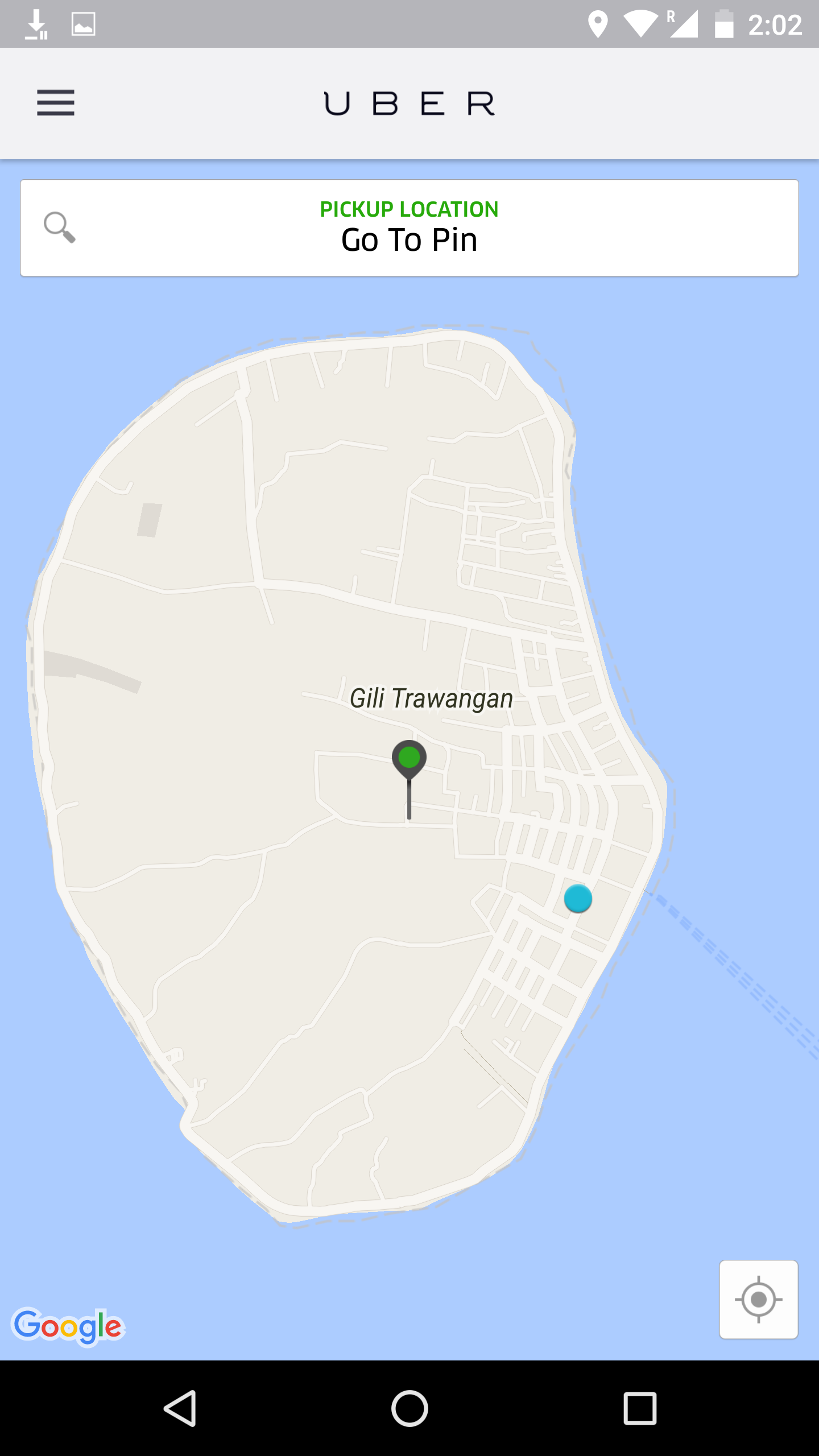
When Australia eventually gets embarrassed into closing the asylum seeker detention centre on Los Negros island, I see another Gili T in the making. All they have to do is remove the fence; they could donate it to the local primary school.

image

mxx1's avatar

Random thoughts from Jakarta

Pondering whether the Islamic religion in Indonesia promotes violence it occurs to me how schizophrenic Christianity has been, oscillating between old testament-style blood and gore against all perceived enemies with the occasional nod to the teachings of Christ. I’m not making a point. Just noting.

Unrelated, to allow people to annoy you, you have to sort of occupy their body with yourself, to some degree. Withholding such a transfer does everyone a favour.

And only vaguely related, a prophet or a guru that teaches others is using that process as part of their journey, the one that never ends. You just have to be wary of the teacher that is stationary. The best pupils aren’t – they find their own path and teach by accident.

Back to location – Indonesia mean “Hindu Islands”. The religion here used to be mainly Hindu before Islam took over. The word Hindu derives from the Indus river which itself gets its name onomatopoeiacally from the noise made by certain frogs that used to inhabit it’s ancient banks.

And finally, with three million Australian tourists a year, Bali has at any time about 60,000 of the breed present, making it the 26th largest population centre of Australians.

It’s not like Australia doesn’t have tropical beaches or rainforests to visit. The primary attraction of Bali is the mostly harmless and cheap labour source (aka servants), helpfully accessed by cheap air transport.

The retarded development of a nanny state in Indonesia must also be a secondary benefit because it allows unlicensed drink driving on motor scooters; a dark desire of all Australians.

It’s a bogan convict colonial hippy surfie illusion.

image

mxx1's avatar

Cognitive Bypassing

The anxiety that you feel may be mitigated by labelling it as cognitive dissonance and then dealing with it by randomly choosing a position and labeling it as the absolute truth.

image

mxx1's avatar

Innovation of the Day

A ‘black’ UV light (that emits no visible light) in your bedroom combined with a mosquito net containing thousands of tiny little photoluminescent dots, imitating a starry night or a glow worm cave.

starry_night