mxx1's avatar

Imbalances

In the psych world there’s a hell of a lot of disorders. 

To me ‘disorder’ implies a departure from order. To that, I say, society has order but us humans, in our heads, we would have a serious disorder if we were to believe that a lack of disorders leads to mental order.

To highlight this point, a computer has no disorders and hence no personality. Which, as an aside, might suggest that the AI guys would be well placed to start programming in personality dimensions through behavioural traits, and then also mental disorders.

A name is just a name I guess. But I am starting to suspect that a mental disorder refers to an individual’s impact on others, society if you will, rather than on the individual itself.

The giveaway is that there’s precious few improvement classes promoting mental order. Happiness and wealth, yes, but order, no.

The spectra of the many, many dimensions of mental disorders supposedly swings from 1-11 for each of them. A score of 11 in just one of them and it’s likely that you’re barking mad.

In truth, a score of 11 means that you have a strong personality trait that makes it hard for you to function in society, whether you accept that or not.

There’s no zeros in the pack and the sane folk all have a score in each and every column.

That doesn’t sound like order to me. More of a balance, or better still, a lack of an imbalance.

In summary, your imbalances are our disorders.

So why make this point?

Well, if things aren’t going so smoothly for you, there are two courses of action: (1) modify your imbalances through the usual process of therapy and drugs, and/or (2) delete their disorders by removing yourself from their society; then you need to find a more amenable bunch of people to hang out with.

mxx1's avatar

Comedy explained

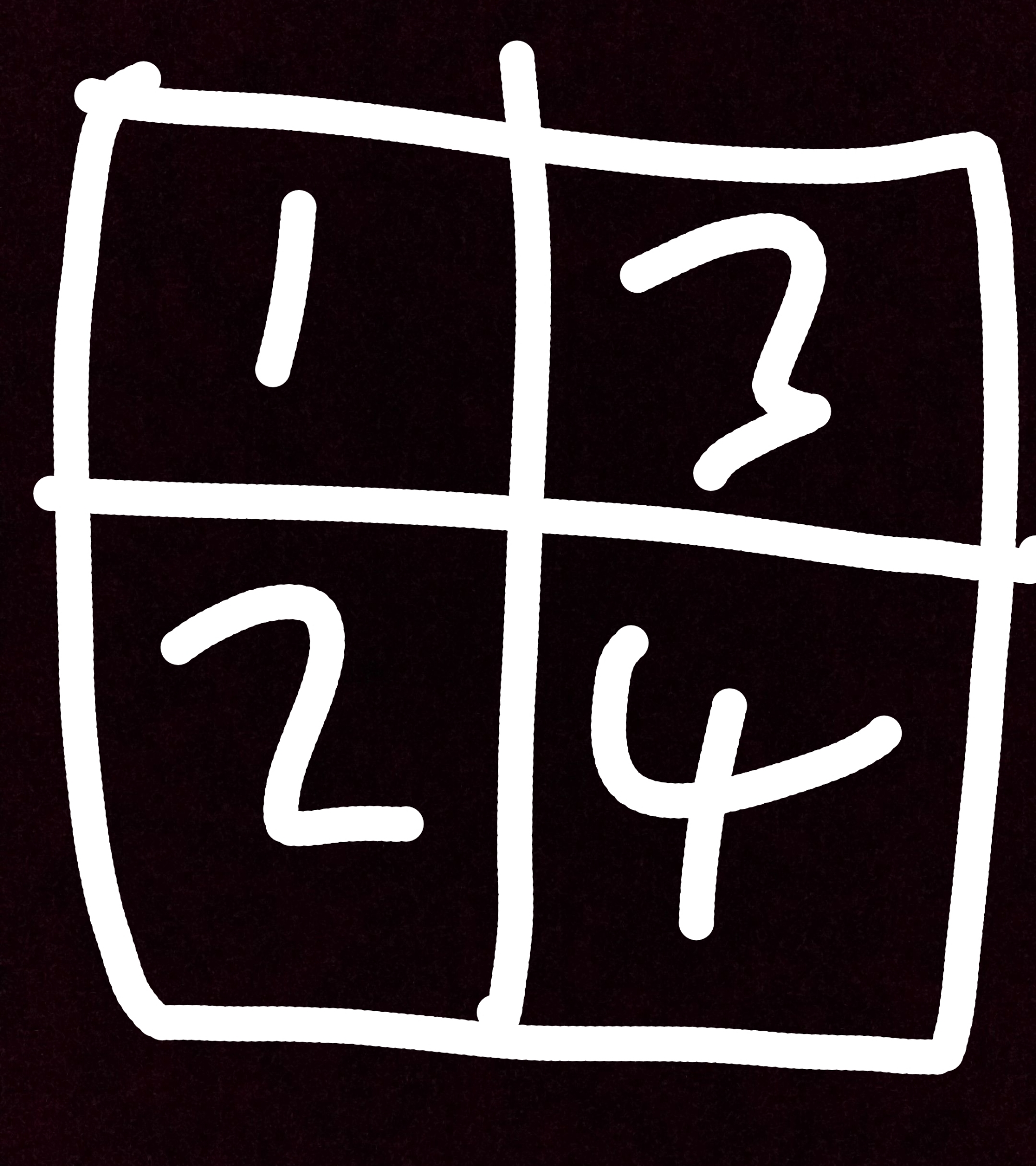
More on the Dunning-Kruger effect; with reference to figure below.

Quadrant one represents those suffering from the Dunning-Kruger effect, namely a cognitive bias in which low-ability individuals suffer from illusory superiority, mistakenly assessing their ability as much higher than it really is. Dunning and Kruger attributed this bias to a metacognitive inability of those of low ability to recognize their ineptitude and evaluate their ability accurately.

Quadrant Four represents the Dunning-Kruger corollary, namely where high-ability individuals underestimate their relative competence and erroneously assume that tasks which are easy for them are also easy for others.

Quadrant Two represents low ability individuals that know they are crap.

Quadrant Three represents high ability individuals that know they are good.

Guess which axis is where comedy lives?

mxx1's avatar

Good Morning Sunshine

What happens when a whole society suffers from the Dunning-Kruger effect? 

I’d say you’d find a few high-ability individuals that supress their relative competence so that others erroneously assume that tasks which are easy for them (the high-ability individuals) are also easy for the others.

mxx1's avatar

QR

I’m pretty sure that Brisbane’s trains are actually one big Quixotic experiment that is attempting to prove Zeno’s paradox.

It can’t be controlled from Queensland; they pretty much can’t spell ‘theorem’ up here.

No, there’s something quite alien going on. I’ll get to the bottom of it one day.

It’s a shame there’s rats on the arrows. More’s the pity that I’m one of them. Collateral damage I guess!

mxx1's avatar

Coup, no grace

This morning I witnessed two magpies in a fight to the death.

I tried breaking it up with a soft kick; they ignored me completely.

They had a claw grip on each other and were pecking away.

Eyes were the main target.

Initially I thought that they were youngsters having fun but at closer inspection they were old, angry birds.

The odd thing was that this was taking place on the middle of the Sydney CBD.

I left them to it, thinking I didn’t need that at 730am.

I’m pretty sure that at least one of them was for the cats, if not both.

In my haste to leave them to their first world problem I forgot to photograph the debacle.

And for that, I’m glad.

mxx1's avatar

Patent Value

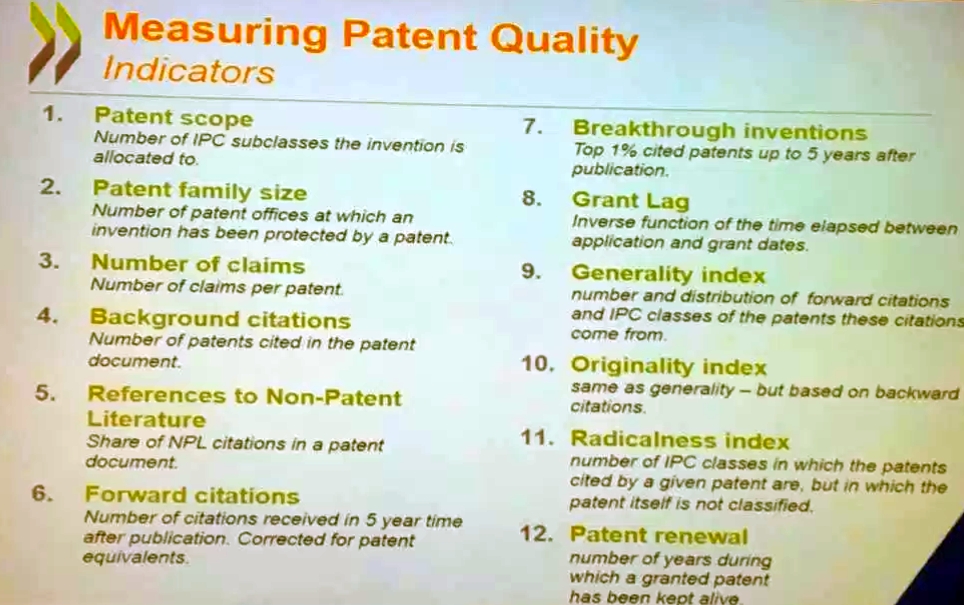
See slide below…

They’ve forgotten the most important thing, opposition and the third-party provision of prior art. Data which they have in their very own grasp. Odd.

Licensing, they don’t have this data, but they could by requiring it by law. 

Enforcement data, they should have. Not mentioned.

Transfer of assignment. A good measure. Somebody cares.

All of the above and below, grouped by inventor and assignee history. The good ones rarely waste their time.

mxx1's avatar

Fences II

​The big Australian dingo fence is 5,614 km long. The big Western Australian rabbit fence is 3,256 km long. The little Queensland rabbit fence is 555 kilometres long.

That comes to 9,425 kilometres, roughly three times longer than the US-Mexican border.

We can do this! 

Especially considering this update from Wikipedia; “Today, the rate at which feral camel are smashing down sections of the fence is fast increasing in Southern Australia. Plans for restructuring the Dog Fence to be taller and electric are in the works.” And this; “Parts of the Dingo Fence are lit at night by 86 mm cold cathode fluorescent lamps which are alternately red and white.”

You have to wonder, don’t you, at the audacity of putting animal fences half way across the country, and electrifying and illuminating them.

Maybe we could fence the North Western coast line as a cheap way of keeping all those asylum seekers out.

mxx1's avatar

Stats Explained

I often come across researchers that do something very silly, such as a study that correlates the distance from the patent office of the work address of inventors as listed on patents.

Why would they do this?

Well, firstly its cheap research because all that data already exists in the patent office databases which are readily available to the public. All you need is a student and a spreadsheet.

Secondly, they might be able to make some headline discovery that inventors are generally closer to the patent office than expected.

Apart from publishing this in the Japanese Journal of Inexplicable Analytics, this type of stuff is gobbled up by the editor-free internet news and info sites.

Thirdly, they may make calls (more newsworthy efforts) for patent offices to be distributed so that all inventors have equal rights and aren’t being geo-positionally discriminated against.

Fourthly, they will get to talk at international conferences on IP analytics where they will confound everyone with their hitherto unexpected results.

And, finally, based on all that they might get grants to do it all again, and again, and again.

Imagine a perfect storm; a nanny state with politically correct agendas where policy is developed by sheltered-workshop public servants that couldn’t spell either correlation or causation.

They’d be straight onto it; developing plans to distribute the patent office from its mausoleum in Canberra. They’d probably put one person in each of the residual post offices in the land.

Which isn’t a bad idea really; the post offices already provide about 200 odd government and commercial services. What harm could one more do? Just don’t try to buy a stamp.

Of course, with any understanding of statistics your researcher could have tested whether the correlation had any causation in any number of ways.

For example, by digging further into the data to find the patenting habits of inventors whose companies had moved offices at one time or another.

Of course the researcher would find that the rate of inventorship wasn’t at all changed by the change of domicile, and therefore he or she could happily conclude that the original correlation was just one of the likely co-location of both businesses and patent offices in the limited number of commercial real estate locations.

The odd, odd, odd thing is this; perfectly well trained researchers, when confronted with the headline correlation, just wouldn’t question it, or they wouldn’t know how to.

If I was put in charge, all Donald-like, one thing I would do, I can assure you, is set up some sort of torture gulag for researchers-in-training that fluffed the sanity clause, as per above.

ipa_155px


mxx1's avatar

Thanks to Sam and Greg

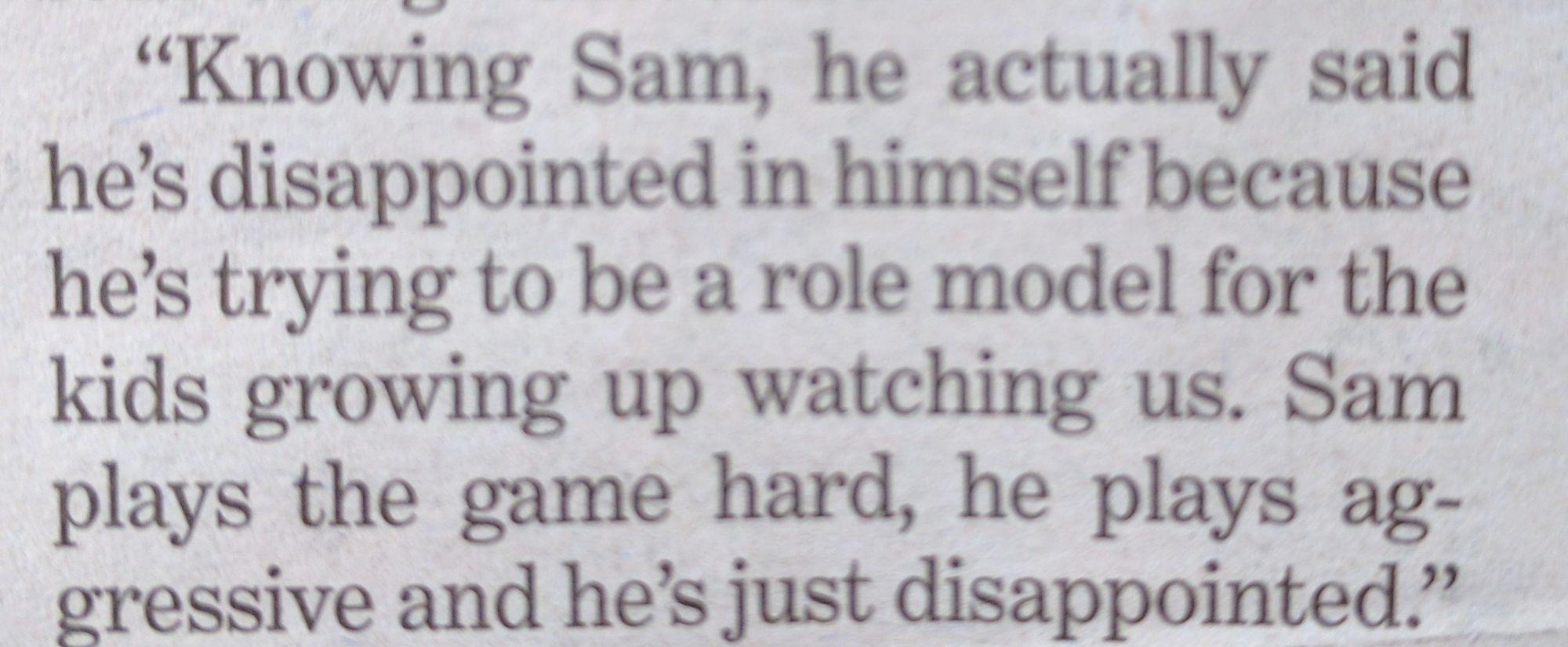
Footballers in this country have the odd, odd habit of being “disappointed” after they get caught breaking the rules.

Upon further questioning a footballer won’t say he is disappointed because he was caught. No, he’ll be disappointed in “himself”.

Occasionally, as in the example below, they’ll get a mate to explain all these conniptions in the third person, complete with a virtual proposition masquerading as a non sequiter.

It reminds me of Johnny Howard offering regret that he had to suffer through the process of thinking about apologising to someone or other, all in place of a first-person “sorry”.

So much emotion, tied up in a million little knots and buried in concrete where his heart should have been.

There’s no message here; these are just observations that bring me much light relief from time to time. 

I’m actually glad that these people at least feel the need to pretend to be decent. 

It’s better than the alternative, as in the Donald, who seems to have no aspirations to grace whatsoever.

I wonder what in the world his parents did to him?

mxx1's avatar

Fencing

So now that the Donald is in and the Mexicans aren’t interested, the Americans are going to have to tender the fence.

Clearly there’s only four credible candidates.

China have their uber-pricey masonary anti-Mongol technology that’s probably a bit dated.

The Germans and the Israelies have their expensive tilt-up slab technology, unproven over large distances and prone to graffiti.

The probable winners would be the Australians with their proven anti-rabbit and anti-dingo wire technology. Very recent, very cheap and very long.

We’d better not tell them that there were just as many dingos and rabbits on either side of the fence to start with, and also after the fact.

mxx1's avatar

Eeee You

Developing a new business, of a sort, is getting very cheap these days.

An example would be, say, a new bike light.

The first step is to design it on a computer and then build a working prototype using 3D printed parts and other bits cannibalised from existing bike lights.

This is then used in a slick little video made using an iPhone and some simple-to-use online editing software.

The sophisticated operator might even do a little professional Design for Manufacturing work here. But that’s usually parked as a problem to be solved later by people that don’t even know that they are doing so.

And then the video is launched on Kickstarter which serves to both fund the company by (a) finding thousands of customers willing to pre-order the thing, and (b) market the product.

Those pre-orders are used to get the product into manufacturing and then delivered to those pre-order customers.

Thereafter, if the product is any good it will be picked up by distributors and it can also be sold on-line through any number of outlets such as the company website, Amazon, eBay, & online specialists retailers.

Boom! What would have taken years and many dollars of equity investment in the past, is now done in a year without have to deal with any dickhead investors.

Things are even easier if there is no hardware involved. Once the code is written, the product can launch.

Therefore is it any wonder that some government agencies have gotten in on the act?

Noticing that they have all sorts of hidden assets such as databases full of information and access to every customer in the land, some agencies are now developing apps and online services which are far more sophisticated than what they have offered in the past.

Often these services are provided for free because this is easier for them than figuring out if they are actually even allowed to make profit.

Their motivation to do all this is simple; they need to be seen to be staying relevant, especially to their political overlords in this IT era.

This acts as a barrier against either privatisation or decimation. In essence, the more ‘public good’ they can market, the more secure their funding and their jobs.

The irony is that, in doing so, they are penetrating further into service areas that are the domain of private operators. But by offering services for free the government agencies are destroying these market segments.

Whereas once government agencies had crown monopolies through acts of parliament, now they also have them through the provision of free services.

The free market analog of this behaviour is readily accepted. No one questions free email, free data storage or free search engines; these are provided free so that Google can drive its advertising revenues.

I can’t see any philosophical argument against government agencies also finding ‘loss leader’ opportunities that leverage existing capabilities and new technologies.

Unless of course, a government comes up with some weird sort of IT-specific anti-trust regulation that prevent loss leader behaviour in the IT era. That would be Europe, of course, if it ever happens.

In the meantime, if you happen to be in a business segment in which a government agency has just burnt your lunch, then your only option is to pivot, and bloody quickly.

img_0082.jpg

mxx1's avatar

Inattentive Statistical Analysis

Here’s a wild stab in the dark. It’s just me grabbing some Australian data and extrapolating to beyond what would seem reasonably minded. But it’s the vibe of the thing that counts.

The current data on the percentage of female students doing post-graduate university studies in Australia is:

Natural and Physical Sciences – 49%
Information Technology – 25%
Engineering and Related Technologies – 21%

Now my guess is that current patent filings are roughly 20% from Natural & Physical Sciences, and 40% from each of IT and Engineering (reflecting 21st century technology business growth patterns).

This is rough but if we assume it is true, then from the participation rate of women in post-graduate degrees (as a proxy for people likely to be inventors on patents) we would expect women to represent around 28% of inventors on patent filings in Australia.

Oddly enough, this is pretty close to the actual figure. Dodgy I know; it doesn’t take into account all the nutty inventors, the time lag of patenting, etc etc. But the numbers are about right.

This would suggest that women who do enter into fields where invention is part of the work discipline are as inventive as their male colleagues.

The unknowable is whether one can extrapolate this to all folks of a gender.

For example, are the women that do enter into tech fields (where invention is part of the work discipline) naturally more inventive than those that don’t?

Or are all women (or people) equally inventive by nature, but are those that enter tech fields (where invention is part of the work discipline) simply those that learn to become practically inventive?

Ah, this is where we wheel in the philosophers, the French and the cognitive psychologists and let them argue for the next twenty years. And not an invention among them.

In an unrelated thread, could we claim that women are being denied access to the right to invent? (chortle over the keyboard)

Only if their personal choices not to enter certain sorts of degrees are also considered a denial of rights (say, due to cruel and unnecessary early-life Barbie doll indoctrination).

Oddly enough, Australian universities are turning themselves inside out to attract more women into engineering degrees, with very little success.

Therefore I would say that this is more of a voluntary denial of opportunities, rather than a denial of rights. And probably quite a sane one at that.

img_0105.jpg

mxx1's avatar

Hysteria

Humans typically base their heuristic hypotheses (aka hysteria) upon observed correlations.

However they are far worse at observing and absorbing a lack of correlation. The beginner’s mistake, worn to the grave.

By way of example, astrology is given some credence because of the odd bit of coincidence that reinforces the dogma. However the far-more-usual complete absence of coincidental reinforcing observations will be completely ignored.

Repeat after me; we don’t know what we don’t know, including just that.

mxx1's avatar

Swipe Keyboard

I’m telling you, writing this shit every day is very, very useful.

It forces a degree of completeness to those thoughts and feelings that run around one’s head, usually loosely to the end.

Slowly, and ever so surely, I’ve sorted out a large number of former mysteries.

And I’ve weeded out a bunch more bad habits, dark thoughts, misguided feelings and, frankly, embarrassingly stupid ideas.

I’m pretty comfortable about where I’ve got to. But I’m still pushing on because almost daily I’m surprised by some new insight or some new detachment from what used to be a chestnut.

Due to time constraints, much of what I ponder or feel gets lost into the ether. But I’ve learned not to panic; the good stuff comes back around when its time is due.

Not being public is an extra bonus for which I should thank my ex-wife. There’s a small handful of you readers; just enough to keep it rigorous, especially considering the calibre of your brains.

But there’s not a hint (to me) in my musings that I’m trying to please an audience, or follow the worm, or build a following, or get mentioned by Lydia Laycare.

I discussed this with my daughter and suggested these benefits of a diary. I may have to follow that up with the ‘limited audience’ caveat. It just wouldn’t be the same, talking to your own lined notepad.

The most amazing outcome that three years of this blogging has achieved is a crystallization of the feeling of detachment from the ungodly cares of humanity, cares that previously I could only day dream of divorcing.

It’s not all about detachment either. Connecting to the local is the ying to the yang of detaching from the ‘global’, those things that are external to you, the person. Safe but meaningless.

It’s almost as though I had to think my way out of thinking.

And daily, I get to practise my writing on the worst keyboard ever invented. I call that bonus training in humility.

mxx1's avatar

Mental

Here’s a great read – “Shrinks: The Untold Story of Psychiatry” by Jeffrey A. Lieberman.

A quick precis…

In the bad old days, mad people got even madder because they were effectively tortured in asylums.

And then as society softened up, doctors started looking for methods of remediation. Of course they fucked up and went down all sorts of silly dead ends.

But after 200 years we now have a combination of drugs, physical procedures and behavioral therapies that are remarkably effective in a majority of cases, if not perfect.

A mystery that the book solved for me was that the Freudians and Jungians et al were, as I’ve always guessed, a bunch of well meaning but completely unscientific quacks. Most of their teachings are now debunked and the bits that aren’t were simply lucky guesses (which one will make if one makes enough guesses).

The most interesting aspect of the book was the description of the line that the industry draws between mentally ill people and well people with mental ‘colds’.

This line moves about, being a battle ground between doctors on one hand (wanting to make more people mentally ill) and the insurance industry & governments (wanting less mentally ill people).

In summary, because of these opposing forces the line is pretty much where it needs to be, give or take.

There is a great definition of ‘mental illness’ that goes something like this – mental illness occurs when a person recognizes that they can’t function properly in society anymore due to stuff that is going on in their heads, or failing that, people around them believe the same.

The definition is quite subjective and depends on the state of the society that the person is in. An extreme example is a person that would be considered amenably eccentric today that would have undoubtedly been locked up in 18th century conservative Holland.

That subjectivity is itself almost a definition of humanity.

For the rest of us, the mentally un-ill, we live with any number of differences between each of us in our mental state, with no ‘ideal’ positions on any of a number of dimensions.

Most of us are impacted by these mental states in ways that we would prefer not to be, but that doesn’t make us mentally ill. Just mental, with room for improvement.

Which begs the question; why don’t we all spend more effort getting mental re-tunes and bugs removed, primarily through therapy?

Mostly, I imagine, it’s because of the potential stigma attached to the unattached notion of mental illness.

But also because of the lack of clarity between therapy and results; there’s simply too many quacks out there, and too much recent past history of failed approaches to therapy.

download

mxx1's avatar

Free Invention du jour

Lego blocks with passive (battery free) wireless 3D location chips in each of them and maybe some fancy local receiver-locator that talks to your phone/pad.

Use cases…

1. When building to a pre-existing design one could get positive and negative alerts from your co-located phone/pad, subject to whether you are placing the block in the right place or not. Aided builds, so to speak.

2. When building something new, the design could automatically be fed into a Lego CAD for sharing and socialising.

Geez, it’s tiring…

mxx1's avatar

SAM, TAM & Rats

App developers are using much the same behavioral psychology tricks that the gambling industry has been into for decades, so as to get people addicted to their apps.

The same tricks that get lab rats to do weird things in mazes.

Growing up in pubs I noticed that the slot machines were calibrated to the average gambler and hence didn’t appeal so much to other types.

Apps have the same problem; they have one format for all punters meaning they limit their SAM.

My view is that someone big, probably Google, needs to calibrate us users and sell that info so that app developers can give each of us a tailored version of their app so the SAM equals the TAM, i.e. 8 billion people.

Minus one, me. I’m immune 🙂

mxx1's avatar

Facsimile

The risks of identification as a means of realising the self are enormous. When you are inevitably disgusted with the options, there’s not much left to hang onto. Personally I blame the marketing industry for placing the facsimile where the soul of the consumer probably could be.

That’s why I am unwilling to oblige feminist fantasies of boundless solidarity in which women of all races and classes walk proudly into booths to vote to further Clinton’s place in history. I am equally unwilling to begrudgingly vote for her under the same identity politics that lead me to punch a ballot for Obama. I’m done being manipulated into choosing candidates who will at most slow the inevitable bleed out that is my existence as a poor black woman. No, #Imnotwithher.”

mxx1's avatar

Intangible Tech

I have a strong preference for tangible technologies and products.

By tangible, I mean, real and/or meaningful.

For example, a new bicycle light is tangible and not just because it is a physical good. Also because, if it is a good one, it helps save people’s lives.

An example of an intangible technology would be an app for baby names. Or gift vouchers for corporates. They are often of value to someone, just not me.

Although the tangible/ intangibles scale isn’t binary, I make it binary by placing every new tech product idea that comes my way into either the tangible or intangible bucket.

They either interest or me they don’t and there ain’t no neutral ground.

mxx1's avatar

Unchartered

Just the other day, I hear through the grapevine that an ‘IP Expert’ was claiming that all those intangible assets on a unicorn’s balance sheet could be subscribed to intellectual property.

Heads a’nodding in the audience, and not a single unchartered accountant among them.

Pre-listing, all that unaccountable value can be happily accounted for by the premium for control that VC’s pay for with their liquidation preference shares. The actual value is the sum of the liquidation preferences and not the headline value.

After listing, the unaccountable balance sheet value is really just the NPV of the hopeful (one might say, dementedly so) projection of future exploitation and monopolization by the company of it’s customers in what is virtually a capital-unconstrained model of product and market development.

I wouldn’t call it intellectual property in any scenario.

Interestingly, the sum of the value of all the unicorns might be achievable. But unfortunately that value will only be achieved by a small number of them and the rest will tank.

This is another good argument against any demented ideas of hypothetical intellectual property. 

mxx1's avatar

On the subject of the CEO Institute

I can only write this because this blog is private, of course. Note well please….

A couple of year’s back I was approached to be a chairman at the CEO Institute. This is a nationwide forum for CEO’s to meet on a monthly basis in order to (and this bit has been pinched from their website):

  • Connect with like-minded leaders and participate in leadership development in a supportive, confidential environment.
  • Learn from others’ experiences. Talk with peers about common challenges and be exposed to alternative perspectives on possible solutions.
  • Networking. Build a wider network of business and personal contacts.

Initially reluctant, I was eventually talked into taking a role as a chair of a syndicate (a group of say 12-14 CEOs meeting monthly). In a way, I actually talked myself into it, using the old dictum that one learn’s most from the new (to me).

They actually built a whole new syndicate for me, and for the first period I genuinely enjoyed learning how to chair such a thing. It is quite challenging; more so than, say, chairing a company board.

After a period they asked me to take over a second syndicate (the chair had retired), which I did. That didn’t go so well because the group was composed of CEOs, Managing Partners and Founder/Owners of small companies that were incredibly static and had no real desire to change in any way whatsoever.

Which is to say, I didn’t really know what they wanted. I did figure it out in the end. Some of them (the professional service providers) were there for leads, and the rest were there for a tea party, and in case something ever went wrong in their businesses.

Needless to say, that group and I parted ways by mutual agreement, and I focused entirely on the other, far more dynamic, group.

Then I was cold-approached to join The Boardroom. They were a bunch of ex-Chairs that had split from the CEO Institute to form a more ‘modern’ group with a better financial deal for the Chairs, etc. I said ‘no’ of course, just on the principle of professional integrity.

However, that conversation made me aware that the CEO Institute wasn’t a not-for-profit. It was in fact a privately owned and very profitable company. Not to worry, it’s not all about the money.

However over the last year the CEO Institute has had troubles with its sales and marketing, i.e. finding new CEO members. Also there has been an ever increasing number of people leaving due to time and cost pressures, amongst other reasons.

The problem is the ‘product’ itself. Essentially it is a Lions or Rotary Club on steroids. Developed in the early 1990’s, and the product just hadn’t been adapted to the changing business environment. The owner either doesn’t see the need, or isn’t interested in investing in R&D.

By way of example, all communications to members and chairs are via email. There is not a web-based communications system. Meeting reports and annual reviews are all done by paper and pen – I kid you not. These days, if I have to write anything longer than an departure and customs card by hand, I get cranky. Actually even the departure and customs cards piss me off given all that duplicated info I have to write time after time – why not an app?

The CEO Institute could only be described as one that is resistant to change, from the top down. And that is not a good thing for a CEO mentoring organisation, you would think, especially in these times of IT-led business ‘chaos’ (as they call it, LOL).

In a way, it doesn’t matter because the institute seems to attract CEOs from SMEs and not from the big end of town. And in Australia, SMEs rarely lead any change; generally they just respond to it when they are forced to.

So once again, I didn’t see any cause for concern from my point of view. It is someone else’s problem and this activity only represents a very small fraction of my monthly activities.

I was then confidentially approached by the CEO Institute’s head of Sales and Marketing. She told me that the conversion of new member leads had recently dropped precipitously, and that she couldn’t get the organisation to respond in any way other than to chase more leads.

She asked me what I thought the product would look like in the ideal world. I noted a number of recurring issues that the members of my group continued to complain about, which could be addressed by these changes to the ‘product’:

1. Shorter 2.5 hours long sessions – the current ones are way too long for my time-poor CEOs. I have come around to the early starts (730am for god’s sake!) and I believe if they were just 2.5 hours long we would get higher attendances.

2. Allow for additional and optional paid one-on-one mentoring and company strategic advisory efforts to enhance financial return to Chairs. At the moment the amount of money on the table for Chairs isn’t very high so they are not attracting the best possible Chairs.

3. I would weed out the Chairs that are consultants or professional mentors (an oxymoron if there ever was one). I would look to ensure all the Chairs were active senior executives and not professional advisers.

4. I would add an app-based membership information system complete with subscriptions to key journals like the HBR, calendars, messaging systems etc.

5. I would add business school qualifications to the benefits of time spent in the groups . This would help with attendance and membership.

6. I would only do guest talks from invited current CEOs, Senior Partners and VPs and not from consultants that are really just promoting their services. The inherent conflict of interest is too apparent in all but the rarest cases. Also active senior managers have much more interesting case studies to talk about.

7. This is the tricky one – but I would somehow get top executive head-hunters into the groups on a weekly basis for a quick meet and greet – these relationships would be a clincher for people wanting to join the groups (the hard bit is that their companies are paying but I can see how this could be managed).

Because most of my group are ’employed’ as CEOs, their strategic input into their business is unusually limited. None of them really get to define product initiatives or business strategy. None of them have ever raised equity or sold companies. This means that the group doesn’t really have any meaty strategic discussions that would help individual members. We only get to discuss second order stuff, which can get a little tedious after a while.

Interestingly, only one of member in my group has any interest in starting his own company. The rest of them have the career goal of jumping from one CEO role to the next bigger one, always remaining an employee in an established company. Therefore they are also strangely focused on learning how to get up that greasy pole whilst minimising the risks of slipping down it (namely, completely suppressing any functional individuality or strategic risk-taking).

One feature of the CEO Institute that I continually have to ignore is the CC email trains between the Chairs and the CEO of the CEO Institute. You have never seen so much vacuous dribble in your life (e.g. “Oh no! Susan, how I will miss your amazing kindness, intellect and warmth. You have inspired me as Chairman on so many levels”). Actually this stuff is so entertaining that I sort of see it as an upside in an odd sort of way.

By sheer happenstance, recently a number of my members left the group at the same time; this because they became unemployed or changed jobs and found their new employer less willing to pay for their membership, or less amenable to the time commitment of the CEO away from the business.

At this point (right now) the group becomes non-viable to the CEO Institute because costs are too high for the revenue it generates from membership fees. In the absence of new members (due to the drop in new sales conversions at head office), the only solution is to merge two groups into one larger group. It’s been happening all year to other groups.

Knowing all this, I believe that I have made sure that I won’t be promoted as the Chair of a merged group. Although all of these issues are ‘someone else’s problem’, I am also becoming a little bored of the format of the meetings. After two years, even with new invited speakers each month, it appears to me that we are starting to go around in circles that we have seen many times before.

One thing is for sure, this isn’t my problem. This is a for-profit company and if they can’t sort their own shit out, then that has nothing to do with me. Gone are the days when I feel the need to spuriously help others. The pigs, they never thank you, even if it works.

So how did I make sure that I won’t be the Chair of the upcoming merged group? Well I just filled out the Chair’s (hand-written) annual report with more honesty than would be expected from anyone in the corporate world. Not a lot of honesty, mind. Just a little more than the usual honey-coated bullshit that people say and write.

The clincher would have been this: Q: “The level of assistance provided by the Chairman (sic) in the recruitment of new members”. A: “My business networks are mostly in high-growth and high-tech industries and it would likely be ineffective to promote the CEO Institute’s product within these circles”.

And I think, with some luck, that it has done the trick. It was starting to worry me, how I would get out. I didn’t want to be seen to be abandoning my group. This way, it’s an act of god, or some-such.

And there endeth the lesson, for now. Who knows how I might apply these learnings in the future. But one thing’s for sure, it’s been damn interesting and certainly not time wasted, from any perspective.

But it is very important to recognise when you’ve hit the Pareto limit, where your potential for future benefits start to diminish asymptotically. This is of course a business judgement call; but if you can’t make one of these then why would you be a Chair in the first place!

white_crop_r_symbol_01

mxx1's avatar

Unexpected Hierarchy

A hierarchy of talk fests, from exclusive through to desperate;

  • ”    ” (as in, say, Davos)
  • Camp (as in, say, David)
  • Conclave  (as in, say, Papal)
  • Summit
  • Congress
  • Convention
  • Symposium
  • Conference
  • Forum
  • Seminar
  • Colloquium
  • Workshop
  • Meeting
  • Session
  • Webinar
  • Skype

It’s all in the marketing. You can call it whatever you want, so you may as well go upstream. 

Your local IP workshop luncheon could become Queen Street or The IP Conclave, or even Camp NicNac.

None of this, however, explains CHOGM.

mxx1's avatar

Innovation of the Other Day

I have defined the problem, O Lord, but the solution has evaded me.

Coconut oil.

It just happens to have these properties that make it the best personal lube (yes I did say that) known to mankind, as compared to the synthetic water soluble polymers that are usually pedalled for the purpose.

Namely, coconut oil:

  1. Does not ‘dry out’ with excessive friction
  2. Can be genuinely eaten without disgust
  3. Introduces a coefficient of friction that is ‘just right’
  4. Is a non-allergen
  5. Is cheap and sold as a cooking oil at your local supermarket

Have you ever thought about the term ‘personal lubricants’? I guess they can be quite personal but most people are happier when they are shared. Maybe we should re-name them as ‘social lubricants’.

Moving on; there is one problem when it comes to coconut oil in this context and that is ‘application’.

The stuff comes in peanut butter jars (or jam jars, you get the idea) and is variably a solid or a liquid, depending on the temperature (it melts and solidifies around 25 degrees centigrade).

This is the cause of many issues that I suspect are holding back the uptake of this miracle product:

  1. Coconut oil can be unexpectedly liquid in the dark, leading to unwanted and messy spills
  2. Coconut oil can be solidified and beyond reach (at the bottom of the jar); bad in an emergency
  3. It’s not exactly a portable packaging solution that one could, say, slip into one’s purse.

That’s about it really, but it’s enough.

What is needed, therefore, is an ‘applicator’ for coconut oil as a social lubricant.

Here’s  the embarrassing part of this blog entry; I started working on a solution, as I always do, by parking the problem in my brain and letting it ferment away.

After much time and day dreaming, the best I could come up with was to make an emulsion of the stuff with, in addition to all the surfactants, a water soluble polymer in the water phase to prevent the emulsion from breaking when the oil phase solidified. This would have the effect of keeping the mixture at a constant viscosity no matter what the temperature, and as such a normal applicator for viscous liquids could be used.

Even I felt ashamed at this Frankenstein of a solution. Imagine spoiling the lean and green nature of coconut oil? I felt as though I had passed over onto the evil side where food technologists do all their dark deeds.

And then, the true solution came from an hitherto unexpected source(s).

Felipe suggested using a screw applicator (like the ones used to apply lip gloss paste) to push the paste through.

And NicNac suggested a underarm deodorant style ball applicator to limit & control the passage of both the liquid or the paste onto the sociable and personable body bits.

Combined these two suggestions provide for a magically suitable coconut oil applicator, for both the solid and liquid form.

The paste would liquefy with the friction of the ball applicator, just FYI. And the paste could be forced in the ball applicator with the screw mechanism.

In liquid form you wouldn’t need the screw mechanism, but it won’t do any harm either. It would of course have to be made free of liquid leakage.

Query the ball applicator issues with pubic hair? Mostly this is becoming a non-issue in these nude days anyways.

In summary, this is a sure-fire winner of a new product, free of charge to anyone that could be arsed.

Untitled.png

mxx1's avatar

Egocentricity

Have you ever had this happen to you?

Someone asks how you are. You tell them.

Then you start getting a lecture on why you’re all wrong. Apparently the truth is elsewhere.

You say, ‘I just told you how I feel. It’s not up for debate.’ (you fucking idiot).

It’s a form of, I’d like to say cognitive dissonance, but it’s probably egocentricity.

Another example, the English backpacker overheard to say on the phone;

‘That sounds great, but to be honest,….’

My only take home is that she was signalling that she is usually not very honest. Verbal tics.

It’s not what she means but it’s what she said.

It’s almost as if you’d be well placed to carve off one of your minor lobes and have it run permanently in ‘other party’ simulation mode.

If you could be bothered.

mxx1's avatar

Eccentricity Explained

The old square peg and round hole trick becomes a lot easier with a splash or daub (depending on the time and place) of coconut oil and a dash of devil-may-care attitude, usually, but not always, belonging solely to the peg.

When it’s time to withdraw, usually because the peg’s getting bored, it’s best not to look. This ain’t no gift horse situation.

You can teach a round hole to be temporarily pseudo-square but, and this should be completely self-explanatory, just don’t expect any thanks for your efforts.

mxx1's avatar

Mentoring

Just an observation really, actually a generalisation, that is often at the root cause of mentoring.

People only want help when they have a specific problem that needs solving, or a specific opportunity that needs to be grasped.

Otherwise they just want to feel good about themselves.

So if you find yourself mentoring anyone, apply this filter and use it to tailor your approach.

You won’t go wrong.