mxx1's avatar

The vibe

I sometimes wonder what it would be like to just ‘be’. Without thoughts and feelings running riot in your head.

In my late teens I spent a summer holiday with my girlfriend on a hippy commune. And I swear I just was.

The summer passed in a flash. It’s a good memory, absent of great detail but comprised of a strong vibe that persists to this day.

In this world that we live in there is constant thinking and feeling, the mental thrashing, that is required to thrive and survive. It’s a race in which opting out is extremely difficult.

Until you get plonked into a nursing home that is.

image

mxx1's avatar

Plurality

Lola and I just had an argument about the plural of mickey mouse. Mickey mouses or mickey mice.

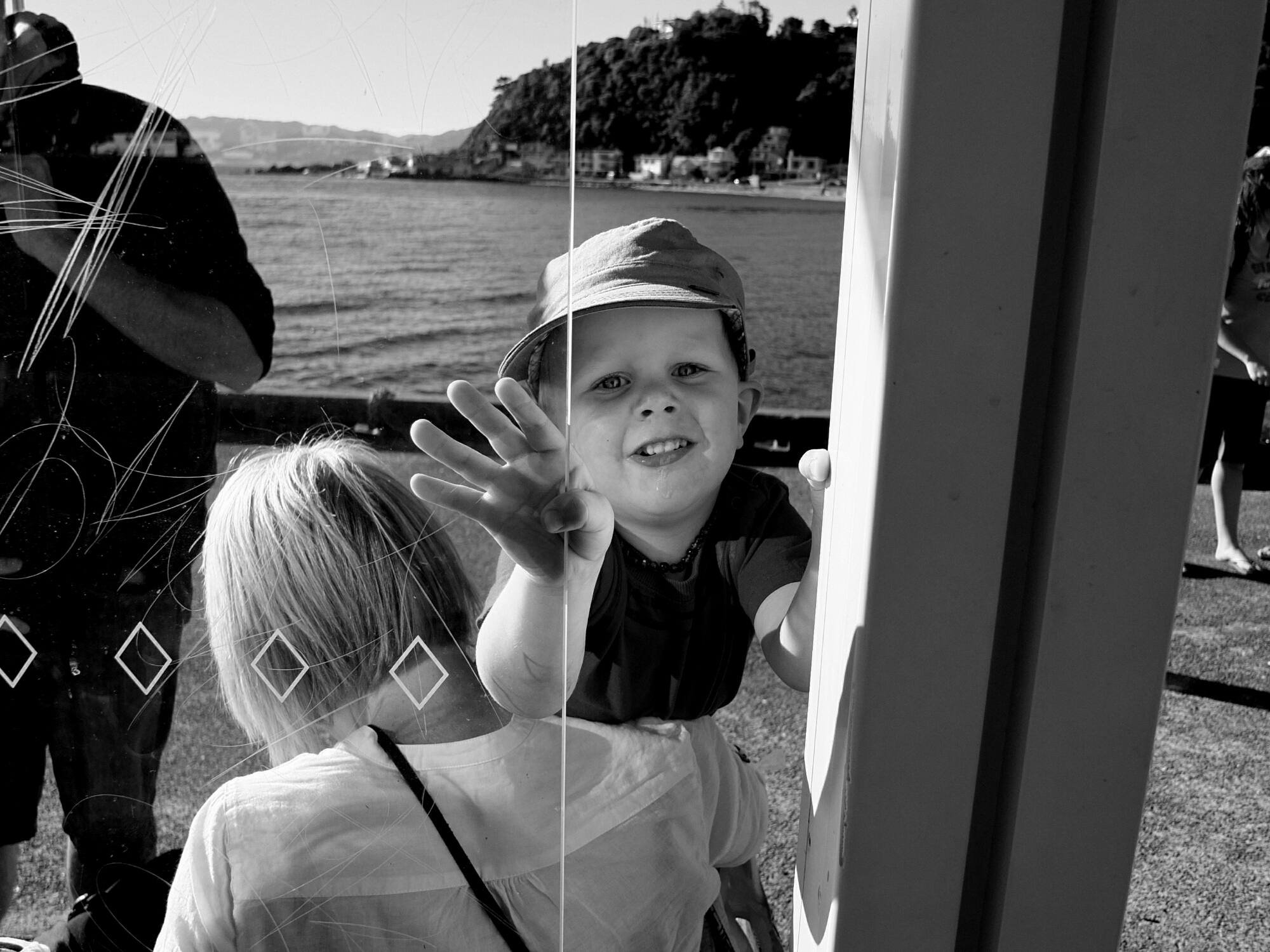
We made up by taking advantage of the gorgeous light to take photos of each other.

Her grandfather was a famous photographer and it’s clearly in her blood.

image

image

mxx1's avatar

Content vigilantes

In the context of a broader discussion I made an aside that I never buy books anymore because I just download them via pirate bay or Gutenberg.

Well, out came the content vigilantes…. stealing from authors etc etc.

I countered that one source of freebies was for books that are out of copyright and where the authors are long dead.

For the more current books I used the argument that in my book buying days I always purchased second hand books; a transaction that the authors never benefited from anyway.

Despite the fact this latter argument has a hole in it the size of a truck, this shut them up.

Thank God.

image

mxx1's avatar

Thrive

I was pondering couples and what makes two thrive as one or two.

Eventually I have boiled it down to three concepts.

One. Sexual attraction. No bonus points for picking this one. This is the most important upfront must-have and the least important after a while. And yet the fading of it can cause otherwise great relationships to falter

Two. Shared interests, values and life philosophies. Again it’s obvious but sometimes over-ridden by sexual desire. The subtle trick with this one is that the shared interests, values and life philosophies have to change in concert. Stagnation together is just as bad as the growing apart.

Three. No awkward silences; these are a symptom of a lack of contentedness at times when one just ‘is’. It’s hard to explain but sometimes it’s just nice to be with someone without the need to communicate verbally or the need to be doing something in particular. I have seen many couples that lack this. Fatal.

In my view these three points are the primary colours; the three that are fundamental and can’t be synthesised. No matter how hard one or two tries.

Oddly, relationships can be deficient in, say, the third of these for years before it becomes a critical issue. People manage this by being too busy to notice.

You really do need time enough for love.

image

mxx1's avatar

Trolls

The first time I ever read the word ‘trolls’ was courtesy of J.R.R. Tolkien.

The second time was with respect to lawyers, patent trolls, chasing operating companies that were infringing certain patent rights.

To this day I don’t get the connection.

Tolkien’s trolls were big lumbering dim witted bullies. Whereas patent trolls are small, nimble carnivores.

A better term for patent trolls would have been ‘patent pirates’.

Or better still ‘patent corsairs’ since they break no laws as such  corsairs were government-mandated pirates.

The use of the pejorative ‘trolls’ for non practising patent entities is pretty silly really. It just reflects a sense of injured entitlement by those who have for centuries profited nicely from the patent system without being called.

In the fact the big lumbering bullies in this story, the true trolls, are the large corporations that have for a long time being clubbing inventors, small competitors and anyone outside the first world. And also throwing rocks at each other in a zero sum game.

If you throw a rock in the pond then you can expect some ripples to come back. I just received a missive that the reference to trolls is from the old Scandinavian folk story, three billy goats gruff, which I managed to skip as a child.

This reference, if true, is even more retarded than the Tolkien reference. In the story the troll skips eating the smaller goats and then gets beaten up and killed by the largest goat, representing the biggest corporation. Firstly, patent trolls will nibble at all the goats and, secondly, if the big corporation can kill the troll then why all the angst about patent trolls then?

And who, in their right mind, would call themselves a fat goat?

Rats miss!

image

mxx1's avatar

Correct

As I was just about to land in Australia on a Singapore Airlines flight the Indian hostie came over the tannoy with a message about the Australian customs form.

He told us to fill the form out ‘truthfully’. That is just so Indian.

We would say ‘correctly’.

The truth is just assumed in Australia and it would be impolite to suggest otherwise.

Anyway we only lie by omission and not by fabrication. Therein lies the difference.

Which is to say we are the better liers.

image

mxx1's avatar

King Khan

Shah Rukh Khan, the world’s second most wealthiest actor, is a Muslim that married a Hindi woman, Gauri Chibber.

Their children are being brought up in both religions, Islam and Hinduism.

Most religions fear loss of market share and pronounce that they are the one and only true religion and that god decrees it so.

They typically go a step further and make it a sin to worship false gods and, by implication, also false religions.

Which makes me wonder how King Khan gets away with it. Probably because his market share is greater than both the religions in question.

image

mxx1's avatar

DSDS

I have often joked that Singapore taxi drivers have the worst peripheral vision of all taxi drivers.

Flagging one down, unless you are within a 10% deviance from the direction they are traveling then they are not going to see you.

Which, you might agree, could be a hindrance in the line of duty.

This morning my upmarket Mercedes cab ride to the airport seemed a little noisy (for an upmarket Mercedes).

Looking up I noticed that right in the middle of the speedometer was a picture of the car highlighting that the front passenger door was open.

Despite this indicator and the wind noise the cabbie appeared not to notice. He was happily doing 140 k’s on the motorway.

So it’s not just vision that is peripherally retarded but audio as well. Assuming the other senses are equally dulled I will call it Peripheral Senses Deprivation Syndrome (DSDS).

I can only assume that they have a lot on their mind. Or very little.

image

mxx1's avatar

Its

The Americans sometimes refer to their country in the feminine just like we often do for boats and ships.

Her bow not it’s prow.

I wonder if this has to do with the statue of liberty being the symbol of the country. Or maybe that God is the father and the state the mother. Or possibly it’s a habit borrowed from the French who give just about everything a sexually definitive status; no wonder they all need counseling.

Here in secular Australia the country is very much an ‘it’. As is the state and as are the states. Even our politicians are bordering on ‘its’.

It’s a mystery of its, it is.

image

mxx1's avatar

Luddites

Keynes said ” We are being afflicted with a new disease … namely, technological unemployment. This means unemployment due to our discovery of means of economizing the use of labour outrunning the pace at which we can find new uses for labour. But this is only a temporary phase of maladjustment”.

In America since the 1970s technology has displaced many jobs. Amazon employees less than one tenth of the people that were employees in the retail shops that it replaced.

Robots have taken people out if the factories; the ones that remain in the US that is. Globalization, enabled by technology, has meant a transfer of manufacturing to lower cost countries.

As a result real middle class wages have fallen as workers have accepted lower salaries and lessor conditions just to survive. This is supply and demand working as it inevitably does; at a low enough price there is usually a buyer at an auction looking for a bargain.

Consumer spending makes up 70% of the American economy and due to the fall in real middle class wages, which drives the bulk of consumer spending, the economy is going backwards in real terms.

The wealthy have continued to thrive because their investments are global. Hence the widening wealth gap in the US. Unfortunately the wealthy simply can’t spend enough within the US to kick the economy along.

Keynes was correct but the long period for readjustment in the context of global leveling means a lot of pain for a lot of people.

Especially if the basic cost of living is subject to an institutionalized high floor price. As it is in the west due to our heavily mandated socio-legal systems.

Paradoxically the expensive rules and regulations, designed to make our lives safer and risk free, and that also drive this high floor price are themselves part of the process of finding new uses for labour.

Eventually it may all equalize, maybe painfully, but there is one interesting horizon that might upset the plan. A systematic shortage of resources is going to take us out of Keynes’s implied steady state.

In this scenario labour may have a strong negative non-linear impact on the global economy. That is, the NPV of a person may be negative due to the price of survival being greater than the profits of labour despite the best efforts of technology.

Science fiction has played out scenario after scenario, describing what may happen. My guess is that we will be surprised.

One thing is for sure; this is a race between technology and resource depletion, or peace and chaos. We would be very well placed to accelerate our global investments in technology and technology education.

Just maybe, it’s possible that the current wealth disparity in the US is caused by or a result of the impact of diminishing finite resources. That is we may have already left the steady state of effectively infinite resources and nobody has got the connection because it has been expressed in an obscure manner. That’s a scary thought.

image

mxx1's avatar

Slavish

In Australia political control is divided up between an institutionalized duopoly, Labor and the Coalition, representing capital and labour.

Or servants and non-servants, if you get them drunk enough to admit it.

I find it odd that the labour movement was clever enough to wedge the political process but not clever enough to also control half the broadcast media.

That was a big mistake.

Whichever interest group eventually succeeds Labor 1.0 they would be well placed to grab half the broadcast media if they can.

On the internet people tend to gravitate to familiar content so it’s far less influential than it might seem.

Unless technology intervenes.

image

mxx1's avatar

Fear and loathing

According to Wiki Hunter S. Thompson’s suicide note reads:

“No More Games. No More Bombs. No More Walking. No More Fun. No More Swimming. 67. That is 17 years past 50. 17 more than I needed or wanted. Boring. I am always bitchy. No Fun — for anybody. 67. You are getting Greedy. Act your (old) age. Relax — This won’t hurt.”

Considering that “the true voice of Thompson is revealed to be that of American moralist … one who often makes himself ugly to expose the ugliness he sees around him” it’s no bloody wonder he topped himself.

He badly needed some cognitive dissonance on top of his satire. And some perspective, which didn’t arrive with the birth of his son.

To see the absurd as clearly as he did you would think this might allow him to shrug off any sense of injustice as an artefact of human subjectivity.

But no he was clearly lost in the mire of conspiracy theories and injustice, unconstrained by his love. The pain of those that cannot trust nor change the world as they see it.

Hunter’s son wrote a blog entry on his father which can be found at http://totallygonzo.proboards.com/thread/19/father-outlaw-juan-thompson

Even here one senses that the great journalist was adored not as a person but as a famous person. The price of living in a large winner-takes-all society.

Despite all this I would say that there is nothing better than the early satire of Hunter S. Thompson. It’s just a shame that it lead him straight down the drain hole.

DSC_0522

mxx1's avatar

Singapore

I am having a lazy weekend in Singapore with just a couple of meetings to occupy myself.

I have been chatting to the ex-pats here and they all seem to be enjoying a boozy party life. When pushed though they proffer an opinion that Singapore is ‘not real’ and only good for a few years of their collective lives.

That got me thinking about the place.

It’s easy to criticise Singapore for being artificial and controlled, especially when contrasted to the rest of its Asian neighbours. But I can’t help feeling great admiration for the founders of this place.

What they have done is create a corruption-free pocket in Asia where Western businesses can feel safe in their Asian adventures. Like anywhere there is institutionalised corruption but the rules as printed can be relied upon, and that is all business needs to properly able to assess financial investment.

With regards to social policies we in Australia can quibble about certain of Singapore’s policies but generally tolerance in Singapore is high by Asia standards. The place was tough for a long while but how else to pull the place out of fishing village status? Now they are governing a bunch of self-entitled Chinese and Malays; I am not sure what else they could do to be honest. These things take time.

With the economic centre shifting to Shanghai, Singapore is trying to reinvent itself yet again. It will keep its trading activities but is now looking for another role and the obvious one is the Asian gate keeper for intellectual property rights. Even this will be hard because of the national nature of IP rights.

Then there is high-tech industries such as medical devices. Taiwan is probably better suited.

But Singapore does represent a consumer market in it’s own right so that will continue to generate economic growth.

Even so, over the next 20 years Singapore is going to need to strategize and execute very well. And hope that China does inevitably resort to old-school behaviours that scare the be-jesus out of Western companies.

The one black spot on the ledger is the mistreatment and exploitation of foreign workers. But this is condoned by all and sundry because everyone, especially the ex-pats, wants servants. It will come back to haunt them no matter what arguments they use to justify it.

image

mxx1's avatar

Divinity please

There is a sadness in me this week.

It has to do with the separation from people that comes with the comprehension of life.

The more I get things in order in my heart and in my mind the more of a gap I feel to people that I don’t know. Even to some that I do know.

I believe that it’s uncertainties and insecurities that drives much of our behavior and that leads to connections with people.

More and more I am starting to feel like an observer.

There’s not much I can do about it unless I find a wormhole though to divinity.

image

mxx1's avatar

Cognitive dissonance

Hypocrisy
Asymmetrical hyperbolic outrage
Injustice
Entitlement
First world problem
Freedom
Nihilism
Chill
Pill

In matters of content, outrage just preaches to the converted.

The practice of satirical cognitive dissonance on the other hand has a small chance of shifting the thinking of the lazy fuckers.

image

mxx1's avatar

Arts wars

The narrator of the documentary “Photographing Intimacy” spoke with such authority that, at times, I almost found myself nodding in concert.

He was talking of photo art as if the artists’ intentions had no meaning. The assumption is that the art just exists and has its meaning in the eye of the observer and chop-chow to the artist.

And I can see that this approach has merit. But it is not universally agreed upon, as any attendee of an art opening could tell you.

Once in a while I get talked into going to an art opening, very much against my better judgement. Actually it probably takes two years for the horror of the previous event to be sufficiently erased from my memory for my resistance to be sub-thresholded.

At an art opening I always, without exception, find myself in a small circle of wine-wielding experts, together with the artist. Some local hero will be spouting on about where the art fits into the latest development of the post-construction figmentism movement. And everyone will be nodding sagely and even contributing an opinion or two.

Someone might segue into French or German, just to cover a wine-induced senior moment. The lead protagonist will start softly just to check there are no academics in the audience and once having validated this will launch into a full scale (de)construction.

There are essentially 100-200 key nouns, adjectives and verbs, not commonly used in everyday language, that must be strung together in a certain rhythmic sonance in order to achieve a tune that sounds convincing. This whole procedure is learned slowly over many years at the feet of other experts and devotees of the cargo cult.

But if there is an academic in the audience then your expert will tread very lightly. Your academic sees no irony in using 100% left brain processes to study the outcomes of a process that is 100% right brained. He or she has a working mental mud-map of Western philosophy and psychology wherein he or she can pigeon hole any work of art or any artist. Just occasionally they excitedly get to make a new pigeon hole.

The artist, poor bastard, just wants to sell his or her expensive raw materials (& improvements thereupon) for food and grog. The whole silly charade sometimes causes the artist to engage the vestiges of the left hand side of the brain in order to communicate some hastily fabricated intentions to the lead protagonist, any academics present and the audience.

This should end in tears but it often does not; quod erat demonstrandum.

Irony intended.

image

mxx1's avatar

Photographing intimacy

I have just watched a documentary called ‘Photographing Intimacy’.

Once again it enforces my observation that visual artists are only ever diminished by the addition of words.

Ahem. Unless the words come first.

image

mxx1's avatar

Integrity

The Bank of Singapore has an advert that says;

“… like you we believe success is built on the Asian values of integrity and hard work.”

My guess is that ‘integrity’ has been very poorly translated from the original Confucius concept of appearing powerful and without personal doubts while doing what the fuck you want.

image

mxx1's avatar

Planking

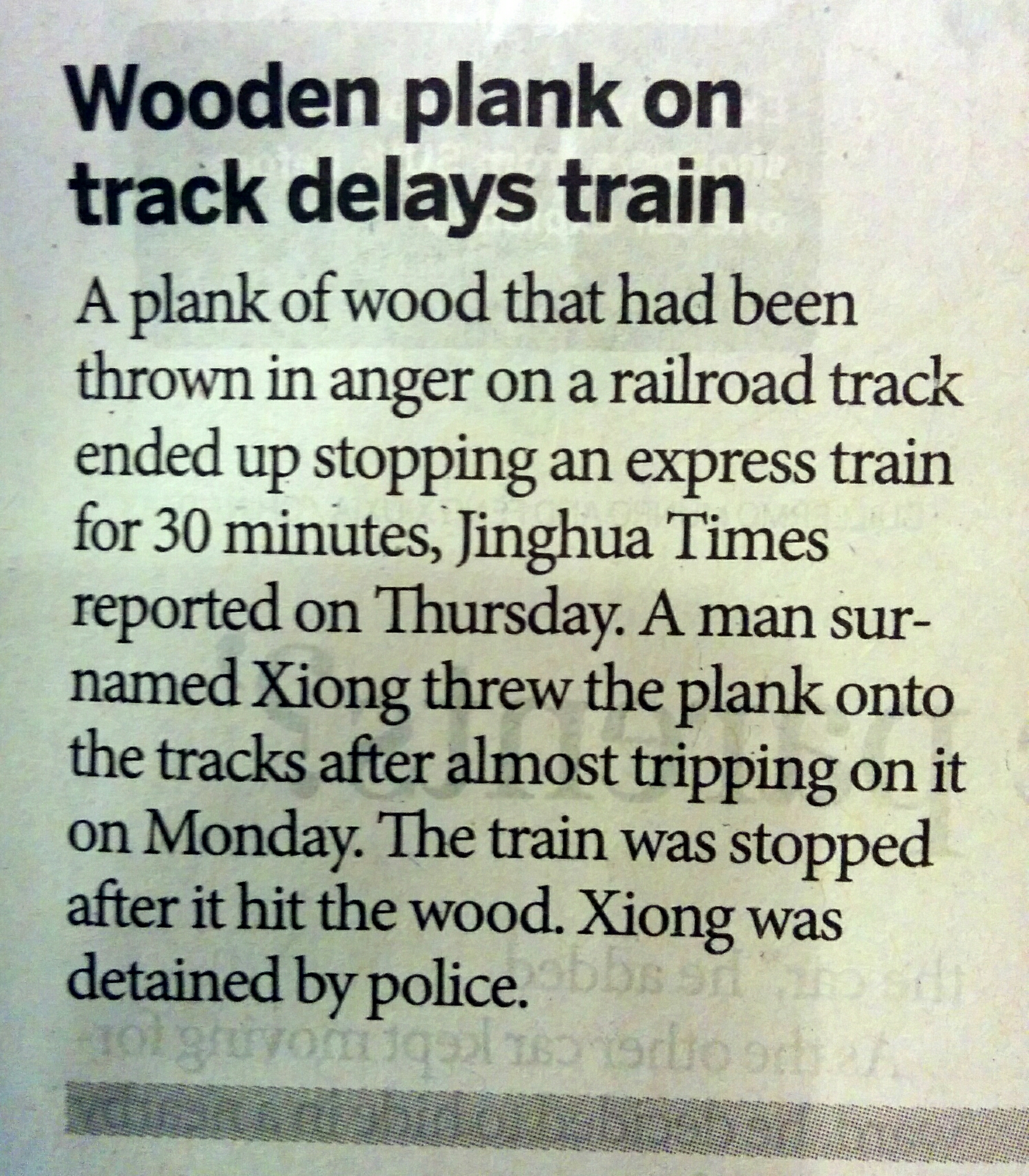
What do you reckon Xiong was so pissed off about that caused him to toss the plank onto the railway line?

And did he knows it was on the tracks? Was he purposefully trying to bring catastrophe into his life?

I might have to track down Xiong and ask him.

image

mxx1's avatar

Scatter brain

In China most urinals are the type that hang off the wall.

And it’s remarkable how Chinese men seem to miss the target. The floor all around is always totally wet.

For the girls in the audience; when you stand up to them you have to be trying pretty hard to miss.

Anyway I was just in one and the old bloke next to me was standing maybe one cm away from the urinal but missing it completely.

He must have been pissing at right angles.

The toilet attendant came up with his mop and shouted at the old guy, who looked down and realised what he was doing. And I think he apologised in Chinese.

In the past I am guessing they just haven’t learnt to be aware of where they are pissing. Things we take for granted.

Not for much longer. There appears to be a government initiative on this issue. They want to appear civilized in all ways Western.

Based on previous experiences with other government initiatives, within a couple of years they will all be anti scatter brained.

image

image

image

image

mxx1's avatar

Affluence and conformity

It’s an interesting debate, the one where you explain to your ten year old daughter that it’s in her best interests to be told what to do by her dad.

As opposed to her just doing what the hell she likes.

‘It makes no sense’ she says.

‘What, not to just eat sugar, watch tele, and sleep all day?’

I ask her if she would go to school if not forced to by her parents and the system.

She answers, ‘Of course not’.

‘There you see, if I let you do what you just wanted to then you would end up fat, lazy, uneducated and with no teeth. Later on you would struggle to get a job that pays well and then you wouldn’t have any money to do all the things you will want to do.’

I sense a slight hesitation in her surety.

And yet I hate resorting to arguments of conformity and affluence.

But it’s all she really cares about at this stage.

The whole point of an education is to learn that that conformity and affluence are false gods. But that takes a bloody good education, that does.

image

mxx1's avatar

Reality denial syndrome

Have you noticed that just about the only internet vendors that are trying to charge for access to their content are refugees from old school broadcast monopolies?

Newspapers, TV stations, magazines, book publishers, record companies – they are having adjusting to the new reality. They miss their mummies.

Maybe their fixed costs are too high. Maybe they don’t have the courage to live off their advertising and marketing revenues. Maybe they simply don’t have the intelligence to know that they have to change.

The reality is that there are too many choices and users prefer free content, even it is of lower quality. Or they will rip it for free anyway.

Peddlers of content simply don’t have a monopoly any more and they never will again. It’s gone.

So you can’t peddle content, you fuckwits!

You have to peddle advertising and marketing and use free content to generate eyeballs to drive your revenue.
Geez, it’s not that hard to figure out!

image

mxx1's avatar

Zero

It is truly a pity that life is so short and yet our imaginations are not so limited.

No wonder there is a belief in after-lives and multiple-lives.

My zeroth law of thermodynamics is that if you you can imagine it then it must be possible

image

mxx1's avatar

Empathy divided

Over the last couple of days the word ’empathy’ has been flying around my environment like a malaria-infested mosquito in the middle of a sleepless tropical night.

I believe that Empathy comes from the id, and it is felt. Sympathy, on the other, comes from the super-ego and is thought, more so than felt.

I also believe that empathy is the result of a number of factors; observation, processing of the observations, and caring. Because there are three steps there are plenty of opportunities for idiosyncratic empathy profiles within humans. For example, a person can be a great carer but a crap observer; this gets in the way of empathy.

But that is not the story I want to tell here.

I want to introduce the concepts of micro-empathy and macro-empathy.

I have noticed that some people have the capacity to be extremely empathetic but only in ’emergency’ situations. When a friend breaks up with their partner for example they can be superb in their empathetic support. I call this macro-empathy.

But the self-same people can be short on every-day empathy, which is what I call micro-empathy. An example is being aware that your noisy child is annoying the hell out of fellow cafe diner. Or that the long winded explanation on a banal subject isn’t helping get the message across; just the opposite. Or that your pen-friend really wants more than a one line response to her deeply thought-through missive.

I would also suspect that many people automatically and intuitively suppress their empathetic responses. Either because it suits them to, or they feel too thinly spread, or they just want to be selfish for a change.

All up, empathy is very complex and it’s no mystery that collectively we often seem short of the stuff just when we need it most. In response, the rules and laws in our society are constructed to reward empathetic behaviour.

But it is a case of two steps forward and one step backwards with humans and empathy.

image

mxx1's avatar

Vendetta

This is quite the story…

At the weekend (love the ‘at’ eh?) Lola accidentally sprayed water over the neighbour’s fence whilst helping me garden.

Now apparently someone on the other side received some of this spray.

This particular neighbour is just one of those people. All the other neighbours are nice people and good for a friendly yarn. Not this one…

Some time later the neighbour accosted Lola and belligerently told her certain things and wouldn’t listen to her explanation that it was an accident.

Now in the old days, before the 1980’s, I would have simply gone over and belted the crap out of him.

Then from the 1980’s onwards, fearful of police involvement, that would have transitioned into terse words at ten paces.

Through to the new millennia where we it is likely that we will exchange opinions with carefully crafted letters with an eye to future legal action.

Fuck me, I prefer the old days to be honest. I grew up in a pub in Pyrmont and there was only way to solve any dispute. But the good thing was, once dealt with, it was over. Done and dusted and forgotten about except for the old drunks retelling the stories over and over (and fucking over). And hardly anyone ever died.

But reflecting upon this, sure, I probably could belt the crap out of my neighbour. But then he might call some old mates to create a bit of havoc on my being. And then I might call some even nastier old mates, etc. Or I would up in gaol.

So I guess as unsatisfying as the current letter exchange may be, it’s better than living in a vendetta environment.

Which brings me to the subject of Federal politics.

Tony Abbot, whilst in opposition, ushered in the era of total opposition. He and his party opposed every Labor policy without exception. They lied and told stories to the voters on every single issue. With the help of a corrupt media they successfully used this approach to win the last election.

And now it looks like Labor, which was absolutely traumatised by the experience, will respond in kind. Granted, they don’t have the full support of the media, but that won’t stop them.

So it looks like our Federal parliament is simply a paddock for political vendettas from now on. And one where libel does not and cannot exist.

Gee this is going to end well isn’t it?

It’s ironic that the source of all the laws, the ones that force us to exchange letters instead of throwing bricks, is the one place in the country that is heading the other way, towards vendettas.

image

mxx1's avatar

Structured madness

Have you ever wondered why many consumer goods are heading to payment plans and away from payment at the point of consumption?

Well the explanation is very simple, finance 101 so to speak. But I just had a chat to a friend, who despite being very educated, had no idea.

So here goes…

Imagine a mobile phone user who uses $100 exactly a month on their phone bills (to make things easier).

On a two-year plan that would mean the phone company will receive $2400 over the two years, which is exactly what they write in the small print of their advertising (as they are forced to by regulation).

However if you are not on a plan and still use $100 per month of phone services, can you guess how much of your future revenues that they can be sure of?

The answer is $898.47.

That is, if their head accountant is sitting in her office looking at two customers with identical phone usage, but where one is on a two-year plan and the other is month-to-month, the accountant can forecast $2400 of revenues from one customer and only $898.47 from the other.

The calculation of the future revenues from the monthly customer is called a ‘net present value’ calculation and is subject to a ‘risk factor’.

For each industry and each business the risk factors can be easily calculated by comparing what actually happened in the past.

For example, if they had 100 customers paying monthly, over a two year period how much revenue did they actually get off them. Well its not $2400 per customer multiplied by 100 customers. Indeed it was much less because some customers changed phone companies, some went bankrupt, some went overseas etc which totalled to a ‘discount rate’ or a risk factor of 10%. In fact the actual revenue number they received was $898.47 multiplied by 100 customers.

Which begs two questions….

1. Why don’t pubs and clubs get their customers onto structured payment plans for their beers?

2. If there is a cartel-style monopoly like there is in Australia for phones, banks, supermarkets, building materials, etc etc – how can the risk factors be over 1%? That is, for any business in these cartels the risk of customer loss is almost fully offset by customer migrating away from their limited number of competitors. Oh that’s right our cartels have licences to print money… silly me. The wonder is why they even bother with payment plan structuring – they hardly need to.

image

mxx1's avatar

Three colours blue

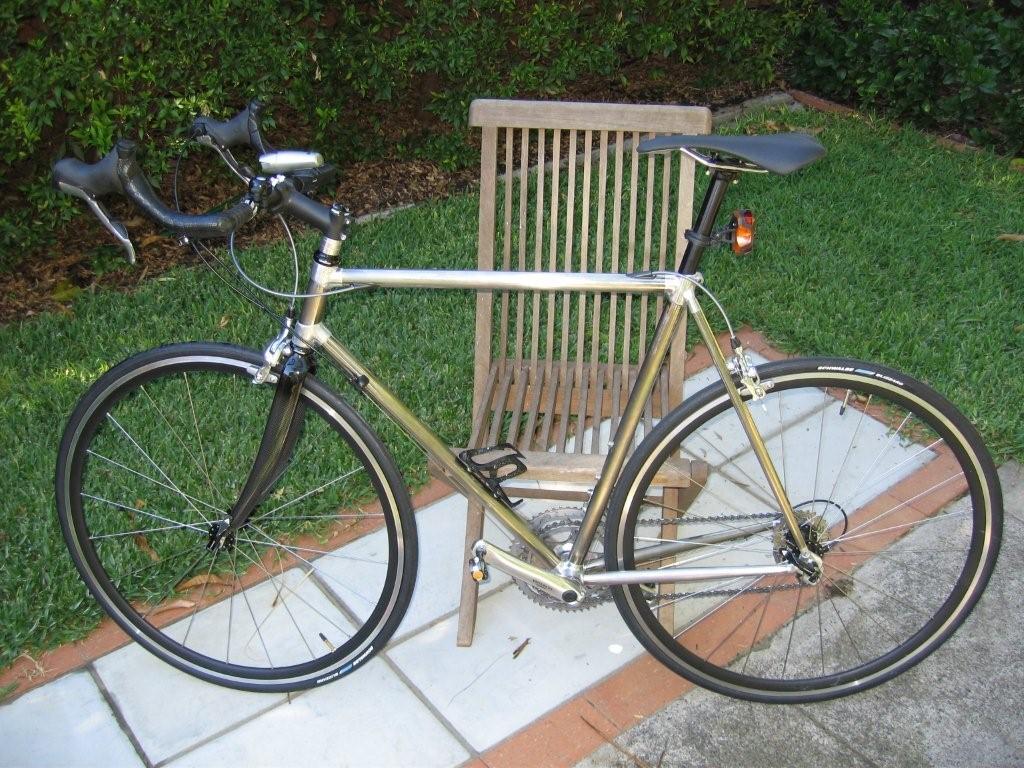
I have three bikes, one black, one red and one metal coloured.

More importantly the black one is carbon fibre, the red one is steel and metal coloured one is titanium.

I did have a black aluminium one as well but gave that to my niece. Compared to the other materials aluminium is a horrible material for a bike frame since it transmits so many vibrations and shocks to the rider. And I also have a shitty old steel pub bike but that is another story.

None of my bikes have any logos from manufacturers on them. My carbon frame which I bought in Taiwan for $200 is also sold to some brand name companies that flog it for $5,000. That is an expensive paint job!

If I had to pick one I would say that titanium is the best material for bike frames. It’s also the most expensive. It seems to smooth out all vibrations. And its lovely to look at. The carbon is the lightest and stiffest and I love it for that alone. The steel frame is the most honest and I do not have to fear it giving out on me at any time. It’s indestructible and cheap.

That’s a crap metaphor for life…I was going somewhere with story but have now forgotten. So I will post it as it is and update the entry if it comes to me.

US June 2007 006

Nick's pics 207

wpid-20130801_204935_20130801205046736

mxx1's avatar

Budget news

I have just read today’s tabloids – the Murdoch rag, and the Fairfax thing (it’s hard to say what it is these days), which has certainly slid a long way from quality journalism. But there is still a hint of pretence about it. I suppose we have to face the fact that quality journalism is likely to be a victim of the internet.

In any case the slide to unprofitably has meant that these tabloids are more amenable to the influence of interested parties. In the case of Murdoch it’s easy to see where the interests lie. For Fairfax it’s anyone’s guess whose vested interests they serve. They are all over the place and figuring it out is like trying to kill a moth with one hand, mid-air.

Today the subject of most interest in the Herald is the federal government budget.

The Daily Telegraph’s position is to ignore any impact of the budget; there is a small story on page 2 and the rest is on page 77 and 78. The editorial basically says that the opposition’s anti-budget stance is stupid. So we know where Murdoch stands – well we knew that already. He clearly wants more favours off the coalition.

The Herald, on the other hand, has pages and pages about the outrageous budget impact on poor people and some not-so-poor people. It also describes how the opposition parties in coalition are going to bring the government down etc etc. A slightly different position than the Daily Telegraph.

One laughable report was that of Joe Hockey trying to defend the $7 fee for visits to doctors, even for those that are bulk-billed. He claimed that it was the cost of a ‘middy’. You reckon someone in his office would have rung the Rooty Hill RSL and asked what a bogan pays for a beer eh? A schooner is about $5 and a middy is about $3.75.

There was a time once when I would have been quite interested in these issues. But in the main they are first world problems. The sense of entitlement in Australia is quite remarkable and even people struggling near the bottom of mainstream society often have the full suite of consumer goods.

Rather than just balancing the budget I would have been more interested in a story about investment in growth in the economy, and also the removal of unnecessary costs to living. The former speaks for itself but the latter does not.

In our lovely country there is a massive hidden cost to just existing. Conforming to thousands of regulations and laws includes a massive hidden cost. For example we have tax, traffic rules, business reporting, rules, safety rules, health rules, audit rules, and the list is endless. All of this adds to the cost of all goods and services. These added costs concatenate through supply chains making goods and services for consumers more and more expensive. Until we get the ridiculous situations that Australia now has the highest cost of living in the world despite that the fact that we have more resources per person than anyone other country on the planet.

The threshold wealth requirement for just being alive in Australia is quite remarkable. For those people nearer the bottom of the tree life could be made substantially easier if the cost of living was eased off. And this could be achieved very easily by removing the layers of rules and regulations that have been created by government.

But most Australians actually want all these rules. How do I know? Well whenever something bad happens to an individual (like their child gets hit at a pedestrian crossing, for example) they become passionate advocates for the introduction of new rules to prevent the thing ever happening again. Basically we are country of people that wants our government to solve all our problems. And we feel this is a moral as well as a legal right and obligation.

And that has lead to a situation where, for example, it is almost impossible to drop out of society. If you go mad and decide to live on the streets without any worldly possessions then you will immediately be in breach of a zillion rules and very likely you will end up in a series of micro-incarcerations and you will also be constantly harassed.

In our lovely country one doesn’t even have the unfettered choice to own nothing, earn nothing and to be left alone. That is, in Australia it is now an offence to be poor and happy.

And it’s this stress of existence, the minimal bar that is quite high, which leads to the existential angst over such a banal event as a federal government budget.

I can’t see things getting better. We have backed ourselves way into a cul-de-sac of moral and legal turpitude. And entropy is against us ever getting out of it.

image

mxx1's avatar

Deserves shoulds

My two least favourite words are ‘should’ and ‘deserve’.

And people would be much better placed if they worried about their obligations rather than their rights.

Pissing into the wind, I know.

image

mxx1's avatar

Napalm

My daughter just finished her year-5 NAPLAN tests.

These are some standard tests done by all students in the country and used by government to justify all their devious education policies. What you don’t measure you can’t control.

Her essay question was something like “if you had to break one rule or law which one would it be?”

Lola wrote an essay around breaking the rule that kids have to do the NAPLAN tests.

She hasn’t fallen far from the tree it seems.

image

mxx1's avatar

Over and out

I have been writing blogs and essays since 2011.

Initially it started as an interesting diversion, a hobby. And it still is.

At some point I started writing about the basket case that is the Australian startup tech industry. And since 2011 things have got much worse in this industry so my writing has had no influence whatsoever.

I have found that I am essentially the sole media critic of the industry despite the fact that I know many experienced people share my concerns. However they keep their opinions primarily to themselves.

This morning I had an interesting debate with a colleague. Despite my best attempts to explain certain structural flaws in the industry he couldn’t see my point.

And that crystallised in me the realisation of the futility of this Quixotic effort. The audience is by and large not only unreceptive, but in the main it is also incapable of following the arguments.

This could be because I am am a crap communicator or because of deep vested interests on their side, or even because they simply don’t have the education to follow my arguments.

Being generous, I have decided that the problem is in my communication. I have tried my best and it’s not good enough.

To wit I hereby give it up, this mug’s game. I have decided to spend my precious time on other things.

And I wish the Australian startup tech community the best in their endeavours. Please prove me wrong.

Over and out.

image

mxx1's avatar

Long tail and VC

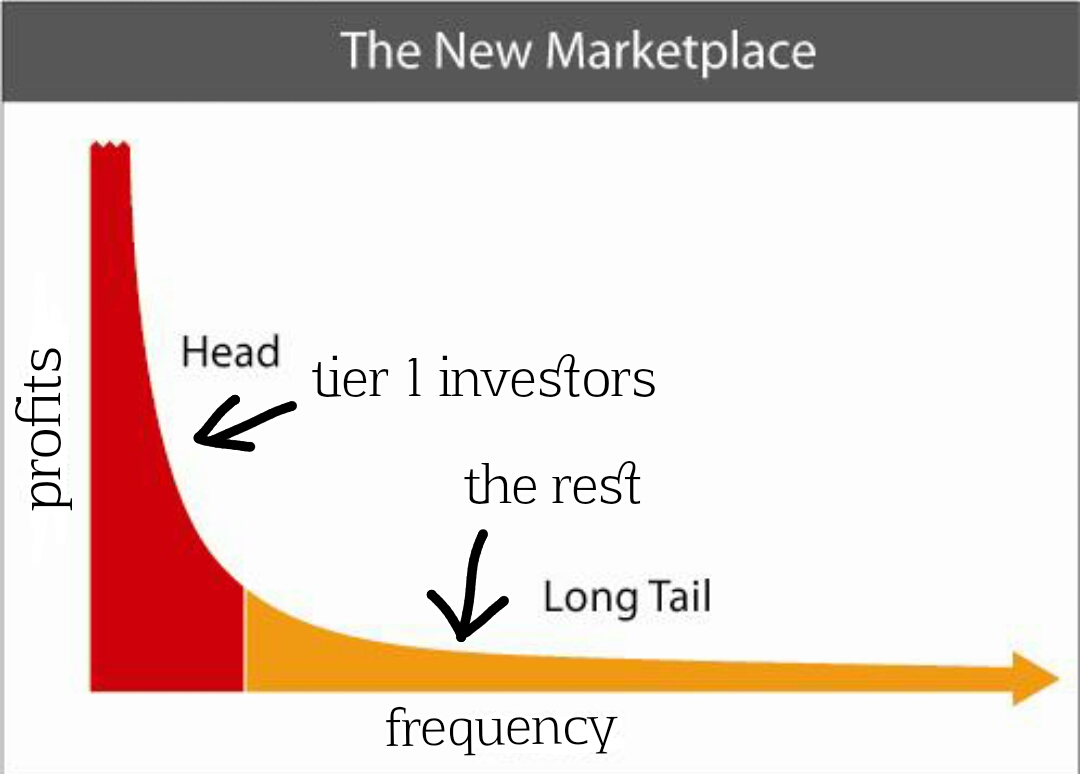
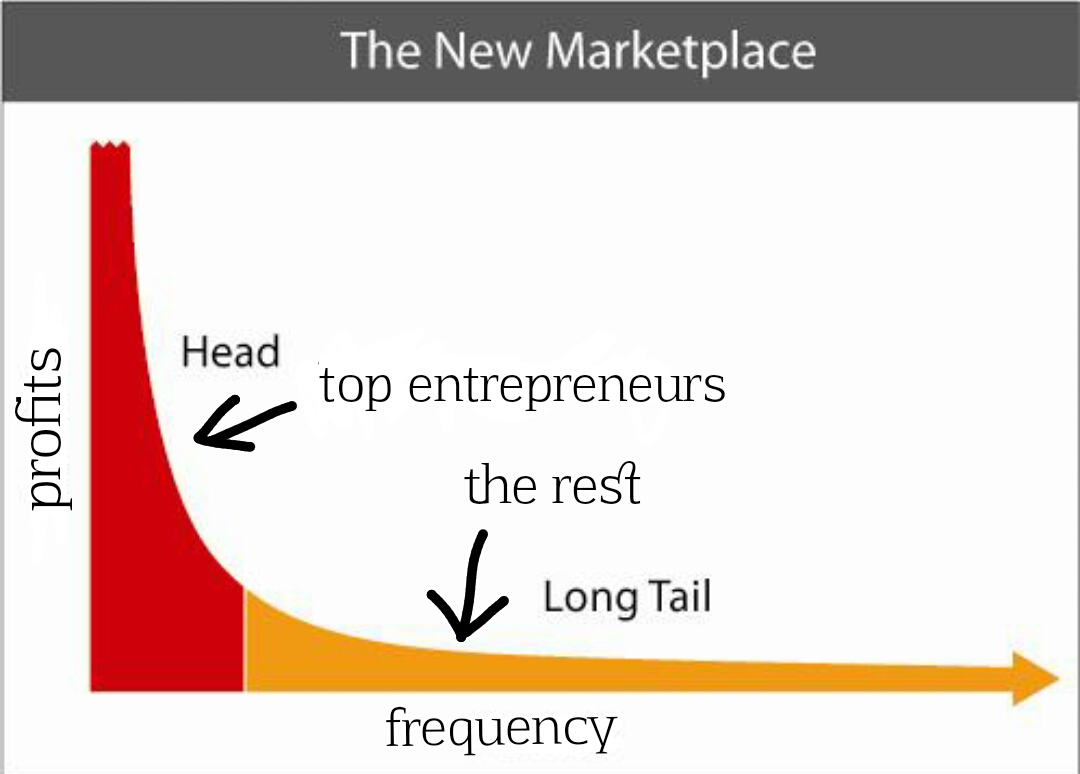
There is one very strong similarity between the venture capital game and online content.

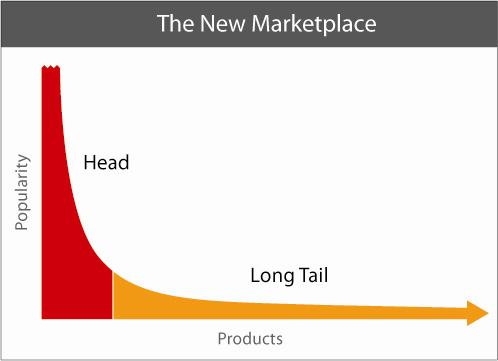
As industries they both conform to the ‘long tail’ principal whereby a few make money and the greater number lose money. See the plots below.

However venture capital has two such plots, one for investors and one for entrepreneurs.

One needs the intersection of successful investors and successful entrepreneurs for profits to be made.

If good investors intersect with entrepreneurs in the long tail then losses are assured.

If good entrepreneurs intersect with investors in the long tail then losses are assured.

If investors and entrepreneurs, both from their respective long tails, meet and do business then you can guess what always happens

Not surprisingly, these plots are self determining in that the good entrepreneurs will seek out the good investors and vice versa.

Both investor and entrepreneurs can only get into the ‘head’ of they are born with right stuff, are appropriately educated, and never get enmeshed with anyone in the long tail.

Those in the long tails can hope all they want but they mostly get what they deserve.

image

image

mxx1's avatar

Swiss Clock

Switzerland is tiny yet they manage to make excessive money by exporting bullshit.

For example they make 2.5% of the world’s watches as measured by the number of units, yet this is 54% of the market for watches when measured be revenue. Annually they export $23b worth of watches, half the value of all Australia’s manufacturing exports. And these are just nice looking pieces of 19th century mechanical technology – they have the whole world fooled. They make massive margins on these dinosaur watches.

Another example is coffee. Switzerland imports raw coffee beans (2.6% of the world’s total), processes it, and then exports it as Nescafe coffee pods. By doing this Switzerland’s roasted coffee exports were valued at 49% more than the next largest exporter—Italy—even though the Swiss export 67% less volume.

Do you see the similarity in these two cases? These seemingly impossible scenarios are held up by a combination of quality, brand value, supply chain complexity, marketing, a little technology and a relentless drive to maintain and improve their market position. Oh, and they keep their manufacturing in Switzerland rather than outsourcing it to Asia. They can do this by making sure their margins are massive and by also investing in automated manufacturing technology.

We in Australia would see the Swiss watch and coffee pod industries as exports of manufactured goods and primary products respectively. The Swiss see these industries as complex and intricate machines that only they can build and manage.

It’s all a matter of perspective.

p.s. The team bus logos (painted on the side of the buses) for the Swiss and Australian soccer teams at the 2014 World Cup are respectively; “End Station: 13.07.2014 Maracana! Final Stop: 07-13-14 Maracana!” and “Socceroos: Hopping Our Way Into History“. Says it all really, doesn’t it?

image

mxx1's avatar

The Australian start-up tech ‘industry’

A colleague of mine just wrote a gushing piece about the current batch of investors in Australian technology start-ups.

He is either deluded or maybe just spruiking the dead horse because it’s in his own best interests.

In truth, our tech investment community is so bad that it’s laughable.

Here are the problems in no particular order:

1. The funds are mostly undersized so we get the age-old problem of micro-investments by investors that end up choking their charges as they look to avoid excessive dilution in later rounds of funding.

2. Fund managers are deeply inexperienced. I can hardly think of a single person that has done the ten year apprenticeship as an associate or principal in a proper venture fund. In Silicon Valley this is a requirement before stepping into a GP role. You can’t learn this stuff in a text book and inexperienced fund managers almost by definition fuck it up, slowly.

3. You could throw a blanket over the amount of uncommitted capital in the system. My guess is that there’s only a couple of hundred million, or less, of genuinely uncommitted capital in the system. And that will be spread out over a thousand micro-investments.

4. Not one investor has any way of improving their deal flow. Australia’s tech dealflow is very bad which is reflected in a 30 year negative IRR on VC investment. Nothing has improved – it’s actually worse than ever right now. If you let the deals just spring out of the pavement like weeds in the manner that they always have then you are doomed. I for one would try something different like importing deals from Silicon Valley by offering great terms to them. Or something, anything, other than what has failed for 30 years.

5. I could go on, but what it the point?

Back to the gushing publicity that the tech sector receives. This is a business sector which is so sick that it’s almost dead. And yet about 99.9% of all media coverage is positive and upbeat. Like the publicity around an app yesterday that sets an alarm clock for your parking meter timing … really are people this fucking stupid that they think this shit is worth doing or talking about?

Why is the media coverage so upbeat? Well it’s delivered by or on behalf of vested interests seeking to extract money off fools. And the fools are either the government, ignorant investors, self-funded entrepreneurs (in the case of the incubators) and others. There is no vested interest in recognising the systematic problems. And there is virtually no educated altruism in the system either.

My view is that until there is a balanced and critical media coverage of this sector that things will not improve. As an example of what can happen one only needs to reflect on the sport of soccer which was until recently the basket case of Australian sport. The structural issues were written and talked about passionately in the media until eventually there was enough consensus for Lowy and the government to step in and invest in a genuine structural change and industry development. It looks like it’s going to work. See, we can do Chinese-style 5 year plans, but only in the business of sport.

In the meantime I would like to challenge the media outlets and the journalists covering the tech space to start practicing a bit of constructive criticism in the interests of the industry that they are serving.

At the moment the tech start-up sector in Australia is like the spoilt child that is always getting told that it is fantastic and never, ever, gets any discipline or constructive feedback. And we know how likely it is that these spoilt and deluded kids end up doing anything constructive, don’t we?

image

mxx1's avatar

National debt

With debt you need to consider…

1. Not all government debt is bad. Sometimes it’s for investment into infrastructure or education or somesuch which generates profits above and beyond the cost of borrowing the money. This is good government debt

2. Bad government debt is stuff that is borrowed for spending on bribing voters and is not spent on anything that generates income to repay the debt. Social equity spending really should be funded out of recurring tax revenues so that it stays within our capacity to maintain it.

3. The total (all) government debt in Australia is about $650b. I reckon less than one third of this is ‘productive’ in that it pays itself back by generating wealth.

4. Business debt is $744b. Possibly over 90% of this wealth generating.

5. Household debt is $1500b. Housing debt is $1350b. and there are a few other categories. All up private debt comes to $2230b, dwarfing government debt. Most of this is not wealth generating but much less of it is foreign debt than government debt.

6. Savings via Superannuation are $1600B

7. I am not sure how much the banks have on their books. But all up the country balances, in a balance sheet fashion. By definition.

8. The govt needs to keep borrowing for a number of reasons. First, the cycle of bribing voters at elections. Second, the need to set a bond rate which then also sets the interest rates and is their sole micro-lever on the economy these days. Third, the ability to invest ahead of tax receipts in big wealth generating projects. It also allows them to respond to economic depression by investing in projects that stimulate private spending.

9. Our govt can’t devalue the A$ by ‘printing’ (actually created in the RBA and lent to the 4 banks) money because this would devalue our currency and our foreign repayments would go up, offsetting any economic benefits by having a more valuable export industry and lower demand for imports. The only way to solve this is to borrow locally from the super funds exclusively. They have the capacity to do this but the low returns to the superfund holders would be a political issue.

10. If our foreign borrowings (of all types) collectively get too large because the income from the borrowing do not repay the loans entirely (primarily because we are borrowing for lifestyle upgrades) then we run out the capacity to fully repay them> in which case we sell assets (like farms, houses, office blocks, national business etc). Which is what we have been doing for 20 years. Eventually we run out of assets and we then learn to readjust our lifestyle expectations or else face a horrible correction when our economy hits the wall.

image

mxx1's avatar

Spoilt

I was recently introduced to a young technology entrepreneur here in Australia. I meet people like this almost daily.

She is working very hard on a new internet business that makes no sense from a technology or market view. However she has character and determination and could, in the right environment, have a shot at becoming a successful tech entrepreneur.

But here in Australia she doesn’t get the feedback she needs to make that transition. In fact she has micro-investors that like her business as it is and tell her so. Her board is a bunch of people that have never been serious investors or entrepreneurs.

She plans on doggedly sticking to the path dreamt up from ignorance some time back. She is guaranteed to succeed in building a very small business. Or not.

In Silicon Valley if, as a young entrepreneur. you have the right character investors don’t put money into your company when you first approach them. But they will introduce you to experienced mentors that will slowly (and hopefully) educate you, help you find a big problem to work on, and then get you surrounded by the right technical and marketing people, After a while you will return to the same investors and get serious funding.

What investors love is the right human capital – the rare ones that have the energy, intelligence, and the drive to succeed at founding and running start-ups. So the rest of the experienced community (that have been there, done that, but the energy is gone) have set themselves up to work through these young people. So long as they listen, and know who to listen to.

The difference between Silicon Valley and anywhere else is that Silicon Valley has a large pool of deeply experienced investors and entrepreneurs that can mentor young entrepreneurial talent. And when that talent is sufficiently educated the VC’s will invest heavily in it.

Here in Australia the odd young entrepreneur that has talent, drive and ambition and that doesn’t go to Silicon Valley gets spoiled by inexperienced investors and mentors. It’s very sad to watch.

image

mxx1's avatar

Budget

When did the federal  budget become a spectator sport? Why the interest?

I am a student of economics and I am genuinely interested. But I wait until the next day to read the details. There’s no point watching the thing unfold.

The interest in Australia is pretty much based on ‘what’s in it for me?’ How much do I get taxed? What handouts do I get? Do I keep my pointless government funded job?

And also the fact that many mug punters are totally compelled by the tabloid media, right down to their interests and daily activities.

One thing I can assure you is that this government will cut the budget hard so they can ‘save’ some money for the next election. Basically they will splash cash to the fools in 3 years; the same cash they just took off them.

The debt will be cut because it has to be otherwise too much of our tax income goes to interest payments and then they don’t have any cash to bribe voters.

What we really need is investment in infrastructure and education, the selective removal of impediments to new business, serious anti-trust, devaluation of the currency via the printing presses, and more more local borrowings (by government from super).

And an Asian style five year plan to build a new industry would be great.

Fat chance.

image

mxx1's avatar

Human beauty explained

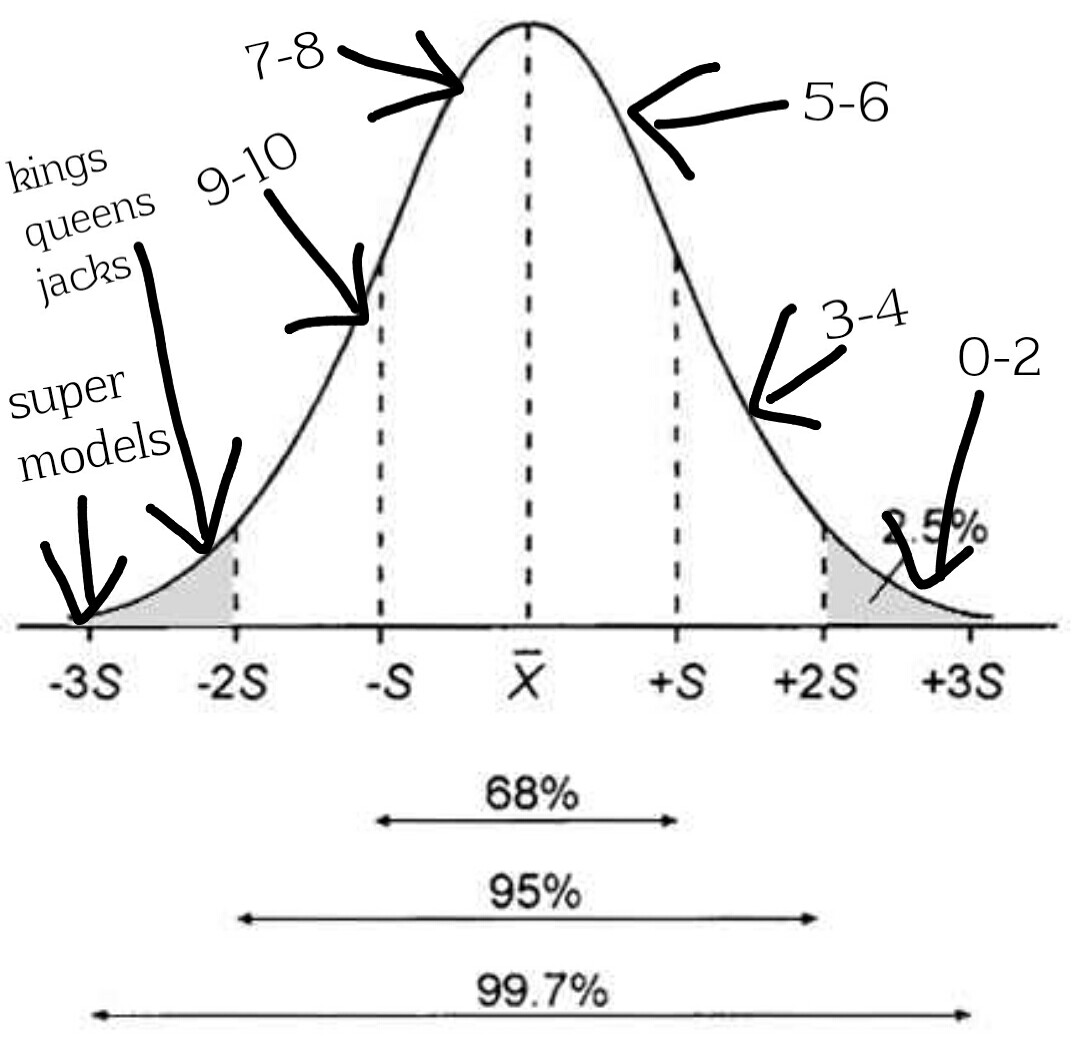
The stats according to a friend of mine.

Just think, an ugly person can be six standard deviations uglier than a super model.

And I reckon that 68% of couples are within one standard deviation of each other. As are their children.

image

mxx1's avatar

Content for sale

In marketing, and especially internet marketing, the concept of the ‘long tail’ is very well known.

Basically, a small fraction of popular products and services dominate the market (‘the head’) and a largish fraction of products and services (‘the long tail’) get very little revenue.

Selling things on the internet is essentially one big pyramid scheme, where a small number of lucky content providers make money and large number of content providers (authors, musicians, etc) lose money. All the profits are in the head and all the losses are in the tail.

The larger number of content providers in the ‘long tail’ lose money because they actually pay all sorts of service providers (website builders, hosting services, professional formatters etc) to get their content on the web in an appropriate format, and their revenues are less than their costs.

The small number of lucky content providers rely on a bit of virality to get initial momentum and then they get picked up by promoters who take a profit share but also invest heavily in marketing these guys’ products.

The whole thing is a pyramid scheme because the promoters that underwrite the investment in the winners also profit from the large number of losers. The promoters are the ‘big assholes in the middle’ like iTunes, Amazon and the like.

Trying to make money from content is a gamble not an investment.

Untitled

mxx1's avatar

Mystery of the prophets

I listen to a lot of people that ‘take the road less traveled’ or that are ‘unraveling the mysteries of life’ .

I have a suspicion that if you solve one mystery then you just replace it with another.

And for those that care this keeps happening until you are left with a set mysteries that you can live with.

Only a very few people complete this process and we call them prophets.

However only the true prophet understands that they end with just as many mysteries as when they started.

image

mxx1's avatar

Not anonymous

Nature’s way of getting people to reproduce as widely as possible is to make them complex and fucked up. And then nature uses that to drive the random sex urges.

Everyone that goes to therapy thinks that they have an entitlement to be free of emotional issues. They do not. It is part of being human.

image

mxx1's avatar

Sex is power

Oscar Wilde said “Everything in the world is about sex except sex. Sex is about power.”

This is what I think

1. The desire for power is driven by human emotional issues, and
2. Almost 99% of these emotional issues also lead to exaggerated sexual behaviour,
3. Which is nature’s way of getting us to reproduce as widely as possible
4. So where you see the power-hungry behaviour you can assume there is also a correlated sexual-hungry behaviour

But

1. Many people with emotional issues are not power-hungry, and
2. They still may have the correlated sexual-hungry behaviour

So

1. Power-hungry behaviour is correlated to sexual-hungry behaviour, but sexual-hungry behaviour is not always correlated to power-hungry behaviour

And

1. There are some people with no real power and no chance of getting it
2. But yet they may have many emotional issues
3. So the only real option for them is to use sex as a tool for power

I think this all got muddled up in people’s mind and Oscar Wilde merged all the options into one catchy, but flawed, line and it stuck for good.

image

mxx1's avatar

Abandonment

Have a read of this story – http://awareofawareness.com/2014/04/25/the-beauty-of-abandonment/

The girl had no choice but to deal with her father’s abandonment.

She has to go through all the stages of grief.

Otherwise she would go mad and some do.

Nevertheless she is scarred for life.

He on the other hand can’t reconcile with her because of his guilt. It always gets in the way.

Unfortunately she wants him in a way that doesn’t allow him to bypass his guilt.

I suspect that, without her father around, she fell right under the tree of her mother. Which is what he sees in her.

And her mother reflected the sins of his parents, which is why he was attracted to her in the first place.

And so it goes on.

We humans live in this merry-go-round of emotional trauma, struggling to inch ourselves out of the slime that we inherit.

And this effort is hampered by our inability to see ourselves clearly no matter how clearly we can see others.

Caravan park anyone?

image

mxx1's avatar

Quotation

“Genius retires to caravan park”

Google didn’t say it’s never happened. But it does say it has no record of it ever happening.

Same, same.

If a genius retires to a caravan park and Google doesn’t have any record of it, then it didn’t happen.

And that is a point that isn’t worth making.

The only act that can’t make a difference is the one that is sequestered away from the polluting influence of binary omniscience.

image

mxx1's avatar

Power lines

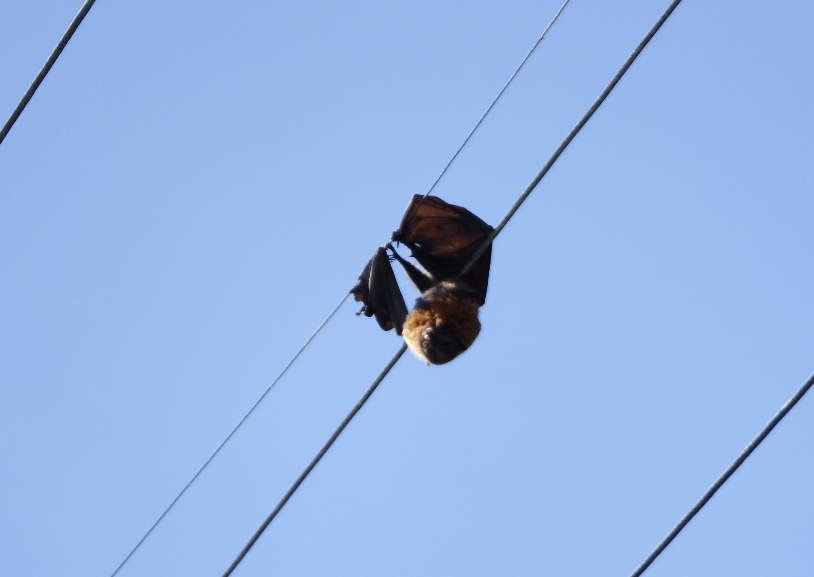
Have you ever noticed that the only two items ever immobilised on our overhead power lines are shoes and bats.

The shoes I understand; gee that’s funny eh?

But the bats – I guess they get electrocuted. But why not other birds?

Well only bats have the wingspan and the inclination to reach out with their wings and touch adjacent power lines.

It took me forty years to figure that out.

image

mxx1's avatar

Chemistry

Chemistry is getting right down into the minutiae…which is OK I guess since it’s all about molecules.

But the pioneering days are long over. It’s all about discovering or inventing complex systems these days.

Hardly the stuff to rivet the masses with the genius of the scientist!

By way of example I have listed the last 10 and the first 10 Nobel Prizes in Chemistry below.

As a trained research chemist I can’t get excited about any of the last ten prizes.

They are, all of them, just another branch of research chosen above all the other thousands, to be important.

God knows on what basis. Given time, most of this will be forgotten and just absorbed into the body of knowledge.

I wonder if the Nobel Prize people should stop prizes in Chemistry and look into some field that is far more pioneering.

If they don’t the whole thing might become redundant.

Here is the last ten Nobel Prizes in Chemistry:

The Nobel Prize in Chemistry 2013
Martin Karplus, Michael Levitt and Arieh Warshel
“for the development of multiscale models for complex chemical systems”

The Nobel Prize in Chemistry 2012
Robert J. Lefkowitz and Brian K. Kobilka
“for studies of G-protein-coupled receptors”

The Nobel Prize in Chemistry 2011
Dan Shechtman
“for the discovery of quasicrystals”

The Nobel Prize in Chemistry 2010
Richard F. Heck, Ei-ichi Negishi and Akira Suzuki
“for palladium-catalyzed cross couplings in organic synthesis”

The Nobel Prize in Chemistry 2009
Venkatraman Ramakrishnan, Thomas A. Steitz and Ada E. Yonath
“for studies of the structure and function of the ribosome”

The Nobel Prize in Chemistry 2008
Osamu Shimomura, Martin Chalfie and Roger Y. Tsien
“for the discovery and development of the green fluorescent protein, GFP”

The Nobel Prize in Chemistry 2007
Gerhard Ertl
“for his studies of chemical processes on solid surfaces”

The Nobel Prize in Chemistry 2006
Roger D. Kornberg
“for his studies of the molecular basis of eukaryotic transcription”

The Nobel Prize in Chemistry 2005
Yves Chauvin, Robert H. Grubbs and Richard R. Schrock
“for the development of the metathesis method in organic synthesis”

The Nobel Prize in Chemistry 2004
Aaron Ciechanover, Avram Hershko and Irwin Rose
“for the discovery of ubiquitin-mediated protein degradation”

The Nobel Prize in Chemistry 2003
“for discoveries concerning channels in cell membranes”

Peter Agre
“for the discovery of water channels”

Roderick MacKinnon
“for structural and mechanistic studies of ion channels”

Here is the first ten Nobel prizes in Chemistry:

The Nobel Prize in Chemistry 1911
Marie Curie, née Sklodowska
“in recognition of her services to the advancement of chemistry by the discovery of the elements radium and polonium, by the isolation of radium and the study of the nature and compounds of this remarkable element”

The Nobel Prize in Chemistry 1910
Otto Wallach
“in recognition of his services to organic chemistry and the chemical industry by his pioneer work in the field of alicyclic compounds”

The Nobel Prize in Chemistry 1909
Wilhelm Ostwald
“in recognition of his work on catalysis and for his investigations into the fundamental principles governing chemical equilibria and rates of reaction”

The Nobel Prize in Chemistry 1908
Ernest Rutherford
“for his investigations into the disintegration of the elements, and the chemistry of radioactive substances”

The Nobel Prize in Chemistry 1907
Eduard Buchner
“for his biochemical researches and his discovery of cell-free fermentation”

The Nobel Prize in Chemistry 1906
Henri Moissan
“in recognition of the great services rendered by him in his investigation and isolation of the element fluorine, and for the adoption in the service of science of the electric furnace called after him”

The Nobel Prize in Chemistry 1905
Johann Friedrich Wilhelm Adolf von Baeyer
“in recognition of his services in the advancement of organic chemistry and the chemical industry, through his work on organic dyes and hydroaromatic compounds”

The Nobel Prize in Chemistry 1904
Sir William Ramsay
“in recognition of his services in the discovery of the inert gaseous elements in air, and his determination of their place in the periodic system”

The Nobel Prize in Chemistry 1903
Svante August Arrhenius
“in recognition of the extraordinary services he has rendered to the advancement of chemistry by his electrolytic theory of dissociation”

The Nobel Prize in Chemistry 1902
Hermann Emil Fischer
“in recognition of the extraordinary services he has rendered by his work on sugar and purine syntheses”

The Nobel Prize in Chemistry 1901
Jacobus Henricus van ‘t Hoff
“in recognition of the extraordinary services he has rendered by the discovery of the laws of chemical dynamics and osmotic pressure in solutions”
image

mxx1's avatar

Ingenuity too

All inventions are innovative but not all innovations are inventive.

The difference is subject to the prior art, your legal budget, the latest version of the patent legislation and the mood of the judge.

image

mxx1's avatar

Ingenuity

I was asked this morning about the role of ingenuity in patenting.

I suggested that ingenuity, for me, is more about how to get around problems rather than inventing new solutions.

Australians are very ingenious.

image

mxx1's avatar

Hedge

A hedge is a fence or boundary formed by closely growing bushes or shrubs.

But we know it better as a way of protecting oneself against financial loss or other adverse circumstances.

I suppose a bet on either side of the fence became a ‘hedge’ because the verb ‘fence’ had already been stolen.

But it would have been quite appropriate to use ‘fence funds’ given the behaviour of a few of the hedge fund managers that I know.

image

mxx1's avatar

Fear and loathing

This is a great site – https://en.greatfire.org/

It’s a list of all the dates when a website is blocked by the great firewall of China.

You just type in the website of interest and the list pops up.

For example Google Drive has been blocked 100% of the time for the last 90 days.

The motivation for the Chinese government is three-fold:

1. To ensure their citizens don’t have unfettered access to certain information that may threaten the government’s position
2. To give Chinese web companies a chance against the foreign (American) raiders
3. To keep on top of the firewall technology so they can shut the whole thing down if they ever need to, in an emergency

India oughta join up with China and create a market as big as the rest of the world behind that firewall.

You can imagine a future where the Earth is divided into two warring IT communities. One side that opens the boiled egg from the big end and one that opens the egg from the little end.

2012-04-02%252008.30.05

mxx1's avatar

Just saying

Here is a list of recent and successful Australian tech companies that have bootstrapped themselves and then gone straight to the US for VC or PE funding:

Campaign Monitor
RetailMeNot
BigCommerce
Atlasssian
99Designs
Freelancer

As far as I know none of these had local interactions with any incubators, accelerators, IIF funds or other Australian VC.

The last three big successes which had Australian VC funding were:

Looksmart in 1995
Seek in 1997
Hitwise in 1997

Regression to the mean anyone?

DSCF3435%2520copy

mxx1's avatar

Body and soul

You can’t say that cycling in Sydney is ever dull.

This morning I almost got wiped out by two nuns in a Toyota Corolla.

Which begs the question; would you rather be nailed by two nuns in a Corolla or two paramedics in an Ambulance?

I reckon 99.9% of all Australian would say the ambulance because they believe in the body but have doubts about the soul.

Truly religious we ain’t.

DSC_0028

mxx1's avatar

Double mac

I have just swapped coffee makers.

My old system was a Rancilio Silvia with accompanying Rocky grinder. It’s retails for $1400 and derives from Italy.

It’s made from components that go into commercial machines that are surrounded by poor design and manual buttons and valves.

Using it was like using a 1960s Ferrari. Great when it worked. But much of the time it just leaked oil onto the garage floor.

Enter the Breville. Australian designed and made somewhere in Asia this machine is a combined coffee machine and grinder.

It’s fascinatingly easy to use, makes a consistent coffee, and doesn’t seem to have any maintenance issues. Using the automotive comparison it’s an upmarket Toyota.

The difference between the machines becomes very apparent at a dinner party when, on coffee duty, I only disappear for five minutes now compared to half an hour of swearing.

The only negative is brand perception. Which I don’t care about.

image

image

mxx1's avatar

Australian Football Exchange

It’s easy to think of Australian business pretty much the same way that we think about footballs. Yes balls, plural.

Australia is unique in that we have four major codes of football and a gaggle of minor codes that we never hear about; gridiron, gaelic football, and a bunch even more obscure codes that you can see on wiki.

Most countries only have one code of major interest.

Oddly, Australian men are quite conversant with all four of our major codes, or generally at least three of the four. They might have one which is their pet project but generally speaking they will pay attention to what is going in in all four codes.

Back to the ASX Top 20. Here is a list of the types of companies that make up the ASX Top 20.

Finance, Insurance and Banks made up 8 of the ASX 20.

Resources make up 6 of the ASX 20.

Mixed Industrials and telcos make up 3 of the ASX 20.

Shops & Malls make up 3 of the ASX 20

In football terms we have:

Finance, Insurance and Banks is the biggie and in football terms this is the AFL.

Resources correlates to Rugby League; is the second largest code and from time to time seems to get near ascendency, always to slip back somehow.

Mixed Industrials is Soccer. It’s made up of anyone and anything and always seemingly chucking a phoenix rising. It has no chance in the global scheme of things because our market is too small for local teams to ever have enough scale to compete internationally.

Shops and Malls is Rugby Union. A smaller code that loves cartel-like behaviour and is always at threat from foreign equivalents and other codes with more money.

The Australian tech sector is represented by our local American Football code. Never heard of it? Well it exists – Wiki tells me that Gridiron was first played in Australia as a league in 1983. There are 2,500 registered players and 73 clubs. That seems just about right for our tech sector.

image

mxx1's avatar

Copyright

I have been contemplating copyright for some time.

It seems to me that the original copyright laws were enacted in such a way because the policing of the medium (say books) was entirely possible. The medium was the content, but no more.

Enter the Internet and all the assumptions behind policing and control have gone to pot.

The ‘business model’ for the internet is primarily advertising – and the related data analytics model which is also for marketing purposes.

The idea of charging for content is being pursued by many groups on the internet but I think it will struggle because people will naturally gravitate to free content even if it is of lower quality.

That is, on the internet the purpose of content is to attract eyeballs in order to drives sales and marketing opportunities for products and services.

And hence I think that copyright as a concept should be restructured around this emerging reality.

What does this mean in reality? Well, the guys that are profiting from sales and marketing should share some of their profits with ALL content providers, be they books, movies, blogs, tweets, whatever.

This would work in much the same way as the recording industry has forever charged for the public use of music.

A cafe, for example, is charged a small fee for the use of music and that money is then distributed to musicians or the owners of the recording on some basis of fairness (based on frequency of playing). Note that the cafe makes it’s money by selling food and beverages and not by selling music. The music is just part of the many ways in which a cafe attracts customers.

In a similar way content is just one of the ways by which online advertisers and marketers attract eyeballs.

I can see a national or even global content distribution model where a fraction of the money made through the internet by advertisers and marketers is distributed to content owners on a basis that is related to the ‘eyeball traction’ of each and every unit of content. On the Internet this is quite easy to measure.

image

mxx1's avatar

Economic sound bites

Sometimes it’s just so tempting to bite the hand that feeds. Actually all of the time.

What I have learnt though is that such unexpected behaviour that can be clearly rationalised (and is) usually pays off in the economic world that I live in.

I explain this by a combination of the ‘4 Unit maths’ and the ‘regression to the mean’ hypotheses.

The 4 Unit maths hypothesis was formulated while I was at school. We had a choice of remedial maths, easy 2 Unit maths, harder 3 Unit maths and the universally feared 4 Unit maths. Only a handful of brave souls took the latter. Including me.

All results in all subjects were scaled to a bell curve and then added up to give a score out of 500. I had noticed that the hidden scaling factors favoured the harder subjects and that even a crap score in 4 Unit maths resulted in a good scaled score.

As an aside, this conclusion took quite a bit of research, probably more effort than I put into the subject itself. And ironically this effort required skills consistent with the harder maths Unit.

Basically the lesson in life is, always do the hard things because there is less competition.

The regression to the mean is a simple concept. The longer you do something the more you will regress to a mean. Economically speaking this means that one should always tackle the hard problems with little competition.

Which is why biting the hand that feeds in a rationalised way actually pays off.

And it helps if you don’t give a stuff anyway.

image

mxx1's avatar

Pyrmont Bridge

Whilst on the subject of cycling I started commuting around this town over ten years ago.

Back then it was just me and the couriers and no bike lanes. Following the couriers’ lead I learnt to take no notice of any road rules. I even went in a couple of their cannonball runs…. another long story that.

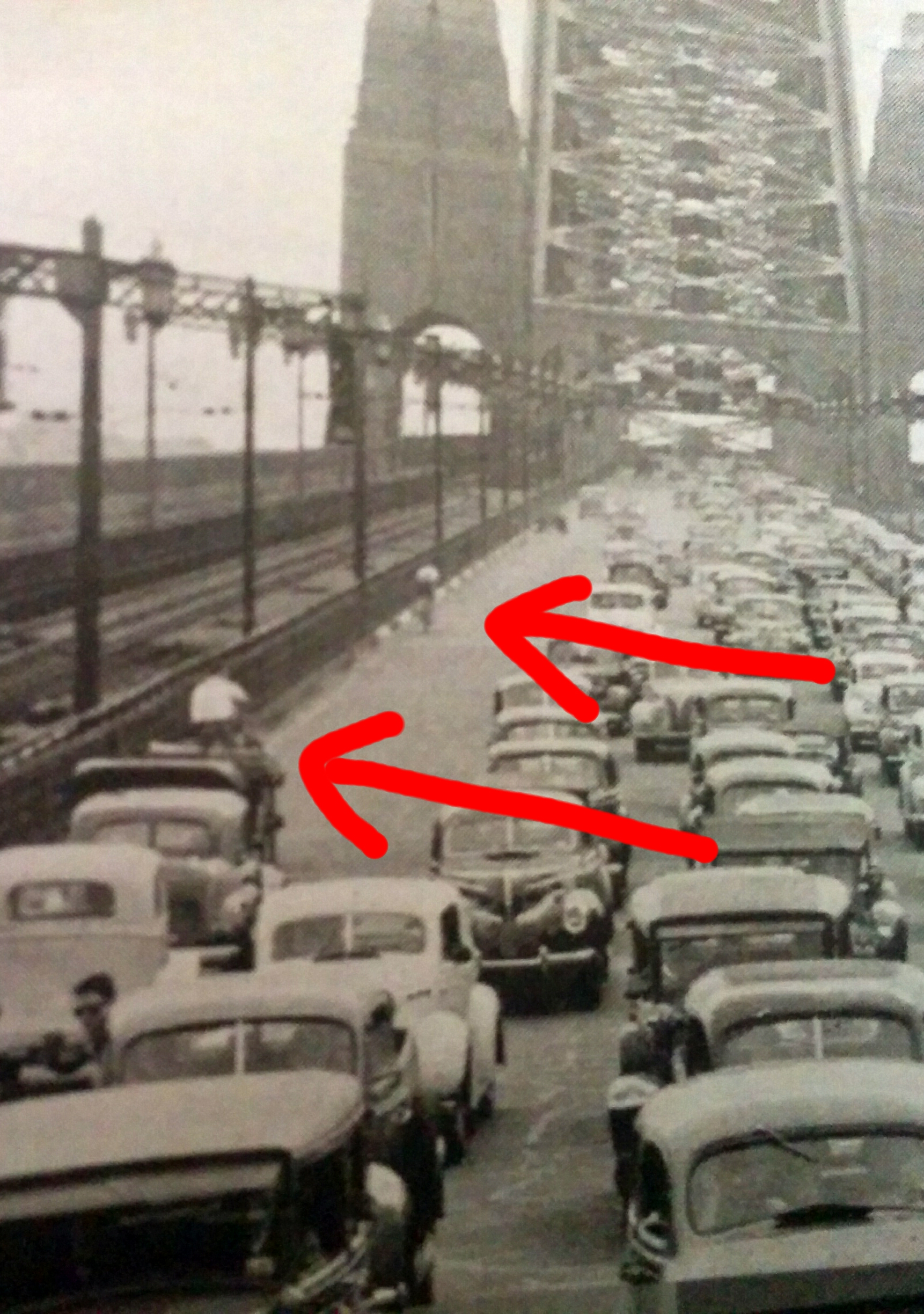
Fast forward to today. Check out today’s traffic at the Pyrmont bridge. And the line was twice as long behind me.

Which is why I am unlearning all those bad habits that the couriers taught me. Especially since it’s only a matter of time before they licence bike riders and the whole deal becomes subject to criminal charges for serious offences.

image

mxx1's avatar

Sight and Sound

This morning I saw a cyclist ride straight into a tram.

He was looking the other way and had headphones in his ears. No sight and no sound.

The scalar value of momentum is mass × velocity. In this case the two vehicles had about the same velocity, say 10 kmh.

One bounced and the other didn’t.

And then it bounced again a couple of times when it hit the earth which had an even greater mass than the tram.

Three bounces later it wasn’t moving and probably wishing it had hung onto the useful senses of sight and sound.

I wasn’t the first to the scene and, would you believe it, someone closer was an off-duty paramedic.

Thank God for that….I have always dreaded having to dredge up those intermittent medical emergency courses in a real situation.

The cat lived; hence all the bouncing. A few broken bones. Unconscious for a spell. Off to hospital for a few weeks.

Me, the police and the tram driver yarned for a while. And we decided there was no case to answer for the tram driver.

The police did note that, in any case, there was no procedure for booking a tram driver.

And that was my morning’s entertainment.

image

mxx1's avatar

Stumped

It’s hard to know whether you can cut down or lop a tree in my local council region.

One thing is for sure; if you ask the default answer will be no.

So on the weekend I manually, with a hand saw, lopped a big old murraya down to a stump.

It was good old-school, Czech proverb style, manual labour for a man.

It’s a philosophical debate whether a murraya is a tree or a shrub.

And I wonder if shrubs can be removed without permission.

I do know that murrayas will regrow from stumps; they can’t be stopped.

So until I remove the stump I don’t think any by-laws have been breached.

In any case if a murraya is chopped down and the council didn’t see it, did it happen?

image

mxx1's avatar

Courthouse fees

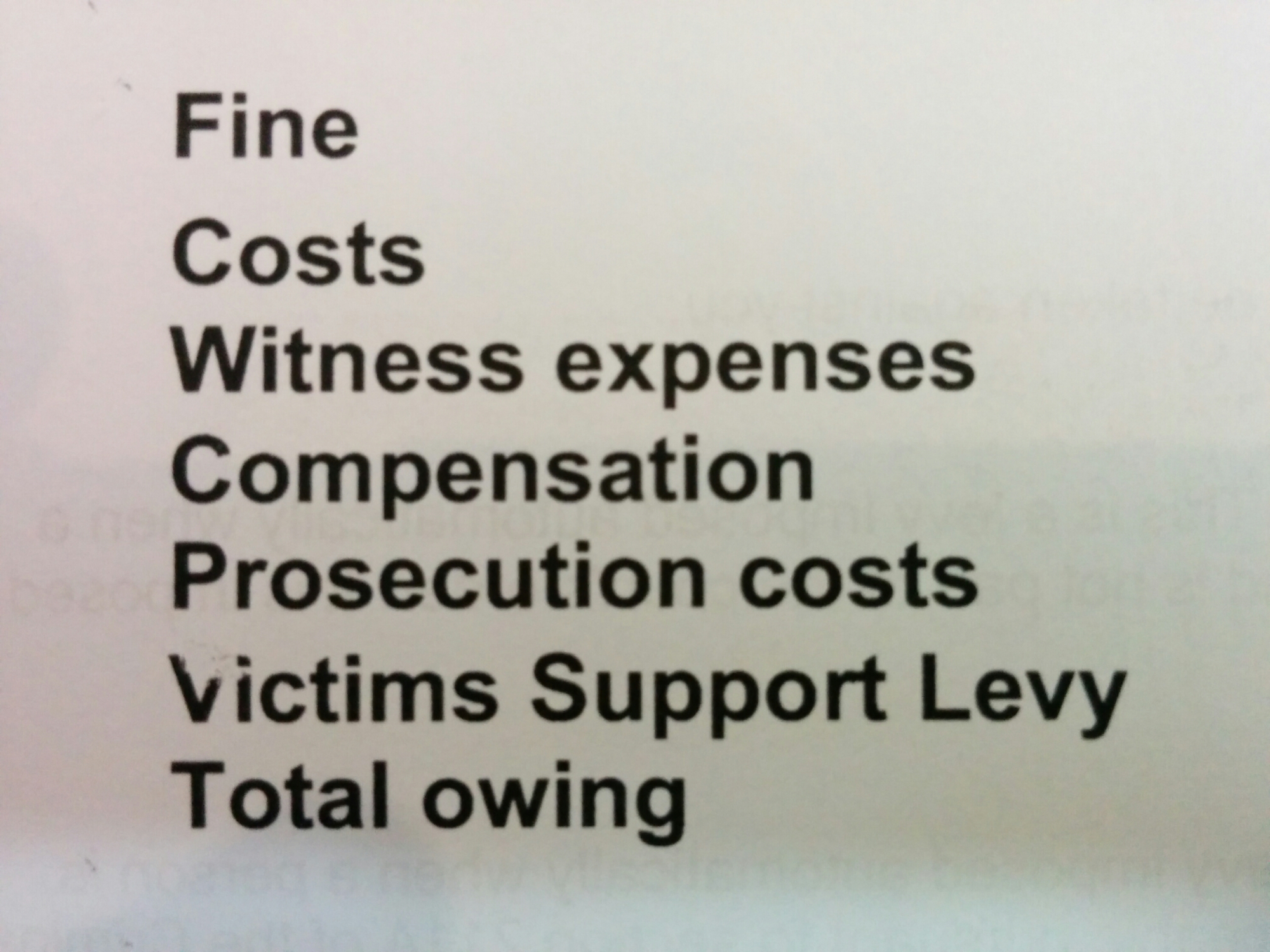
One wonders why, if found innocent of all charges, I am paying a ‘Victims  Support Levy’. Especially if there wasn’t a victim any way.

What I really object to is the shit grammar. It should be ‘Victims’ Support Levy’.

Our constitution needs to include a ‘grammar’ clause giving citizens the inalienable right not to be the financial victims of poor grammar.

But the true problem here is that they really did mean to leave off the apostrophe; ‘Victims’ in this context is a proper noun describing a financial line item. Not a group of people at all.

image

mxx1's avatar

Fish nets

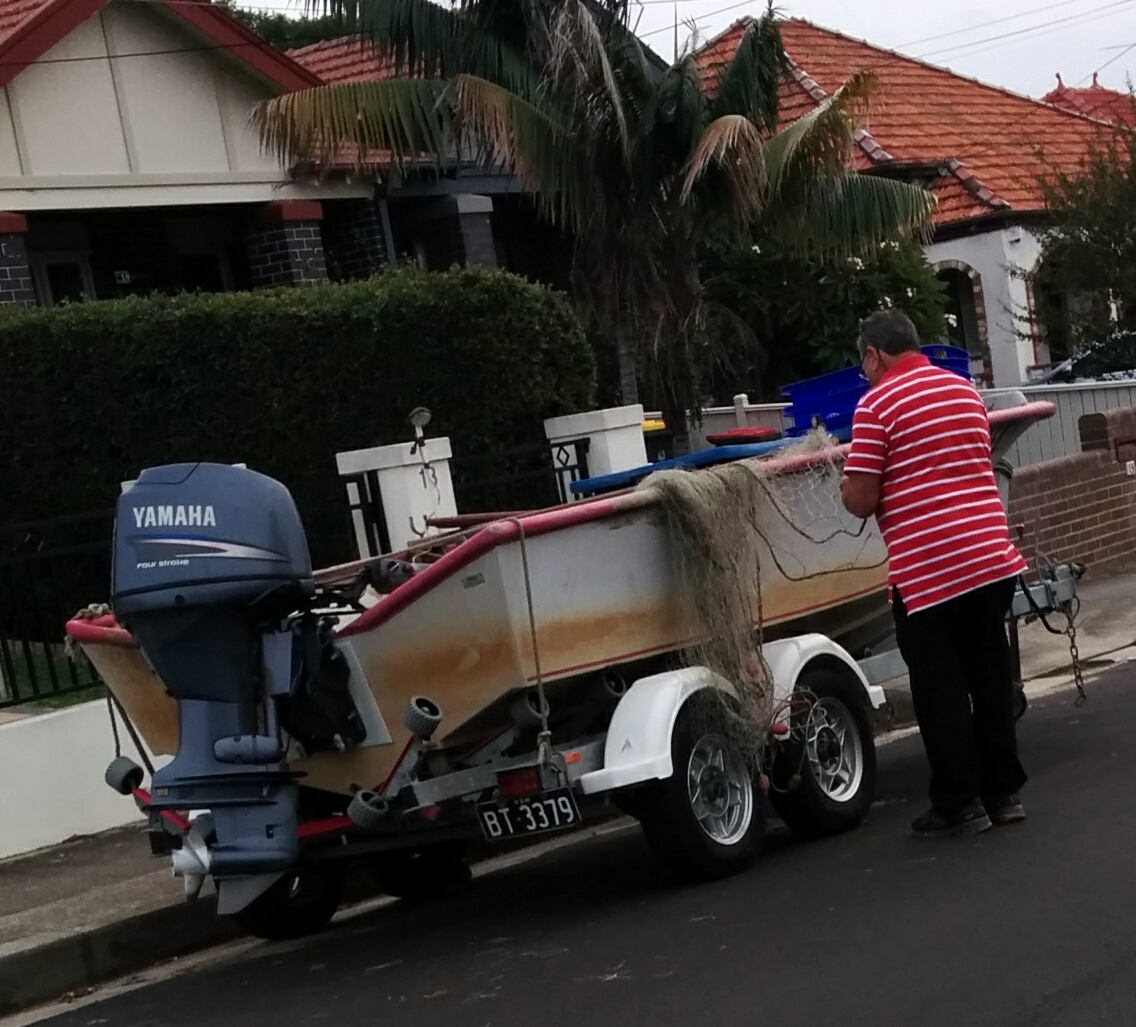
A taxi driver told me the other night that he fished for the first 25 years of his working life. With his old man who had emigrated from Italy.

He isn’t doing it any more because the financial returns are rubbish due to over fishing.

In fact he told me that if the old blokes didn’t spend all day fixing their son’s nets for free there might not be any fish to be had in Sydney.

image

mxx1's avatar

In the interests of full disclosure

On the subject of birth defects I have one other, well two; slightly clubbed little fingers.

Wiki is surprisingly ambivalent on the causes. There are many listed as possible but very little evidence for any.

I have no other family members with this condition. I don’t suffer any of the disease-related causes for clubbing. And I have had it since birth.

So it’s a mystery for now.

image

mxx1's avatar

Ignoramusa

From the madhouse that is the USA…

I just heard President Obama label as ‘ignorant’ someone prominent who got caught saying something racist. Or something like that.

‘Ignorant’ implies a lack of education. Whereas I would suggest that racism is the result of a very active education.

image

mxx1's avatar

Dipthong

A diphthong isn’t an Australian pub sport but one of those very odd nouns that hardly anyone knows but yet they all practice.

To wit, my mum says ‘pool’ as ‘poo-o-oo-l’. There are at least three different sounds in the ‘oo’, maybe more

Officially a dipthong is two adjacent vowel sounds occurring within the same syllable.

But some Australians just love pushing those boundaries past two.

image

mxx1's avatar

Old school social equity explained

Justice = fairness – trust

Goodness = justice for all + minimal spread in opportunity and resources

Democracy = the right for all to attempt to correct a perceived absence of goodness

Note: assumes unlimited resources

image

mxx1's avatar

Hippo Capital

There is another form of collective hypocrisy that I don’t like.

An example can be made in the context of a government programme for, say, investing in venture capital that has been going on for decades and clearly does not work.

How does this continue? Well it’s a combination of vested interests of the recipients of the money and those who hand it out, plus the fact that there is no upside for those in the know for whistle blowing on the whole deal.

Thus it continues as minister after minister kicks the can along the road.

The hypocrisy of all and sundry is manifest. And yet who can blame them? Unless there is a reward of sorts for suggesting an unpopular truth then the popular lies will thrive.

I used to stay quiet too but I just don’t give a stuff any more.

The learning here is that great leadership includes creating an environment that encourages alternatives views to be expressed.

image

mxx1's avatar

Self eye spy

Lola asked me why I have a black ‘hole’ in the iris of my right eye (see photo below).

I said ‘Lola, you may not have heard me say this before, but I don’t know’.

In fact it has never occurred to me to find out.

I think this is odd.

Lola thinks it is VERY odd in more ways than one.

p.s. a short web search later I find that it’s a small coloboma which is a genetic defect. In my case it hasn’t affected my vision.

image