Mark Twain said “The surest way to create an enemy is to do a man a favour that he didn’t ask for; he’ll be properly indignant at the required sense of gratitude and obligation”.
Or words to that effect.


Mark Twain said “The surest way to create an enemy is to do a man a favour that he didn’t ask for; he’ll be properly indignant at the required sense of gratitude and obligation”.
Or words to that effect.
The term “burnout” is a term, first co-opted for pop psychology in 1974 by Herbert Freudenberger, in his book, “Burnout: The High Cost of High Achievement”.
He defined burnout as, “the extinction of motivation or incentive, especially where one’s devotion to a cause or relationship fails to produce the desired results”.

The pope’s a man after my own heart. Why focus on substantial issues while the world’s burning, I say?
Grammar, that the real issue! The one that drives me mad.

“I don’t know half of you half as well as I should like; and I like less than half of you half as well as you deserve.”Tolkien

The purpose of failing is not to learn how to succeed via the development of useful heuristics (although this may be a beneficial side product), it is to learn how to live your life on your own terms. You can only do this by rejecting the terms of others, those which define “success” – the opposite of the failure. Or to put it another way “ah, but to live in the imagined and reflected glory of others!”
You’ll know you’re well on the way when you learn to fail on purpose and not by accident.
Let’s face it, when you go for something, generally you measure up the odds before launching into it. You either learn to ignore this step, or increase your appetite for risky propositions.
What’s the deal with living on your own terms? Well we’re social animals and we derive our life forces from social interactions. However the social ennui can go too far and capture us in glass cage, defined by the expectations of others. It’s always someone else not the person you’re talking to; each is a victim of the collective just like you.
It’s a paradox for the ages. All you can do is free yourself. The rest, well that’s their problem. By definition.

The price of living in a society that is truly just, that is, has a rule of law that applies to everyone, is that, from time to time, one is unjustly treated.
The mechanisms of justice are human just like you. Bloody imperfect. Or to be more precise, accurate but quite imprecise.
There’s no such thing as a free lunch, after all. Suck it up when it’s your turn, I say.
The trouble is we don’t live in such a society.
Oh justice is on average quite accurate, but only when the parties involved don’t have a vested interest in the outcome. And it’s bloody amazing how obscure those vested interests can be.

Ashley Madison apparently passed the Turing test with their fembots, posing as real women, that chatted to real men.
All it says it’s that the Turing test is relative. It’s easy to pass if you’re dealing with a horny bloke. Not so easy if you’re dealing with a less than horny woman I guess.

Economists talk about radical uncertainty, that is systems that are too complex to allow forecasting and predictions.
What we do is develop model systems that have containable levels of variability and then study these in great detail to elucidate the fundamental principles of operation. We start with hypotheses, and test these with data until we have generally accepted theories.
When we are done with this, we then extrapolate to the more complex and useful generalized systems, using the knowledge gleaned from the model studies to formulate (usually numerically) simulations of the complex systems.
I am thinking that maybe there is no such thing as radical uncertainty, just limited patience and discipline in the face of serious complexity.
What makes economics so difficult to model, especially in time, is the number of variables that are both hard to measure and define, the large number of higher order effects (events whose outcomes depend on many things) and the amount of stiffly coupled outcomes (feedback loops, if you like).

I’ve always thought people were attracted to God because of the promised after life. Now I’m starting to think God represents good luck, hence the title god.
Throughout history, people have generally had a shit time of it, and good luck is needed to get ahead and avoid pain.
So why not pray to the God of luck? Not that it works but gamblers tend to keep going anyway.
Affluence in the West has partially killed the need for luck, and hence god has waned.
Science doesn’t require luck and is therefore anti-god. You either know or you don’t.
Not all thing are knowable though. So science can’t address all the matters previously assigned to the divine. Let’s call this the luck gap.
Actually, radical uncertainty is the luck gap. This is the wedge that the religions need to exploit.

This label is made from synthetics.

First, technology start-up success is an environment subject to radical uncertainty. This can be proven since there is less money returned to investors in the global VC sector than goes in from this same cohort of investors; that is, it is a gamble, an environment where you need luck to either pick or be a winner.So why do some VC’s and some entrepreneurs seem to have systematic success? Well, they solve their problems and create their opportunities by having access to unusually high levels of capital. That is, they throw money at their problems. If all access to capital was equal there would be very, very few recurring winners.So why bother seeking habits or traits of successful entrepreneurs? There is a point and that is that the right basic personality and skills are a necessary (but NOT sufficient) trait for success. So even if you have the right personality and right skill set, you may still fail as an entrepreneur. In fact you are more than likely to fail, time and time again.There’s a bias in the social media environment that we live in that makes people think they can “cargo cult” their way to success. For example, adopt the 7 habits of highly successful people and you will be one. Or, eat fruit, be an arrogant dickhead and wear all black, and you will end up as CEO of Apple. This is not the case; these are correlations and not causations.So, a final word, any measure of your “entrepreneurshipness” (or whatever) should be treated with the disrespect it deserves. By all means, find out if you have the necessary traits and skills. Note well though, even if you do, you need access to bucket loads of luck, or access to enormous amounts of risk capital (which also requires bucket loads of luck).Whichever way you look at it, luck is needed. And you can’t cargo cult yourself into being lucky.The visitation of luck is a random thing. Some get it first time, and forever after think they are geniuses. Some never get it. Some give up before they get it. Only the mildly insane keep going once they realise luck is needed, so mild insanity is a trait that is also needed on most cases.Case study; Elizabeth Holmes. The perfect entrepreneur in fact, except she was low in luck. She just couldn’t attract enough capital to overcome this fact. So she was really unlucky in fact.Oh luck is random by the way. You can’t influence it. People aren’t lucky; lucky is people. The only way you can influence luck is by stacking the game using capital. Rigging, in other words.ps if you could just follow a formula to success, then the owner of the formula wouldn’t be spending their time teaching it for little bickies, they’d be flogging it to highly successful entrepreneurs for a slice of the guaranteed outcome.
No idea what it is. And I’ve certainly got no fucking idea why.

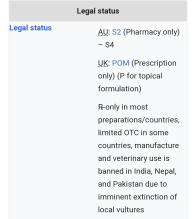
Properly known as 2-(2,6-dichloranilino) phenylacetic acid. Wiki had this useful information on it’s legal status.
Is capitalism that much better than communism just because the latter collapsed first?
Each tries, but fails, to take into account the worst of human nature.
Capitalism almost collapsed in the thirties but just pulled through. Right now it’s sputtering along on three cylinders. You can hear the death wobbles from space.
The Soviets had one meltdown, the West has had two biggies. They argue though that because of superior design they weren’t as bad as Chernobyl. True that but if the West had a Chernobyl they’d have never pulled off the miracle save.
But that’s possible a cultural thing.
 offshore westerly