
Just yesterday I learnt about the H-index and it’s competitor the i10-index (not the one from Hyundai).
I think it is just the two of them at the moment. Just like in the early days of boxing when we just had the WBA and the WBC. But who knows, there may already be a bunch more paper indices I don’t know about.
Citations in academia are an odd beast.
They are considered a proxy for the ‘importance’ of an academic paper. And on this basis are grants awarded. Now this is pretty messed up because academics, being clever, have long ‘gamed’ the system by structuring their efforts to improve their indices, rather than just pumping out good work.
In fact it can be argued that efforts that are aimed at improving the indices automatically take academics away from areas of uncrowded activity (white space) where genuine innovation is more likely to be achieved,
Consider this; the more important a paper is the more often it is read. This is 100% true because academic papers are so boring that no one would read them unless they were genuinely interested in the contents.
Before the internet there was no way we could measure how many times a paper was read. All we knew was that a paper was printed. A paper might have sat on 1000 library shelves around the world and never, ever read – to this day.
Hence, in order, to measure the worth of an paper and its author(s), the citation indices were born. A paper is cited because it describes a bunch of things that saves the author of a new paper from writing a bunch of things or, worse still, trying to prove a bunch of things.
Essentially a citation is a valuable short-cut. A short-cut that proves that we are all standing on the shoulders of those that have gone before us.
In the absence of a direct measure of readership, citations were the best proxy we had. But an imperfect proxy at that.
Sometimes, for example, a paper can be heavily cited because it nicely summarises some information that other authors can use in their introductions. Yet in no way does it introduce, for example, new science.
Also, when cited a paper probably has a greater chance of being read by others because they may be compelled to ‘chase’ the reference. A citation is a very poor advertisement for a paper, but it is one nevertheless.
Clearly in this era of e-journals the value of academic papers can be measured directly through readership.
Firstly, however, we need to get papers from behind the paid ‘firewalls’. I often need to read academic papers even though I am not an academic. Just yesterday, for example, I wanted to get a paper on patent enforcement studies in Australia. Wiley’s wanted to charge me $35 for the privilege and I demurred.
Eventually I girded my loins and forced myself to get a copy through the RMIT University library system (which I have access to as an Adjunct); it is so convoluted that in itself it presents a barrier to entry
Fortunately the move away from the old cartel of ‘paid’ journals has already begun. Once it is completed we then need some new indices. Actually we would probably need two indices; one for the level of readership and another as a measure of innovativeness.
Let me explain – a great review, for example, can be highly read but introduce no new (say) science. Don’t get me wrong – a good review is a very valuable thing, but it isn’t the whole picture. In any case, the level of readership can be very easily measured on the internet – Scribd for example measures how many times an article is read and what the ‘engagement time’ is.
A index for the measure of innovativeness poses a greater challenge. At one level great innovation can often be measured by the number of people that initially disagree with the contents of a paper. And eventually the number of people that agree. There are other factors as well – I will leave this challenge to the social engineers.
For grants I personally would weight my generosity to those with greater innovativeness indices, but that is just my personal prejudice. I have noted that the authors that attract high readership can often be older and simply more adept at playing the system; from these people we do not necessarily get innovation unless they take on the responsibility of fostering the young innovators.
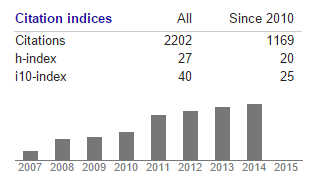
Finally, to show how silly the current H index is, I have attached my own profile below. The last time I was employed at a university doing research was in 1991. And yet this apparently tells me that I am a good practising scientist (or similar). How messed up is that? If I could get a job in academia (say convert my adjunct position to full time) I could argue that I am worthy of grants over and above some young up-and-coming scientist that is probably capable of great work. Having said that I would have to go for grants in the very boring field of physical polymer chemistry (where the index was earned) and that just isn’t going to happen my friends. Once in one lifetime is more than enough.

























































 offshore westerly