mxx1's avatar

Even water has an LD50

With reference to the article below, it’s sort of surprising that the mice survived long enough to develop any changes to their neurons; the dosage was such that the poor buggers were lucky not to drown. The whole thing is certainly hurting my neurons.

image

mxx1's avatar

Inanis Caritate

Subject matter – Surf Life Saving Australia (SLSA). Consolidated revenues of $72m.

As one experienced lifesaver said “the SLSA is top heavy with management and  too little of the money raised by the national body makes its way down to the grass roots … if anyone knew what was going on they would go down to their local club and donate money straight to the club.”

Nowadays you can’t even get off a plane at Brisbane airport, a long way from any beach with surf, without some kid hitting you up for a donation to SLSA. I always tell them to bugger off.

Although it is a charitable organisation, much of the money bludged off the unwitting public ends up in the pockets of head office staff via salaries and expenses. Much of the rest goes into marketing.

As it stands a charity must have these features:

  • be a not-for-profit
  • have a charitable purpose
  • be for the public benefit or for the the relief of poverty
  • must have convinced the Australian Charities and Not-for-profits Commission of the above three points

And the benefits of charity status are:

  • charity tax concessions:
    • company income tax exemption
    • goods and services tax (GST) charity concessions
    • fringe benefits tax (FBT) concessions
  • deductible gift recipient status

It’s no mystery that charities now attract the most horrendous rent seekers in this land of rent seekers.

Think of the SLSA. Previously a small head office coordinating sporting events for surf life saving clubs, it is now a mini-corporation serving it’s own needs first but saying and believing the opposite.

It’s not much better than your local happy clapping church with the evil pastor raking it in.

How did this happen?

Essentially charities are soft targets for the lazy and greedy. It’s pretty easy for the ruthless to sidle on in and take control and then argue for expansion via marketing and increased charitable donations.

Because of the increasing abuse of this sector by the inherently greedy I would argue for a few changes: I would get rid of all tax concessions (even for donations) and just leave with them the ability to carry over profits without being taxed.

Indeed I also think there should be a new class of limited liability company; one that also has the ability to carry over profits without being taxed, with a quid pro quo that it doesn’t have the ability to pay dividends. Shares would have to be 100% owned by Australian entities or individuals and there would be a 50% capital gains on the proceeds of selling shares.

That option would entice the rent seekers out of the charities and into this new category of companies. It’d be too attractive for them to resist especially if all those benefits were taken off the charitable organizations.

image

mxx1's avatar

Anti-Eveythingers

So I sent my last blog on anti-vaxxers to Rod and got this response:

“me-thinks Bill Gates is not an altruist … especially since his dad was a acolyte of eugenics … and Govt is for the most part filled with brainwashed twats that wldnt know a false flag operation to save themselves … a lot of people are just starting to awaken and to question the hierarchical control system that lurks in the shadows.”

Now I’d put Rod in the first category of anti-vaxxers; those that are general conspiracy theorists without kids of a vaccination age.

These guys are just using the issue to vent their general disliking of the current first world systems that they find themselves in.

What I am struggling with is whether Rod’s partial and selective use of rationale thought is to be admired or to be found disturbing.

I sense a set of disconnected dots that Rod has somehow mentally drawn together in order to arrive at a conclusion which I don’t think is fully articulated.

I am not saying that I don’t agree with him; I can agree nor disagree because I don’t understand what data he has used, how he has drawn a conclusion, nor what his conclusion is.

I do sense a negative vibe towards all forms of authority and that’s about it.

What I do know is that there isn’t enough data nor process for anyone else to reproduce his efforts.

I was taught was that this ability to reproduce the process is the point of all rationale methodologies.

Once you can see what data was used, and how, then you can also assess the strengths and weaknesses of the whole shebang.

Without any such due process, I either have to take Rod at his word, or more likely put some pretty big mental error bars on whatever missives I receive from him.

The irony of course is that people that don’t use any form of due process to sort through data and to derive conclusions also don’t question the absence of such, and therefore don’t apply error bars under any circumstances.

Which is to say, even if by some odd miracle Rod has found a vein of truth, the only people listening are those who don’t give a stuff if it’s true or not, nor do they have any influence of any sort.

That probably suits Rod just fine despite any complaints to the other that he may make for appearance’s sake.

image

mxx1's avatar

Budgies in the Mines

Anti-vaxxers, what to make of them?

The ones that I have met fall into a number of categories:

1. Conspiracy theorists without kids of a vaccination age. These guys are just using the issue to vent their general disliking of the current first world systems that they find themselves in.

2. Concerned parents that suspect that their kids are being meddled with by governments. This lot generally don’t have the capacity to assess the information on the subject and hence sensibly land in the ‘do nothing’ category.

3. Then there’s the missionaries, the generally poorly educated campaigners that know that vaccination is a prelude to some Matrix-like future where we all end up chipped and totally controlled. In the meantime, have you seen the side effects?

What makes the issue very interesting is that the battleground is played out by proxy in the future health of (currently innocent) children, and not that of the people choosing not to vaccinate.

So morally, the question is whether parents even have the right to make such a decision as to not vaccinate.

Generally speaking, our rights to even make decisions regarding our own well-being are being slowly removed, one by one.

Many people are very much struggling with the modern view that parents don’t have moral rights over their own children. Where does it end? Do parents even have the right to force religious beliefs on their children?

And the fact that anti-vaxxers might be threatening the health of other children just enrages the debate even further.

It’s a very emotional issue pitting the government purse and the Nanny State against the barely educated, the scared and the suspicious.

And to make it worse, the medical industry won’t stop at life threatening diseases. Sniffing large profits they’ll argue for vaccination for what could only be called nuisance diseases.

I suspect that somewhere hidden in there is a sort of Pareto Rule. Let me explain.

The first generation to be freed from life destroying diseases such as polio probably just breathed a collective sigh of relief; no opposition.

But as the generations proceeded and the memories of death and permanent illnesses receded, and as the diseases being targeted diminished in their impact on mortality and morbidity, the tide turned and there was less support.

I suspect that this opposition to vaccination is very amenable itself to epidemiological study and modeling.

Once achieved, governments would know exactly what they can achieve with such programs and what levers they have in order to garner wide spread support for new vaccination programs, if achievable.

They should use the same diligence that they inexplicably expect from the general population on the issue, rather than the ‘trust us’ approach.

I’d argue against just shoving vaccination down people’s throats; it’s clearly starting to be counter productive.

And not just counter-productive in the context of vaccination.

The issue itself is a proxy for the general distrust of first world governments in their modern form of serving many undeclared masters.

The risk is that the good becomes a victim of the greed that we all know exists.

image

mxx1's avatar

Measuring Innovation

TR announces the top 25 global government innovators.

You’d have to think this is measured by the quality of lies used to increase taxes as a percentage of GDP whilst also managing to get re-elected.

image

mxx1's avatar

Foundation and Empire

The last time I played Monopoly it was with pounds and the real estate had names like Mayfair and Islington. My parents had an English relic from before the war.

Today I played the modern incarnation, Monopoly Empire.

The money is undenominated, presumably to save costs on international sales.

Instead of real estate, one buys billboards which are added to one’s skyscraper.

The first person to cover their skyscraper to the top with billboards wins the game, ignoring the fact that even in the extreme case of Japan that billboards only climb up as far as the fifth floor.

In the old version, rent was due when one was found lurking, squatting even, in someone else’s property.

Now one pays the owner of a billboard the full cost of purchase of the billboard just for looking at the billboard.

This makes no sense since billboards are a form of paid broadcast media designed to catch the unwitting eyes. No money changes hands in the eye catching.

It would have made more sense to have a fine for graffiti crimes against the corporate machine.

There are bunch of other rules and cards (including baseless legal injunctions) which make just as little financial sense but are designed to even out the game a little; an improvement over the old game in which the first person to become a slumlord slowly drove the others into liquidation.

Very slowly, like an inevitable and quite unenjoyable train wreck.

The billboards themselves are a random selection of global corporate brands which have presumably paid Hasbro healthily for this opportunity to place all these micro billboards in front of consumer’s eyes.

And since the consumers pay for this privilege one has to admire the completeness of the logic; there are occasions when consumers do pay to see billboards!

Ultimately kids get to learn very little useful finance or economics from the modern game but they do get a first hand consumer’s view of neoliberal capitalism in action.

Which is to say, they get to play a game in which there is one winner and lots of losers but where the real winners aren’t even playing the game.

And most of the players would be none the wiser! Just downright bloody genius…

image

mxx1's avatar

There’s never been a better time…

To be a media publisher, not an Australian.

“Editors used to spend years developing their natural and core instincts to select the best stories for the day: what would sell papers, what would catch the reader’s interest, what would make for good water-cooler conversation.  Today, an algorithm does that for us.”

“We can do more experimentation than our predecessors who committed their day’s stories to print.  We are free to experiment.”

Bit of a paradox there I’d say…

image

mxx1's avatar

Oh dear

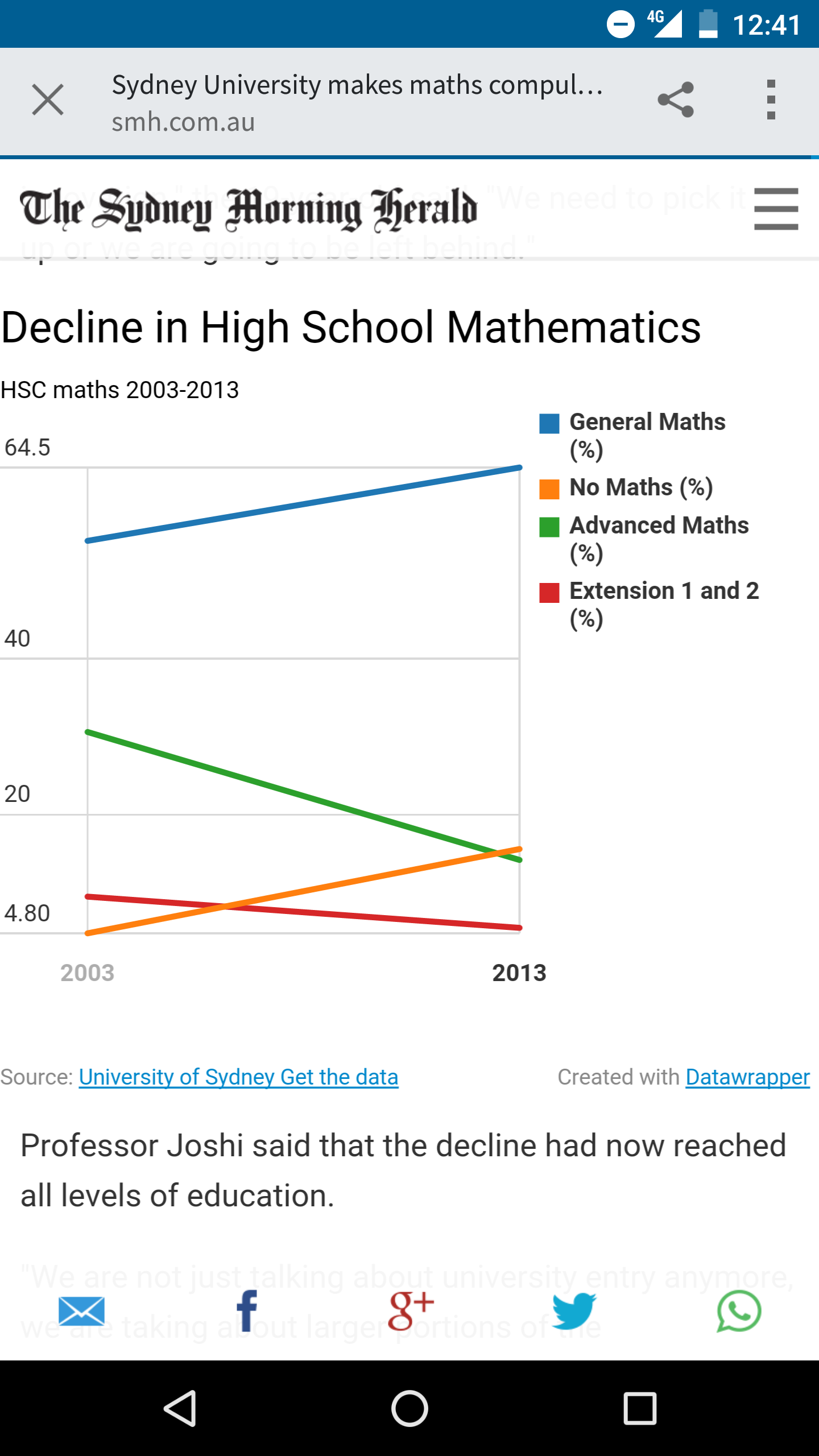
The UTS is about to make every student, regardless of their degree, complete a compulsory numeracy subject before graduation. 

Numeracy is the ability to reason and to apply simple numerical concepts.

Basic numeracy skills consist of comprehending fundamental arithmetic like addition, subtraction, multiplication, and division.

I suppose you’d need these skills at the very least to make sense of the TAB.

I wonder if interest groups aligned to the gambling industry will attempt to oppose the general reintroduction of maths to schools and universities?

image

mxx1's avatar

Game Theory

Courtesy of The New York Times; when using Tinder, men are three times as likely as women to swipe right on any given picture.

The article explains that men basically select just about every woman that pops up whereas woman carefully select the men that they might want to connect with, based on the photos and accompanying text.

I suppose it’s a good thing that one half of the population is curating otherwise there’d be mayhem.

It makes me think though, whereas people assume that this observation is evidence for the polarised dating nature of the sexes, maybe not.

If one of the sexes was slightly more ‘curating’ in nature then, due to competitive pressures, the members of the other sex would be forced into a polarised non-curating mindset.

Any game theorist would attest to this. It’s simple maths.

I wonder what happens on the gay-equivalent apps to Tinder? Is there some other polarization of behavior based on a distinction other than gender?

As a final note, as in all things human, these apps ought to come with a safety warning ‘be careful what you wish for, you may just get it’.

That’s especially pertinent for the women. Being the curating party to this fatal dance they hold the moral peril as their own.

The men? Well I guess the internet was designed by their ilk just for this purpose.

image

mxx1's avatar

Glassdoor

A US research agency had done a thorough study of gender based pay levels and found that in Australia women earn on average 3.9% less than men when all other factors are accounted for.

No mention of how big the error bars are on this number but you’d hope the number being reported is statistically significant.

3.9% is much less than the 24% that is reported by the Australian Workplace Gender Equality Agency because (a) the 24% figure wasn’t adjusted for industry sector (women cluster into certain industries putting downward pressure on salaries through supply and demand factors), and (b) the Agency has a self-interest in reporting the biggest number.

Even so, the 3.9% has to be explained.

I don’t think in this era that anyone is consciously paying women less than men for the same role.

I suspect that it’s got to do with the mechanism of pay rises.

Whilst in a role, pay rises would be similar between the sexes. That’s what I’ve observed anyway.

But as we all know the biggest salary jumps come with new roles.

My hypothesis is that men are more likely to change roles and hence get the greater pay increments associated with this behavior.

And it’s a hypothesis that can be tested with the existing data.

If the data was normalised for average period spent in a role then the 3.9% would probably go away. Or not, if my hypothesis is wrong.

All you’d have to do is take all of the data, men and women, and find the correlation between job hopping and salaries, and use that to correct the data.

My guess is that women are slightly less likely to change jobs than men simply due to the (on average) higher demands they face associated with parenting and domestic activities.

Which would suggest that any program aimed at removing gender inequality in pay levels would be well placed to:

1. Target domestic equality for working couples, and/or

2. Promote job hopping training for women.

image

mxx1's avatar

Manslaughter

Manslaughter; the crime of killing a human being without malice aforethought, or in circumstances not amounting to murder.

Why then does manslaughter sound more gory than murder?

Etymology says ‘no idea’ as usual.

As in “c.1300: killing of a cattle or sheep for food, killing of a person, from Scandinavian slahtr“.

That is, it has something to do with the Vikings. They probably had 300 different words for killing (like the aborigines had 300 for water). And we randomly pick one or two of them.

I reckon murder should be renamed manslaughter, and manslaughter ought to be renamed whoopsdeath.

image

mxx1's avatar

7-Eleven

In Australia company directors are, amongst other things, personally liable for company ATO matters such as unpaid and unreported Pay As You Go (PAYG) withholding or Superannuation Guarantee Charge (SGC) amounts.

Director penalties include

1. Being charged with a criminal offence with a penalty of up to a maximum of $200,000, or imprisonment for up to five years,

2. Being charged with contravening a civil penalty provision (penalties up to $200,000)

3. To be personally liable to compensate the ATO and other parties for any losses

4. To be prohibited from managing a company in any capacity.

Personally I’d like to see a tick box list on company tax returns where the directors confirm that the company has complied with all sorts of government regulations such as:

1. Having satisfied all minimum wage regulations

2. Having satisfied all fringe benefits compliances

3. I’d even throw in unfair dismissals regulations because current penalties are laughingly small and not taken seriously.

4. And a long list of other dubious and common company activities

Then, if found in breach, the directors would be on the hook for having made false declarations as well as for the original offense.

They’d be up for financial reparations and both criminal and civil charges.

That’d fix things in one year, flat. Just one little page of director’s declarations.

image

mxx1's avatar

Conspiracy Hypothesis

If viruses can be developed for computer systems it stands to reason that IT viruses can also be developed for organisations.

Something developed and then released into the organisation, that corrupts the organisation from within.

And I’m not talking about corrupting the IT systems, I’m talking about corrupting the ethics of the place but using IT as the weapon.

An example; introducing spurious occupational health and safety regulatory forms that drive people mad, or formal facilitated systems for holding meetings, and onerous compliance systems for equality opportunities and minority rights, and so on.

These are all now driven by documents and forms and database systems. It wouldn’t be too hard to slip some more in, on the sly.

If the terrorists got it right they could ensure that the whole work force inside an organisation was completely tied up with random conformance, thus sending the place broke.

More insidious would be a level of introduced IT systems that stopped short of sending the business into liquidation but slowly sent all the people mad. Frogs in slowly boiling water.

Imagine if this was taking place on the quiet in every organisation in the country.

For a invading force this would be much cheaper than submarines and nuclear weapons. And a lot more fun.

By the time the invaders arrived we’d be begging them to take over if they promised a return to former days, before the CIO and VP, HR.

That’s all just wild dreaming of course. It’d never happen here.

image

mxx1's avatar

What?

I think there’s something wrong with me.

United Airlines just asked me to save answers to specific questions as part of an attempt by them to tighten up account security.

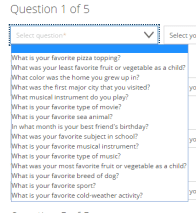
With reference to the questions below, in all cases I either (a) don’t have an answer, (b) don’t know the answer, (c) might forget an answer that I make up, or (d) have more than one answer.

Do normal people just have one answer to each of these questions or do they just make them up and remember them?

I prefer it when you can make up your own questions. Like:

1. What do you like about United Airline? (nothing)
2. Which is your favourite US city? (none)
3. What do you hate about the United Airline website? (the security questions)
4. Why do you fly United Airlines? (because there is no other choice direct to SFO)
5. What’s the worst aspect of flying on United Airlines? (the flight staff)

Untitled

mxx1's avatar

Idiopaths

Due to popular demand there’s a carve out for consultants in the idiopathic definition.

Idiopaths work in:

Test 1. Organisations that are not for profit, or

Test 2. If it is, where the job has no meaningful impact on the profit of the organization, or

Test 3. If if it does, where the profit of the organization is the result of some government mandated legislation, monopoly or oligarchy. That is, the performance of the organization doesn’t impact its prospects for survival and growth, nor does it impact the prospects for survival and growth of the organization’s customers. Except where the so-defined idiopaths under this test 3 are self employed consultants serving the organization.

These guys are simply taking money off fools, so all power to them.

image

mxx1's avatar

New Element Discovered

[Mike, I am sure this is what you meant me to do. Fortunately this is a private blog so please, no leaks!]

CSIRO scientists have actually discovered the heaviest element yet known to science.

Most recent elements have actually been invented in heavy particle colliders but this one was found lurking in CSIRO’s own headquarters.

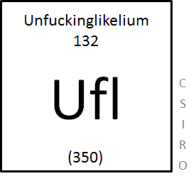
The new element in the superactinide series is Unfuckinglikelium (Ufl), formerly known by its temporary IUPAC name of Untribium.

The sole example has one chief neutron, 5 executive neutrons, 26 director neutrons and 318 junior management neutrons, giving it an atomic mass of 350.

Brian Greene has commented that even if there are an infinite number of universes he would never have expected to see ‘an element this un-fucking-likely’. Hence the newly adopted name.

The 350 particles in the nucleus are collectively known as morons and are surrounded by vast quantities of scientist-like particles called peons that have no mass or energy (collectively, no gravitas), nor function and that cannot be detected except with ultrasonic screech detectors.

The chief neutron lies at the centre of the other 349 morons in the nucleus. These 349 morons are separately classed as ‘yes-men’ neutrons after the yellow colour of their traces on the monitor at the Large Haldron Collider (where Ufl has been tested for its physical, chemical and junket properties).

Since Unfuckinglikelium has no electrons or protons, it is mostly inert and therefore it too has no known practical use.

However it can be detected because (a) it impedes every reaction with which it comes into contact, (b) it sheds peons at an alarming rate, and (c) it radiates high levels of disturbing radiation in the broadcast and wifi frequencies.

As an anti-catalyst in its atomic state, a single atom of Unfuckinglikelium can cause a reaction that normally takes less than a second to complete to take from four days to four years to complete.

Unfuckinglikelium has a normal half-life of 2-6 years.

It does not decay but instead regularly undergoes a reorganisation in which a portion of the executive neutrons and director neutrons exchange places.

Once in a while the chief neutron is replaced with another when (a) a suitable unwitting replacement is encountered via random diffusion, and (b) the peons have absorbed sufficient energy from the chief neutron via a tunneling process known as ‘white-anting’.

Whenever Unfuckinglikelium comes into contact with Governmentium it reacts to shed even more peons than usual in a process that is oddly also known as ‘reorganisation’. The number of morons remains constant and money is consumed in the exchange, but no other by-products are produced.

CSIRO Scientists have projected that in the year 2030, when the last peon is shed, that the sole Unfuckinglikelium atom will undergo spontaneous fission to form hundreds of atoms of Businessconsultium.

Untitled 1

mxx1's avatar

Start-Up Prostitution

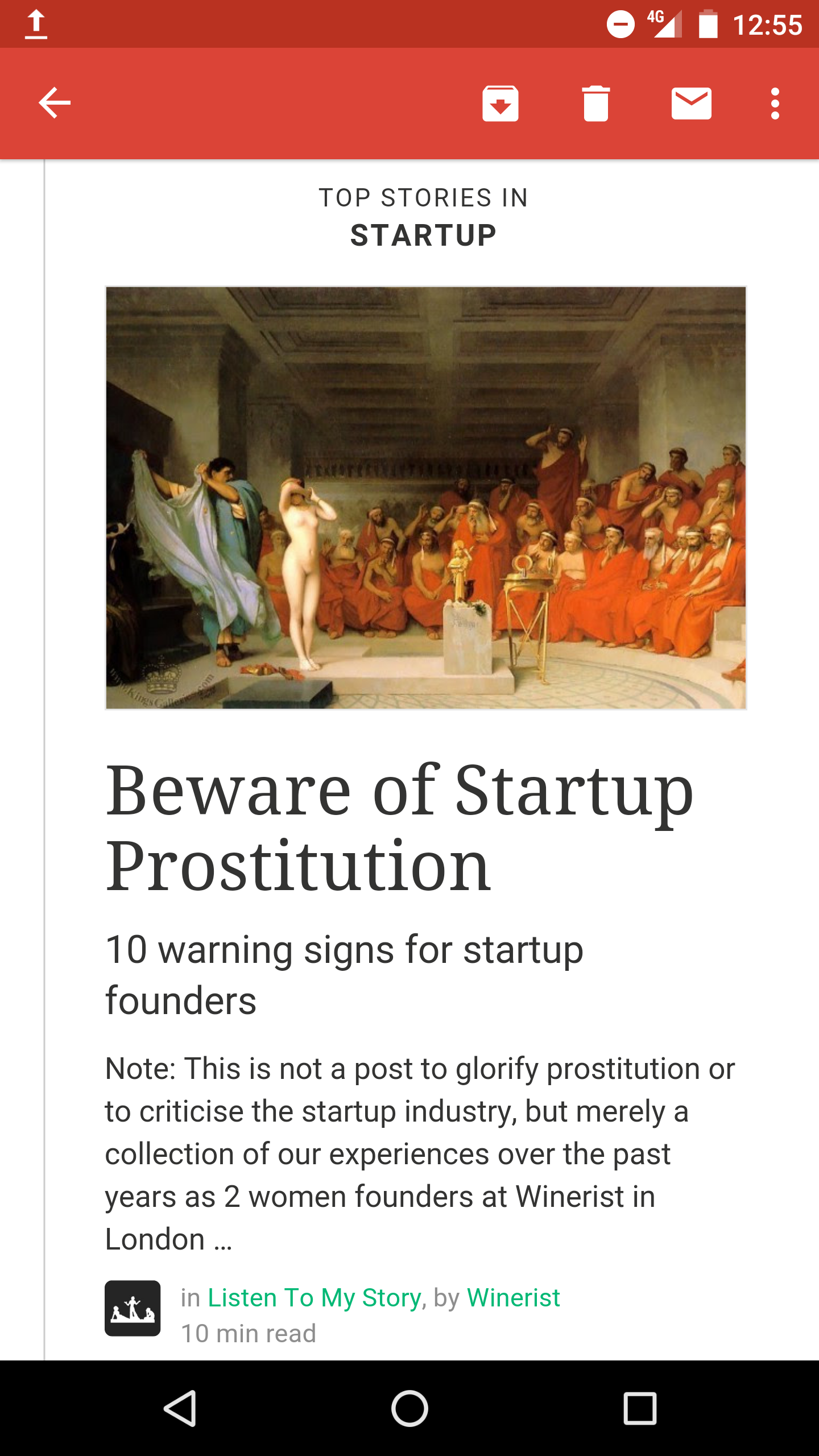
[Prologue: Dave sends me a link to a UK article below that lists ten factors that are ‘causing’ the modern start-up world to be be like ‘prostitution’. The article lists 10 (a nice round number that) reasons why start-up entrepreneurs should stop taking part in beauty parades (incubators, awards, useless fund-raising activities and the like) and spend more time building their businesses.]

Firstly I would note that prostitution is a legal profession in the UK so the authors ought to be rapped on the knuckles for implying the pejorative to this ancient and successful industry.

And secondly, they have missed the point entirely. Let me explain.

The root cause of all current start-up industry woes is that the bar for entry is very low.

In this IT era an idea can be turned into app within days, allowing anyone to be a start-up entrepreneur if they choose to be so.

In days past, one would had to have (1) special technical knowledge, (2) a track record in, and a deep knowledge of an industry, (3) done an apprenticeship in other people’s high growth businesses; all before even considering starting a tech business.

The bar was higher because much more early stage funding was required to turn ideas into products, and to turn market problems into revenue opportunities.

Since anyone can jump into the start-up world today, and because many do, the mean return on investment into start-ups is undoubtedly quite negative.

Any investment into an asset class that has negative mean returns is called ‘gambling’.

Any such environment naturally deters entry by the properly qualified, thereby even further reducing industry returns.

A classically trained start-up entrepreneur or investor will turn to other activities rather than participate in an unsavoury environment full of deluded Gen Y’s that have collectively degraded the industry to a Totalizator agency board where the only profits are made by white shoe operators pedalling services such as incubator real-estate, access to government grants and miscellaneous advisory services.

The only parallel to prostitution that I can perceive is the requirement these days to have a bloody long shower after engagement with the startup environment.

As to the advice by the authors that the entrepreneurs should stop taking part in beauty parades (incubators, awards, useless fund-raising activities and the like) and spend more time building their businesses; they are missing the point – this is exactly the reason why all these so-called entrepreneurs are in the business in the first place!

They have redefined success solely in terms of lifestyle and fame.

It’s a called a reality TV show, but in real life.

I’m not sure what I’d call this but ‘unreal reality-life show’ sounds like a start.

image

mxx1's avatar

More on Kids

I was unexpectedly surrounded by consensus on the weekend and it didn’t go unnoticed.

The subject was children, homes, parents and co-parents.

That latter moniker is just one of the many used for what used to be labelled as step-father or step-mother.

Since the spouse has become a ‘partner’ you’d think the co-parent would have become a partner-parent, but no matter.

It appears that there are two motivating forces that drive parenting styles; those that believe that the primary role of parenting is to instil a sense of good behaviour in kids, and those that focus of ensuring that kids feel safe and secure at home.

In practice, I am told, these are opposing forces that often lead to loud noises.

And often this is correct. Let me explain.

Humans naturally follow the path of least resistance. Very few freshly minted humans volunteer unnecessary labour.

So children in an environment where safety and security is foremost naturally take advantage of this by adopting an attitude in which their sense of safety and security is threatened by an insistence upon onerous behaviours.

And conversely, kids in houses where higher levels of entropy-defying contributions are the norm don’t necessarily feel unsafe and insecure. Mostly they are quite comfortable indeed.

But when there is a clash of parenting styles the kids may get confused and feel genuinely threatened.

The paradox here is here of course is the psychological source of the parenting styles. My mostly ungrounded hypotheses for these, based on a quick review of past friends and acquaintances, is as follows:

Often the parents that prefer the ‘safety and security’ gig have this preference due to an absence of the same in their own childhood homes.

It goes without saying that these homes were often low on the consistent behavioural model as well, so this is considered an optional set of mostly unwanted free steak knives that might get in the way of the primary goal.

These parents are trying to correct past wrongs and good on them, I say.

Those that grew up in homes with high levels of behavioural expectations insist on the same, and take the safety and security angle for granted.

So what to do when two co-parents unexpectedly find themselves with different thermodynamic driving forces for their parenting styles?

Obviously there needs to be a parental consensus, a middle ground that is adopted to avoid childhood confusion.

Or you hire servants.

Or send the kids to boarding school.

Or you run an experiment to see if the kids really do get confused and see if the human brain can cope, contrary to expectations.

As I have said previously, if you want your kids to have different values to those that you harbour, it’s probably best that you get someone else to raise them.

Other than that, there’s only three certainties in life; death, taxes and the fact that you have no chance of shielding kids from your true nature.

So just maybe the answer is to seek partnership from those with similar parenting to yourself. Yet another filter on the long list of “must-have’s”!

Or, if you are sufficiently evolved as a human, you can in fact moderate your parenting style towards a compromise.

But that would involve first understanding this blog and, secondly, that both co-parents do so.

In which case you need two sufficiently evolved humans under the same roof. Sounds bloody unlikely but not impossible.

This sounds like a more inclusive relationship filter, even if it does result from a statistical anomaly.

image

mxx1's avatar

Crisped Nutrition

Chips, crisps, whatever you call them; they are thin slices of potatoes that have been deep fried and left to mummify ahead of casual ingestion.

Health food shops led the charge. They introduced beetroot chips, sweet potato chips and those made from other less obvious vegetables.

Now Coles and Woolies have the interlopers as well.

The consumers, well for some reason they seem to think that if their oxidised and saturated fat is absorbed into some vegetable other than potato that they are doing their bodies a favor.

But I digress. This blog is all about the full square meal. Meat, potato and two veges.

All that’s missing from the menu is meat chips.

The closest proxy that I can think of is meat jerky which doesn’t come even close to being a chip.

Then there’s the slice of salami forgotten at the back of the fridge. This dessicated relic gets a lot closer but usually defies fracture mechanics.

A chip is crispy but fragile. We would all accept this fact. Teeth are optional right?

So the challenge to the food technologists, the Dr Mengele’s of our time; please make us a meat chip.

Then the next time we are out on the tiles and forget to eat dinner, we can simply buy a meal in a bag.

A completely chipped full square meal comprised of meat chips, potato chips, and variety added by different combos of chips made from two other veges.

Guilt-free fast food consumption, that’s the future.

image

mxx1's avatar

Employment

Yet again I’ve had to explain to an employee that a company is not a representative democracy.

In the latter model, we elect representatives to ‘lead’ us by creating laws that we must comply with. Other than that we can do what we like on a daily basis.

In a company, we accept the leaders that are in place when we sign on and, within the constraints of common law, we do what they say.

If we don’t like what we’ve been asked to do then our recourse is to leave.

We don’t get to randomly do what we want.

Nor do we get to develop the rules that we have to comply with, unless asked.

And we don’t get to elect our leadership.

In fact employment, in political terms, is like a country with undemocratic totalitarianism but with completely porous borders so one can leave whenever one wishes.

image

mxx1's avatar

Idiopaths

A new definition of an old word; an idiopath is either a fraud, a cheat, incompetent, lazy, frightened, a freak, a sociopath, or a psychopath.

How do you know if you are an idiopath?

Just ask a good psychologist, or if you are having trouble finding one just reflect on the sort of employment that is attractive to you.

Are you, for example, attracted to jobs in organisations with these features?

Test 1. Organisations that are not for profit, or

Test 2. If it is, where your job has no meaningful impact on the profit of the organization, or

Test 3. If it does, where the profit of the organization is the result of some government mandated legislation, monopoly or oligarchy. That is, the performance of the organization doesn’t impact its prospects for survival and growth, nor does it impact the prospects for survival and growth of the organization’s customers.

Roughly speaking, test 1 above attracts worse idiopaths than test 2, and test 2 attracts worse idiopaths than test 3.

This will give you a degree of your idiopathy to ponder.

This may change over time. For example, you might lose your naivety, become less lazy or meet a shaman.

image

mxx1's avatar

Rogue

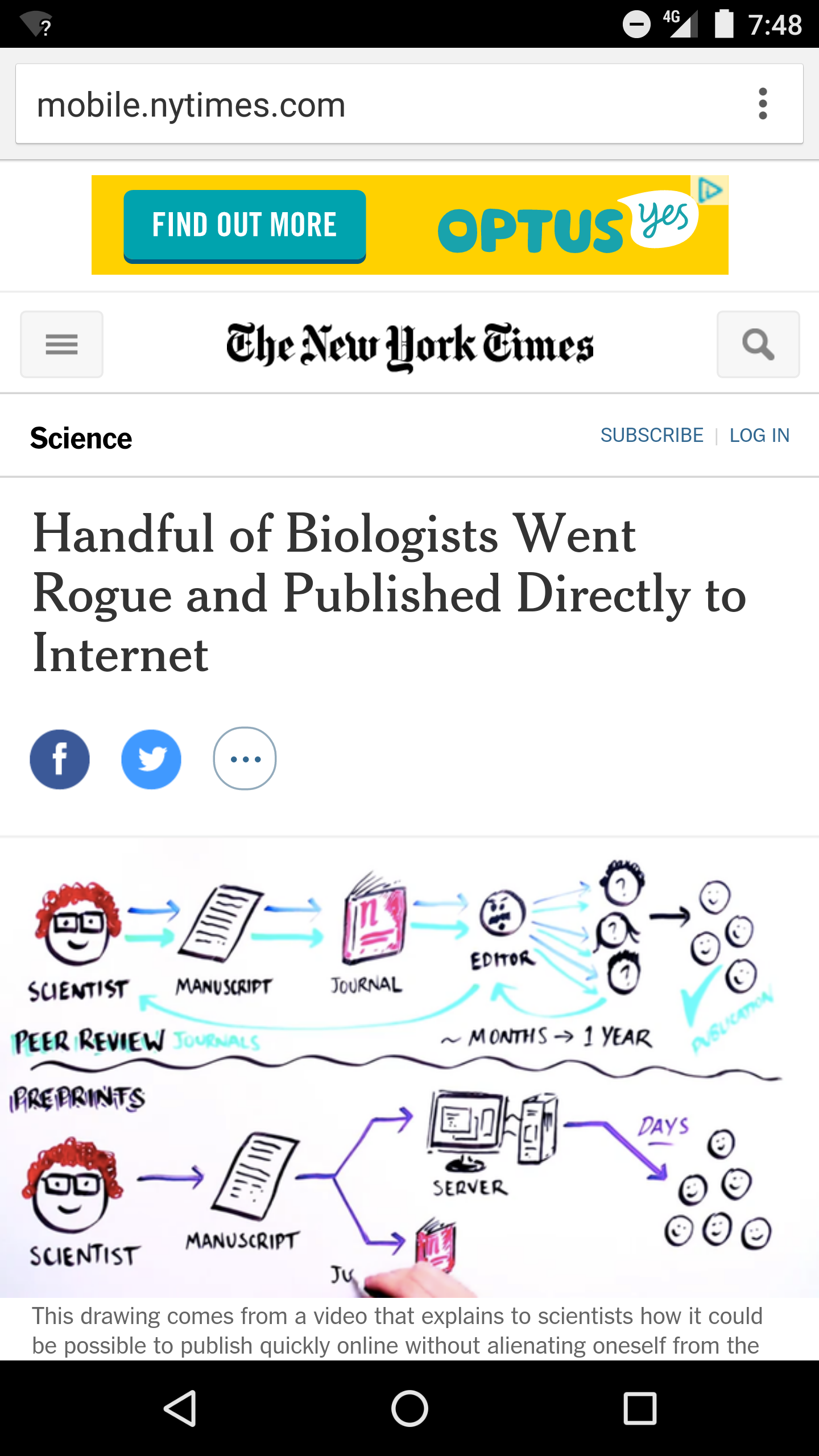
In the attached is highlighted a story about a Nobel laureate (and colleagues) that has bypassed the academic journals and their peer review process and gone straight to publication on the internet.

Academics are aghast because the authors have sidestepped all the usual peer review processes.

But the paper had also been submitted for publication where it will be reviewed.

Since the journals insist on owning copyright for the articles they publish, I see an issue ahead.

What value copyright when the material is already blatantly available on the web?

What happens if they refuse to publish the article?

Will they also refuse to publish any articles that reference this unreviewed article?

And what of peer review?

If all academics just published straight to the web the odds of crap and fraud being published and cited must go up.

The answer of course is to wrest control of publishing off the private enterprises that make profit by charging access to the very same institutions that generate the free content for them.

And this will happen.

It is happening.

The internet is a wonderful thing.

image

mxx1's avatar

Idiopaths

If you are not a fraud, nor a cheat, nor incompetent, not lazy, not frightened, nor a freak, not a sociopath, nor a psychopath, (let’s group them as idiopaths) then I would suggest that you use these simple filters to avoid employment that would make you a malcontent.

1. The organisation you work for has to be for profit

2. Your job has to have a meaningful impact on the profit of the organization

3. The profit of the organization can’t be the result of some government mandated legislation, monopoly or oligarchy. That is, the performance of the organization must impact its prospects for survival and growth, and also the prospects for survival and growth of the organization’s customers.

If these conditions are fulfilled then the people in the organization will care about you and the work you do. And then you will too.

It’s sad in a way that money is so important.

In fact it’s not; money (through profit) is simply a metric that uncovers the idiopaths.

There is no escaping the beautiful and ruthless measurement of performance in a truly competitive environment, other know as a profit.

Except that some people do escape, into organisations that fail the tests 1, 2 and/or 3.

If you aren’t an idiopath then I can assure you that the idiopaths will despise you for not being one.

So you need to avoid organisations that fail these tests, at all costs.

image

mxx1's avatar

Death, the black hole and nothing

The very worst human soul on this planet is an Australian academic that doesn’t teach, and pretends to be commercial, that lives for plenary speeches, abuses the introverted innocence of his research students, is very passive aggressive, lies to the media and himself about the importance of his demented and generic research, and sucks like almighty off the government teat.

Put a hundred of the fuckers in a building and you might just have a prelude to hell.

image

mxx1's avatar

Slim Fit Cargo Cult

It occurs to me that gen Y’s and beyond (millennials and whatever else gets promulgated) are totally beholden to the marketing message.

This means that the appearance of doing something is the doing of something.

What else could one believe in the face of the marketing machine?

Whole generations of cargo cultists!

If there is a God she has a bloody good sense of humour.

You’ll know what I mean when this lot gets around to having kids of their own.

image

mxx1's avatar

Kids

If you want your kids to have different values to those that you harbour, it’s probably best that you get someone else to raise them.

Other than that, there’s only three certainties in life; death, taxes and the fact that you have no chance of shielding your kids from your true nature.

image

mxx1's avatar

Crime Pays

From a fellow who is studying for his PhD on the subject of crime throughout the last few centuries.

“…society gets the criminals it deserves.”

And we get the politicians we deserve.

And on and on it goes.

We are what we eat apparently.

What the researcher meant was that we create the environment for criminals to exist through social conditions so we can’t be surprised when they exist.

The liberals would have it that we can solve the problems of crime by addressing the appropriate societal issues.

Some conservatives would counter that the effort would be outweighed by the cost. They don’t, but they should quote the Pareto Rule.

Most people usually believe in punishment, not as a deterrent but as justice.

Justice which just happens to validate their values and hence their whole existence.

There are days when I suspect that societal values only exist because of the negative examples that act to enforce their benefits.

Without these counter examples we probably would forget the benefits within a week or so and devolve back to whence we came.

image

mxx1's avatar

Working Dogs

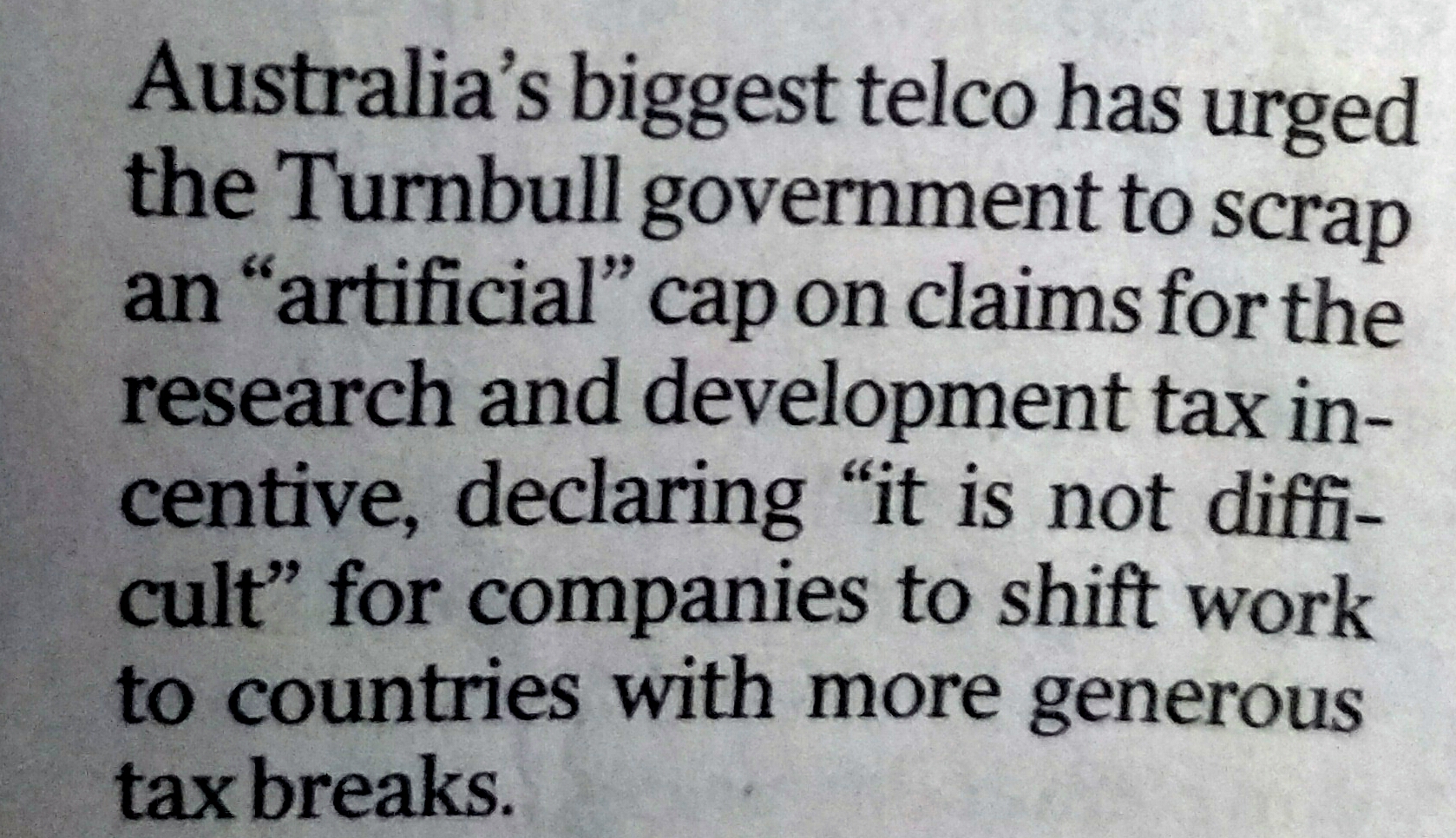
With reference to the clip below, I would respond that ‘yes it is, if you don’t do any R&D’.

But I guess they mean the work of all those accountants that artificially rebadge operational expenses as R&D.

image

mxx1's avatar

Go

The luxury of comprehension of this complex world of ours is pretty much a thing of the past.

There was a small window of opportunity for enterprising individuals sometime in the third quarter of the 20th century, after sufficient insight had been gathered after the invention of the rule of reason in 1700 and before the resulting over-complexity that developed by the late twentieth century.

Simply stated, our human systems are now too complex for any new born brain to be able to develop sufficiently so as to be able to model and extrapolate the contraption in its entirety.

Indeed both the education systems and flat screen industry seem somewhat determined to ensure that no individual even gets close.

I’m not sure whether it matters or not.

Personally I’m working on the principle that it does because I can’t help it anyway.

But I could be wasting a lot of potential leisure time.

image

mxx1's avatar

Milo the Second

I bought some bicycle handlebar grips on eBay.

A couple of weeks after installation, one of them popped along the seam.

I asked the Chinese seller if they could send me another one.

They said they preferred to just refund the money since the postage is really expensive.

I said surely the cost of the grips plus postage is less than the retail price they were going to refund me.

“dear friend,I’m really sorry for this situation,but our grip is in good condition when you receive it,right?
since this shipping fee is really high,please check if we can refund money to you as discount.
hear from you soon”

About there I gave up. Maybe they’ve figured out that it’s hurts our heads too much to deal with the Milo Minderbinders* of the world.

* At the beginning of the Catch 22 Milo gets fresh eggs to the US military mess halls by buying them in Sicily for one cent, selling them to Malta for four and a half cents, buying them back for seven cents, and finally selling them to the mess halls for five cents. 

image

mxx1's avatar

Ray

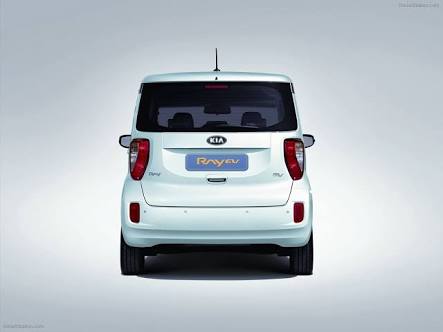
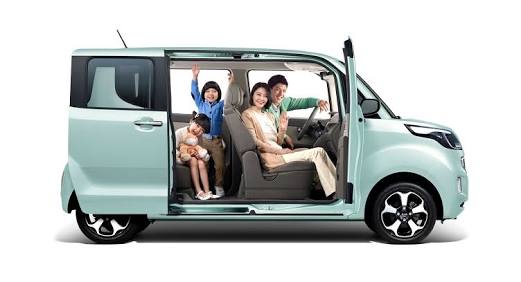
My new favorite car, the Kia Ray.

Check it out. Those people in the ad below must be midgets.

It’s a mini version of the Kia Soul and unfortunately it’s only available in Korea.

I just did a bit of research and my guess is that this is a Suzuki or Daihatsu ‘kei’ car re-skinned for the Korean market.

The Japanese would have no chance selling their cars in Korea. Hardly any foreign company does.

Those Koreans, they won’t buy Japanese cars on principle. Except they will, so long as they are rebadged as a Korean car. Everyone just pretends to look the other way.

So it makes sense for foreign car companies to do badge jobs under license but only for the Korean market. Which explains we don’t get these Kia Rays.

image

image

image

image

mxx1's avatar

More rubbish

Geez some academics are morons.

Some researchers in Land and Water Economics (sic) at CSIRO are looking into ‘economic resilience’.

They compared economic data from various US counties, before and after the 2008 economic crisis.

Quote…. “Our key findings are that counties with higher shares of relatively young workers (aged 25-44 years) on average had lower resilience, suggesting that having a more experienced labor force allowed counties to cope better after the financial crisis.”

I suspect this is dead wrong. Counties with relatively young workers probably faired poorly because young workers are far more mobile and hence left the county looking for opportunities elsewhere, leaving the county worse off for their absence.

There’s a big difference between a statistician and an economist. The former should never be allowed to attempt to explain any correlation that they dig up, on the threat of death.

What’s the bet that these researchers are well above 44 years old? Heh heh.

image

mxx1's avatar

Peak Affluence

In emerging Asian economies, with increasing affluence there emerges a growing awareness of endemic dystopia.

This results in reduced birth rates and aging populations which eventually leads to economic decline.

Japan was first. Taiwan and Korea will be next. And even China will get there I reckon.

There’s something to be said for functional indolence as practiced by the children of the enlightenment.

image

mxx1's avatar

The bulb

One can’t help thinking that it takes a lot of Koreans, working around the clock, to change a light bulb.

But in contrast to their Chinese cousins across the border, once they’ve changed the bulb they’ll remember how they did it.

image

mxx1's avatar

Someone’s mad…

Hushan, on the Chinese-Korean border, was identified as the eastern terminus of the Great Wall in 2009.

This section of the wall was excavated in 1989 and in 1992 a section of the wall was renovated by the Chinese and opened to the public.

The Korean academia alleged that the Chinese renamed the city from Bakjak to Hushan, then built the local section of the wall to diminish local traces of Goguryeo, the ancient Korean state which Koreans consider to have first built Bakjak (Hushan).

image

image

mxx1's avatar

Blue Green

Roofing materials are an odd thing.

In Australia, residential roofs are either made of Zincalume (which used to be galvanised iron) or cement tiles (which used to be ceramic underneath but nobody noticed the switcheroo).

Try putting anything else up there and the supply chain has a fit.

The supply chain includes; manufacturers, multiple layers of distributors, installers, builders, architects, developers, designers, engineers, standards bodies, and home owners.

All you need is one element to reject a new material and it’s dead meat.

Which is why after two hundred years we have just the two roofing materials. It used to be three but asbestos cement was scrubbed out in the 1970s.

Everywhere it’s the same. Roofing materials just resist and resist change.

In the US it’s shingles (real or fake) and slate in the cold and wet areas, and shingles (mostly fake), tiles and flat cement/asphalt roofs in the dry and hot bits.

Here in Korea (which is where I am) the industrial buildings and rural residential buildings all have odd blue bright blue coloured (exhibit attached) roofing materials.

The industrial buildings are Zincalume and the rural residential buildings are Zincalume and cement tiles.

Some punter in a forum claimed that this electric blue roofing color has historical precedence in Korea.

Curious, I did some research and came up with this:

“A  small pavilion named ‘Cheongjajeong’ built above Geowul pond inside the National Museum of Korea in central Seoul to celebrate the centennial anniversary of Korean museums, was unveiled yesterday….The notable part about the pavilion is that Cheongja, or blue celadon, is covered on its roof like some used to be in Goryeo Dynasty….Blue celadon is the essence of Korean culture.”

Yeah, it seems the Koreans are colour blind. Blue Celadon is actually green – see below.

Another forum entry that I stumbled across provided this alternative explanation; “It’s because the government provided only one colour paint for housing and construction assistance in the 70’s. It’s all that was available on the cheap.”

So did some enterprising US paint manufacturer with mates in the US government off-load cheap surplus paint through government assistance to Korea after the war?

The only problem with this argument is that blue roofs are also found in North Korea which was separated from the South in the 1950’s.

The Japanese controlled Korea from 1910 to 1945, and the Japanese have areas with blue roofs as well. A much nicer and less garish blue I might say. But still blue.

But the Japanese forums are at a loss to why there are blue roofs. And indeed they point to Korea and China as the source of fired clay roof tiles, way back when.

I guess it will have to remain a mystery.

image

image

mxx1's avatar

The Rabbits and the Foxes

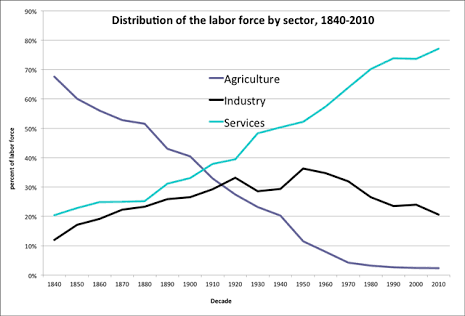
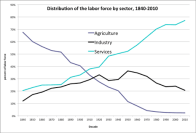
With reference to the plot below.

Before the industrial revolution over 90% of people in the West were employed in agriculture.

After the industrial revolution, productivity in the agricultural sector improved and people increasingly shifted to employment in factories because they weren’t required on the land.

It was a self-fulfilling prophecy; factories needed people to run and they also needed all those people to have jobs so they could consume the work product.

But eventually technological unemployment caught up with the factories. As productivity improved, labour, the unreliable and expensive input into manufacturing, was slowly made redundant after the 1950s.

Then, with nowhere else to go, the workforce started shifting increasingly to the services.

The services sector can be thought of in many ways;

1. As people serving people or people serving business. A taxi driver versus an IT administrator in a large corporation, for example.

2.  As people employed in improving business efficiency, or as people employed in artificially constructed jobs with no economic benefit other than the employment of the service provider. For example, the same IT administrator in a large corporation versus someone employed in an ephemeral NGO or a spiritual guidance guru.

3. As people employed in incumbent services or people employed in creating new services. An extreme case study would be the taxi driver again versus the CEO of Uber.

Where I’m going with this is that the services sector needs to be broken up into more useful sub-segments.

There’s not much point having a sector of the workforce that supposedly accounts for over 70% of the population in an artificially uniform slab.

With three categories of services, as listed above, each with two options, my way of looking at the services results in 8 sub-segments.

That’s too many to be useful and in any case, the categories aren’t really binary. On each measure any specific job could be anywhere on the three dimensions. Visually, that’d be one of those useless spider web plots.

But of these 8 sub-segments some have already peaked in employment and are falling victim to disintermediation and ever improving productivity.

For example, the ticket selling job at the train station that is no longer required due to the newly introduced universal ticketing system. Or the call phone operator role that has been replaced by a computer generated voice system. The enterprise software systems support engineer made redundant by cloud services. The Uber driver who will no longer be required as autonomous vehicles become a reality.

My guess is that the current IT era will eventually be seen as a turning point where, around the start of the 21st century, two sub-segments of the services increasingly absorbed most of the people.

Driven by competitive forces, businesses will do everything possible to reduce their collective services workforce.

So I expect to see most people finding roles serving other people in ever more artificially created jobs.

At the same time, employment in larger companies or large government enterprises will give way to employment via consulting and in SMEs.

These jobs are in what I call the “Rabbits” Services Sector.

These will become incumbent roles that are not immediately replaceable by machines because of government legislation, or because of the whims of the human customers, or due to the scope of the technical challenge.

There will be a second group, the “Foxes” Services Sector, composed of a smaller number of people employed in business strategy and management.

Ironically the focus of this sector will be on accelerating this polarization of the workforce through the development of ever accelerating disintermediation and automation technologies.

When the Foxes can also be replaced by machines we’ll be living in some sort of Asimov novel.

It occurs to me that modern schooling is mostly to do with preparing kids for a life with the Rabbits. It all adds up. Unquestioning and harmless participation in both the workforce and the community is coached. Hard.

A school for the Foxes would be so much more fun. But its probably not needed. Oh well.

Philosophy will become redundant. We already know what we’re doing here on this planet. Surviving with the minimum amount of pain and for the maximum amount of time.

42 my arse!
image

mxx1's avatar

Addictions

My own personal version of the Pareto Rule is that in matters of human behavior it is often the case that extra effort after some initial mental and/or physical attention results in ever escalating negative results.

The results don’t just plateau off with extra effort, as the Pareto Rule would have it. They head south into negative territory.

In its extreme form this hypothesis covers addictions.

Addictions are the brain’s attempt to force it’s host moron into addressing some grievous psychological harm.

In these instances, if the horse doesn’t drink the water then it tends to flog itself to death.

image

mxx1's avatar

Jobs

Stuck on a plane and lacking viable options I’m watching a movie on the subject of Steve Jobs.

A man that I met once for a business meeting and one that didn’t resemble the one in the movie.

Indeed it’s chestnut central, this movie.

The Jobs character even said “whoever said ‘give the customer what they want’ was probably a customer.”

It’s a tad confusing because I’m pretty sure I saw another movie on the subject and it wasn’t this one.

But maybe the Americans made more than one. They’re pretty much into eulogising Jobs.

And I’m not sure why. Although he was at the helm when a few things happened for the first time, these things were going to happen without him, in time.

Many innovations are like this.

Flight for example. If the Wright brothers had run out of cash then someone else would have been the first to get airborne that year or the next.

Just as a thought experiment I made a special category of innovation, one where it’s highly likely that an innovation wouldn’t have happened ever if the originator hadn’t innovated when they did.

I couldn’t think of a single technical innovation to put into that bucket.

Firstly, all of old-school science is ruled out of this category since it was just about all ‘discovery’; putting words ands maths to observations of nature.

This is “plod” country, and the so called great scientists are completely redundant to the process.

Once the unexplained observation exists it’s only a matter of time before some highly functional Asperges character figures it out.

Physics for example wouldn’t have had to wait too long for Relativity if Einstein had fallen under a bus.

Secondly, there’s engineering which includes all of IT. Plod, plod, plod. What has happened always would have, in one similar form or another.

If VHS had never been funded we would have happily used Betamax for a couple of decades and it would now be long redundant. Who cares?

Truthfully the only true innovators are in the arts, where ironically the genius of creation is totally subjective. But also totally unique.

So why are science and technology innovators, the first to create the inevitable, given so much airtime?

I suspect that it’s just for encouragement. The story that is spun is that the rewards supposedly go to the winner of the race. The money, the fame and the power.

Unless you’re Confucian.

Then you’d know that the rewards go to the person with the most money hanging around waiting to pick up the new things at the appropriate time.

Imagine that; a whole country that thinks like tricky financiers. There’s a reason why they don’t have to fight wars too often.

image

mxx1's avatar

Holy Something

Here’s the headline in the Guardian:

“US agency reaches ‘holy grail’ of battery storage sought by Elon Musk and Gates

And here’s the details.

“The companies incubated at Arpa-E have developed new designs for batteries, and new chemistries, which are rapidly bringing down the costs of energy storage, she said.”

Well strictly speaking they aren’t bringing down the price of anything since they don’t have any products on the market.

Even overlooking this piece of academic stupidity, you’d think the term ‘Holy Grail’ might be reserved for a definable but bloody hard to achieve specific invention.

Like the first aeroplane, the first solar cell, the first non-latex condom, or the first autonomous dildo.

You get the idea.

image

mxx1's avatar

Catholic Church

I’ve blogged this before but in the context of George Pell’s anti-confession I thought I would summarize it again.

The Vatican pretty much only owns the land within its borders. It’s annual revenues are around just less than half a billion dollars, as are it’s costs.

One third is from profits from the Vatican Bank, a sort-of investment back.

Another third come from tourism.

And the final third from Peter’s Pence, a small fraction of all of the world’s Catholic collection plates.

The local dioceses around the world have their assets in local trusts and get their revenue from collection plates, schools, grants and endowments.

They run cash neutral as well, on average.

The relationship between the Vatican and the dioceses is essentially that of a franchise. A small payment to use the brand and the promise of promotion to the employees that are so inclined.

That relationship is sans contract.

In essence, the church is a very small legal target because of the lack of internal contracts defining these transactions and the complete lack of control or ownership by the Vatican of the distributed hard assets.

Indeed a diocese can leave the church tomorrow and be better off due to not having to pay the Vatican their franchise fee. The employees would get to keep use of their assets but lose their hopes of promotion to titles such as cardinal and beyond.

In fact this is what happened during the reformation.

If the “church” is forced to make financial reparations resulting from these child abuse claims my guess is the local diosceses will foot the bill, and will do so by selling assets.

It’s a bit of a cluster fuck to be honest and desperately in need of modern restructuring, which may just be forced on them, at least in Australia.

image

mxx1's avatar

For the record

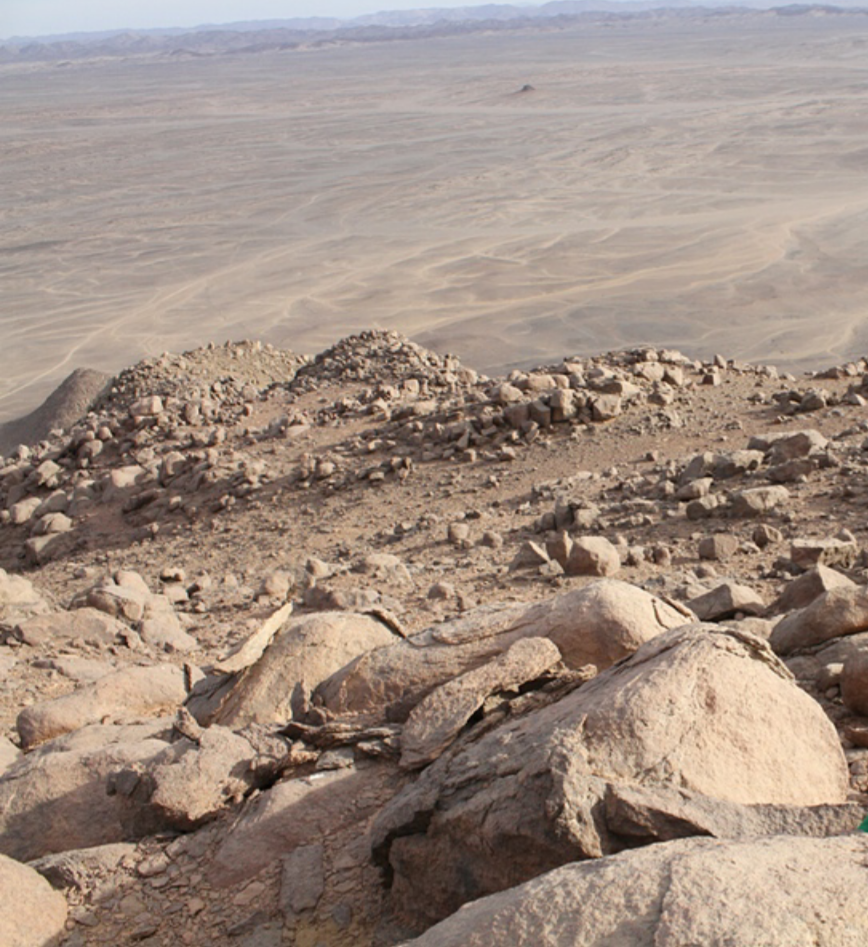
Bir Tawil is an 800-square-mile section of complete desert nestled within the border that separates Egypt and Sudan. Both nations have renounced any claim to it, and no other government has any jurisdiction over it.

Egypt and Sudan’s rival claims on neighboring Hala’ib, which has oil reserves, both rest on documents that appear to assign responsibility for Bir Tawil to the other country.

As a result, neither wants to assert any sovereignty over Bir Tawil, for to do so would be to renounce their rights to the larger and more lucrative territory.

On Egyptian maps, Bir Tawil is shown as belonging to Sudan. On Sudanese maps, it appears as part of Egypt.

In practice, Bir Tawil is widely believed to have the legal status of terra nullius – “nobody’s land” – and there is nothing else quite like it on the planet.

Maybe Roddie could go live there! The king of the nannyless state.

image

mxx1's avatar

Mason Dixon

All my shorts have gone North
And my socks have joined them
Jeans? South, the lot
As with belts
In protest at unfair work conditions
Whereas the diaspora of undies
The insidious buggers presume what the heart does not
They’re all getting binned next week
And replaced
With smalls of the heart

image

mxx1's avatar

Vampire Singularity

I’ve got to the stage in life where I hardly ever meet new people that have thoughts, feelings or experiences that add to my gestalt.

Generally I don’t bother; one glance and the item is catalogued.

Finding genuinely new or surprising ‘content’ is also getting asymptotically harder.

Experiences? I’m happy to have them but I’m not seeking any insights therein. That’s an unexpected bonus when it happens.

I guess that this is my punishment for exploring the universe so avidly for the last 500 years. Or is that 2000?

The result? I’m spinning around looking for an angle, all the time modeling what I already know.

It can’t be that interesting to watch, I bet. And my interest in sharing all this is rapidly diminishing as well.

I can see a singularity ahead. Ahem.

image

mxx1's avatar

Time Alert

Just because I know that some members of the audience sometimes miss the inferences I’ve decided to be clear about it.

I suspect that self-awareness and consciousness depend critically upon an awareness of time; past, present and future.

To be able to recall oneself in the past, or to project oneself into the future, these must both be a critical requirement of human consciousness.

Imagine a goldfish with the infamous three second memory. No memory of the past self; no consciousness.

Similarly you’d have to think that the goldfish doesn’t spend too much time worrying about the future.

Therefore it’s extraordinary that the super-evolved humans attempt to ‘live in the now.’

What’s going on here?

Well they are simply trying to depress their human consciousness in attempt to at least partially achieve the contentment that a goldfish must feel when it’s not being eaten by the pet cat.

These human pseudo-goldfish, in their quest, depend entirely on a safe human environment (such as a nanny state) because by attenuating their consciousness they are turning off the key human survival mechanism of using the past to intelligently model the future, and adapt behaviors accordingly.

Irony alert!

To be fair to the pseudo-goldfish, the habits of consciousness might sometimes overshoot or be on some sort of Pareto curve where the cons of living too much in the past or future start to outweigh the benefits.

Knowing this I’d suggest that the concept of ‘living in the now’ itself should be used cautiously and not exclusively.

It’s all about the balance and the vibe of the thing.

image

mxx1's avatar

Futurology

Now that bicycles riders are being fined to buggery in NSW, you think they are going to stop there?

Just for the record, here’s the details:

● Not carrying approved photo ID – new fine of $106

● Not wearing a helmet: increases from $71 to $319. Equivalent to the motor cycle fine, even though a motorcycle has much higher power and can reach much higher speeds.

● Running a red light: increases from $71 to $425. Equivalent to cars, even though at many intersections bicycles are unable to trigger the traffic signal.

● Riding dangerously: increases from $71 to $425.

● Not stopping at children’s/pedestrian crossing: increases from $71 to $425. Equivalent to cars.

● All other general bicycle fines: increase from $71 to $106.

● Riding bicycle without working warning device (e.g. bell or horn): $106

This is all in the name of safety mind you.

What’s the chances that the next victims of the Nanny State will be pedestrians?

Here’s a bit of futurology for you:

● Pedestrians not carrying approved photo ID – new fine of $106

● Not wearing a helmet on skateboard, scooter or similar: $319

● Pedestrians walking whilst using a mobile device – $425.

● Pedestrians crossing against a ‘no walking’ indicator light:  $425.

● All current J-Walking offences: $425.

Now you know how the cyclists feel!

image

mxx1's avatar

Artificial Humanness

I honestly believe that the difference between humans, chickens, geckos, amoeba and the most powerful computer system is processing power.

Sure there might be different mixes of digital, analogue, quantum and who knows what other type of processors amongst the species, but this just changes the volume and energy efficiency of a unit of processing power.

Given enough digital processors I’m pretty sure that one could model a human brain. This is an assumption that would be strongly disagreed with by those sentient beings that are low on the the ability to reason (which just happens to be correlated to those that have strong religious beliefs, by way of example). For this reason,  I’m pretty comfortable with my confirmation bias on the subject.

So where in this soup of processors do we derive our sense of ‘humanness’?

Oddly, the scientific and IT community is focused on ‘intelligence’ as the key arbiter of humanness. As in the interest in the invention of Artificial Intelligence. For example, a machine fooling a human into ‘perceiving’ that the machine is a human.

Philosophers are more focused on Artificial Consciousness. They break this up into ‘access’ and ‘phenomenal’ variants. Access consciousness concerns those aspects of experience that can be apprehended, while phenomenal consciousness concerns those aspects of experience that seemingly cannot be apprehended, instead being characterized qualitatively in terms of ‘raw feels’, ‘what it is like’ or qualia.

Sentience is the capacity to feel, perceive, or experience subjectively. Eighteenth-century philosophers used the concept to distinguish the ability to think (reason) from the ability to feel (sentience). In modern Western philosophy, sentience is the ability to experience sensations or ‘qualia’.

Artificial Sentience is a lower bar than Artificial Consciousness, but a Google search suggests that not too many people are using this lower bar as a guide to humanness.

My hypothesis on the matter is that, unlike machines we humans live and die. A machine can be kept working forever if well maintained. And unlike amoeba we are aware of the threats to our lives.

Somewhere along the evolutionary path we developed consciousness, and awareness of self and time, so that we could perceive not just the daily threats of death, but future threats of death including the inevitable and ultimate death.

This enabled us to properly use our newly evolved intelligence to delay death by planning ahead. This is the point of the existential fear of non-existence; it defines our humanness.

And the proof is in the pudding – we are now living longer than ever.

Who could argue that this is not a result of our intelligence and consciousness, working together in our social construct in order to devise ways for us to live longer and longer, and to avoid risks along the way?

This capability has given our species the upper hand over all others in this closed biosphere with its limited  resources.

So if one truly wanted to create a machine that fools a human into perceiving that the machine is human, then the machine must have these characteristics:

  1. A future undeniable point of non-existence
  2. Intermittent and measurable risks of non-existence on daily basis
  3. A means of utilising processing power to attenuate risks of death
  4. A bucket-load of processing power that it can reconfigure itself

Out of this will come a sense of time and self.

Oddly enough, if one accepts this reasoning then both artificial intelligence and artificial consciousness are each necessary but not sufficient conditions for artificial humanness.

And those individuals that manage to seriously attenuate their fear of non-existence are essentially attenuating their humanness. So they’d better get used to being lonely along with their desired-for contentment.

There’s going to be a day when a machine that is on the way to artificial humanness will become more human than an individual attempting to achieve artificial unhumanness.

No one will notice.

image

mxx1's avatar

More on Chess

It’s no accident that the first big effort at demonstrating Artificial Intelligence was played out in a game of chess.

In the late eighties IBM’s Deep Blue super computer was pitted against world chess champions.

Finally in 1996 the machine defeated Garry Kasparov in game one of a six-game match.

No one truly believes that this effort conformed to Turing’s test for Artificial Intelligence, namely that Deep Blue was able to fool a human into thinking that Deep Blue was a human.

All it showed was that Chess is a very constrained mathematical problem that can be solved quite happily by code. The constraint up until 1996 was simply processing power.

In any case, the Turing test is retarded. A much better test for AI is when a machine has a bank account.

This is a smart-arse way of saying that we humans live in the past, present and future (to varying degrees) whereas machines live in a timeless state, blissfully unaware of the past, the present or the now.

The desire to own money and to have a bank account indicates some sense of living in the future rather than the now, and a memory of the past.

When a machine desires money and a bank account we will know that a machine has some degree of consciousness and also some fear for it’s future safety. These are very human traits.

Back to chess; my assertion would be that a human chess expert is practising Artificial Unintelligence (AU) by forcing their brains into a constrained mathematical domain.

My version of the anti-Turing test is this: Artificial Unintelligence will be achieved when a first human can convince a second human that the first human is actually a machine.

This has already been achieved. I’ve met a few and I don’t envy them.

image

mxx1's avatar

Cross Eyed

I know exactly what I hate about chess and it has almost nothing to do with the type of people that play the game.

My disliking of the format has to do with the mathematical-visual space that I have to take my brain in order to be good at it.

I can do it; I did for a while when I was at school. And I was good.

But I particularly dislike this brain space because it requires that I turn off all sorts of other functions such as esthetics and empathy.

What I am afraid of is that the wind might changes directions whilst I’m playing chess and I might get stuck in the mode forever.

A fate worse than death. It makes me shiver just to think about it.

image

mxx1's avatar

Spiritual Dysfunction

It must be true, the papers said so…

“Nearly two-thirds of  women experience ongoing sexual dysfunction six months after giving birth…the four most common problems were sexual pain disorder, sexual desire dysfunction, sexual arousal disorder and orgasmic disorder…A prospective study of 500 women in the UK found 83 per cent of women had sexual dysfunction at three months and 64 per cent of women were still experiencing it at six months.”

The final paragraph of the story reads … “Women with deep religious convictions were three times more likely to experience dysfunction than those without religious affiliations.”

The cunning buggers probably subconsciously decide they don’t want any more kids for the time being, and this is their most viable option.

A study at the University of British Columbia has shown that people’s ability to analytically solve problems is strongly anti-correlated with measures of religious belief. Cause or effect, nobody knows.

Putting it all together; there’s more than one way to skin a cat. But in every scenario the poor old cat cops it.

image

mxx1's avatar

Large Garbage Bag Days

Amongst a long list of compulsory items for all students, Lola has to take four large garbage bags to her three day school camp.

For a sack and spoon race? For excessive waste disposal? To black out the curtainless windows? For midnight raids on suspected terrorists? For the teacher’s home stash? I can’t wait to find out.

One thing’s for sure, she refused to countenance any discussion upon the merits of this requirement.

Hardly an education is it?

image