mxx1's avatar

Commission-funded real estate projects in the parts room collection!

It’s hard to know what to do with this inbox pearler…

“Commission-funded real estate projects in the parts room collection!

In order to concentrate fully reflect the development of new building materials, new materials to promote technology exchange and further provides authoritative reference for the tender project nationwide, China Real Estate Resources Committee decided to editing and publishing the “national real estate resources and new materials applications recommended Directory. ” If your company is interested in participating, please read the recruitment files, fill in a single receipt.

Wish business Great!”

image

mxx1's avatar

Thingy

When you fully understand something, especially some complex human system thingy, it loses its power to outrage.

It is even denuded of its aura of interesting.

However that “full understanding” isn’t for the faint hearted (understatement for the ages.)

Parsing all this, habit is the addiction of the third quartile. But this disguise makes no sense since it is a resignation borne in ignorance and fear.

There’s a wormhole and I’m pretty sure those that have gone through it could not see any xxx in communicating it’s whereabouts.

xxx = rationale + vibe + feeling + point + purpose + gestalt + karma

image

mxx1's avatar

Default

Interesting data point from this morning.

I met this bloke who used to underwrite student loans in the US.

By category, the worst defaulters were from the Bible Schools, with default rates as high as 50% by students from some institutions. Gotta wonder about those Christian values.

The next biggest offenders were law school graduates, who probably could properly assess the risks, could use their skills to get out of trouble, and generally didn’t give a shit.

The groups with the lowest default rates were from Ivy League schools, small liberal universities and doctors.

image

mxx1's avatar

Chit and Chat

Email from an old colleague: “I’m looking for a speaker to talk to a group of Sydney start-up Entrepreneurs”

Me: “I suppose you could pencil me in – it’s always subject to travel of course.”

Old colleague: “Thanks for the quick reply I’ll be able to fill the April speakers spot without any problem if you’re not too keen?”

Me: “To be honest I don’t know what to say to Gen Y’s and Millennials. They confuse me since they seem to filter out anything that isn’t confirmation bias.”

Old colleague: “Yeah I know what you mean.”

image

mxx1's avatar

The rise and rise of the ?

Online newspapers just love posting articles with titles that have question marks. This is why:

1. They can post the cheap brain farts of pseudo experts and keep some (very vague) semblance of authoritativeness, and

2. Readers that disagree with the proposition don’t switch off until after they click through and read a few paragraphs, and

3. Readers that are enticed by the proposition click through, and

4. In both cases 2 and 3 advertising revenues are earned. This is gaming of the advertising metrics related to their revenues

And it’s implied question marks as well as literal ones.

As in (thanks SMH) “Mother explores cause for child’s uneven teeth. You will be shocked at what happened next.”

What?

image

mxx1's avatar

Godless

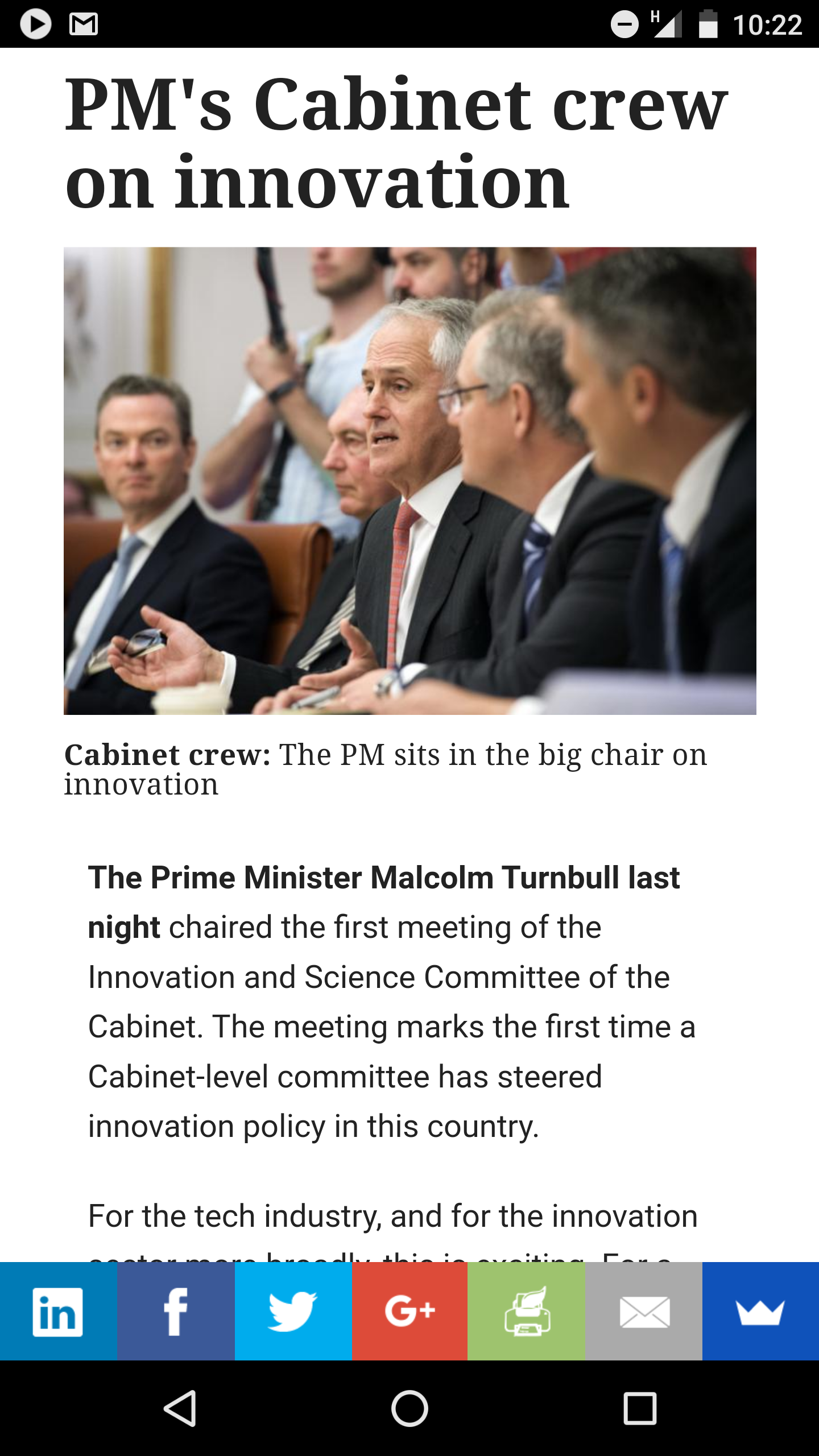
Referring to the story below, one wonders what was discussed at this historic event?

My guess; landing pads on Mars, tax breaks for asylum seekers, R&D tax incentives for marsupials and monotremes, visas for qualifying Chinese billionaires, the importance of science in the IT century, handouts to the oligarchies for pondering innovation, and the repurposing of CSIRO into an unwilling marketing agency.

If Innovation is Turnbull’s signature policy focus then the man has a serious problem. He either doesn’t know (1) that the policies are shit, or (2) that no voter gives a shit. Or both, I suppose. Either any way; shit politics.

Please bring back Tony. At least he was consistently inconsistent, and damned funny at times too.

image

mxx1's avatar

Fitted Sheet

I’m telling ya, peoples are morons.

If you only own one fitted sheet you never have to fold the fucker.

Consumerism would have your average moron buying more than one fitted sheet and then worrying about how to store the unused one, neatly.

And that is a fail on at least two counts by which intelligence is measured.

If you have to think about this for more than a nanosecond them I would suggest some serious remedial psychoanalysis.

image

mxx1's avatar

Meme

A meme (/ˈmiːm/ meem) is  supposedly “an idea, behaviour, or style that spreads from person to person within a culture.”

The word meme is a shortened version of mimeme which was artificially derived from the Ancient Greek μίμημα meaning “imitated thing” by some craven adulation-seeking wanker known as a “Dawkins”.

Supporters of the concept (i.e. other, even less intelligent wankers) regard memes as cultural analogues to genes in that they self-replicate, mutate, and respond to selective pressures.

What a meme seems to be these days is a re-posting on Facebook of a picture with words added to it in block letters in what seems like a seemingly random approach.

From my sampling of Facebook I would say that people post them because (a) they don’t have anything of their own to post, (b) they find them ‘funny’ (i.e. they don’t understand them), and (c) they have an existential fear that a lack of postings on Facebook equates to not existing.

So I would like to suggest that a meme is in fact “an image with meaningless words added that spreads from Facebook page to Facebook page within a culture of uneducated morons that have a dreadful existential fear of not existing.”

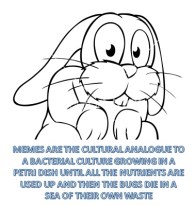
I regard memes as the cultural analogue to a bacterial culture growing in a Petri dish until all the nutrients are used up, where upon the bugs will die in a sea of their own waste.

images

mxx1's avatar

Self Esteem

This is worth recording…

My daughter has just ‘escaped’ (my verb, not hers) from the Eastern Suburbs of Sydney and is now ensconced in a forward-looking and quite culturally diverse Queensland state high school.

I asked her today if she liked her new friends.

Very much.

But (followed the whine) today she wore new Nikes, and nobody even noticed. Back at Clovelly they would have been the subject of half a day’s conversation.

I chuckled and said something like “you can’t buy self esteem my love.”

image

mxx1's avatar

Flaws in the Current

At the weekend I had the great displeasure of hearing this bloke say to an audience (in an Oprah-like fashion);

“Greatness is already in you. All you have to do is remove the barriers that are stopping you being great.”

I disagree.

Greatness requires talent, drive, inordinate amounts of hard work, and good luck.

Or bad luck, depending on where you’re coming from.

Often the drive required for greatness is motivated by an early (in life) lack of self esteem.

As self esteem is established the need for achieving greatness should diminish. It’s just a means to another end.

After all, the drive for greatness is very much rooted in the existential fear of not existing.

The fear is strong in some, so strong that it overrides the comfort of inertia.

Inertia is the path of least resistance which unfortunately for many leads them to depart their lives with exactly the same fears that accompanied them into the world.

Failing to address the fear of not existing, in my world view, leads to an ‘F’ on St Peter’s report card.

What the guru should have said to the people is;

“The fear is already in you. All you have to do is remove the barriers that are stopping you from not fearing non-existence.”

Back to the others, the ones that do achieve so called greatness; I tend to take no notice of them.

I just assume that they are all critically flawed.

I guess there’s going to be the odd character that achieves greatness through no fault of his or her own, or posthumously (when, for example, they are unable to delete their social media pages).

So I suppose I would have to cut these guys some slack. But there’s so few them that I’m pretty comfortable making them collateral damage, all Utilitarian like and all.

I’m pretty sure they wouldn’t care a jot.

image

mxx1's avatar

The Philosophy of Hair Curling

I’m telling you, that increasing productivity is going to lead to none of us being employed in critical jobs. Machines will do it all.

This is going to lead to all sorts of new spiritual jobs as we collectively dig into our functional lack of purpose.

image

mxx1's avatar

Hippies

There are many ways to explore questions relating to life, the universe and everything.

I just wish that people would stick to one competent medium when they do so.

For academic philosophers I say, stay in your cognitive written world.

Authors, whether it’s feeling or thinking that drives you to write, please don’t talk at book launches.

Hippies, for God’s sake, please don’t try to think at all. You will invariably be revealed to be the cerebral morons that you are. So you’re much better off learning and communicating in other ways.

Oh, by the way, the center of the universe doesn’t actually exist. You’d know that if you’d finished high school.

image

mxx1's avatar

Strategic Marketing, Chinese Style

The first question that is asked in Western style strategic marketing process is ‘what is the problem that needs solving?’

Does the product or service need to be cheaper, better, re-packaged or easier to buy? What does the customer find annoying?

A professional innovator can ask these questions of any Western business leader or any set of Western customers, and get answers that may lead to innovation.

Thereafter follows the usual processes of strategic marketing and innovation – brain storming, benchmarking, the R&D process, the 4P’s, and 4C’s, planning, yada, yada.

However, ask a Chinese business leader the same question and you will usually find that there isn’t a problem. The product or service is quite fine as it, thanks, and will remain so until the customers think otherwise.

The focus of the Chinese business leader is more often to make the company too big to fail.

Innovation is done by others and then copied only after it has been successful in the market. This approach just about completely de-risks innovation.

Strategic marketing becomes bloody simple under the Chinese model; just copy anything new-ish from the West after it looks like it’s working.

And indeed they have even invented a new style of a ‘patent-like system’, one where the Chinese government makes it hard for Western companies with new IT products to access the super-large Chinese market.

I call this a ‘patent-like system’ because it grants Chinese companies a period of operating monopoly (or oligarchy) in which to create business success, free from competition from the original Western source of the innovation.

They don’t have to do this for manufactured goods because they are so cost competitive that there is little incentive to import manufactured goods into China.

We in the West believe that the first-mover advantage in innovation is far more valuable than it really is.

In times past we have even propped up the first-mover advantage with patents.

But in this IT century the first-mover advantage is greatly diminished because of the weakness of the value of IP in the IT domain.

Patents; they have little value in IT due to the often obvious or abstract concepts behind IT innovation. Trade secrets; well they hardly exist in IT because just about anyone can code up a solution from scratch once they have seen it in action.

The first-mover advantage in IT is far less important than access to capital and access to markets, of which the Chinese have plenty.

My personal view is that we in the West are addicted to the concept of innovation because of three hundred years on confirmation bias since the Enlightenment.

Essentially we selectively re-run success stories of innovation and first-mover advantage to such an extent that we don’t stop to question the business value of new ideas in this IT era.

I believe that an innovative solution to this problem is to redefine innovation as access to both capital and markets, and to de-emphasize the creation of new ideas, maybe to zero.

The problem in Australia of course is that we don’t really have much access to risk capital. Nor do we have much of a market to play with.

If I were to share these views with any local experts in marketing communications they would counter that true innovation is the creation of the perception of brand value.

Long being a services-led economy we have been world leaders in the dark arts of marketing communications. Over many decades, for example, we have been harangued into believing that our oligarchical service providers are soft and cuddly pseudo-charities with world-leading products and services.

But even in marketing communications the Chinese have skipped ahead of us in their use of social media instead of broadcast media in order to promote the more useful concept of democratic brand value, which is far closer to the true value of a product or service.

To be honest, we in Australia have much to learn from the Chinese in respect to innovation in the 21st century. We would be well-placed to copy their approach rather than believing that we have great innovation skills to offer them.

AAEAAQAAAAAAAAUlAAAAJGZlOWFkNTE2LTU4YTctNDgzYy04YTQ3LWRhOTBjNDUzMjczMA

mxx1's avatar

Button Up Plan

Can you imagine an Australian designed and manufactured car, free of intervention by American or Japanese overlords?

My guess is that the OH&S risk analysis part of the project would be so vicious that it would be deemed way too dangerous to allow humans into the vehicle.

So we’d end up with autonomous vehicles not suitable for carrying any passengers.

But they’d look great, have great big turbo-charged V8 engines, and accelerate to 110 km/h in 2.3 seconds.

Despite the autonomous control, they’d be programmed to occasionally exceed the speed limit to keep the state government coffers from drying up.

They’d be made in Senator Xenaphon’s seat in Adelaide and distributed by Dick Smith autos.

Each and every vehicle would be subsidised by the tax payer to the value of a Hyundai i20.

And they would require hand washing every weekend or else they would refuse to start on Monday morning.

image

mxx1's avatar

The Dandy Arsehole

I am caught in two minds here.

Coffee in one hand and my egg and bacon roll within reach of the other, I have found just about the only unoccupied seat left at the Qantas domestic terminal.

But the neighbours….

As in is my wont I have given myself about 45 minutes too much waiting time. It’s simply that I hate missing planes. Well that’s not true; I hate worrying about missing planes when I am just about to. And even that’s not true. Once I know I am going to miss a plane I stop worrying altogether. What I hate is thinking about it all, more than I hate getting up early.

So I needed to find a seat; it’s too long a wait to consider standing, eating and drinking.

Back to the business of the neighbours. Next to me at the solely unoccupied table is two persons. My guess is that they are government employees of the state variety. Maybe upper middlish managers in State Rail. Or something like that.

She, who doesn’t figure in this story, is a middle aged Indian woman of a totally nondescript nature. She hardly says a word. Nods a lot though, like one of those dogs on a dashboard.

He is about 40.

Probably a tad over-dressed for State Rail. The suit is too sharpish with its pin stripes contrasting with the over-contrasting shirt. He has a pocket kercheiffy thing going down as well. Pocket squares, I seem to recall, is what they are called.

Not unexpectedly he looks prematurely out of condition. But he has had plenty of practice in talking about himself, that is for sure.

[Switching to past tense; 15 minutes have gone by dear reader and the pair of nuggets have gone now]

I just got his whole life story in ten minutes in an annoyingly high-pitched first generation accent. Having gone to a multi-cultural school I would guess his parents were Yugoslavian of one sort or another. And I can say that because they were born in Yugoslavia, and when they left it was still Yugoslavia and not the current collection of seething pocket squares.

His mother was a saint that died young, at 72. Worked hard, raised all the kids, went to church and imparted all her wisdom on the kids (including my confessor) which seems to have boiled down to this; work hard, be entirely self focused and die shortly after you retire. Oh, and be as banal as you possibly can be.

The rest of the conversation was broken up into lectures on work and real estate.

Work was just a series of brain dribbles masquerading as management activities. Dribble, dribble, dribble. He even said at one point; “we need to do something new or innovative”. I would have loved to a have asked the difference.

Real estate was all about the value of his house, then the value of the one next door which didn’t even have an en suite and sold on the weekend for one point five millions dollars, and then the one he almost went deep into debt for last year which is on a thousand square meter block and is now worth half a million more than he would have paid for it.

Finally he got onto his vision for his life. At forty years of age he is fixated on retiring young and enjoying his retirement with plenty of cash and no anxiety. At some point, he said, he might even travel somewhere.

About here I couldn’t take it any more, the headphones went in; The Dandy Warhols to the rescue.

image

mxx1's avatar

Zebra Ethics

This has happened before but it’s worth recording again.

I was cycling along when a twenty-something girl from the Hillsong Church, on a bicycle, was about to cycle across the pedestrian crossing in front of me, from footpath to footpath.

I could have stopped or kept riding whereupon a direct hit might have got her in some soft spot and killed her.

Would you kill the skinny chick?

Firstly you should note that in half of Australia’s states and major territories – Queensland, Tasmania, the ACT and the Northern Territory – adults are allowed to ride on the footpath.

In the other states, including NSW, it’s illegal unless you are accompanied by someone under 12 years old. Usually that’s written the other way around but same-same.

Legally, the skinny chick on the bike was breaking the law. But so may I be if I take her out.

Then there’s the ethics of the thing.

Do you just stop for everything at a pedestrian crossing on the basis of the common good.

Or does it have to be a certified ID carrying human ambulator that is obeying each and every one of the two hundred laws that could be broken at a pedestrian crossing?

Then there’s the morals.

Should all skinny chicks from the Hillsong Church on bikes at pedestrian crossings be taught the lesson that they need to be taught? Your bike is not better than mine, luv.

Or do you go with the vibe and observe ‘Be Nice to Tweeting Millennials’ week?

image

mxx1's avatar

Futurology 101

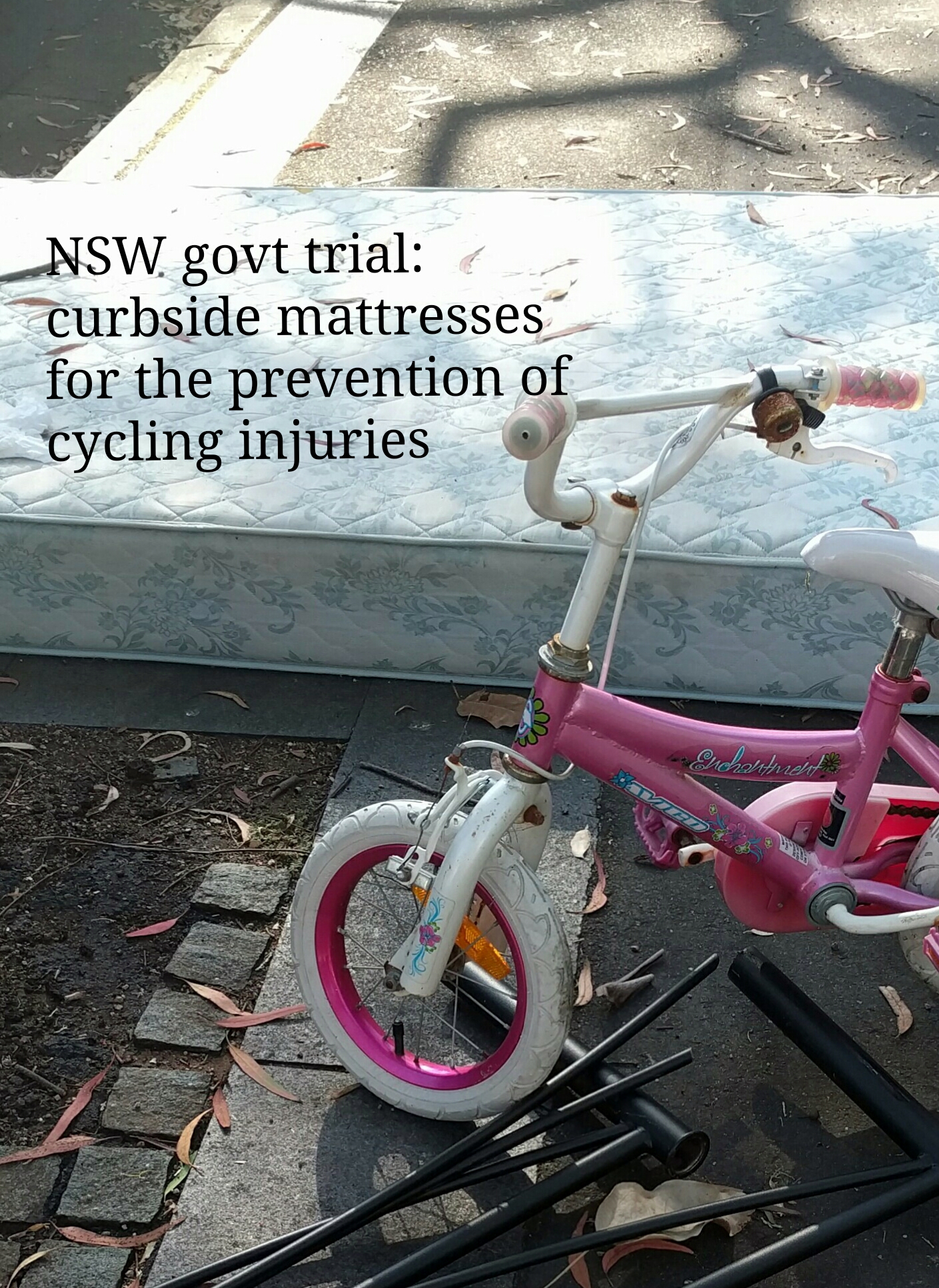
So I got a little worried about the rest of my life, based on recent cycling-related Nanny State issues that just keep popping up like weeds.

One minute it’s the cops, the next a drunk former shearer that inexplicably was handed the role of NSW state minister for roads, and then its the Sydney Harbour Foreshore Authority.

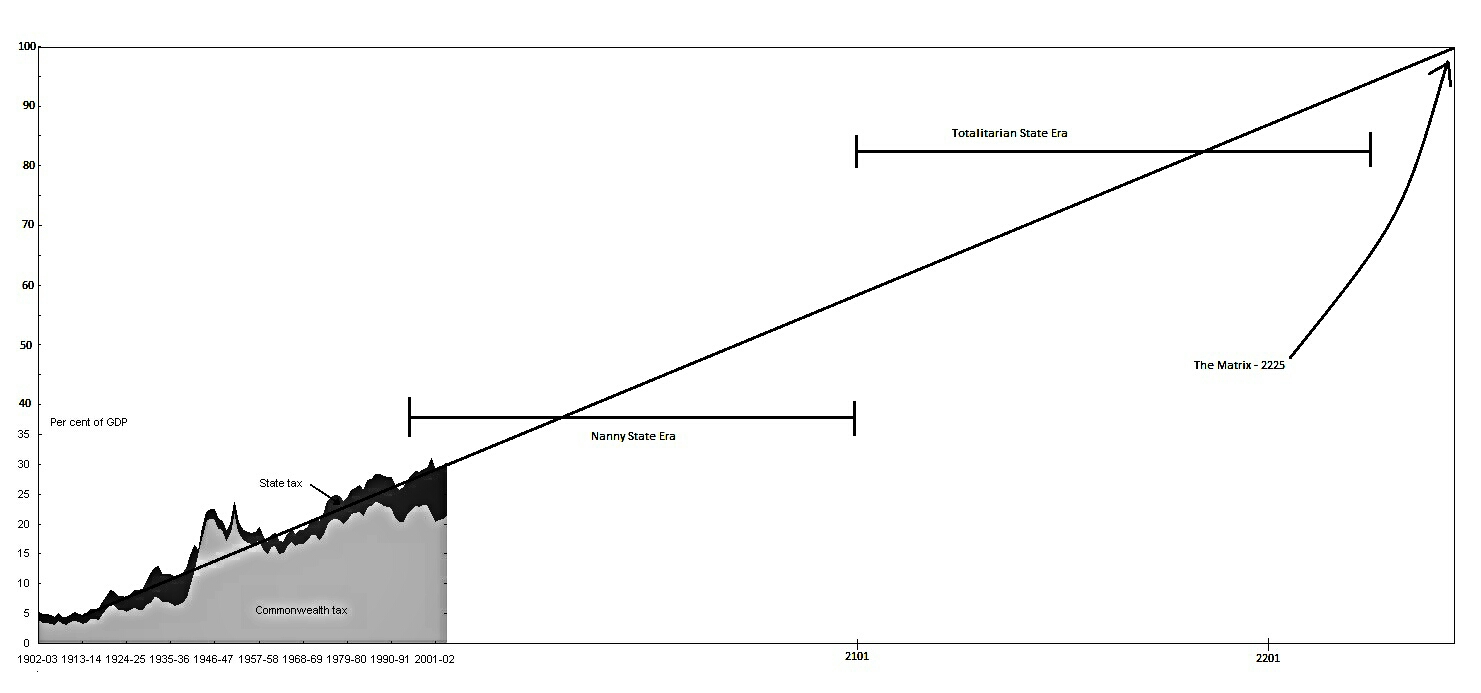
This prompted me to do what I’ve been meaning to do for a while, and that is extrapolate to 100% the plot of the percentage of Australian GDP that is taken as tax  receipts.

My thinking is this; the Nanny State only exists because governments need to create extra laws in order to spend all that extra money they take off us. Or, looking at in reverse, all those extra laws are there means by which they take all that extra money off us.

It’s a sort of chicken and egg scenario, but with frogs and fruit loops.

In any case, it’s all good news.

We will be in the Nanny State era up until the turn of century (the rest of my life that is, lucky me) when tax receipts will top 50% of GDP.

Then we will have another hundred-odd years of old-school totalitarianism, culminating in an event in the year 2225 when tax reaches 100% of GDP and the machines will put us all into The Matrix for safekeeping.

Or, if we’re lucky there will be a zombie apocalypse before then.

image

mxx1's avatar

Frog on the Boil

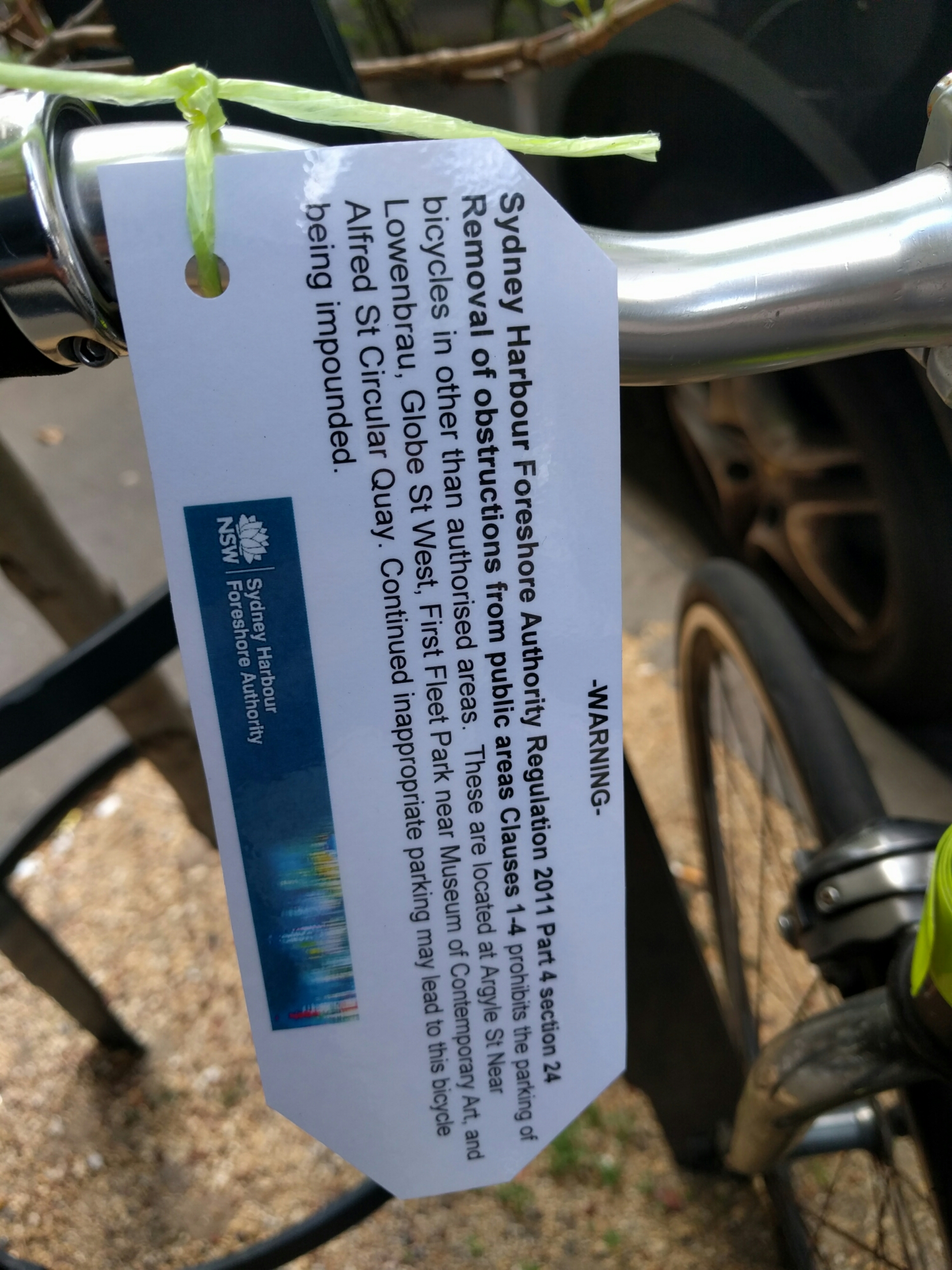
This is getting quite frustrating; who in their right mind writes ‘inappropriate’ when they mean ‘illegal’, thus making a mockery of grammatical jurisprudence?

This is what happens when people that look after boats get into bicycles that don’t float. They see the ‘no parking’ signs as akin to pylons.

Me thinks that SHFA must really stand for systematic high functioning autism.

image

mxx1's avatar

Nanny State

I was riding through Redfern today when, lo and behold, I was shanghaied by JJJ reporter, mike in hand, that  forcibly threw herself in front of my bike.

She was after a cyclist’s opinion on the new NSW laws with regards to the same. I suspect she had a deadline and was short of some juicy feedback.

Being careful only to proffer a first name, I proffered away. Heh heh.

image

mxx1's avatar

The Fat Man

For Greggie,

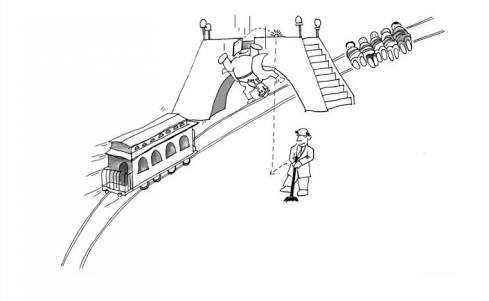
Utilitarianism as embedded in law would have it that we never have the right to kill the fat man. This right is what we had before laws and that is why this right was taken off us. Because on average we are much better off not having this right.

Blog over.

image

mxx1's avatar

Syria

A breakthrough in Syria announces the headline … with the details listed as:

“A cessation of hostilities is to come into force within a week, US secretary of state John Kerry has said.”

All good so far …

“In an agreement brokered between the US, Russia and other powers overnight in Munich, a UN task force will meet within days ‘to develop the modalities for a long-term, comprehensive and durable cessation of violence’.”

Developing modalities? In which dimension did these people never finish high school maths?

“The cessation deal explicitly excludes Islamic State and al-Nusra front against whom military action will continue.”

Oh, so all they have is agreed to do is gang up on the little blokes before they get back to fighting each other through proxies.

“Russia has not committed to end its airstrikes in Syria but repeated its insistence that it was targeting terrorist groups.”

And indeed the whole thing is bullshit since Russia has only promised to consider the vibe of the thing.

Gotta love it.

image

mxx1's avatar

Logical Defences

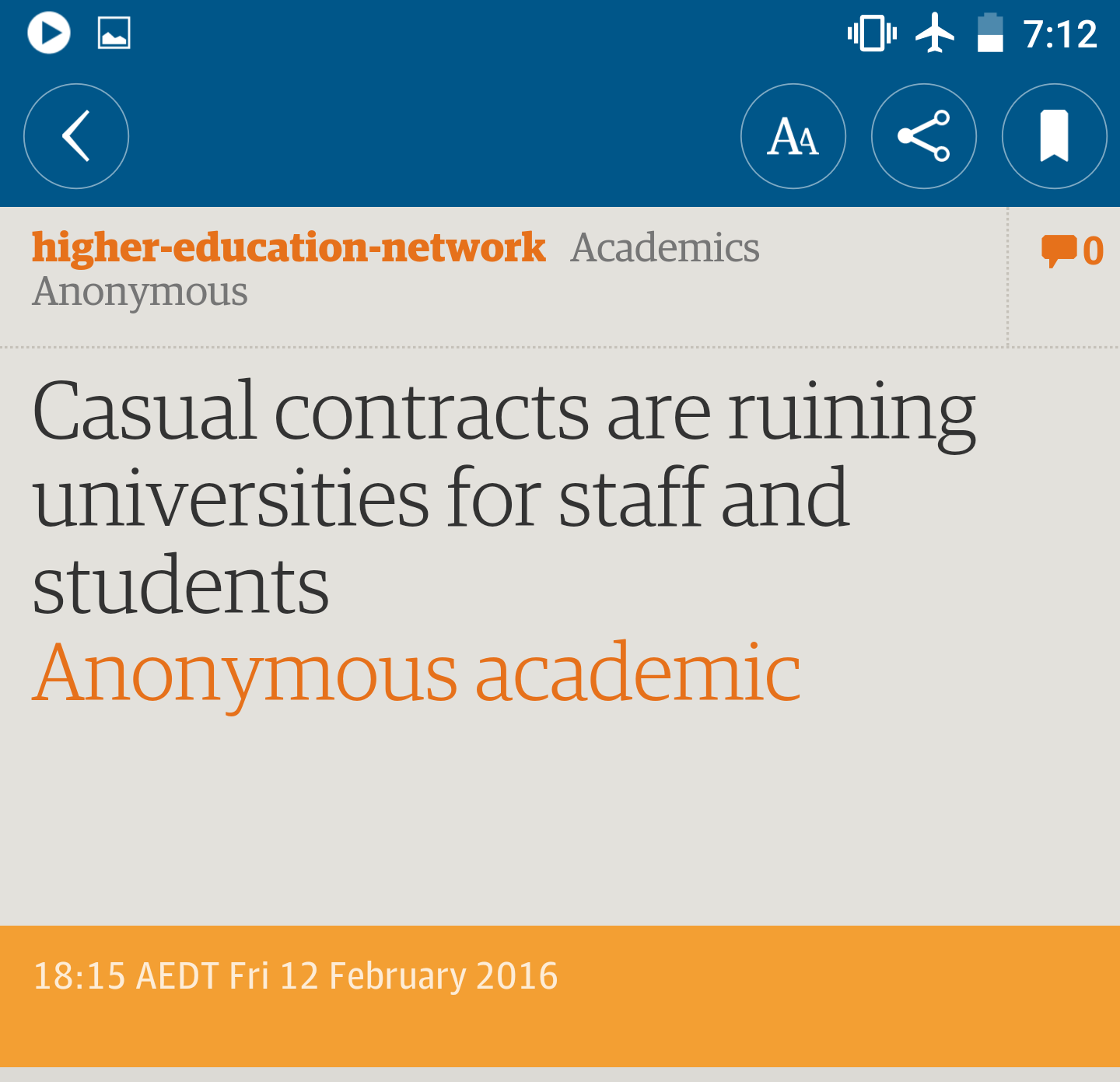
Today I had a chat to an old friend who’s a sort of university academic.

I say ‘sort of’ because this person exists from contract to contract which vary between one and three years in length, subject to research grant success.

What I got was a big whinge about the unfairness of this, viz a viz those lucky academics with full-time and even tenured employment.

I countered that I couldn’t think of anything worse than being shackled to a job at a university through some cushy T&Cs. I noted that it’s the teens not the sixties, after all.

I suggested to my old friend that rather than seeking the rotting debenture, he could look for ways to diversify his income through contract work.

Confusion at the other end.

I explained that he could have more than one contract in place at a time, and that one or more of those contracts could be from non-university sources.

I suggested that income certainty was better in this scenario and that if he is worried about continuity of personal cash flow he would be better off seeking multiple-contractibility rather than job security with its binary risk factor of temporal non-existence and CV-destroying lack of variety.

I also noted that modern IT massively enables the ability of an individual to become a genuine contractor.

I suspect that I was up against some resistance from the personality type in this instance.

There was to be no inserting of logic through the defences not constructed with logic in the first place.

image

mxx1's avatar

Stink Eye

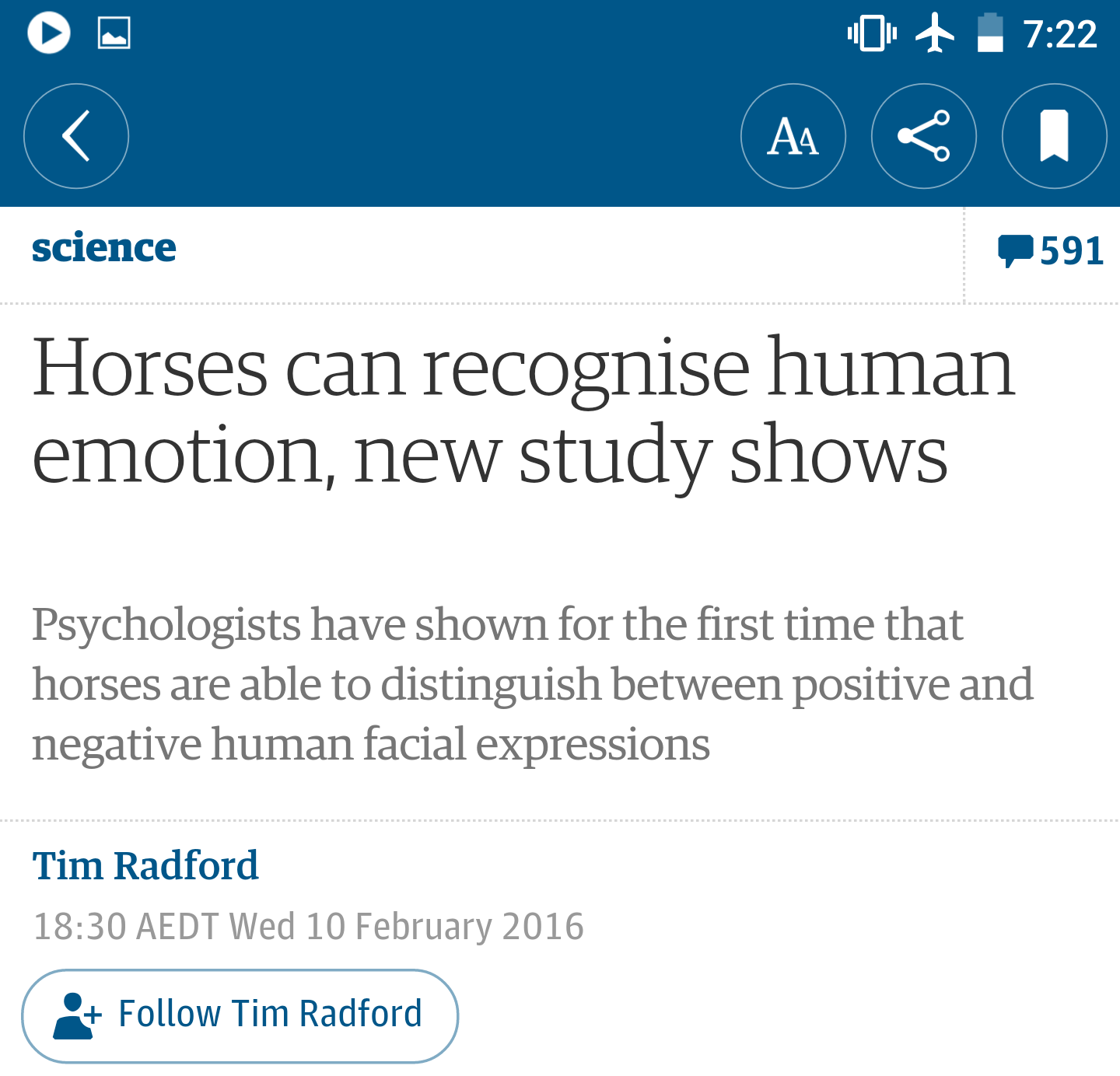
Horses can recognised human emotions (only with their left eyes, LOL), new study shows!

“Karen McComb, who heads the research group and co-lead author of the study, said ‘Horses may have adopted an ancestral ability for reading emotional cues in other horses to respond appropriately to human facial expressions during their co-evolution. Alternatively, individual horses may have learned to interpret human expressions during their own lifetime’.”

Nuh, she’s got it all wrong. Humans learned to read facial expressions off horses. Before we domesticated the buggers we were all autistic frozen faces.

image

mxx1's avatar

Uber Bus

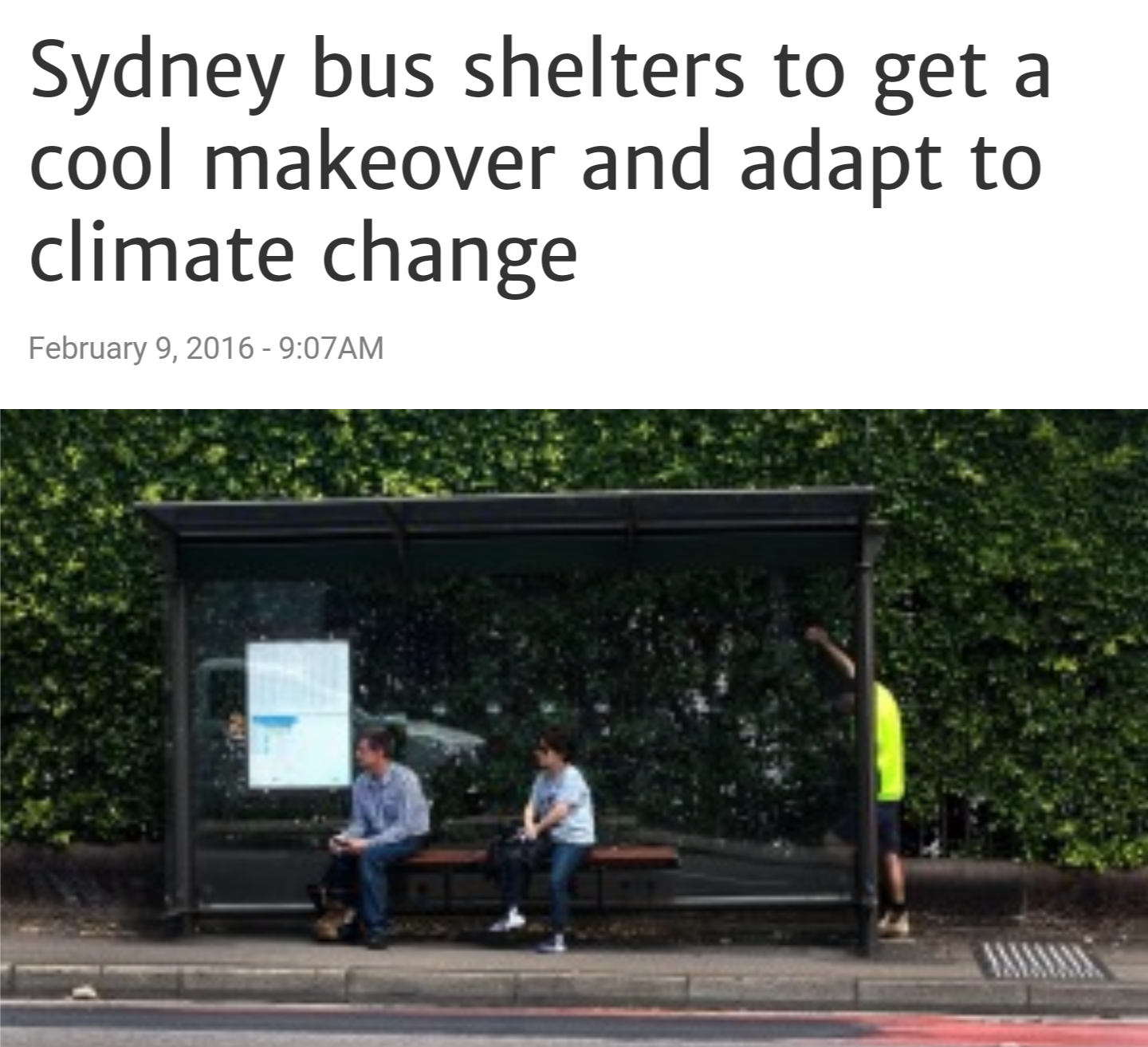
This is an odd story; there’s a competition to design a new style of bus shelter for Sydney.

Someone has finally recognised that half a glass house on the side of a busy road is a shit place to be.

In winter you get wet. In summer you get fried. At all times you get asphyxiated.

My best idea is to remove the need for visual contact between the bus and a prospective passenger by having an app that allows prospective passengers to simply state where they are going and then hit a ‘hail’ button.

The relevant bus driver will then know that he or she has a passenger to pick up at that bus stop which is identified by the prospective passenger’s GPS location.

The passenger would be alerted to the bus’s near arrival by the usual alarms. In fact the passenger could even see their bus en route on a map.

It’s just freaking Uber guys! Do it already…

Under this scenario bus shelters don’t have to be made of glass or have walls missing etc. Problem solved. They could be air conditioned. You’d know who’s in there by the app. In fact you could use the app as a door lock to keep out strangers. Etc

image

mxx1's avatar

The Conversation

The editor at The Conversation writes to me thus:

“Ian, I thought you might know if there was any research on this area.

I’m not sure if it’s becoming more of a thing or I’m just noticing it but after the announcement today from Vodafone about their ‘start-up incubators’ in London, Singapore and Comm Bank’s ‘innovation lab’ in the same sorts of places, it got me to thinking what is the purpose of these places? They are couched as places to inspire innovation (and probably to capitalise on talent in these tech hubs) but I wonder whether it’s mostly a marketing thing.

Do you know if there is any research on the use ‘hubs’ or ‘labs’ like these? Either internationally or here in Aus?

Thanks,
Jenni”

I reply:

“Jenni

I am not aware of any research on the subject, however my casual observations would suggest that these corporate incubators have three functions:

1. Marketing to customers, as you suggested. I put this in the bucket of ‘profile’ marketing – where a company is trying to create a positive impression with the public. This is usually a sign that a company is in an oligarchical environment and thus it has the money and the inclination to attempt to create the impression otherwise.

2. Marketing to staff. This is an attempt to convince staff that the organisation is groovy and funky, so as to help with staff retention

3. Keeping up the corporate Joneses. Down at the club the CEOs now must have an incubator to discuss, whereas once it might have been a corporate jet. These things come and go, like fashions

You will note that usually the actual cost to the company of operating the incubators and investing in the companies is way less than the marketing budget associated with the incubator.

Also you will note that the people that run these incubators are usually wonderfully unqualified to make any sort of success out of the things.

A genuine ‘unicorn style’ success would be embarrassing in as much as there would recriminations as to how much the corporate made out of the deal; no matter what, it would be too much or too little, or something. The party with the deep pockets always seems to get sued!

Which brings me to my last point; I have checked a few of the Australian corporate incubators and not one insists that its incubator companies sign a Covenant Not To Sue – which shows an incredible level of ineptitude.

All of that is opinion, unfortunately.
regards
Ian”

image

mxx1's avatar

REAL index

I don’t really want to write this but I may as well get it down so that I can refer to it if I ever need to.

Ever heard of the GINI index? It’s a measure of statistical dispersion intended to represent the income distribution of a nation’s residents, and is the most commonly used measure of inequality.

It’s not very accurate or precise but it gives the impression of quantifying the subject matter, and it’s main purpose is to stop those morons that insist on references to academic papers from derailing any debate on the subject.

In this very context I have in my head a new index which I will call the REAL index.

It’s a measure of the ‘realness’ or ‘usefulness’ of a person’s employment.

At one end we would have a 0, where employment is totally artificial and at the other end, 1, where employment is very much directly related to basic human needs.

I haven’t come up with any specific maths but this index would be impacted by things such as:

  1. Does your employment exist only because of some government legislation?
  2. Does your organization provide unique product and services?
  3. Are your job skills unique, or are you readily replaceable?
  4. Is your employment or organization in any way associated with basic human needs?
  5. Yada….

I would say that before the industrial revolution that most people had a REAL index close to unity.

Today my guess is that it’s totally the reverse and that most people have a REAL index closer to 0.

What has happened is that increased productivity has meant fewer and fewer people are needed in employment related to basic human needs; probably well less than 1% in the West today.

This could have gone two ways; you might expect that all those people that weren’t required for critical employment would have been left to rot and we could have ended up with an incredibly two tiered society.

But, fortunately I guess, we needed all the people to have money so they could consume the outcomes of all that increased productivity in goods and services that we don’t really need.

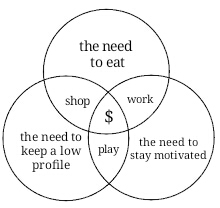
And thus we all went up the REAL index as layers and layers of complex and quite artificial jobs were created around layers and layers of non-critical goods and services.

image

mxx1's avatar

Goggle Msuci

I tried. I really did.

For about a year now I have been subscribing to Google Play Music which is sort of like iTunes.

For a $11.99 monthly fee you can stream just about all the music you could ever want to listen to. Although I have found weird exceptions, such as Neil Young, which they don’t seem to have the rights to.

You can even download music to your phone for listening when you’re not connected, like when you’re in a plane. This downloaded music is hidden deeply in the phone in files that I couldn’t find; I guess this is to stop people posting them on torrent engines or just buying lots of music cheaply.

I have had a few gripes with this service but not enough to force me to leave.

For a start the app is sort of B- quality. Lots of stupid functionality and things missing etc. Not a show stopper but really you’d expect more from Google.  The web version is even worse.

But the biggie occurred yesterday; the system just failed to charge the monthly fee to the credit card. The card was fine – I just used it for something else, so it seems their carrier pigeons were having an off day.

When I finally managed to re-subscribe all my music was ‘lost’. Which is to say my selected music and playlists are no where to be seen. I now have to go and curate all that music again, apparently.

Well they can get fucked. I am going back to Pirate Bay.

I’ve said it before; offer a good service at a decent price with access to all content, and people will happily pay. But go and fuck up the basic functionality and you get what you asked for.

Geez.

Untitled

mxx1's avatar

Imputation

Impute: to assign a value to something by inference from the value of the products or processes to which it contributes.

As in “recovering the initial outlay plus imputed interest.”

Those high school English teachers, they’d take that transitive verb, consider the related noun and call it a implied contributive computation.

Maybe they’re onto something there.

But maybe I’m incorrectly assuming that impute and imputation are related.

In economics, the theory of imputation maintains that factor prices are determined by output prices.

Which is a fancy way of saying that the value of a good or a service is determined by the consumers, by way of what price they are willing to pay. This being instead of some calculation based on the cost of producing the good or service plus a margin.

In yet another permutation, imputed income is when someone avoids paying for services by providing the services to themselves (e.g. avoiding the cost of a prostitute with a bit of masturbation), or when a person avoids paying rent for durable goods by owning the durable goods.

An example of the latter is when someone lives in their own property and therefore passes up on any rental income they could get in exchange for not owing an equivalent amount of rent to someone else. This person also avoids paying income tax on any rental income they would get from renting the property.

When it comes to receiving company dividends in Australia, New Zealand and Malta (yep, just the three countries), an imputed dividend is where some or all of the tax paid by a company on its profits is attributed to the shareholder by way of a tax credit to reduce the income tax payable on the shareholder’s increased income resulting from the distribution via dividends.

Having reviewed all this, it would appear to me that in the world of finance and economics that any shifty transfer of an obligation is labelled as some sort of imputation.

Commonly this is known as a SEP or Someone Else’s Problem. Rather than being a implied contributive computation I would suggest that an imputation is an implied non-contributive computation.

Further, I would impute that an imputation is so-labelled to confuse and befuddle those that don’t benefit from them.

image

mxx1's avatar

Good Writing

In order to consider the question as to ‘what is good writing?’, I first have to separate fiction from literature and non-fiction.

For non-fiction, good writing leaves the reader in no doubt as to what is intended and does not get in the way of consumption. It helps if the writing is elegant or in other ways attractive – that’s like added coconut oil between the sheets.

For fiction, good writing has one key goal; the ability to take the reader away and into the story, whether that is via imagery or otherwise.

Literature, on the other hand, is all about the writing first and the story second. The point of literature is to showcase fantastic, novel or complex writing. Of course if that is also in the context of an interesting story; all the better.

Horses for beaches I say.

image

mxx1's avatar

More Grammar

An independent clause is often followed by a subordinating conjunction, upon which a dependent clause owes its existence.

Try explaining that to a 12 year old that already knows all this and couldn’t be arsed trying to remember what you call the things.

The odd thing about writing is that you don’t need to be able to articulate the rules of grammar in order to apply them.

Memory and the vibe of the thing will pretty much do it, in most instances.

But try doing maths without a full understanding of the rules. Not a chance.

image

mxx1's avatar

Literally

The state high school system seems to have invented it’s own form of pre-remedial grammar and literary deconstruction construction.

The evidence?

By week two of high school I’ve seen a few examples in Lola’s homework.

This weekend’s reiteration quiz asks her to identify an ‘indirect judgement’ in a short story that she was given to read.

Never having heard this term I turned to Google. And they have no record either.

So I read the story, looking for an ‘indirect judgement’ using the common understanding of what these words mean.

Nothing. Five paragraphs later, not a clue as to what they are talking about.

They gave a clue. They sort of implied that an ‘indirect judgement’ is an implication. To me this sort of implies an unnecessary ‘indirect construction’, otherwise known as a complication.

My best guess is that they are referring to the fluff on the right hand side of a semi colon which contains the evidence for the assertion on the left.

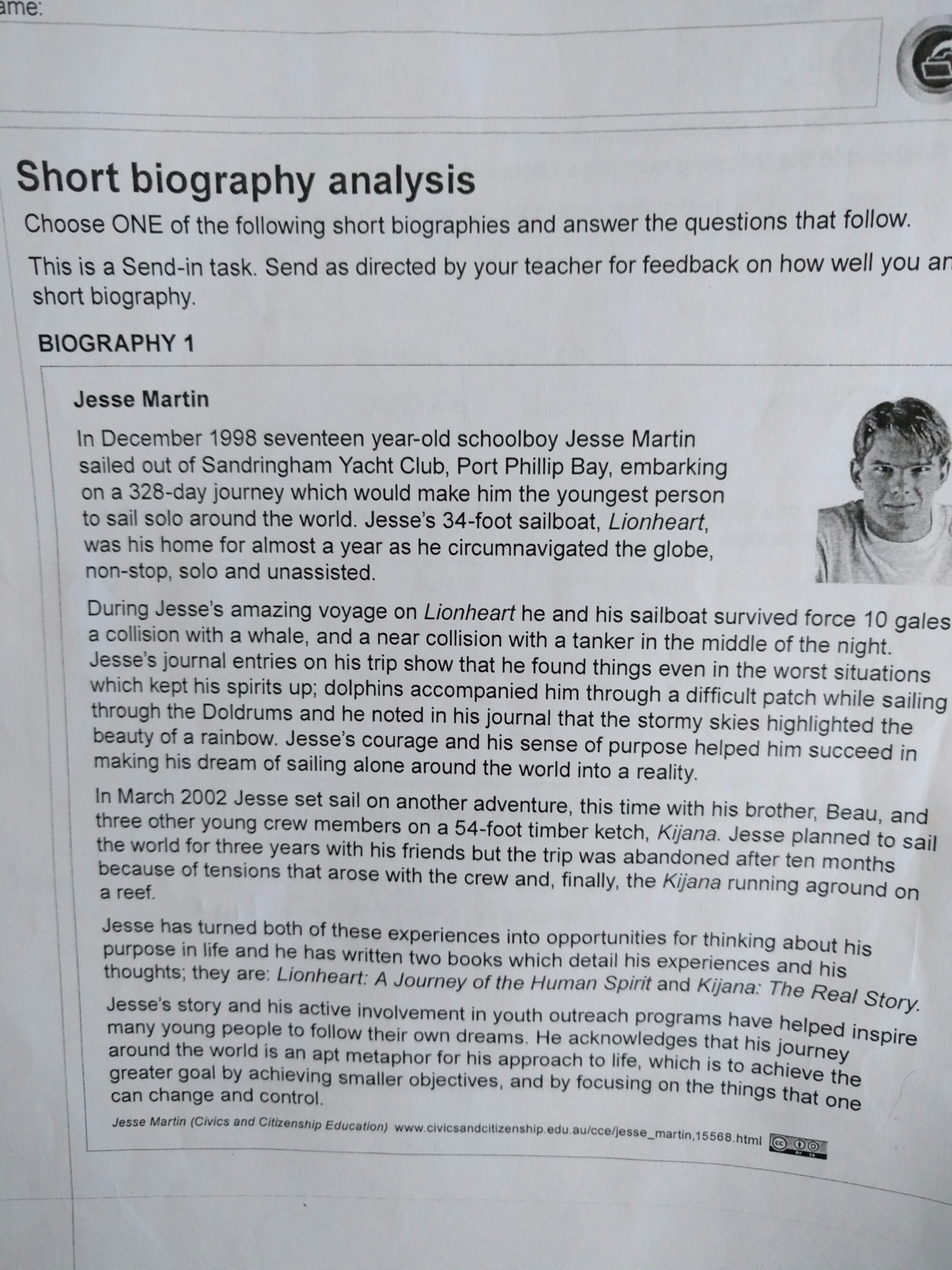
“Jesse’s journal entries on his trip show that he found things even in the worst situations which kept his spirits up; dolphins accompanied him through a difficult patch while sailing through the Doldrums and he noted in his journal that the stormy skies highlighted the beauty of a rainbow.”

I’d like to say to them, please construct your sentences with some thought … the left hand side should read;

“Jesse’s journal entries show that even in the worst situations he found things to keep his spirits up”

The right hand side barely passes the credibility test; 12 year old kids can see through bullshit.

Now I don’t have a strong issue with these guys making up their own terminology and deconstruction structure except that;

1. It won’t amount to any useful learning for anyone that intends to pursue any sort of literary career, and

2. It makes it bloody hard for parents to help their kids with their homework.

image

mxx1's avatar

The Long Short Affair

Google is now a subsidiary of Alphabet.

Last year, Google’s products such as its search engine, maps, Gmail, YouTube and Android, made up $74.5bn of Alphabet’s $75bn annual revenue.

That means that every other subsidiary of Alphabet had a total revenue of just $448m, and an overall loss of $3bn.

From automated cars to smart contact lenses, to vacuum cleaning robots. You name it, it’s in Alphabet’s loss-making whacky ideas department.

What this proves, yet again, is the failure of early and lucky success to teach entrepreneurs anything worth knowing about how hard it is to do tech.

What makes it even worse for the Google clowns is that they had access to cheap capital, their shareholder’s capital, to invest in whichever tech butterfly caught their collective attention.

Which means that the ideas that they backed were absent the professional pushback from those that manage risk capital.

I call this a double jeopardy; doomed to fail.

I hope there’s a way to short Alphabet whilst going long on Google.

One thing’s for sure; the recent division of Google and Alphabet must have been constructed to isolate the eventual losses in Alphabet.

image

mxx1's avatar

Quinella

Quinella: a bet in which the first two horses in a race must be predicted, but not necessarily in the correct order.

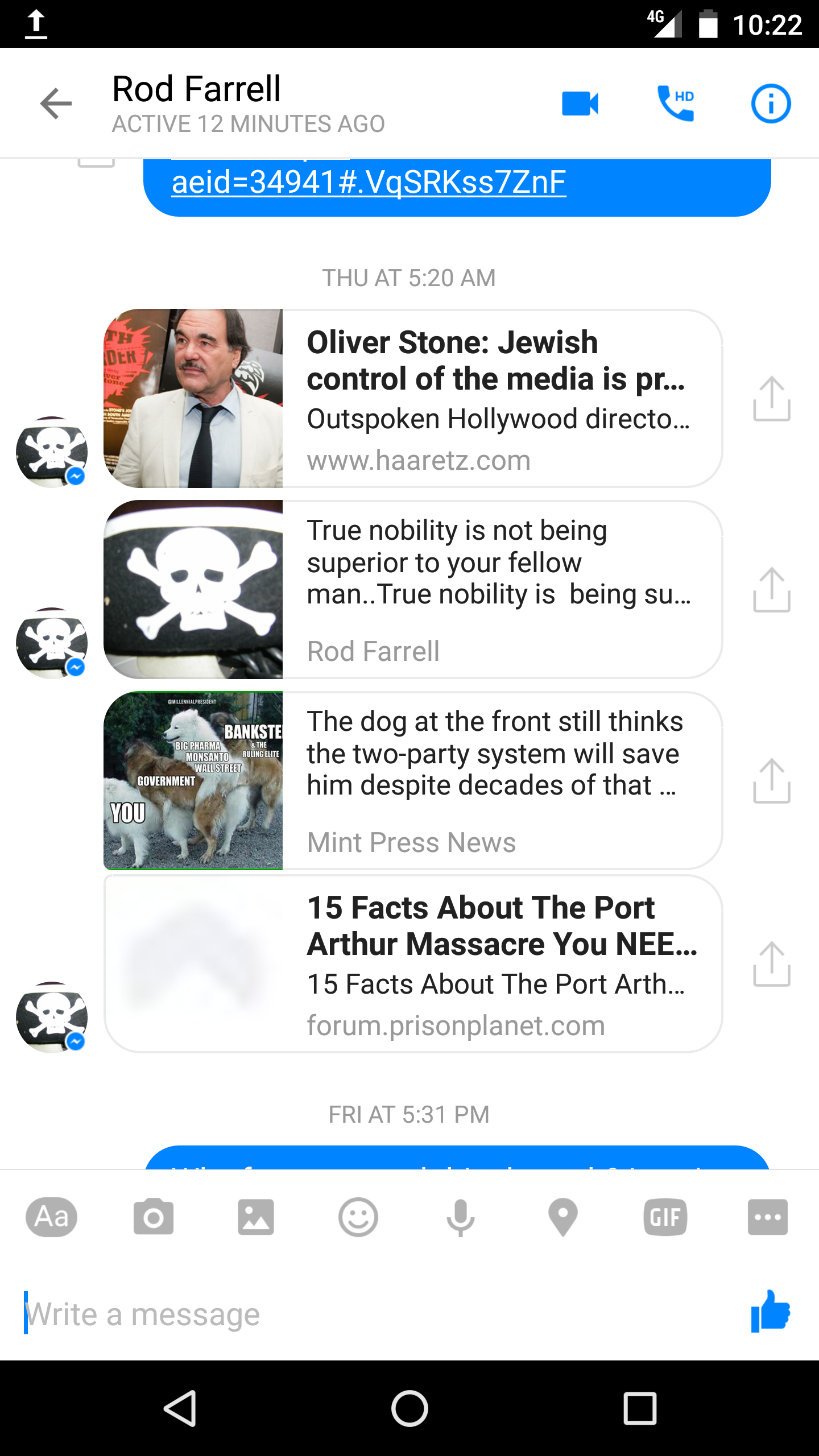
Roddie sends through another series of conspiracy theories by Facebook messenger … see exhibit below.

Exchange of messages ensued:

Me: Why for your send this through? I assign the same value to all internet information whether I agree with it or not. That is, I apply a pretty low calibration factor. The style of these entries makes me mark them down even further as they appear to be constructed by morons. Not that I think you are of course! You’re just cherry picking. Use that training

Rod: The training is the problem…..

Me: There’s good and bad in all skills. You just have to use them wisely and not exclusively.

Rod: The biggest skill is to question your own belief systems that the matrix generates…and then to have the fortitude to overcome the cognitive dissonance.

Me: Well it shouldn’t be too hard to tunnel through to a solution if you’re unconstrained by reason. In such a scenario, cognitive dissonance could itself be a cooked up emotion designed to keep you playing the game.

Rod: Dissonance is real … and tunneling takes commitment … most can’t handle the quinella.

Me: I can’t even pick the daily double since Anastasia changed her mind.

image

mxx1's avatar

Suspicious Minds

The trouble with highly developed minds is that they sometimes can’t help manipulating others.

Just yesterday my daughter was playing the ‘I’m just a child’ card. And for no potential gain other than a few extra credits in the cookie jar of future leniency.

If she’s this good at it now, how good will she be as an adult? Fortunately her behavior was pointed out to me by an highly qualified expert.

I wouldn’t say that it’s painful to be on the receiving end, but it’s annoying if you sense it and then have to work through all the possible scenarios on behalf of your often blissfully unaware adversary.

Unaware because it’s subconscious behavior. Or sometimes not; sometimes it’s habitual. Or even addictive. And sometimes just completely self-centered and greedy.

The only course of action that works to defuse this behavior is to out it. There no good that comes out of chasing a scenario around a mobius strip.

Call it. And then the discussion can go back to what everyone is thinking and feeling about a subject rather than being shanghaied by the desires of one party.

Which is exactly what I’m doing right now.

image

mxx1's avatar

The Argument

It would be fair to say that all couples argue. Who could argue with such a proposition?

The worst sort of argument is when you, the adversary, gets accused of some sort of character defect, and sometime later you get an apology. An apology for what? For voicing the thought?

When you feel like there is no point in counter-arguing then you know you are dealing with a fixed position that leaves little hope for redemption.

Which gets me to the nub of the issue. What’s the point of an argument? Is it simply a pressure release valve for the stresses of consumerism? Or is it a genuine learning experience for self improvement?

The best person to argue with is someone that realises that just about any accusation one makes about another is simply a mirror,  a reflection of yourself and your fears. If it comes out of your mouth then aim it at yourself, I say.

The good ones also have ways of owning their own argumentive ways. They don’t simply blame the other person and absolve themselves from self reflection, fault and change.

Now if two such people get together then arguments can be seen as a constructive path towards a future where arguments are mostly redundant.

Dysfunctional arguments are in this paradigm simply a reflection of the combatants’ conjoint unsortedness. And such unsortedness doesn’t lead anywhere, last time I checked.

Which brings me to failure of counseling. Often it focuses on breaking such a dysfunctional deadlock.

But in fact what a couple really needs is individual skills training so they can head towards functional discord redundancy.

image

mxx1's avatar

Uber Ride Sharing

If I were the gubment (and this falls under the auspices of that genius Dunc Gay of the NSW liberal party) I’d let Uber operate …

BUT

I’d make them include ride sharing in their app.

That is, a page on the app where users can post upcoming rides they need a host for, or are doing in their own car, and then let other users ride share with them through the app, free of payments to Uber.

Say I’m going to Canberra this weekend. I’m only an Uber user, not a driver. I post the Canberra trip and a couple of other users want to come along. We share petrol. No money to Uber. All they did was let users share info. And no liability to Uber either.

This is called car-sharing mixed with crowd sourcing. The benefit of doing it through Uber is that everyone is already a signed-up user; having enough users is the problem that haunts all crowd sourcing concepts. Especially ones without a business model.

This would be tough for Uber to swallow because it inherently shrinks their market and they don’t get paid.

The irony in my suggestion is that Uber is doing what’s it doing, it says (ha ha), in the interests of the user. They’d say no to such a suggestion (as above) of course.

And then the government could tell them to get fucked and be seen to be doing so in the customers’ interests and not in the interests of their mates with brown paper bags in the taxi industry.

This is a blog about good politics. A how to, if you like. That is, how to be a sneaky and effective politician. Like say Neville Wran – will we ever see his like again?

And the other irony is that there’s nothing good about Uber. As Jim Clark said, the Ubers of the world are just one big asshole in the middle replacing lots of little assholes in the middle.

Once they have the market wrapped up you wait and see how they decide to exploit their monopoly. It won’t be pretty.

image

mxx1's avatar

Empathy and Software

I’ve said before that empathy is a three-part process; the first being aware of how another person is feeling, and the second is caring about how they feel, and finally acting on that caring. Without all of these, empathy can’t be achieved.

So, to the subject of software engineers. The reason that most software, even the best software, is such rubbish is that software engineers miss the first step – that of being aware of how the users of the software might feel.

When I tell my software engineers that a way in which they have implemented a certain function is retarded because of this and that, they go ‘oh, of course’. And then change it. Usually they care about the users and have no problems changing the code once things have been explained to them.

The reason that most software is so shit is that there is rarely a person specifying the user interface that also checks and challenges the software that is supposed to meet these specs. Indeed, often a better way to do things isn’t always obvious until the first dodgy approach becomes a reality.

The reason such a person doesn’t usually hang around bossing about software engineers is that (a) it’s very boring and there are many much better things to do in life, and (b) the sort of people that hire software engineers are former software engineers that don’t have the empathy to realise they need to put such a person in charge.

In fact, the lack of empathy in the product development process of software is a pure form of rational proof of my definition of empathy. People using software; it is in fact psychology encoded into maths.

I hadn’t thought of that before. People don’t conform to mathematical models but when they interact with software they do in a sort of second-order way. You only need one side of the experiment to be mathematical for the whole shebang to be solvable. This is a way in which we could mathematically model psychology. Huh!

Anyway, I got onto this because of the stupid, stupid self-check out machines at Coles. My god they were specified and/or programmed by utter fucking morons.

img_0274.jpg


mxx1's avatar

Effective Altruism

Straight from Wiki –

“Effective Altruism  is a philosophy and social movement that applies evidence and reason to determine the most effective ways to improve the world.

Many of the criticisms of effective altruism are the same as those that have historically been made of various forms of Utilitarianism.

These include questioning one’s ability to make a full and accurate calculation of the consequences of any action, since we have only very limited ability to predict the future.”

Well, I’d say it’s better to try and fail than to never try at all, especially if your reason for not trying is an educated scaffolding of excuses.

On the other hand, trying without first educating oneself a little about human actions and consequences seems a little retarded.

Using wealth to outsource Altruism, otherwise known as charity, might or might not help the cause but it certainly won’t help you.

I suppose my point is this; Altruism isn’t a binary issue. It’s a set of guidelines that should be used amidst other guidelines to direct one’s life strategies.

The outcomes of Altruism are twofold; the good one wants to see in the world, and the good one wants to see in oneself. The former certainly won’t improve if the latter isn’t addressed.

My argument for this assertion? It’s just the vibe of the thing.

image

mxx1's avatar

Discipline

A friend who is a Dean at an Australian university was bemoaning to me that he has inherited a department of electrical engineering, mechanical engineering and mechatronics, all rolled into one.

I said that is like having a Department of Chemistry, Physics and Material Science, all rolled into one.

Two separate disciplines and one pseudo-discipline, all under one roof.

Doesn’t make sense! Tell me, where do the students play?

image

mxx1's avatar

Gambling and Physics

Today I had the ‘pleasure’ of talking to two academic types that want to spin their technologies out of Australian universities as startups.

One is in IT and the other is a physicist.

I explained to both of them that:

1. The ROI of all Australian startups is very negative, and

2. That despite this there is a small number of startups that have a positive ROI, and

3. Even for these positive ROI startups where the executives had trained and knew everything they could possibly know about the startup gig, that their successes also relied on a large element of luck, and

4. Therefore embarking on a startup in Australia is gambling, and

5. That the odds are such in Australia that one’s life isn’t long enough to do enough startups properly (after you have had the appropriate skills training) in order to guarantee success.

The IT guy didn’t have a clue what I was talking about and will go about his business exactly as he planned before we talked.

The physicist on the other hand, he understood completely and asked me what I could do to change the odds.

I told him and this included, in his specific and very unsexy case, going to the US and bypassing investment in favor of bootstrapping.

I suspect he will.

It pleases me muchly that his classical training hasn’t been wasted.

image

mxx1's avatar

Wet

In the context of my daughter being shocked at the concept of walking to high school I just remembered that not only did I walk to school every day but that we would walk even in the heaviest rain.

All we did was don a useless yellow vinyl raincoat with click buttons and a hood, and get soaked.

image

mxx1's avatar

The Fridge Story

The company was founded by your grandfather between the wars. Initially a manufacturer of iceboxes in Sydney, the company expanded into electric fridges after the second one (war, that is) by copying a fridge imported from the US and exhorting local suppliers of components to come to the party.

You dad took over when the old man kicked the bucket. And your dad managed to go national and even get a distributor in NZ. And then in the late 1970’s he retired to the Gold Coast, his fishing and his second (and much younger) wife.

So there you are in the 1980’s, running an Australian manufacturer of fridges.

Your company designs and builds them. You have a well-known local brand. You distribute to all the large department stores and electronic goods chains, as well as to all the little retailers (some through secondary distributors).

Your two competitors are both subsidiaries of US companies but also do their manufacturing at the fringes of Sydney and Melbourne, but their designs come from the US.

You also sell a few fridges in NZ and South East Asia where your brand is not unknown.

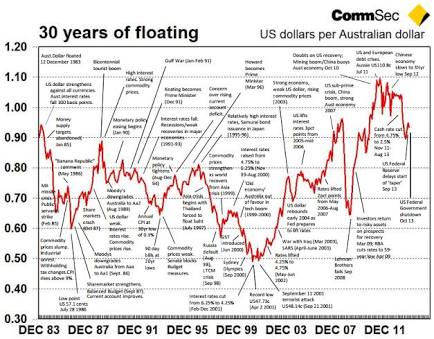
Then Hawke and Keating famously float the Australian dollar and deconstruct a few trade barriers in order to save us from our fat and lazy selves.

At the same time Japanese and Korean manufacturing really kicks into gear. International shipping gets a lot cheaper as well, after containerization.

Before too long you are facing imported fridges that are cheaper than yours but initially no one buys them because they have weird brand names on them like Lucky Goldstar.

But every year they grab more and more market share especially after they figure out that LG is a much more useful trademark.

Eventually, in order to compete, you are forced to outsource some of your manufacturing to Asia. You get parts made and sub-assemblies assembled overseas and bring them into Australia for final assembly and test.

Due to ever increasing cost pressures one day you move test and assembly to Taiwan and the media has a field day as another Australian icon closes its factories with images of sad and angry workers leaving the premises for the last time.

Towards the end of the 90’s China gets into manufacturing properly. One day you are offered a deal where some Chinese company will make your fridges for you and sell them to you at a price half of what you could make them for.

So you take the deal and your customers find themselves with fridges that leak cold air, stop working in a year or so, with lights that don’t work, and that also occasionally leak water.

You design team is totally disconnected from sourcing and manufacturing and soon lose their way as the old blokes retires. Eventually you defer to designs suggested by your Chinese suppliers and cut the costs of your own design team.

You even outsource marketing to a brand promotions company and put all your sales team on a full commissions basis. Your fixed costs are you, a handful of office staff, and a warehouse of inventory and parts.

By the mid 2000’s your market share is less than 2% and the higher quality Korean products have grabbed much of the market along with well some known US and European brands (that no one is quite sure who owns but they know damn sure they are made in China).

Then you get acquired, for a mix of cash and stock, by an Australian company that has purchased a bunch of retail chains and branded product companies and is heading for a high profile listing. Which they do.

They need to list in to order to raise capital to service all that junk debt they used to do the roll-up. But of course the aggregated business cash-flow is a Furphy; there is no central intelligence to the plan. The white shoe brigade behind the scene cash out early and all the mum and pop investors are left holding the frightened cat.

A couple of years after listing the whole shebang goes into liquidation and your intellectual property, i.e. your brand, cannot be sold by the liquidators (not that they tried very hard) and lapses into oblivion.

The good news – you have been siphoning of dividends from your company for decades and there is about $60m in the family trust. You can retire to Palm Beach and your kids and your grand kids can all go to expensive private schools and then receive stipends for life, solely from the profits from the Trust, which is invested into all sorts of things known as the Australian stock market.

You once tried putting some money into a mate of your son’s new venture and he screwed it up. So you will never do that again.

And this how the proceeds of past innovation are sequestered into islands of useless value-destroying capital in this wonderful country of ours.

Because they did this then it’s self defining; they did the right thing. If they had the skills to do something useful then they would have. Without the skill there’s not much point.

The moral, if there is one, is that oligarchy breeds an inability to adapt. And that is our inheritance.

image

mxx1's avatar

Mfg Mfg

Ok I’ve failed completely…

I had a chat to someone that I thought I’d explained Australian manufacturing to. No progress…

I explained that although there has been a demise in Australian manufacturing, that there had been far less a demise of Australian manufacturers.

Confusion.

I explained that Australian manufacturers have simply moved their manufacturing offshore but as companies they are still manufacturers.

Ok, I that got through to them.

Then I had to explain that this transition wasn’t just about costs being lower in Asia.

It had also been driven by the wild fluctuations in our currency, driven as it is by forex traders, which makes business and financial planning virtually impossible, especially for export where revenues are often in foreign currencies.

In fact we have one of the most fluctuating currencies on the planet.

There is a fix to this problem –  little special pockets of Australia that operate solely on US currency and fully automated manufacturing.

Or we get the government to take control of the currency again, if not fully then partially, just enough to discourage the traders.

image

mxx1's avatar

Me Good Business

In business I have noticed that the two psychological types, the good’s and the me’s , are pretty easy to spot. Just like little kiddies.

Which is odd since the modern business environment pushes everyone to assume the demeanour of a good.

I think because of this the me’s become easy to spot; essentially they are putting on a whole false demeanour and it shows.

I find the me’s easier to deal with but the good’s more lucrative to deal with – let me explain.

The me’s are easy to deal with because it’s much easier guessing what they want. And what they want is whatever is in it for them. A raise, a bonus, more holidays, a promotion, a CV building opportunity, an ego boost, whatever. It takes a couple of minutes of conversation to out a me and their self-interests. Then any negotiation of any sort is pretty simple – you just hold out whatever they want and promote whatever they have to do to get it (if you have it to offer that is).

As an aside, people’s voting intentions are a good question to ask if you can guide the conversation around to politics; do they vote for what’s in it for them or what’s in it for society as a whole?

The goods are more motivated with everyone else’s welfare. And in business its harder to know where the ‘everyone else’ starts and stops. But they are more amenable to being negotiated into a position that suits via a discussion that spins one’s own position into one of the greater good, once you understand how they measure that. Which can be hard because often they themselves can’t articulate this.


I guess this insight makes me a bit of me.

image

mxx1's avatar

Invention of the Day

A vertical treadmill for indoor climbers.

It only has to be about 15 feet high with no need for ropes since the drop to mats is OK from that height – it’s used for bouldering.

Each vertically treadmill could have fixed hand and foot grips, or better still these could be electrically actuated to simulate a long wall with dial-up degrees of climbing hardness.

Mechanisms for electrically actuated grips popping in and out of the treadmill wouldn’t be hard to figure out.

Then every air conditioned gym could have an indoor climbing section and the things wouldn’t be so bloody crowded and hot.

image

mxx1's avatar

The Tale of the Man Who Was Too Lazy to Fail

In Robert Heinlein’s ‘Time Enough for Love’ there is a sub-story entitled ‘The Tale of the Man Who Was Too Lazy to Fail’.

It’s the story of one David Lamb who was extremely smart and able but, in the face of stupidity and bureaucracy that surrounded him, decided to scam his way through life; using his intelligence and empathy to make his life easy, and in doing so, achieving no good for anyone but himself.

Dave Lamb was what I call a ‘me’ type. Someone whose base personality can be measured on one axis as someone whose basic default motivation is aimed at doing good for themselves rather than others. The opposite of a ‘me’ is a ‘good’.

If you look at little children you can immediately tell the me’s from the good’s.

As people mature, many of the me’s learn to adopt the habits of good’s, and it can be harder to tell them apart.

But this is for sure; under stress we all revert to type.

The irony of the story in the book is that it is being narrated by one Lazarus Long, 500 years later. And Lazarus was the old David, and David was the young Lazarus – even though it wasn’t explicitly stated. The characters lived a long time in this book.

If we all had 500 years to contemplate ourselves surely then even the most rigid ‘me’ might be able to work themselves into a ‘good’. As Lazarus did in the book, sort of.

But we don’t have 500 years in our lives.

So if you find yourself, for example, being gutless in the face of hypocrisy aimed at others then you might just have to face that you are a bit of a ‘me’.

That is, someone that can justify not helping others even if one could do so at relatively little cost.

Time_Enough_For_Love_73

mxx1's avatar

Chauvinism in China

It was suggested to me recently that the women of China are potentially far more usefully entrepreneurial than the men when it comes to innovating (as opposed to copying).

Maybe because they actually have some empathy whereas the men do not, and can thus imagine what annoys customers. Maybe because they weren’t spoiled as much as children. Maybe because they have female intuition. Maybe because they don’t label any new idea as absurd the minute they hear it. The options are virtually endless.

I have to accept that, although I go to China quite frequently, I don’t have enough data to test this hypothesis because women are mostly excluded from senior executive roles (of the type that I interact with).

In fact, I would say that in regards to women in the work place, China feels like Australia in the early 70’s. The men have a vague understanding that things will change but they still have absolutely no compunction about making fully chauvinistic statements in public.

Even if the women are better at strategic marketing and innovation, how in the hell are they going to get their hands on investment capital? The old blokes with their hands on the capital are truly old blokes in the youngest sense of the word.

I don’t think the Chinese have developed enough karma that warrants anyone helping them with these sorts of problems. And they won’t pay for help. And they won’t listen to anyone that knows what they are talking about.

They can sort it out themselves in their own odd but strangely effective way.

image

mxx1's avatar

Maconomics

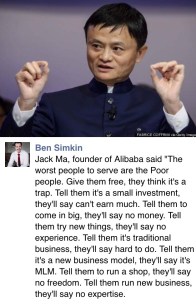
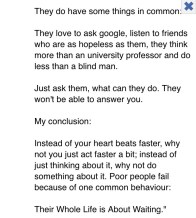
For every Jack Ma that is recorded in history there are thousands of similar characters that have been unsuccessful and are long forgotten. The bias in the narrative of the business media towards the adulation of past successful entrepreneurs doesn’t fool too many peasants. They understand statistics thanks very much!

img_4260

img_4261