
Recap
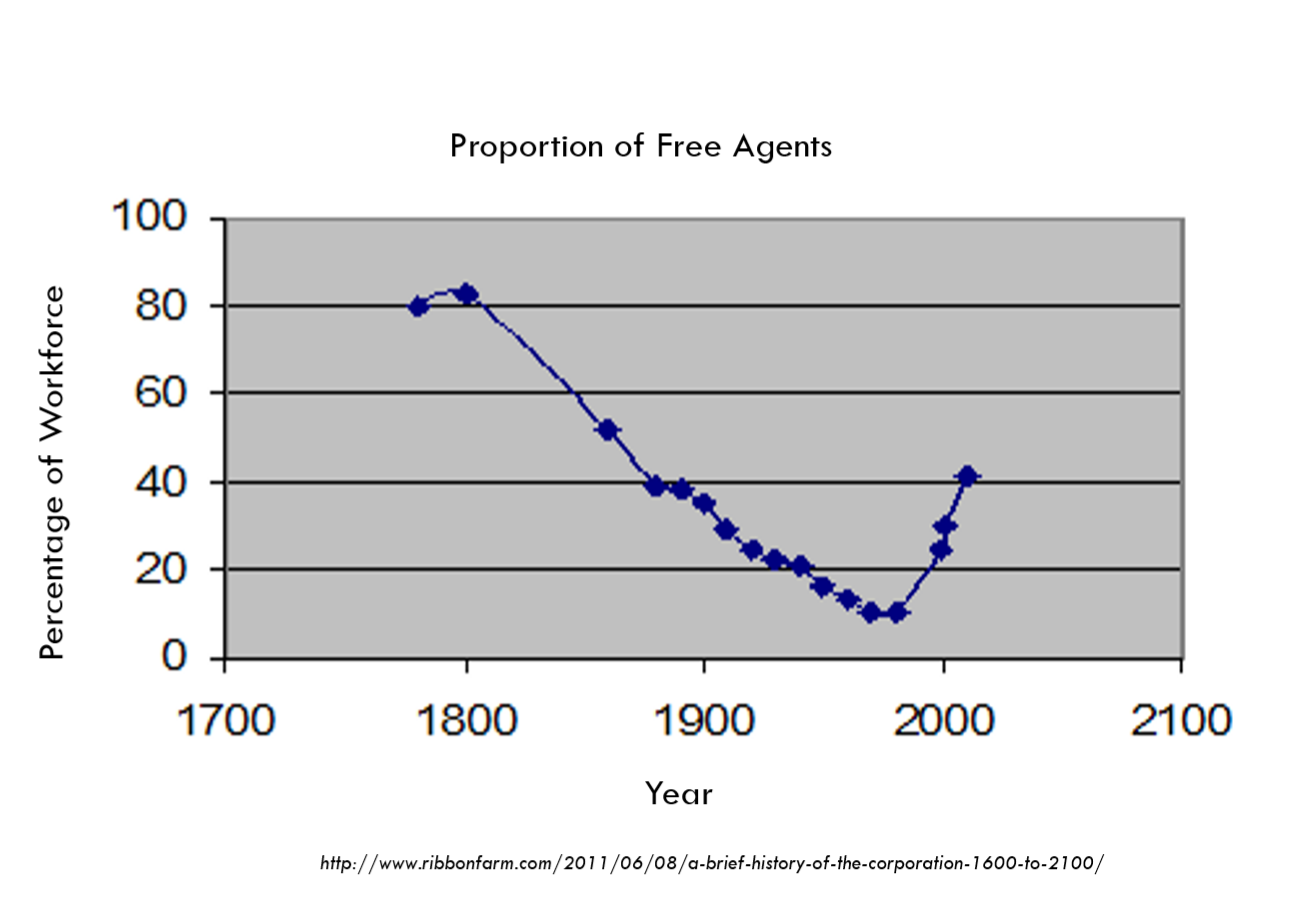
A free agent refers to a person that works independently, rather than for a single employer.
Free agents include self-employed workers, freelancers, gig econonomy folks, independent contractors and casual workers, that together represent about 44 percent of the current U.S. labor force.
The trend towards free agency is driven by technology in two ways.
First, new technology permits companies to reduce their labour force whilst increasing productivity. This effect derives from both automation and outsourcing, which is itself enabled by technology.
Due to competitive pressures, companies are compelled to reduce costs and increase productivity in this fashion. This trend seems to be accelerating along with the rate of development of new IT solutions.
Secondly, new technology allows individuals to make a living as free agents through the ready availability of technology tools.
Free agents are the most likely to be under-employed and/or under-paid since (1) the supply of free agents is increasing, (2) the technology tools that they use are generically available and controlled by companies that exploit them to the maximum value, and (3) the rate of increase in demand for free agents is itself slowing as technology automates many tasks.
Case in point. A corporate upper middle manager that loses his job after successfully restructuring his corporate employer’s business to an outsourcing model. Then he struggles to find another similar job because the supply of his genre far outstrips demand. He turns to Uber for cashflow and because he is self employed, is not subject to minimum hourly rates; his are on par with 7-Eleven’s franchisee’s casual employees. At the same time Uber is working as hard as it can to replace all of it’s drivers with automated cars…
My view is that almost half the population in the West is feeling a little dislocated at the seemingly sudden loss of what used to feel like a sense of security with respect to the means for consumption.
And the other half ought to be worried just the same because this whole trend is putting downward pressure on consumption, leading to an auto-catalytic mess.
According to Karl Marx, modern capitalism was headed for an ultimate crisis of what he called “overproduction.”
Marx thought that the capitalist use of technology would extract surpluses from the labor of the proletariat. Because the proletariat would not be able to afford these surpluses this would lead to greater concentrations of wealth and the progressive immiseration of workers.
Clearly Marx thought that misery was a relative concept. And I think he was right in this regard.
In any case, overproduction didn’t happen last century primarily because labour, especially skilled labour, was the key input into increased productivity. Labour pay rates thus increased and relative misery was avoided.
It may happen this century though; the capitalist use of automated technology may extract surpluses from resources, leading to greater concentrations of wealth and the progressive immiseration of the free agents.
If enough of the middle classes get pushed downwards into nouveau peasantry then democracy may be the victim.
After all, a large middle class is a necessary requirement for democracy; the presence of a small one doesn’t cut it.
 offshore westerly
Always start with demographics I say. When I graduated college in 1980 the US population was only 2/3 of the current circa 320 million. Similarly, the global population has more than doubled, almost tripled, in the same time. What is clear is that there is not a linear relationship between population growth (demand) and the creation of quality full time jobs (supply). In this context technology displacement is but an extra on a screen set.
Did I hear someone say “jobs and growth”?
How do I explain that the non linear relationship between demand and jobs is driven by technology?