I wonder why no one ever gives a left nut?


I wonder why no one ever gives a left nut?
In the academic literature references and citations are used virtually interchangeably. An academic’s citation count is simply the number of time her papers have been referenced in other academic papers.
However in the patent world, the concept of a reference and citation are not interchangeable. A reference in a patent is typically added by the patent attorney that is drafting a patent specification, often so as to draw attention to known prior art or to reduce the amount of descriptive text in an application. Sometimes the reference is provided so as to fulfill a duty of disclosure in relation to the known prior art.
A patent citation is (in the patent attorney industry) construed to mean a document cited by a patent examiner in an examination report during the patent examination process. There are three primary types of patent citations
An Innovation Index should focus on X and Y citations only and ignore A citations, especially since these latter often include academic papers of the inventor where the academic is an inventor (a form of self-citation).
Furthermore, not all patent examiners use A citations. An index using A type citations is arguably an inconsistent duplication of the academic journal type of citation and probably doesn’t really mean anything in the context of measuring innovation.
An academic journal citation that is an X and or Y patent citation can be considered related to innovation because that journal article has posed an obstacle to an individual or an entity attempting to secure inventive rights in the patent examination process.

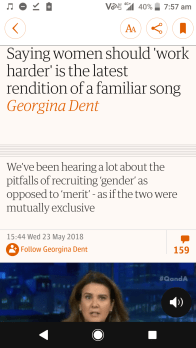
Because of the CBA mess, there has been some debate about company board appointments being based on merit or gender.
Cue the usual outrage…
But we all know it’s true, some dodgy women have got roles they aren’t qualified for, just to make up the quota.
The trouble with business, even the oligarchy that is the Australian corporate landscape, is that it is ruthlessly measured in a single metric, profit.
Only the skilled are successful. This is because someone else’s loss is my gain. To be in the top half of performance, one needs to be in the top half of capability.
It’s not about merit. It’s about results.
Only a fool would generalise that because one woman failed, they all would. The same sort of fool would also suggest that all men are fools.
Psychology studies have shown that tokenism is a bad way to effect change. A token (say gender) appointment that goes wrong is likely to enforce prejudices against the minority by a factor of 8.
As I said, fools!




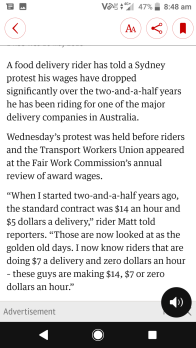
They call it wage theft, see below.
Actually it’s classic dumping. Providing a service below cost to drive your competitors out of business, and then increasing your profits (not prices) once you have a monopoly. The last bit of the only modern twist in the gig economy.
If the oldest professions are prostitution and tailoring, then the oldest institutions are religion and slavery.
You don’t have to venture too far from wealth to find folks agitating on behalf of these institutions.
Because wealth dulls the enlightened mind, just so.

This is how life is measured in America; these are all the categories that one needs. Now that’s something to look forward to…
There’s just one problem – there’s no “looking at smartphone” category.

Most people seem overwhelmed just by being alive.
t’were me too.
I think I’ve come to realise that life needs to be venerated and enjoyed for the sheer bloody unlikeliness of the thing.
Didn’t sound too hard, does it?

My life has been inundated with mad women – my mum, my ex wife, my daughter’s mum, a few girlfriends, etc.
Which makes one wonder:
What is mad? It’s very subjective, no? For mine, a primary characteristics is the fascinating internal fight within the mad ones, between rational thinking and a reversion to emotion. For whatever reason, the mad women seem to want to torture the men in their lives by psychological means. Sharing the pain, seems to help them ease the burden. Not only do they not know they are doing it, they certainly are never going to admit it to themselves or anyone else.
My guess is that that they are all born mad, and a small handful that manage to drag themselves out of the mud. There are not many sane ones out there though; I have met maybe one or two only. Why is the condition so prevalent? Well, musing here, there is a direct conflict between their emotions, their purpose and their expectations. All modern socialisation of the female form has driven them into a corner of despair, as they juggle the dissonance between what they want to achieve in life and what they really want to achieve in life.
An easier, Occam-style solution, would be to assume that I am mad, not all of them. I have thought this in the past, but not so any more. I have evidence to the counter, and it is compelling. I am hard on myself, unlike many others. So this conclusion wasn’t arrived at lightly.
x

I was the frog in water, slowly going to the boil.
I was also the frog with its hands around the stork’s neck, refusing to give up.
I also kissed a lot of frogs, in order to find a princess.
My life is one big frog analogy.

 offshore westerly