
Mental
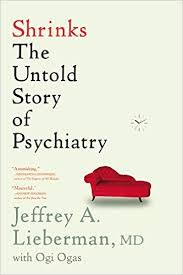
Here’s a great read – “Shrinks: The Untold Story of Psychiatry” by Jeffrey A. Lieberman.
A quick precis…
In the bad old days, mad people got even madder because they were effectively tortured in asylums.
And then as society softened up, doctors started looking for methods of remediation. Of course they fucked up and went down all sorts of silly dead ends.
But after 200 years we now have a combination of drugs, physical procedures and behavioral therapies that are remarkably effective in a majority of cases, if not perfect.
A mystery that the book solved for me was that the Freudians and Jungians et al were, as I’ve always guessed, a bunch of well meaning but completely unscientific quacks. Most of their teachings are now debunked and the bits that aren’t were simply lucky guesses (which one will make if one makes enough guesses).
The most interesting aspect of the book was the description of the line that the industry draws between mentally ill people and well people with mental ‘colds’.
This line moves about, being a battle ground between doctors on one hand (wanting to make more people mentally ill) and the insurance industry & governments (wanting less mentally ill people).
In summary, because of these opposing forces the line is pretty much where it needs to be, give or take.
There is a great definition of ‘mental illness’ that goes something like this – mental illness occurs when a person recognizes that they can’t function properly in society anymore due to stuff that is going on in their heads, or failing that, people around them believe the same.
The definition is quite subjective and depends on the state of the society that the person is in. An extreme example is a person that would be considered amenably eccentric today that would have undoubtedly been locked up in 18th century conservative Holland.
That subjectivity is itself almost a definition of humanity.
For the rest of us, the mentally un-ill, we live with any number of differences between each of us in our mental state, with no ‘ideal’ positions on any of a number of dimensions.
Most of us are impacted by these mental states in ways that we would prefer not to be, but that doesn’t make us mentally ill. Just mental, with room for improvement.
Which begs the question; why don’t we all spend more effort getting mental re-tunes and bugs removed, primarily through therapy?
Mostly, I imagine, it’s because of the potential stigma attached to the unattached notion of mental illness.
But also because of the lack of clarity between therapy and results; there’s simply too many quacks out there, and too much recent past history of failed approaches to therapy.
 offshore westerly