You have to love the clarity of thinking of those university commercialisation types.
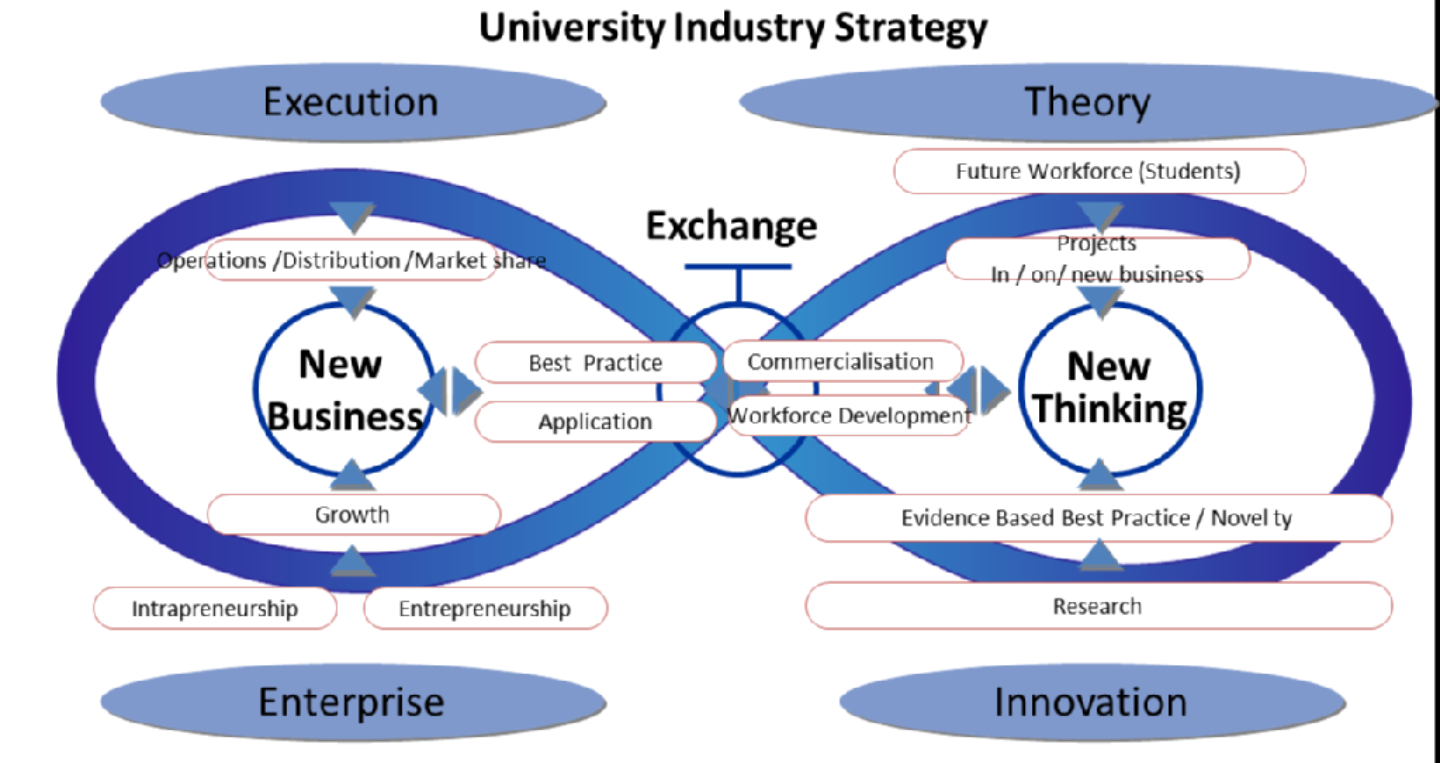

You have to love the clarity of thinking of those university commercialisation types.
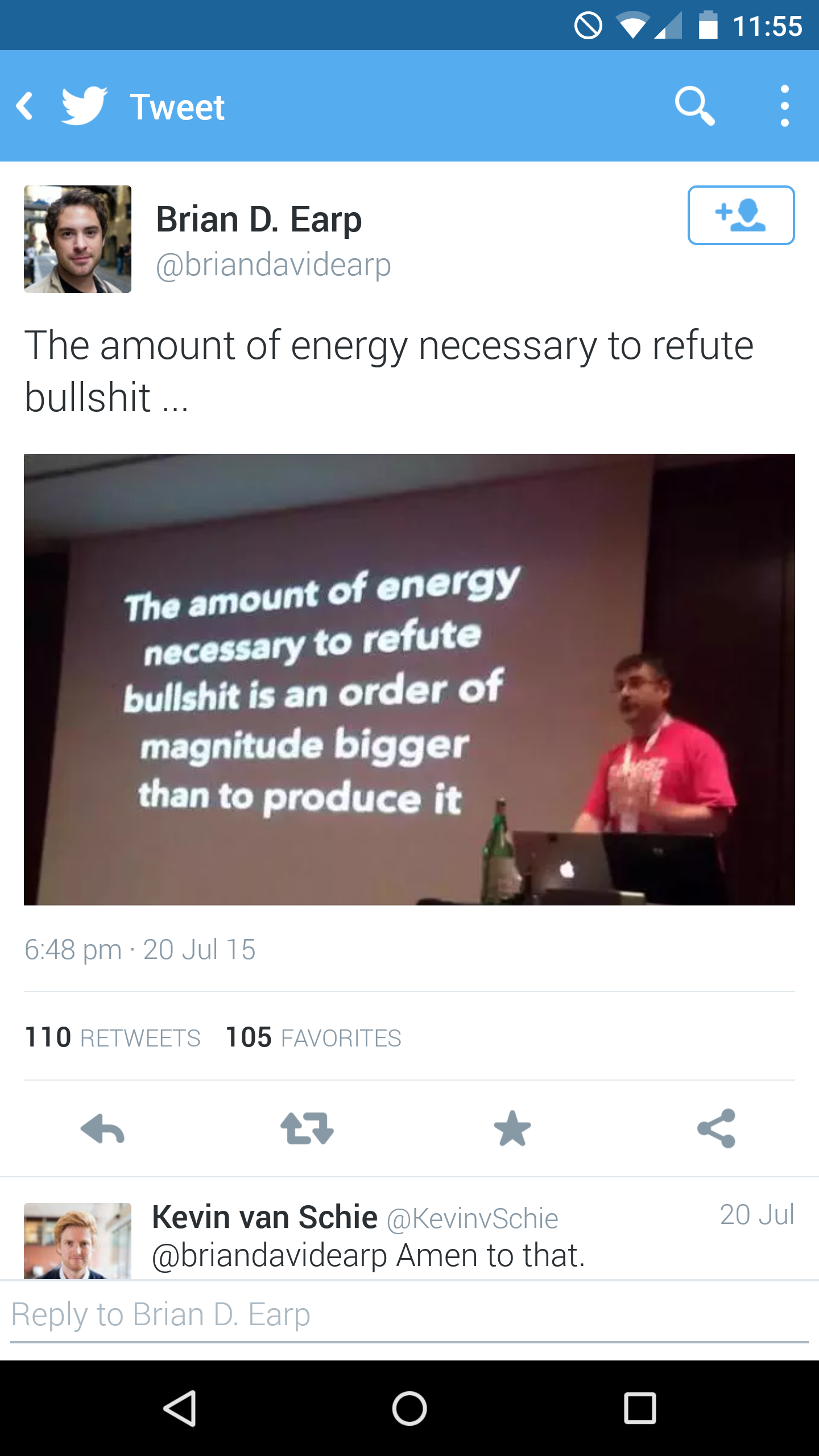
The slide below, found on Twitter, is not true for me.
I can refute bullshit with barely a nano-calorie’s worth of effort.
However it may take some considerable effort to explain that refutation to a moron.
So I don’t.
It’s a conspiracy I’m sure.
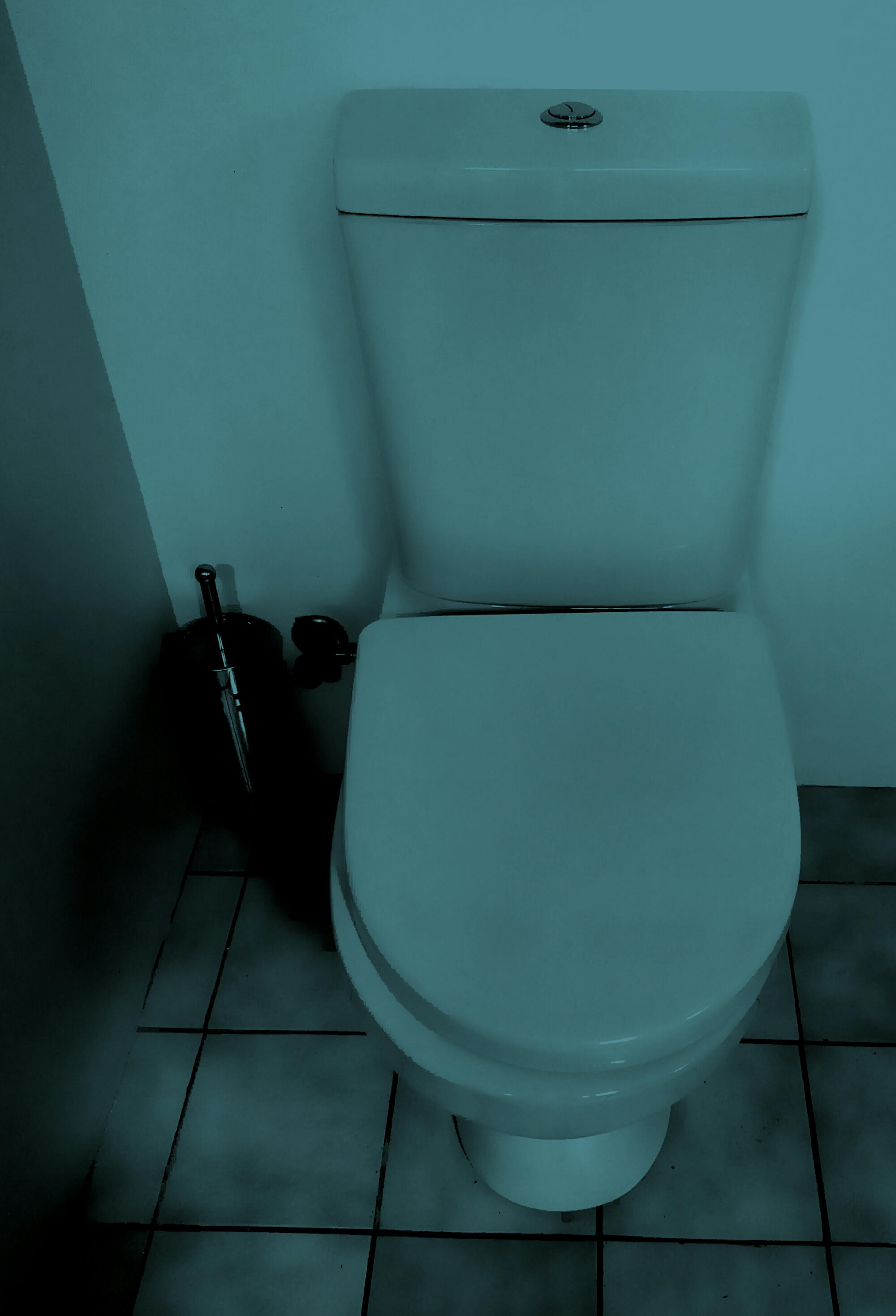
Half the houses have silent closing toilet seats and the other half do not.
If you live with the former it can be bloody embarrassing when you shake someone’s house in a botched attempt to close the latter.
Whoops.
Men, I think we should revert to just leaving the seats up.
This would be totally consistent with the modern day concept of engineering risks out of our lives.
The risk of breaking someone’s porcelain has to be greater than incurring the disdain of a member of the opposite sex that has to wear the unbearable burden of closing the seat prior to use.


See this photo below? That’s a bike lane of sorts.
When they paint white lines to indicate a bike lane they really should add big-mother lane bumps to encourage cars not to drift into the so-called bike lane.

I have just come up with a new name for a new style of business activity (specifically for someone else’s new business opportunity).
Disinteremediation
I will keep the meaning to myself. Commercial in confidence and all that.
This new word makes as much sense as the existing term, disintermediation.
‘Dis’ is a prefix that means ‘apart’, ‘asunder’, ‘away’, ‘utterly’, or having a privative, negative, or reversing force.
‘Intermediation’ involves the ‘matching’ of lenders with savings to borrowers who need money by an agent or third party, such as a bank.
‘Disintermediation’ in this context is the reduction in the use of intermediaries by investing directly in the securities market rather than through a bank.
Therefore the term ‘disintermediation’ first came into use in the finance sector which was one of the first supply chains to be bonsaied by ITC technologies.
But the use of this term has expanded to include any supply chain that is being gutted by new internet businesses.
That is, the action of any new style of internet business that acts to reduce the number of corporate entities involved in any transaction between producers and consumers. Or any B2B subset of the supply chain between producers and consumers.
Jim Clark was much more eloquent on the subject. He said that the internet it is all about creating a new business that is ‘just one big asshole in the middle’.

Laura Tingle’s article in today’s (14 Aug) AFR pretty much nails it. It’s all about the current coalition government which she says has well and truly jumped the shark.
Well she didn’t use that term but she may as well have.
And on the subject…
What would be truly entertaining would be a Tony Abbott-led multi billion dollar shark initiative aiming to address the outrageous situation where the lives of sharks are being put ahead of the lives of humans.
It’d be inspired wedge politics.
Who knows, sharks might also be into same sex marriage, people smuggling (or parts thereof), ISIS (the international state of iniquitous sharks) and cannabilism.
Alan Jones would certainly get behind any scheme to cull sharks since the Greenies would hate it.
I can foresee a scheme where unemployed fisher folk, destitute due to over fishing, are paid to kill sharks.
Of course it could go the way of the pink batts scheme if some of the fisher folk themselves got eaten in the course of duty.
Let’s hope Tony hangs in until the next election!

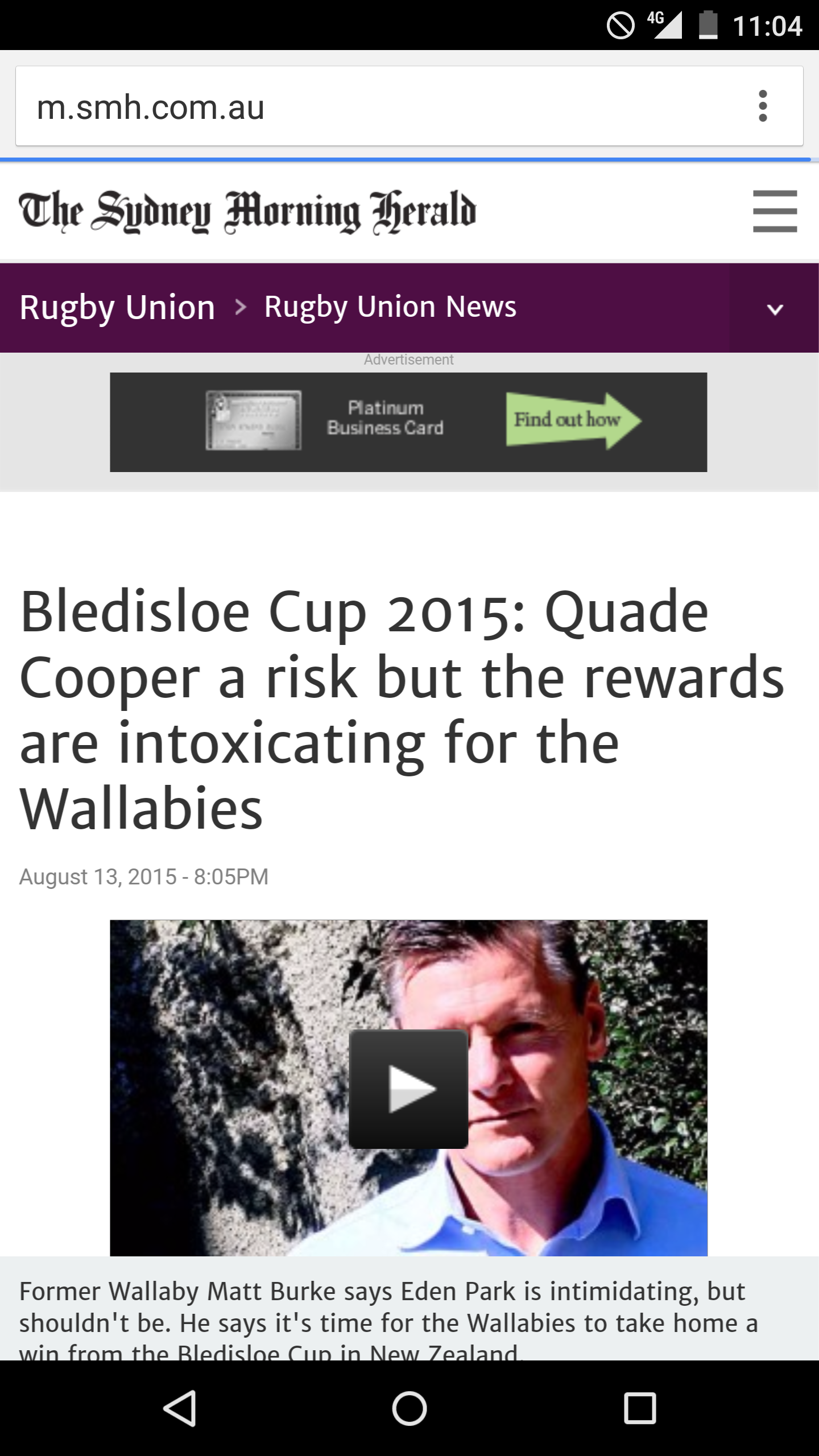
Cheika picks Quade the crab for the Bledisloe decider in Auckland.
What does this mean?
Either Cheika’s a genius, or he’s a genius that wants a really good excuse to rid himself of Quade forever.
Whatever he’s up to, I have to admit that I really don’t understand.
I bet the bookies aren’t so circumspect.

I don’t usually watch broadcast TV, so my recent incursion into the genre is allowing me to connect dots between things that I have read about and certain talking heads.
Last night this bloke named Tony Jones on the ABC interviewed this absolute corker of a nutter from some religious loopy corner of a rabbit hole in the US of A.
Why this was deemed a good use anybody’s time, who knows? Bloody entertaining though.
This bloke, Tony, is supposedly one of our better TV journalists. If so, we are in trouble.
The nutter was anti gay marriage for a number of reasons but primarily because children apparently should have both a mother and a father as parents. And the mother and father should be female and male, respectively (implied but not stated).
The interviewer didn’t point out that gay people in Australia already have the right to have and bring up children, so using this point as an argument against gay marriage is totally fallacious.
Yada … they all seem to be in a logic free bubble anyway. I don’t know why they bother even making up any excuses to support their prejudices. It’d be much easier and far more effective to just say ‘we don’t like it’.
At which point I would thank them for their honesty and tell ’em I don’t give a shit what they like or don’t like. And I don’t. (To Dave’s point I am usually polite about this. Ohmmmm).
This morning some woman told me that she didn’t like me locking up my bike where I currently let it sit overnight. I told her quite honestly that I don’t care what she thinks and rode off. (OK that wasn’t polite but trust me she’s trouble. I can tell. This was a considered initial incursion designed to cut off her potential rampaging campaign).
Rude in one context, sure. But if you give these people some air they seem to add fuel and start a fire. There are times when that is not advisable.

My mate Rod gets a fair fraction of his income from picking up stuff in the chuck-outs and then putting the so-filtered goods into second hand auctions.
On matters decorative, stuff that goes into houses, he is a whizz at selecting the junk that will sell and rejecting the rubbish that won’t.
More recently I have partially convinced him that there is money to be had from all those bicycles that get chucked out.
So he has picked up a couple of bikes and it’s pretty clear that he can’t tell a good bike from a bad bike. Hence this blog entry.
Firstly, why do people throw out bicycles? Well there are a number of reasons.
The primary one is that there are roughly one million bikes sold in Australia every year but less than 20% or so get ridden more than half a dozen times.
For most people a bike purchase is a new year’s resolution ‘fail’. People think that buying a bike will force or encourage them to do exercise. Not so it seems.
After a set period, say one to two years depending on the person, the unused bike is deemed ‘fully depreciated’ and deposited on the street during a council chuck out, or at any time of the year in Bondi.
The decision to chuck out an unused bike is made easier if the bike is rusting (which is invariably the case if it was bought at Kmart or Target or similar).
Typically bikes with gears will go out of ‘tune’ due to cable stretch and your local bike shop will charge people enormous amounts to do a 1 minute fix-up job. The high servicing cost also encourages people to chuck out bikes that they aren’t using.
Kids bikes also get chucked out as the kids outgrow them. Being made to the lowest feasible specification these kids bikes invariably have no possible resale value.
On the odd occasion that someone regularly rides their bike, a short time into their cycling career (usually as a Lycra clad weekend warrior) they will realise that their first purchase was a piece of shit. They will then start on the merry-go-round of continual bike upgrades and this can entail chucking out older bikes if they are at the cheaper end of the scale.
Now, Rod, I am going to explain specifically why some bikes are worth money and some are not. And the important point here is that you need to stop considering a bike as a ‘bike’; you need to start looking at a bike as a co-located selection of bike components.
Firstly, let’s consider bike frames.
The most expensive frames are carbon fiber and these don’t get chucked out unless they are cracked and therefore worthless.
Aluminium is an abomination used at the lower end of the market. Slightly lighter than steel in principle (but never in practice) it is favoured by the cheap Chinese and Taiwanese manufacturers of frames. Leave it where you found it unless it happens to have some nice components attached to it.
Steel frames are the only ones ever worth picking up. These can be rusty but you need to look past that – it’s nothing that a bit of sanding and painting can’t fix. The older frames can be very valuable in fact.
Oh, there is titanium too. Unicorns – you will never see one.
When a lay-person looks at a bike all they see is the frame. Oddly, if you ever build a bike using parts purchased on Ebay you will find that the most of your money will go on all the other bits, the wheels, the tyres, the gears, the shifters, the cranks, the headset etc.
That is, the true value of a bike is the bits that are attached to the frame and not the frame itself.
This is where you need to know the good shit from the crap. It’s a matter of brand and model recognition. Even the top brands like Shimano make a lot of low end rubbish components.
Even without this insider knowledge of which components are worth money, take a look at the grips on the handlebars, or the gear shifters, or the pedals, or the wheels. Do they look like high quality or some piece of shit knocked up in Shenzhen?
And here’s another odd thing. You can buy a fixie from Reid Cycles for just $200. But if you wanted to build the same bike from parts bought online it would cost you at least $500. Just the wheels without tyres would cost you $200. Now supposedly the internet (Ebay and Alibaba) has cut out all the margins in manufactured goods. So what this tells me is that the supplier to Reid Cycles is either getting massive volume discounts or that these bikes are made from shit components that are very cheap and that aren’t even offered for sale online. Probably the latter.
When a corporate weekend warrior buys a $10,000 road bike they are buying a bike that costs maybe $1,000 to put together by the assembler or $2,000 if you or I wanted to buy the parts and assemble it. That’s right, ‘assemble’. What happens is that someone buys the frame from one place, the wheels from another, and all the other bits, and assembles it. A branded bike is just a paint job that costs $9,000 to the fools that buy it. There is hardly a branded bike company in the world that designs or makes a single component on any of the bikes they sell.
So with all this mind here are the golden rules of picking up bikes from chuck outs:
1. The only frames that have any value are steel frames. The older the better unless they are in really crappy conditions.
2. When you look at a bike that doesn’t have a steel frame then look at the components and not the frame. Either learn to recognise brands and models of components that have high value or use your common sense and filter out the cheap components that are unsellable.
3. Remember just about nothing good happens in and around aluminium bike frames. So if a bike is aluminium (you can tell by the welds and the large tubing sizes) it’s a fair chance the components are rubbish.
4. Ignore ‘mountain bikes’ – these are mostly what is sold at Kmart and Target and they are highly represented in the Bondi ‘lost bike’ exhibitions. These are the bikes that visiting backpackers have left chained to posts to rot for eternity. Backpackers are canny enough to realise that these barely functional velocipedes have no market value; so should you.
5. You’ll make more money by putting the components on eBay than you will by putting a chuck-out bike into a second hand auction.
I really wish that the Chinese wouldn’t waste all those raw materials when they make crap bike components. With the same amount of effort they could make high quality components – the only difference would be the use of higher specced materials and better quality component designs.
The differential cost of building say a gear lever that is designed to last forever, look good and function brilliantly, compared to something that you might find on a Kmart special, is in fact only a small percentage of the cost.
But we can’t blame the Chinese because they will keep building these bikes if we keep buying them and chucking them out.
PS I am just building my first bike completely out of parts scabbed from chuck-out bikes and abandoned bikes. So far I have got parts from five bikes for this ‘new’ fixie and I lack only for a rear wheel and a brake caliper of merit.

Last night whilst working on my bicycle I had the television on in the background.
There was this goddam awful show playing named (I think) ‘The Project’.
It was one of those ‘witty’ panel shows although this one was cringfully unwitty.
In one segment they reviewed the 40 final entries for the new NZ flag.
Apparently the PM there wants a new flag without the English flag in the corner, so they are going through the charade of public entries, long lists, shorter long lists and then a short list ahead of a referendum where they pick the silver fern on a black background.
The risk of course is that the bogan nation picks some bloody awful concoction instead of the silver fern, just like we in Australia ended up with ‘Advance Australia Fair’ as our national anthem. Thanks Malcolm!
Evidence for this was the personal favorites of the panelists in The Project. They picked awful, awful options that would only be suitable for airline logos, Dick Smith peanut butter jar labels, or government agency posters.
It goes to the point that certain issues shouldn’t be put in the hands of amateurs or the people.
Sometime back I watched a TED talk on the subject of flags and, guess what, there are experts on the subject that really know what they are doing.
Employ them and leave the people out of it, I say.
On the same show I had to endure a clip of Tony Abbot rabitting on about why the coalition had voted against putting the issue of same sex marriage to the parliament as a conscience vote.
In that very painful interview (was there ever a poorer communicator in the role?) he said that after the next election (and assuming the coalition gets reelected) they would put the issue to ‘the people’.
Same sex marriage is bloody inevitable so why waste zillions of dollars just so same sex marriage can be put off for a few more years?
He knows that our referendum process is easily gamed. A change requires a majority in a majority of states which makes it pretty easy to stop initiatives with a concerted effort in places like Tasmania and Queensland.
You have to wonder why people are so keen to control what other people can or can’t do.
Maybe there needs to be a ‘no harm’ clause added to the constitution whereby any majority (or even a minority) can’t assert their will over the rest of us, whether that is through parliament or otherwise, if the majority/minority can only point to the ‘vibe of the thing’ as their only objection.

Every time I am subjected to MSG it makes me feel weird. This has happened today when I was invited to a Chinese hotpot lunch.
Three things happened:
1. I could taste the MSG in my mouth for hours later. Taste is not the right word; there is this very unique sensation in my mouth.
2. Mood wise, it made me quite intolerant where I usually might be tolerant. I see this as analogous to the anxiety that can be brought on by too much caffeine.
3. Holistically my whole body felt odd.
Wiki says that whilst MSG has a unique aftertaste (tick) the negative health effects are mostly unproven in double blind placebo studies.
I can’t argue with that. I am not claiming negative health effects, just temporary negative mood effects and a bloody awfully taste and feeling in my body.
I suppose if you have it all the time then it’s just like caffeine; a pseudo stimulant that isn’t overly mind altering and can be lived with quite happily especially if you build up resistance.
I might stick with caffeine.

And so it starts…
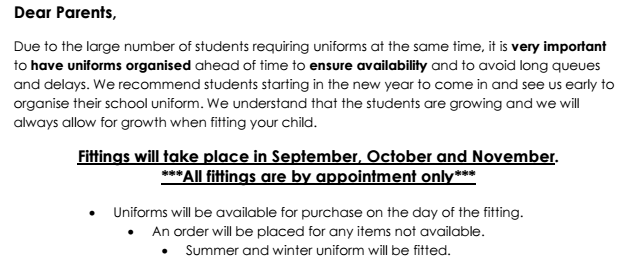
It’s just your local catholic girls high school but apparently they too have the ability to complicate the simplest things.
What I don’t understand is why all the girl’s dresses look like potato sacks.
Hang on, maybe it’s a sneaky catholic exercise in anti-fitting. ‘Room for growth’, I’m good with that.
This morning over my morning coffee I accidentally got speaking to the couple next to me at the local cafe.
They were your archetypal Bondi couple. Late thirties. She blondish. Exercise gear on. Hers including black tights of course. She was trim. He was not. Some obscure sort of bull terrier called Max. iPhones. Exercise stroller containing the real boss of the household. BMW X5 parked outside. And that weird pseudo-English drawing out of the latter diphthongs that they must practice for hours in front of YouTube, because it ain’t natural.
By trade he was formerly one of those finance sector types with no discernable trade. She was in PR. Both out of GPS schools I would guess.
A few years ago, disgusted with the then current offerings of bottled juices, they had started their own concoction with a target market of ‘their mates’. After a little success they sold out to an FMCG for a ‘large sum’.
Now they spend their time moving between Bondi and Bali, where they have a ‘villa’.
She spends her time hunting for consumer goods but he has found a more effective means of wasting money; investing in startups.
This seems to be one source of marital discontent since all these startup investments have ended up in pulp and not juice.
He can’t understand why it’s that hard for his investees to make it work. He even steps in to help them and that doesn’t seem to make any difference.
They are thinking of going back into juice to make a few more millions just in case they run out of money.
I left them to their plotting of the rest of their daily activities without a single word of friendly advice.
My prediction; in about three years they will join the ranks of business consultants in Sydney.
General Assembly is an interesting business.
It’s the start of the disintermediation of universities.
Offering courses in a limited number of disciplines it allows students to pick and choose courses that suit their needs and timetables.
It’s a boon for continuous education.
Courses can be given by anyone qualified to give them under any circumstances.
In an expanded model imagine your under-paid scientist on a shitty short-term contact at UNSW earning more by running courses at night, all managed by the app.
Eventually whole qualifications in a discipline could be earned this way.
All that the purveyors of these ‘degrees’ have to do is demonstrate the value of their ‘graduates’ in terms of pay scales.
Employers usually only care that their new hires can do the job, not where they got their degree or whether they even have one.
A degree is just a form of assurance that someone has been trained to a certain level of capability. The internet offers so many simpler and cheaper ways to create such assurances.
More importantly, many people also want to start their own business, and that might be a startup or running courses through some online app.
The whole concept of discreet employment is going into the dustbin, I’m telling you.
And along with it so will all the old-school old schools.
I have just used Sherpa for the first time; it’s basically Uber for couriering.
I am not sure it’s cheaper but it’s O’ so much easier to use.
Just get out the app on your phone or use a browser and select your current address and fill in where the parcel is going, and that’s it.
Payment is automatic. No printing out triplicate forms, filling them out and sticking them all over boxes. You can track your driver, yada, yada.
Time and time again we see that the incumbents just can’t adapt to the new reality.
All these businesses that just can’t believe that the internet is going to make them obsolete.
I mentor a bunch of CEOs in the services sector and I just can’t get them to face up to fact that this is going to happen to them too, no matter what their business.
This has got to be some sort of psychological condition.
Firstly, many people in business (and elsewhere) are quite conservative and hate change.
Secondly, too much emphasis is placed on how things have been in the past, which is obviously a poor predictor for how things will be in the future. The chance of imminent change actually increases the longer things remain the same!
Thirdly, groups of people that are facing oblivion like rabbits in the headlights seem to be comforted by all the other rabbits at their side.
I have decided to call this the Compression Denial Syndrome.
People living in earthquake zones are a classic example of this syndrome by the way!

A Fibonacci retracement is a popular tool amongst traders of stock, currencies and derivatives, and also with superannuation managers that have a need to baffle their clients with bullshit.
The Fibonacci sequence of numbers is 0, 1, 1, 2, 3, 5, 8, 13, 21, 34, 55, 89, 144, etc.
Each number is approximately 1.618 times greater than the preceding number. Which is how we get the so-called average Fibonacci ratio of 61.8%.
The 38.2% ratio is found by dividing one number in the series by the number that is found two places to the right.
The 23.6% ratio is found by dividing one number in the series by the number that is three places to the right.
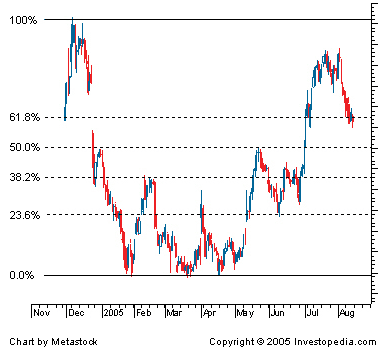
A Fibonacci retracement line is created by taking two extreme points (usually a major peak and trough) on a stock chart and dividing the vertical distance by the key Fibonacci ratios of 23.6%, 38.2%, 61.8%. And for good measure they usually add 50% and 100% – these representing nice and wholesome round numbers that are easy to admire.
At each of these percentages the chartists draw horizontal lines that are used to predict support and resistance levels, i.e. the critical points that might correlate to a point on the chart where an asset’s price will reverse, or not.
Traders believe that the direction of the prior trend before a curve hits a Fibonacci retracement (or the 50% and 100% lines) is likely to continue once the price of the asset has retraced to one of the ratios.
So what’s really going on? Well:
1. Because so many people believe this stuff there’s enough of them behaving a certain way with their trading that they might make these retracement lines a self-fulfilling prophecy.
2. There’s enough horizontal lines drawn all over a chart such that any reversal is near enough to one of the lines so the argument that the lines are meaningful can just about always be upheld, at 100 paces at sunset with one’s eyes squinting.
3. The chartists and tech-traders have a form of Stockholm Syndrome where they believe that there is something mystical or mathematically baffling behind the movement of stocks, currencies and derivatives. And they love the sexy sounding Fibonacci moniker which they barely understand.
4. And the traders really do need to feel special about what is essentially guesswork. Trading at a profit over time really only occurs when there is some sort of information asymmetry with respect to the asset in question.
I would also point out that the Golden Ratio of 61.8% was discovered millennia before Fibonacci was born. The ancient Greeks developed the Golden Ratio – where two quantities are in the golden ratio if their ratio is the same as the ratio of their sum to the larger of the two quantities.
Calling a line which just happens to be at the 61.8% point between two other lines the Fibonacci retracement is clearly an exercise in putting lipstick on a very dour pig.
Imagine if they just got sensible and used 20%, 40%, 60%, 80% and 100%? Nuh, there’s no magic there to bullshit about.
The best bit is that there is probably no correlation between the lines and when a stock reverses and certainly no causation.
Well, to be fair, there might be a correlation if you allow for error bars as large as the gap between adjacent lines.
Yesterday I was asked by The Conversation to write an article about CSIRO’s new Chairman (sic) (you’d think it’d be a Chair by now).
I said ‘no’ on the basis that I couldn’t think of anything positive to say about the appointment of a former branch salesman and professional oligarch manager to such a role, and also because the CEO is a friend.
As far as I know this is my first ever effort at conscious self-censoring in my latter day writing ‘career’.
I don’t feel too bad about it to be honest. It’s just a thing.
And as I said to the people at The Conversation, it hardly matters anyway; the most likely scenario at CSIRO is that:
1. They will try to make changes yet again – this time they will go for more ‘high-tech’ and less ‘science’, more ‘start-up’ and less ‘corporate contracts’, and more China and less anywhere else
2. There will be a restructure or two – they have been having these continuously since 1987. So no change there
3. They will lose another 500 staff every 18 months on average through budget cuts, as they have been for a decade
4. The residual scientific staff will become more hostile and despondent, if that is possible, especially since their scientific disciplines, on the whole, won’t be wanted
5. Just about all the press coming out of head office will be super positive with a focus on beating up the odd success
To be clear, this is the most likely scenario but the probability function is very broad. To you lay people this means that the chances of any specific prediction becoming a reality is very low; the one above is simple the slightly more likely amongst a bunch of unlikely scenarios.
As I said to Larry, no matter what type of organisation I was tasked with building I wouldn’t start from where CSIRO is today. I suppose that in itself is an interesting challenge for the executive and the board.
But I wonder if they even understand the scope of the challenge? I guess not from what I know.
But then this is Australia, and no one seems to notice or care whether government funded exercises are successful or not. So why should they at CSIRO be any different?
There is a scenario where they stop doing any scientific or technical work altogether and spend their entire budget on media and public relations.
Apart from doing the usual boring press releases they could build interactive tech museums in all the major cities, create reality TV shows like the Shark Tank, license their brand to all sorts of consumer products (CSIRO-approved etc), license the brand and all of their residual tech (on an non-exclusive basis) to start-ups for a teensy-insy equity stake (so they can claim any unlikely start-up successes), set up post office franchises selling kids collectibles, maybe take over one of the dud universities and create the CSIRO Institute of Technology, and the list goes on.
I suspect that this would actually work. Our economy lives on services (70% of our GDP) and media, so why not take the organization right into the guts of main stream society?

Well, updating windows was a disaster. I am down one laptop. He’s dead. Good job Redmond.
My particular path to disaster was thus:
1. Offered a free upgrade
2. Being a natural early adopter I couldn’t resist
3. When Win 10 was up, my chrome browser wouldn’t work. You can imagine why MS wouldn’t want to make it easy for an alternative to their new browser
4. I tried a few fixes as per forum chatter. Nix.
5. Executed (sic) the option to return to Win 8.1
6. Now it dies after login. Just a black screen. I have done all the usual things to fix it. Nix.
7. So now I hand it over to the experts and it’ll probably get wiped.
I am not even a little surprised.




Do you think it’s possible that these houses were designed by an algorithm?


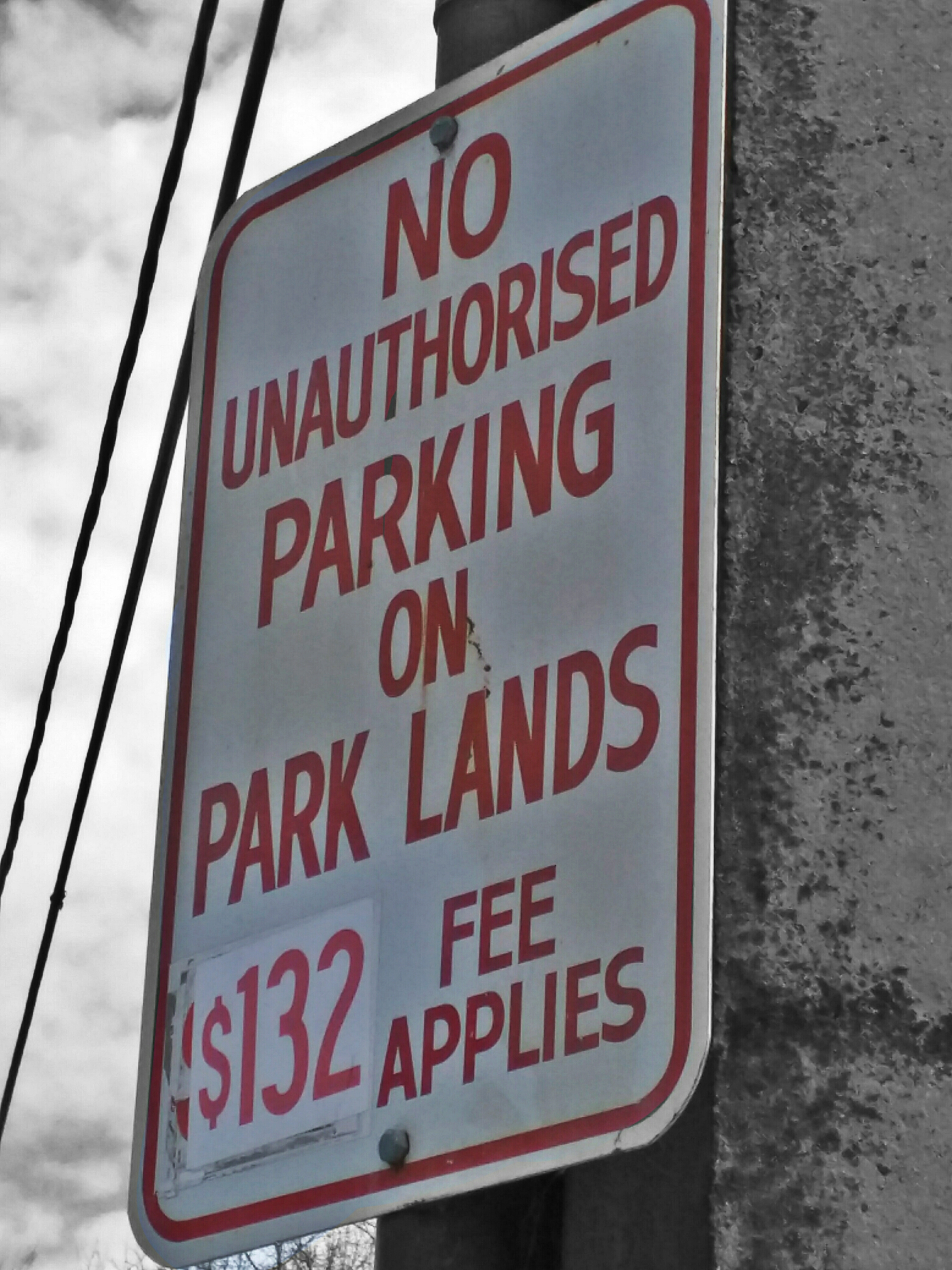
Never thought of parking in a park. It sounds like a very natural act. Interesting that it’s a fee not a fine. Who does the authorising and who does the fee-ing? I’m all confused.
This is another random thought related to consciousness.
We humans, because of our consciousness, assign a value to consciousness that is possibly distorted by the same.
For example, we have feelings and because we are aware of them we often believe that consciousness and feelings cannot exist independently.
You would probably assign a much lower value to the external signs of feelings in an animal because you would assume it is either unaware, or very much less aware, of the symptoms of its ‘feelings’.
But then think of your own heart. Most of the time its beats without you having awareness of it beating. Occasionally, under great stress, some people become aware of their heart ‘pumping’.
My point is that most of the time a heart beats quite independently of the awareness of it.
The same is true of our feelings and possibly also our thoughts.
So my proposition is that our conscious awareness of our bodily functions, feelings and thoughts is quite intermittent, variable in intensity and sometimes absent altogether.
That’s not quite the computer control system that we like to consciously believe that we have.
It would appear that consciousness floats above the other functions, dipping in and out, and focusing here and there or nowhere as needed and possibly according to some operating system rule set that we inherit and/or learn.
It would appear to me that most mental syndromes and conditions relate to a failing in an individual of the consciousness override system to kick in when the rest of us expect it to.
The underlying feelings or thoughts that drive the odd behavior are probably always there in all of us.
The same is possibly also true for action of drugs. Consciousness altering not mind altering.
Now I’m going to consciously stop thing about consciousness ’cause it’s odd isn’t it?

Right, I was just accused of being churlish towards the Chiefly Scientists of the federated states of Australia.
Additionally I was challenged to suggest what the breed should be doing (given the churlish manner of my commentary on the subject etc etc).
Well that is easy. Here is a quick and dirty list – I will add to it as ideas come to mind.
1. First, for universities and research institutes that get government grants for research, I would put a stop to the citation madness that drives researchers into crowded spaces where innovation is virtually impossible. The recent Dowling Report in the UK is a good starting point.
2. Enshrine the right that all government funded researchers own their own IP
3. Allow for abstract ideas in patents and allow software and business model patents (the opposite to what the US just ‘outlawed’). This would give local IT start-ups a more solid local monopoly which would reduce the risk for investors and this in turn would help promote a local investment community
4. Take all re-examination of patents in patent enforcement court cases away from judges and give it back to the professionals at the patent office
5. Make sure there is a speciality low-cost quick patent court which awards super large punitive damages to patent infringers
6. Introduce a really high % patent box tax concession for the patented export earnings of locally domiciled corporates (that have patents in the countries where the foreign income is earned).
7. Enhanced tax incentives and other government mandates for Venture Capital, but if and only if VC fund managers pass a suitable VC apprenticeship threshold. No self-appointed white shoe brigaders, Mac bank refugees, former entrepreneurs etc would be eligible
8. Promote the development of ‘Fonterra’s’ for the existing export markets in the meat, horticulture and education sectors where we have many small exporters with no global ‘weight’
9. Ban all political donations. (Less realistically wouldn’t it be nice if we could ban anyone entering politics before the age of 40. Maybe we could also disallow all lawyers, arts graduates, former lobbyists, former journalists and former union organisers from entering politics).
10. Sack all the current Chief Scientists and appoint a new bunch of Chief Technologists that have each been successful in a high-tech industry or two

Unfortunately I had to sit through a few speeches last night. Fortunately I was allowed to clutch a beer and I also had my phone with me, so it wasn’t all bad.
One of the speeches was by the Chief Scientist (sic) of New South Wales. She must have some Indian scientists in her employee maybe?
She said something very odd … she said that we in Australia (or was it NSW?) have all the ‘inputs’ for great innovation but none of the ‘outputs’.
I don’t think she was offering any solutions to this so-called ‘root cause’ analysis (to the problem of a lack of an innovative high tech exporting sector?) other than to imply that a good start was the current offering (namely the awards that were being handed out to former female graduates in engineering from the UNSW that were currently employed at sexy work environments such as UNSW, Rio Tinto or Sydney Water).
In any case, just for the record, O’ Chief Scientist of NSW, the reason why we don’t have measurable outcomes in the so-called innovation scale is because we hardly have any of the required inputs.
Specifically we lack these ‘input’ features:
1. A culture of very large investments of risk capital into start-ups or any other risky ventures apart from digging or pumping stuff out of the ground
2. A university sector that is a sandpit for proven or upcoming high-tech entrepreneurs and not a sheltered workshop for citation-mad self-aggrandizing academics
3. An economic and political system that is free of the dead hand of entrenched oligarchies and their third-rate management cultures
4. An employment environment that attracts our best and brightest to the innovation sectors. They all go to the professional services and the finance sector
5. A patent granting system and patent enforcement system that offers large damages to patent owners for infringement and assumes that the patent office is better at judging the merits of a patent than a judge
6. Chief Technologists at the federal and state government level that aren’t scientists and aren’t former academics, and that actually develop real policies that are implemented rather than spend their times handing out awards
6. Media commentary that is in any way critical of our innovation and tech sectors rather than simply bleating on about half-baked ‘success’ stories that are either complete fabrications or ‘gunnas’
Other than, it’s all good!

The one thing I do like about riding my pushie around Waterloo and Redfern is that car drivers never ever give me shit, no matter how outrageous my moves.
Intuitively they know it’s probably not worth their while. Clever little buggers aren’t they?

10/60 off 18 overs. What does this say for our chances in the Bledisloe you dickhead?
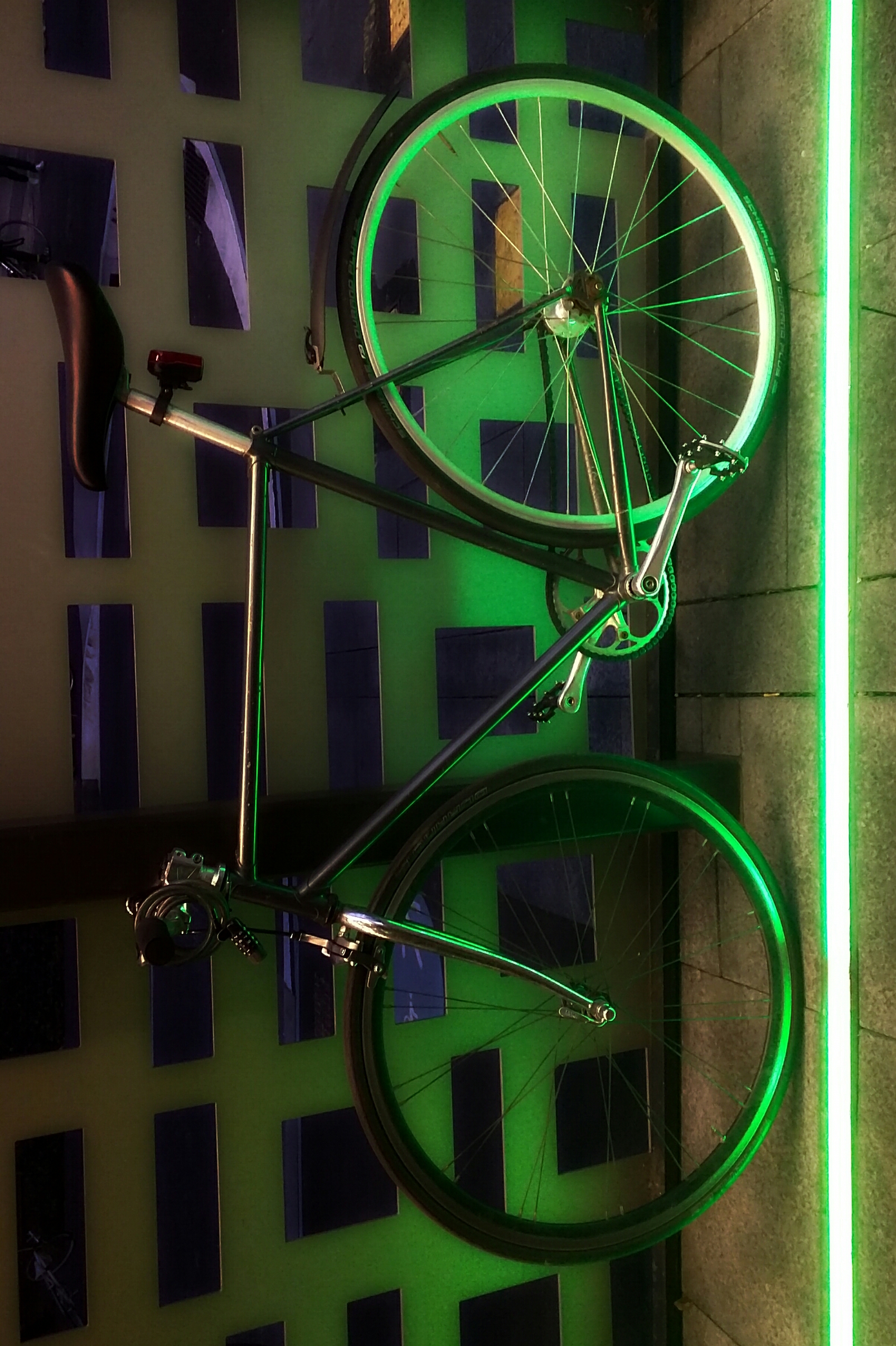
Thanks to Pete, yesterday I rode my first electric bicycle.
[Metaphor alert] It’s like not walking up an escalator; you have to consciously pedal the thing or else you find yourself cruising on the finger.
Pedalling the Skillion with its motorcycle fat tyres and 20 odd kg weight reminds me of Kurt Vonnegut’s ‘Harrison Bergeron’ (yes, really) in which the Handicapper General’s agents enforce the equality laws, forcing citizens to wear ‘handicaps’; masks for those who are too beautiful, radios inside the ears of intelligent people, and heavy weights for the strong or athletic.
Without electricity the Skillion would even bring Cadel back to peloton, the one composed of Lycra-clad pot-bellied corporate warriors puffing around Centennial Park on weekends.
Back to Harrison Bergeron. In this book Kurt extrapolated to the year 2081 by which time the American constitution was amended to dictate that all Americans be fully equal. Therefore no individual was allowed to be smarter, better-looking, or more physically able than anyone else.
Laugh? A friend was telling me a story the other day of a friend’s young son’s soccer team. In this team they rotate the ‘man of the match award’ and there is a rule that each kid has a mandated touch of the ball every 5 minutes during a game.
I am pretty sure that the parental push for childhood equality must have started in the Eastern Suburbs of Sydney. Bondi possibly, given the accelerated state of hysterical parental delusions down there.
This movement is an obvious extension of the Nanny State. First we engineer as much risk as we can out of our lives. And once that is cracked we start engineering inequality out of our lives. After that I suppose we will be so unhappy we will work on removing consciousness.
I have written previously (http://bit.ly/1T4MmV7) that, as productivity and real wealth has increased over the last three hundred years (since the industrial revolution), western governments have increasingly upped the percentage of tax they take out of the economy to ‘redistribute’.
Taxing us and spending it on behalf of all is a process related to, amongst other things, ensuring ‘equality’.
Right now all government taxation in Australia represents around 35% of GDP. By 2081 you can expect that to be more like 70% of GDP.
Most of the real work will be done by computers and robots and us humans will mostly be employed in fabricated employment related to (1) ensuring we are all at low risk of harm, and (2) that the equality laws are adhered to, and (3) a third category of jobs with no discernible function (there are plenty of these already).
Given the accelerating development of biotech I wonder if someone might have the bright idea of ensuring equality prior to conception or prior to birth. For example IQ could be attenuated artificially to ensure that no one is smarter than anyone else. Or appearances could be modified to ensure that no one is prettier than another.
Kurt Vonnegut was a genius hidden within the world of science fiction. He correctly spotted this equality trend before anyone else did.
He was trying to point out the difference between the ‘equality of opportunity’ and the ‘equality of outcomes’.
The former has merit and the latter is just plain stupid because it will enshrine a decline to the lowest common denominator, otherwise known as fair average quality.

I received the tweet below from ‘Jargonbuster’.
I wonder what sort of mind wishes to freeze the English language as it was in 1950?

The Harper Review correctly notes that ‘… Australians are enthusiastic adopters and adapters of technology and net importers of IP’.
The review goes on to note that the rules governing IP enforcement ‘should be designed to operate in [Australia’s] best interests’.
That is, water ’em down.
And by implementing policies along these lines the government will ensure that we stay as enthusiastic adopters and adapters of technology and net importers of IP.
To loosely quote Douglas Adams…
“Oh dear,” says the entrepreneurial tech sector, “I hadn’t thought of that” and promptly vanishes in a puff of logic.

Professional service sectors often have a guild-like structure grafted onto a Amway-like partnership structure.
Together, these features act to preserve profits to the partners of the companies in these sectors.
For example, the number of practitioners that are allowed into a profession might be controlled, under government decree, by a professional association, completely comprised of leading partners in the industry, that claims to maintain ‘standards’.
The number of practitioners may then be managed by setting a complex process of learning and examination, trainee fees, and even by requiring sponsorship of trainees by a member company of the association.
Managing the number of practitioners effectively allows the association to ensure that the supply of practitioners is managed to ensure that margins in the industry aren’t impacted by an over-supply of practitioners.
Everyone who enters into such a profession is offered the carrot of potential future partnership where the guaranteed wealth of these pseudo-monopolies is collected.
Of course not everyone makes it to the top of the Amway-like employment pyramids but, by the time they realise they aren’t going to make it, most in a profession have a sort of Stockholm Syndrome whereby the structure of the environment is unquestioned.
Another means by which companies and partnerships in such pseudo-monopoly sectors ensure high margins is to control salaries at the lower rungs of the pyramids (wages being their major variable cost of business).
Salaries are controlled in many ways; by working people for so many hours that the hourly rate is less than working at McDonalds, or by making people sign employment contracts that ensure all employment remuneration is confidential information to ensure worker collusion on such matters (i.e unionism) is avoided.
The victims here are the salaried workers in the sector whether they make it to the top or not.
If they make it then they are usually burnt-out zombies that hate their boring lives and the fact that they could never walk away and try other employment without losing their place in the pyramid.
If they don’t make it to partnership then they are victims of the greed of their partners in more ways than one – it’s an environment that seems to breed contempt towards those at the lower reaches of the pyramid.
The other victims of course are the customers that pay through the nose for professional services. The business margins on some of these professional services can be obscene (and many times the multiples of their customer’s margins).
On the multiplicity of such price gouging, it’s but one reason why our exporters are so uncompetitive.
Sometimes the senior partners in a sector might collude to own a key supplier to their own industry. By exclusively using the services of this supplier they can further obscure their high margins.
One would query whether this whole scam is worthy of ACCC investigation. But that is unlikely; not to worry, the internet will disintermediate these guys soon enough.
Probably sooner rather than later actually because those high margins make disintermediation just that much more attractive to the types that like to innovate in these areas.
Just for completeness, disintermediation in this context means using the internet to automate professional services or to make them completely obsolete. If, O’ professional service provider, you aren’t scared of the internet, you should be. Very.
PS to my many friends and colleagues in the professional services, of course I don’t mean your profession.
Just recently, for no especially good reason, I was looking at my family tree.
The christian name of one of my great grandmothers’ was Ingo.
It took me a while but then I got fascinated by the name, having never heard it before.
Ingo’s mother’s name was Ingogereth, even more unusual. And Ingogereth’s mother’s name was also Ingogereth. But that Ingogereth’s mother’s name was Ingagarth.
And the good thing about an unusual name is that a Google search can become pretty targeted and useful.
After Ingagarth the trail runs out of Ingos but it was well into Scotland by then.
According to one conversation that I dug up on-line, the name Ingagarth or Ingogereth is a female name of Scandinavian origin and it was traditionally found only in Shetland Islands north of Scotland.
Apparently these names were passed down from family to family in the Shetlands all the way back to 9th century when the islands were colonised by the Ingaevones (roughly these were Germanic Danish Vikings).
The fate of the original indigenous population is ‘unknown’.
The Shetlands were taken over by the Scots in the late 15th century but the Norn language (an ancient Scandinavian language) was still spoken there until the 19th century.
The name Ingogereth (and it’s many variations) derives from the Old Norse Ingigerðr.
Ingigerðr was derived from the name of the fertility god Ing or Ingqaz combined with garðr meaning ‘enclosure’. In the feminine context I expect ‘enclosure’ means ‘womb’.
My daughter is now quite chuffed that she is a miniature Viking.
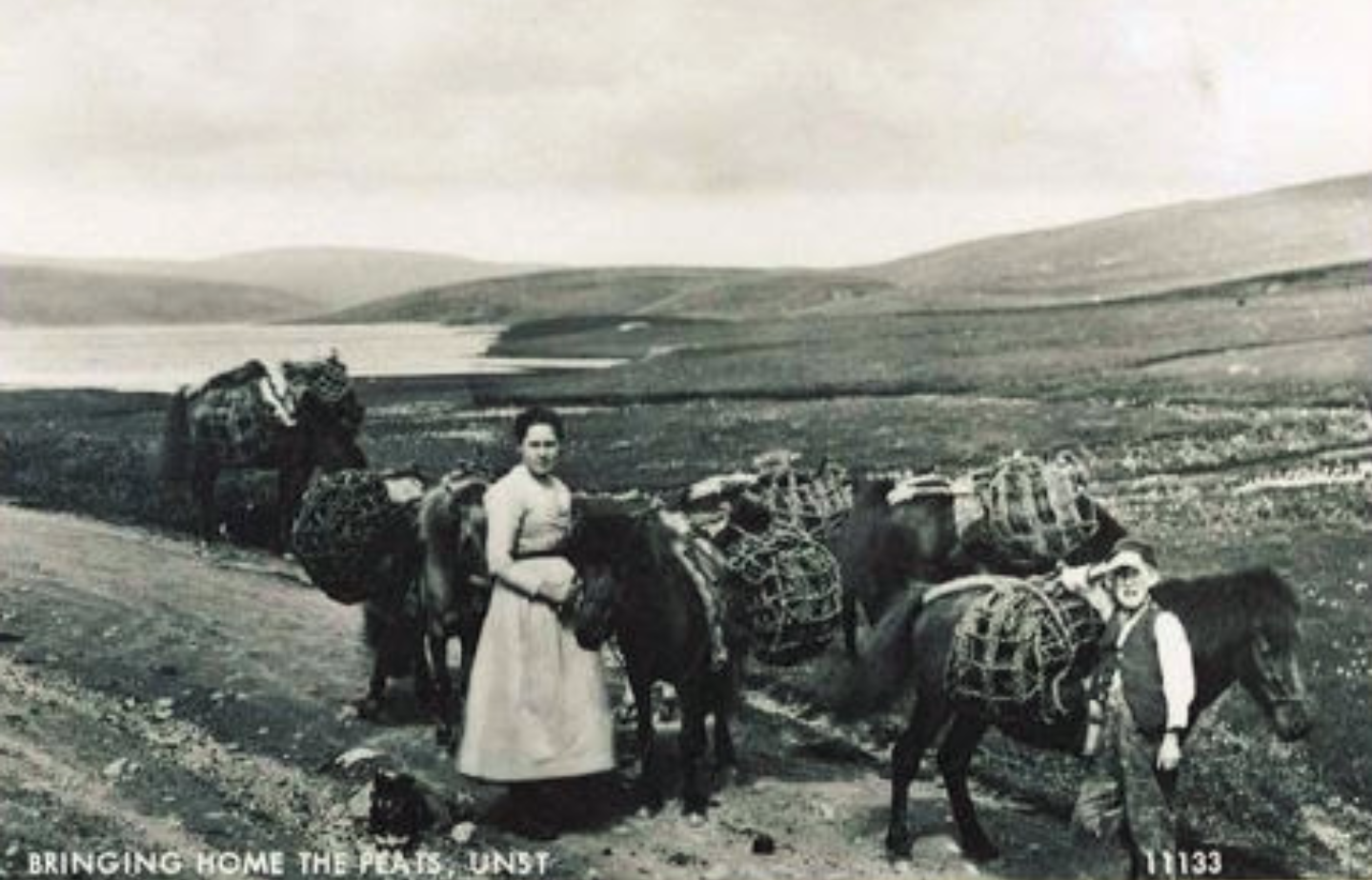
The Shetlands are as far north as Greenland’s Cape Farewell, i.e. bloody cold and windy, and looking at the photo below can you blame the locals for getting out of there when they could? Good on you ancestors!
“42% of startups fail due to the wrong product”
So screamed the headline.
The author simply doesn’t understand the difference between correlations and causations.
If a startup had the wrong product it’s because the founders didn’t have a clue and that is why they failed.
If you don’t understand this then think of traffic accidents. The authorities assign a cause to every accident – one of; speed, alcohol and drugs, or inattention.
I can assure you that you could put speed governors on every car, drug and alcohol meters that control the ignition and also readily available attention monitors, and you would still have plenty of accidents.
Why? Because some people are just shit drivers.
Same for startups; 42% of startups fail because the founders are shit at their job.
Some would be shit because they just are.
The rest are too stupid to realise that they should do an apprenticeship (or two) as an employee in a startup with an experienced founder before launching their own effort.

A final word on the Goodes saga…
Two years back I sort of guessed this thing would blow up eventually, especially after they made him Australian of the year.
The whole saga is quickly polarising Australians into two camps;
1. Those who defend the right for crowds to boo Adam Goodes for any number of reasons. Not one of these folks is saying they are booing him for racist reasons – in fact that they are making any number of excuses, just not racism. Oddly though, not one of these folks will admit the possibility even one of the people booing, amongst the many thousands, could even be racially motivated.
2. The rest who are appalled by the whole thing.
There is another dimension to this problem and that is one of the hatred of the nanny state. Many of the people who support the right for crowds to boo Adam Goodes are using their hatred of the nanny state as their excuse.
Would that they choose another issue to vent their spleen on…
What they don’t seem to realise is that Australia’s completely unsorted and shameful relationship with its indigenous people is a boil the size the whole body.
It just so happens that many of the people that hate the nanny state also hate the idea of genuine reparations to the indigenous people of this country.
They fear that the nanny state and associated politically correct policies will lead us down a rabbit hole where they may actually be financially affected by whatever the reparations end up being.
My guess is somewhere in the back of their minds they know that by any rational assessment they are guilty of enjoying the proceeds of Australia’s horrific treatment of its indigenous people over the last 200 odd years.
‘It wasn’t us’ they say, ‘It all happened before we were born.’ Or ‘we just got here 20 years ago’.
This is what could only be called a very convenient untruth.
So when you boil it all down this whole race issue in Australia is mainly down to greed.
The number of genuinely insane emotionally-motivated racists is probably quite small.
All I can say is the longer we wait to deal with this issue the bigger the boil will get.
If we wait too long the bloody thing will kill us.
The really difficult question I have is how we get this reality into the minds of all those first order greedy nay-sayers?
Forcing them to come along with whatever the resolution package we concoct without consent won’t really cut it, especially if they represent a good portion of the population (as they seem to do).
After all, in all other matters of our consumerism existence we do seem to promote a ‘greed is good’ culture.
I have this very uncomfortable feeling that using the socio-political machine to force a resolution might just be counter productive.
All I can hope for is that this current crisis (because that is what it is becoming) might create enough noise for a path forward to be identified.
The darkest hour is often followed by the chink of dawn.

Lola on the subject of primary colours…
‘Dad, I know red is supposed to be a primary colour but I reckon you can sort of make by mixing yellow and brown and maybe a little green, or something like that.’
Nice one; questioning orthodoxy already.

So what’s the chances?
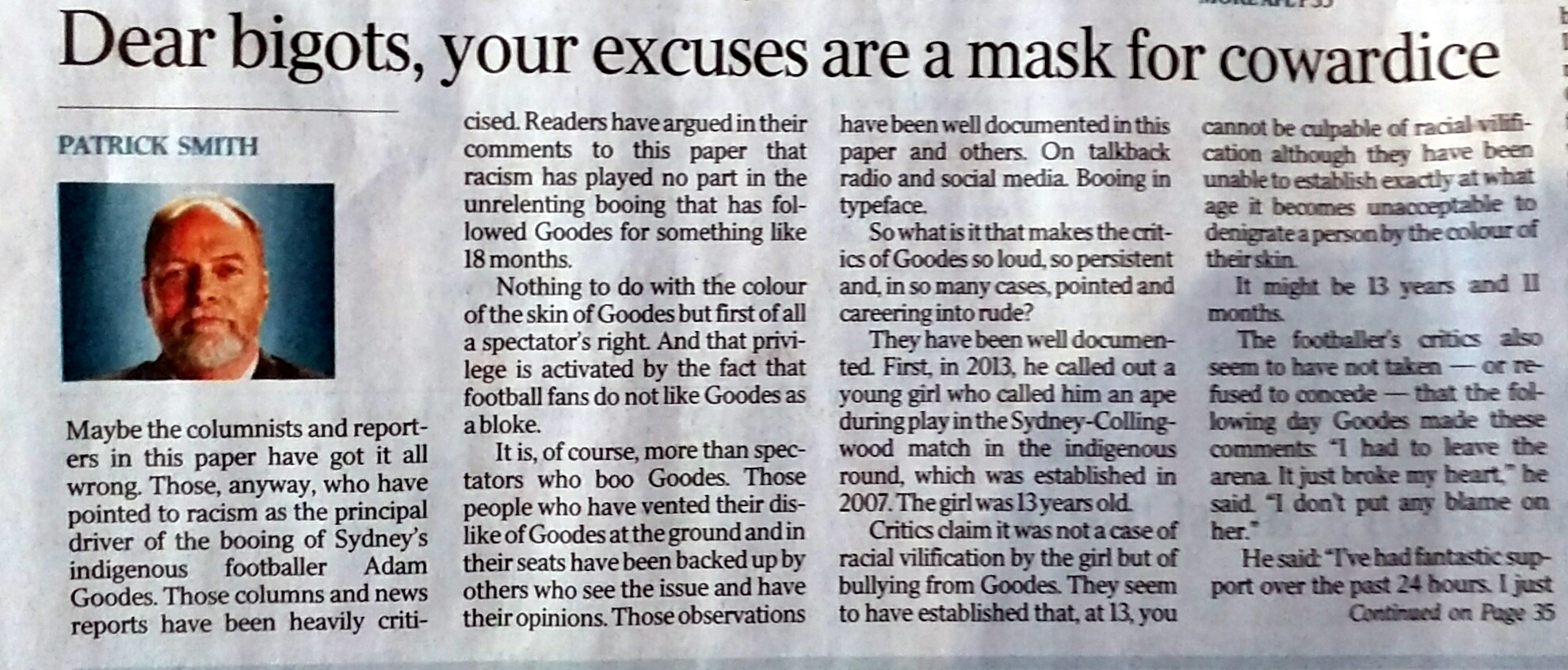
I was sitting waiting for the business forum to start and the bloke next to me, noticing that I was reading Patrick Smith’s wonderful piece on the Goodes affair, opined that the booing isn’t racist.
He reeled off half a dozen excuses, the usual ones.
I said that I didn’t believe him and in my eyes these actions are racist.
He said he didn’t care and that it was a free country and he could do and think what he wanted.
I laughed at that one and suggested that we have more laws and regulations per capita than any other country on the planet. Free country my arse.
Then I suggested that even if he truly believed that his opinions weren’t based on racism would he want people thinking that he was racist? Or that he was in the company of racists?
Right there I caught him wobbling in his resolve.
You could see the mental balancing act; his gut feelings of subterranean racism, his righteousness, guilt, fear and shame – these feelings and thoughts were all at war within his skull.
Right at that point I let him off the hook because I didn’t want his brain to explode and leave the indelible stains of shame all over my free volume.
Adam take a bow, you have flushed out all the racists in the country…
My view is that there are three types of people in the racist dimension;
1. Those that are racist in both their limbic and neocortex systems, their feeling and thinking parts of their brains, and don’t deign to hide it.
2. Then there are those that are racist in their feeling limbic brain but override it in their thinking neocortex, most likely because they know it’s socially unacceptable. These are the ones that think booing Adam Goodes is OK and justify it by saying he is too big for his boots, or that he made a little girl cry or whatever.
3. The rest aren’t racist because the limbic feeling party of their brain isn’t so wired.
Adam, by his actions, has flushed out the large fraction of society in the second group.
Boy, do we have an issue do deal with here.
Divisive it is but sometimes that’s a good thing. It’s much better to have the division out in the open so we know what we’re dealing with.
The solution? Death and renewal to be honest. But this will help to make sure that the youngsters are properly schooled.
What a brave man.

Wiki says ‘Consciousness is the state of awareness or the quality, or, of being aware of an external object or something within oneself.’
Philosophers, spiritualists and, more latterly, pseudo-scientists (the clinical type) and scientists have been trying to unravel the mystery of consciousness to little avail.
I recently viewed a ‘banned’ TED video of this character named Graham Hancock who is an advocate of certain consciousness altering drugs.
His view is that we are all better people (in the collective) if we carefully experience certain altered states of consciousness through the use of drugs.
He notes that modern Western society has a serious issue with mind-altering substances because we are fixated on the rational here-and-now and, by implication, control and power structures that rely on people being in this rational here-and-now state.
One of his most interesting statements was a question he posed as to whether the brain was like an electric motor and consciousness was the electricity running around inside of it. In this model, he says, when the brain stops so does the electricity.
The other model that he proposed is that consciousness is like a TV signal that the brain picks up and that even when the brain stops the TV signal may still be out there in the ether.
I hate hypothetical either/or’s because usually real life is a bit messier than that. So I smell a rat.
Which led me to wonder as to how consciousness developed in the first place.
My guess is that as animals (including us humans) started socialising there was an evolutionary benefit to observing and understanding how others in the pack were feeling.
Later on as the human neocortex developed this observation of others may have extended to us elucidating what others in the pack were thinking.
So the initial benefit of consciousness might have not been self-awarenesss but other-awareness, which would be beneficial in any social pack activity.
However, we may have started using our own rational processes to process the incoming other-consciousness data to produce higher order predictive models of others as to their likely behaviour.
My proposition is that other-consciousness developed firstly through being aware of others and eventually this led to a heightened self-consciousness as we started used rational predictions to modify our own behaviours through both feelings and thoughts to even further optimise the outcomes from social behaviour.
This would explain the effect of mind altering drugs and their effect on consciousness. Let me explain;
The key impact of mind altering drugs and even dreaming during sleep is to drag one into the self and in the process to cut off much of the outside world including that data associated with other-consciousness. That is, the other-consciousness associated with the awareness of others is mostly removed during sleep and whilst taking mind-altering drugs, and replaced with memories and internal constructions.
Using classical scientific methodology, a limiting case of this proposition would be a human being that has never had any external stimulus of any sort. I would suggest that self awareness (self-consciousness) would never develop simply because its primary purposes is to process and utilise the ‘other awareness’ data (other-consciousness).
So in this context this is what I can say about various of the usual chestnuts on the subject:
1. Having a holiday from other-consciousness (i.e. dreaming during sleep or drugs or whatever) must be an important part of the program because dreaming is built into our make-up. Running dummy scenarios in our dreams may just be our method to calibrate our models. Running drug altered models may have real benefits by randomly showing us radically alternative solutions that we wouldn’t otherwise arrive at.
2. When we die our ability to pick up the signals of other-consciousness is lost. Logically our ability to process this data (the self-consciousness) would also be lost and indeed it would be also quite redundant without the key data to process. The so-called TV signals of all those still alive might be still floating around and the memory of us may live on in others but I doubt very much that our particular version of the program is floating around in anything but fragments of our impact on others.
3. Noting that everyone on the planet is connected through the so-called six degrees of connectivity and that with 7.5 billion people on the planet we are therefore also connected to just about every molecule on the surface of the earth, it’s not hard to imagine that all of our incoming other-consciousness data incorporates an awareness of the whole thing. When our collective physical existence starts presenting a threat to the ecosystem and some yellow canary people start feeling these emotions, this must ripple through all of our self-consciousnesses to some degree or another. This may make us feel ill and therefore, for those more ‘open’ and inclined to ponder the issues more deeply, a desire to process this other-consciousness data in some dream or drug induced sessions.

Loyalty and justice…
There’s a case for being passionate about these principles but using them as guidance for the daily execution of friends and strangers will drive you nuts.
There are simply more ways to fail these tests than there are conspiracy theories on Facebook.

To what do I owe this dark symmetry?


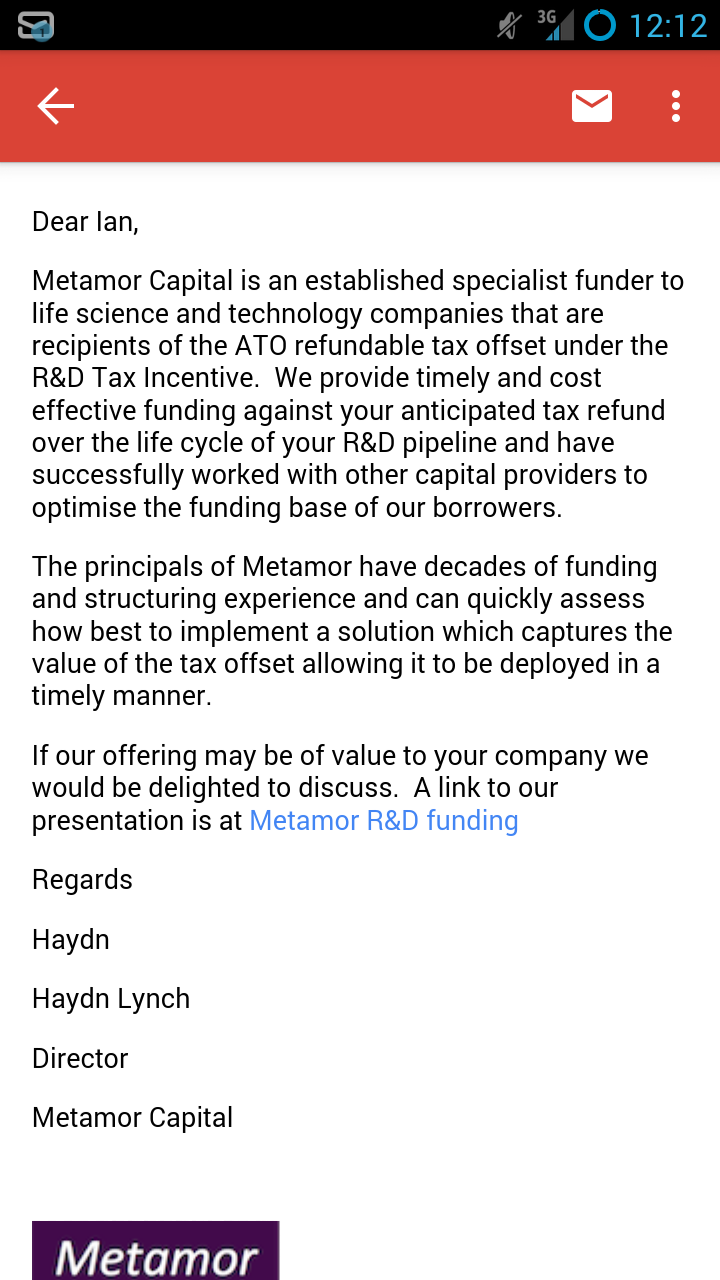
There are a number of groups that now offering yielding debt based on the Australian government’s R&D tax concession.
My prediction is that this is the beginning of the end for this particular hand out.
Governments usually don’t like underwriting finance schemes unless it’s their idea.
I was wondering what would be an interesting set of countries to visit in an attempt to avoid the usual tourist traps and then the light bulb went off…
The list is already there I just had to look for it in the right place:
The following countries simply have no laws to enable patents to be obtained and/or enforced: Afghanistan; Eritrea; Holy See (Vatican City State); Maldives; Marshall Islands; Micronesia; Myanmar; Palau; South Sudan; and East Timor.
Apart from the Vatican not too many of these places are on the usual tourist agenda.
I’ve been to East Timor and that was great; not too many rules. So there’s my validating data point.

I simply cannot believe they want to raise the rate of GST. It’s just so easy to divide things by ten…
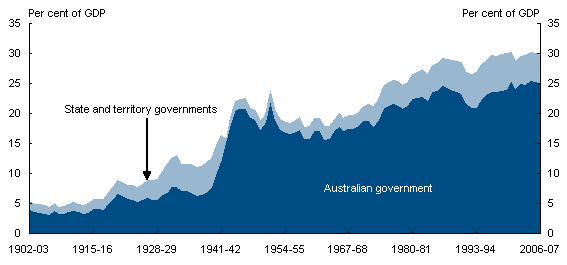
I think we all have to accept that as our economy gets more and more productive that the overall rate of taxation will just keep rising (see plot below) for a whole bunch of reasons but primarily because (a) we don’t really need all that extra wealth, (b) it’s a great means of redistributing wealth, and (c) more tax equals more control and power for those egocentric weirdos that go into politics.
You don’t hear any of them saying let’s just spend less. Or let’s just cap health and educations spending as a % of GDP and work within that budget for the best outcome.
Given that taxes have to rise (forever) me-thinks the best tax to raise would be state property stamp duty. I would make it 20% for residents and as high as 50% for foreign buyers (we may as well fleece them).
Oddly these high figures wouldn’t affect house prices too much. People spend up to their specific budget limit on a property and they don’t care who gets their money, the former owner or the government.
What this means is that house prices in the city are just about completely set by supply & demand, and budget limits. The prices have absolutely nothing to do with any inherent value of the land and very little to do with the true cost of the building.
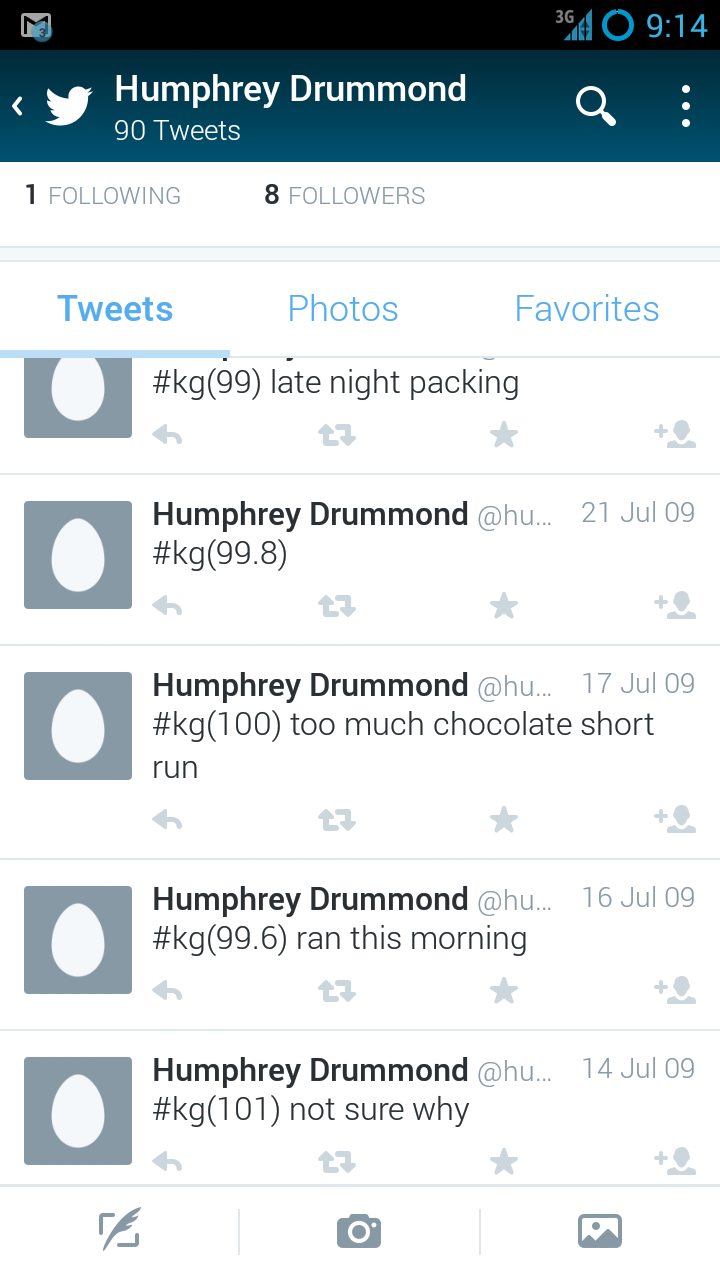
My old mate Humphrey seems to be using Twitter to keep tabs on his weight. Another example of privatising the gains and socialising the losses.
For what it’s worth folks the story of Humpty Dumpty is just an early embodiment of the second law of thermodynamics.

Never drink your own bathwater unless it’s chock-a-block full of Berocca after a big night out.

What do you think? A skywriter fuck-up or a case of frustrated friends?

If you’re searching for a new business concept let me help you out…
70% of Australia’s GDP is in the services sector.
Apart from a few oligarchical ASX top 20 dinosaur corporations the services sector is chock-a-block full of SMEs.
Just about all of them have finally caught onto social media and they know it’s going to be the primary way to interact with their customers and the rest of their supply chains.
They know they have to post content on LinkedIn, Facebook, Twitter, Instagram, WordPress blogs, and others, on an hourly basis or even more frequently.
But what they don’t have is content. And no idea how to create it. Videos, articles, tweets, photos, blogs, reviews, etc. It’s just not their expertise.
Which is where you come in.
No matter what your interests are there’s a business sector whose business is your interest.
It could be cooking, toy trains, gardening, accounting, fashion, science, drones, Lego, truck logistics, whatever.
You simply approach businesses in that sector and offer them a month’s free introductory service.
In that month you create relevant content for them and push it hard on their accounts on all the social media platforms, which you take control of.
Here are some handy tools for this task … http://www.searchenginejournal.com/top-10-tools-for-managing-your-social-media-accounts/
You measure the levels of engagement and show them the great analytics. Where possible you link that engagement directly or indirectly to sales or customer and supplier support.
In month 2 you get the customer on a recurring monthly fee, anywhere between $1k and $100k per month depending on the size of the company and how much work you’re doing for them.
The content? Your ideas mixed with stuff pinched from the web. You’ll become pretty good at morphing this borrowed content so that it looks original. Look out for any genuinely original thoughts in your field and jump on them quickly.
After a while you can start recruiting part time casuals to help.
You can build a whole services business that becomes the domain expert for social media content management in your chosen business sector niche.
Your business can eventually go global.
Eventually you will be able to buy a house in Bellevue Hill.

Warning: Substantial penalties apply for improper use of the English language

Well guess what, not only do we get to rate the Uber drivers, they get to rate us.
I just discovered that I have a 4.7 rating of 5.
Which means that I am a very good bloke according to my driver.
Eventually Uber will have enough data to give us all a geniality rating.

Proposition: women are better at multitasking than men.
Firstly, I smell a rat because this proposition has usually been proposed to me by women as a point of superiority.
Secondly, the examples given have smacked of cherry picking the data to provide non-statistical evidence for the proposition.
Thirdly, there are conscious tasks and subconscious tasks and most of us can simultaneously handle one of the former and a number of the latter.
Fourthly, the ability to do so probably depends on training and not gender. Although maybe one of the sexes may be encouraged to train more than the other?
Finally, the best multitasker I have ever known was a male flat mate who could, with wonderful ease, simultaneously read, watch TV, listen to music, eat, think about his PhD thesis, hold down two conversations and scratch various parts of his anatomy.

Three great Australian misnomers…
Nanny State (it should be the Mum & Dad State)
Babysitter (it should be Post-Baby Sitter)
Kindergarten (it should be KinderGefängnis)

Twitter just keeps giving….
“Appreciate the time that you have now. As every second passes, you’ll never be that young ever again.”
I question the ‘that’. I would have used ‘as’.
But what do I know? Me and grammar (gic) are like two siblings separated at birth.
The culprit is the state government of NSW, so we may as well call ourselves the grammatically lost generation.
Six English teachers in six years of high school and hardly a tense taught in anger.
I got substantially more grammar in those useless Latin classes.
To be fair though, I am possibly an unreliable witness in matters of amisit grammatica.
Still I can feel a class action coming on. Think of those hundreds of thousands of state school graduates that are simply too embarrassed to Tweet?
Lost earnings could be argued, straight up, because, as we all know, social media is now the number one tool for acquiring customers.
Back to the Tweet in question. What my well-intentioned fellow state school graduate meant to say was:
“Appreciate every second before it passes; you’ll never have it again.”
That’s sort of depressing really.
And, indeed, you could spend a second appreciating a second and never end up doing anything in life.
Nuh, thought about it now, life is best lived with minimal real time reflection and a Hunter S.-like Gestaltian flourish.
“Appreciate time; don’t waste time appreciating every second as it passes.”
You can always contemplate it and write about it when you break a leg.
Yesterday I ducked around the corner on my bicycle to pick up my laundry.
Being all back streets and lanes, this 500m route does not require a helmet IMHO.
Of course a couple of the local wallopers cruising the back lanes of Waterloo for drug deals and break & entries stopped me, probably to relieve their boredom.
They both got out of their Commodore.
“Do you know why we pulled you over?” says Plod 1.
I feigned complete ignorance. It never pays to pre-justify their prejudices.
“It’s a requirement to wear a helmet at all times whilst cycling …. [Insert short lecture on the near-shark attack like dangers of cycling]”.
I noted the backstreet nature of the short journey to reunite me and my smalls.
They had a mini-confab about the merits of booking me versus giving me a warning.
So I thought I’d push the issue a little.
“These are not the droids you are looking for”, complete with hand movements.
Plod 2 burst out laughing. Said he’d been waiting years for some clown to use that line.
I got off with a non-stern warning.

Yesterday I met my first female misogynist.
I called her on it and suggested that she probably doesn’t hate herself.
We then agreed on a new pseudo definition of a misogynist.
A person who hates, dislikes, mistrusts, or mistreats some women.
After that was agreed I asked how she knows which women to dislike, mistrust or mistreat?
She said “all of them and if on the rare occasion I’m wrong I just apologize. Being the sane ones they naturally accept the apology.”
Was there ever a better definition of an affinity group with a shared prejudice and a fear to know?

Since the industrial revolution, when systematic advances in technology were first used to make labour more efficient at turning raw materials into finished goods (whether that is coal to energy, grass to meat, or iron ore into a car) participating workers have been rewarded with an increasing ability to consume.
In fact, in most Western economies the growth in average wages perfectly tracks the growth in multi-factor productivity.
This makes sense; if the benefits of all that technology weren’t shared around there simply wouldn’t be enough consumers for all those lower cost goods to provide the required economic growth.
It’s a ‘virtuous’ circle; increased demand drives investment in technology-driven cost reductions which drives higher profits which results in higher wages which leads to more consumption, aka increased demand.
In the West, where this pattern has been trundling along for three centuries, we got to the point of universal ‘sustainability’ around 1900. At this time just about all the people were earning enough to sustain themselves in a secure fashion.
Thereafter we simply began to consume in excess of our fundamental needs. Cars, whitegoods, large houses, holidays, electronics; these are all luxury items in one context. We wouldn’t die without any of them.
After 1900 governments also started taxing more heavily. Since the administrative technology existed to universally tax both companies and individuals it has been used with ever-increasing intention.
Slowly and surely the rates of overall taxation have crept up (as per the graph below).
Some say this is a bad thing because the more the government takes, the less individuals and companies have to either consume or invest. But I would note that the removal of that money by governments won’t kill them.
I suspect that the return on investment on all government expenditure is ZERO. That’s right, nought, nix, nothing. That’s how inefficient governments are at what they do.
But remember this would also be the case if this money was left in the hands of consumers. They wouldn’t usually invest the money either; they would consume ‘luxury’ goods; an activity where the sole function is to drive increases in demand.
Another way of looking at all of this taxation is that governments are unwittingly addressing the issue of technological unemployment by creating artificial jobs.
Currently they collect and spend around 30-40% of GDP. This won’t stop there either – as we get further towards 100% automation and artificial intelligence I suspect that only 10-20% of people will be employed in ‘real’ jobs and the rest will rely on the redistribution of wealth via the tax systems in order to participate in the consumption game.
All that the collection of taxation ensures two things; (a) continued growth in consumption, and (b) social peace which would be challenged if a large fraction of the population was living below the sustainability line (which is very different to official poverty lines).
I would note that companies don’t consume, they invest. It makes no sense whatsoever to tax them because companies are the source of all those continuing increases in productivity that drive the whole shebang.
Also companies are a lot more mobile than people and will happily shift their operations to lower taxation domiciles. For this reason alone, company taxation rates are heading to zero. Which makes sense anyway.
I do however believe that that the game will change pretty soon, for a couple of reasons:
Firstly, the ‘industrial revolution’ economic model relies on the assumption that resources are unlimited. Which they are not. As this fact become more apparent the whole model will be severely challenged.
Secondly, after company tax has gone away and as technology allows less and less people to be employed in ‘real’ jobs and more and more in government mandated jobs, there will come a point where the amount of tax one can extract from the ‘real’ workers asymptotes and a government simply won’t have enough tax receipts to distribute the proceeds (indirectly) without allowing for an official two-tiered wealth system.
This problem can be understood by considering the maximum rate that one can be taxed at. Say it’s 90% of income but of only 10% of the population (that are truly productive). A government simply couldn’t tax these people enough to feed the rest of the population unless there was a dual channel taxation and employment system (where some people earned a lot more but were also taxed incredibly highly). Politically and socially difficult, this one.
At this point governments will be helpless to address the genuine wealth disparity issues caused by technological unemployment. This may not be a crisis of relative consumption but one where some people fall below the ‘sustainability’ line. If this happens this will cause serious social unrest – it could prompt the Second Luddite Uprising.
It would appear to me that the timing of these two issues will be coincidental somewhere in the second half of this century.
The solution to the first problem may require a change to our socio-political systems. What I mean by this is that we may have to introduce a consumption tax that favours lower consumption of raw materials but at higher cost and higher levels of intellectual property.
For example, lower sales tax on goods that incorporate advanced technology that provides for long service life.
This will help lower the consumption of raw materials but will not necessarily depress the rate of improvement in technological developments.
My very odd suggestions for the solution to the second problem is twofold:
(1) Rather than let the benefits of the continued technology improvements fall into the hands of a few from which there would not be enough government revenue to peacefully distribute amongst the rest, it may be useful to allows machines and computers to earn income and tax them at 100%. That is, we should not let the profits of increased productivity fall into fewer and fewer hands.
(2) Another way to solve this problem would be to stop taxing companies by profit and to start taxing them by equity. That is, every year some fraction of company equity would end up in government hands as a means of taxation. Then the government purse could directly benefit through dividends.
The next time I get sprung for robbing a 7-Eleven of $5200 I am going to give the money back and claim it was an error of judgement.

All over Bondi there are abandoned bikes chained to posts.
Probably left by departing backpackers these bikes were rubbish when they were first bought from Kmart.
Months and years later, rusting and warped from drunken attention, they are now unheralded street art.
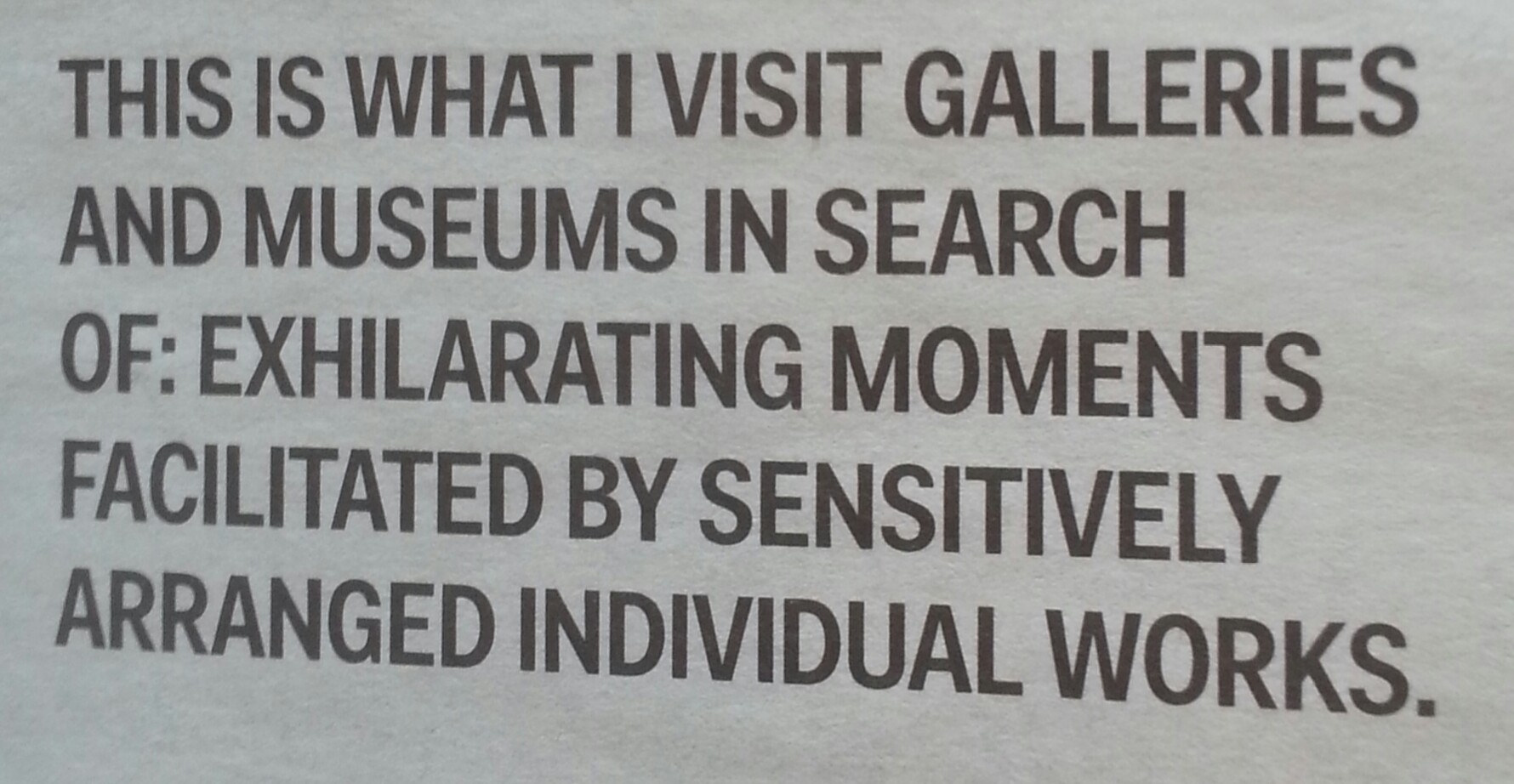
This is what I visit Bondi in search of: exhilarating moments facilitated by sensitively arranged individual works.


Overheard …
[Toddler] “I don’t want to go to the party”
[Grandmother] “Nan wants to go to the party. You can stay outside if you want.”
Overlooking the admirable old-school response, why do people talk to toddlers in the third person?
I suspect it’s a subconscious effort to depersonalise the responses and impress role-values into kids.
In the overhead example Nan is also saying “It’s not just what I want, this is what every (sane) Nan would say.”

The Saturday Rag has any number of well written conspiracy theories.
I have just completed reading one on the subject of the federal government’s agenda to retard the growth of renewable energy.
What the government is actually doing is culling government agencies that supply clean energy research grants, and investment funds and rebates for renewable energy installations.
This is supposedly due to the evil influence of the coal exporters and the coal burning electricity generators.
Maybe true. But I think there’s a couple of other agendas at play such as wedge politics and some required budget cuts. Possibly also spiced with a bit of Luddite denialism.
My personal view is that renewable energies are now so cheap that we don’t really need government involvement and all the associated white collar welfare.
Truly, in the context of global warming and renewable energy, the only government intervention that ever made any sense was the carbon tax.
PS this is a photo of some of those most concerned about global warming having an ice skating session at Bondi at twenty degrees Celsius.

Referring to the somewhat embarrassing confession made by the arts and craft writer in the Saturday Paper (see below), the nuances referred to comprised of a white room, a piano and one little picture on the wall.
It seems to me that every time I accidentally find myself in a modern art museum I discover a white room containing just one big object and one little painting hidden somewhere on the wall.
What ever happened to novelty? I suspect that fine arts degrees now have a course on Sensitive Whiteroom objets dissonance Arrangement.
A.k.a. how to hide the fact that you can’t paint for shit.
Just yesterday I was forced to change my mind on gamification.
Gamification is where an internet service uses any sort of game theory to encourage participation.
Essentially the concepts of ‘play’ and ‘fun’ are used in an internet-based service.
Apparently there are four types of user personalities when it comes to gamification:
Killers: these guys focus on winning something, or rankings and the like.
Socialites: are driven by developing a social network of friends and contacts.
Achievers: have a focus on attaining status and achieving pre-set goals.
Explorers: have a focus on exploring and a drive to discover the unknown.
Actually I think there is a fifth type, the gambler: these guys can’t stop themselves even if they want to.
So, when in the past I have disliked gamification in apps or websites, it has been because it was targeted at a personality type that wasn’t mine.
A lot of older school business types don’t like gamification because it appears to them that they are being gamed, which they are.
Gen Y’s don’t seem to have a problem with this for some reason.
In an entirely unrelated discussion, I was just talking to an expert about how to get businesses to contribute more diligently to their own social media efforts.
The problem is content – the people in these businesses rarely have enough content for daily postings. And they generally can’t create it for shit.
I suggested an app or SaaS which gives them daily reminders to write that content.
Starting with small demands it could build up as they got used to the habit of creating (and posting) content.
And, as to the gamification aspect, I would add individual content creation targets with non-compliance penalties being a community ‘swear jar’ where those people not meeting their goals simply have to put money into a pot, which eventually would go to charity when full to a certain level.
For this style of gamification I think there is a sixth type of user, that of the boomer and Gen X character:
Contributors: users that are willing to pay for non-participation so long as the proceeds go to a good cause and the purpose of the function that has been gamified is not trivial
Ford is currently flogging a new Mustang and after many generations they have finally, once again, designed something that is actually (sort of) nice to look at.
In fact their own marketing material (shown below) has a gap in the design of Mustangs of about, ooooo…, 44 years.
What they are implicitly saying is that none of the Mustangs in the gap years will ever be considered a classic, no matter how long we wait.
This is a loooong period for anyone to propagate crap designs with no internal recognition of that fact at the time.
It would make an interesting case study on the woes of corporate management.
Bad management would believe that cars sell on price and specs, or a great big distribution channel and lots of marketing, whereas they really sell on brand perception and design.
Customers generally have a budget and within that budget they will select the car that they perceive is the most desirable brand and that also has the best design or the least objectionable design.
It’s hard enough to find good designers. But for car makers to get it right the decision making process around design has to be supported by management that understands the importance of great design and can recognise it but not try to run it.
That sort of right brain thinking just doesn’t normally come with the left brain requirements required for climbing the management ladder of a global corporation.

IBM has engineered up a new pilot line for making chips.
The gates are just 7nm wide and 30nm apart.
Which allows them to make processors with 22 billion transistors.
At 7nm this means the gate is about 14 atoms wide.
In silicon this number of atoms just couldn’t carry enough current for the rest of the chip to function properly so they have moved to Silicon Germanium wafers.
For those of us that have done R&D in wafer fabs this is beyond belief. Really!
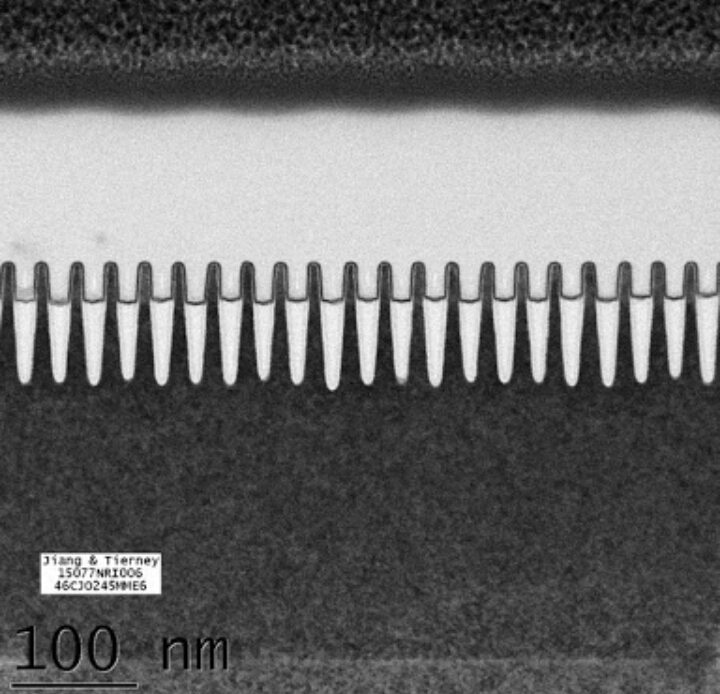
French authorities are considering new laws that would allow cyclists to run red lights in Paris.
They are considering bike-only traffic signals that would be placed beneath regular signals.
At certain times cyclists would be allowed to ride through intersections while cars are stopped at the red lights.
Why?
They are trying to encourage bike riding in order to get cars off the road and this is is enhanced by quicker bike rides.
Also they have recognised that getting bikes away from cars ahead of the lights turning green actually reduces accidents between bikes and cars.
I can explain this by noting that the risks of collisions between bikes and cars is correlated to the gap in their speeds – the greater the gap the higher chance of collisions.
A slowly accelerating bike and a rapidly accelerating car epitomises accident risk.

What the artist said “My portrait is an attempt to depict him [Charles Waterstreet] as a giant: part-man, part-mythical creature with hands that appear otherworldly, as though the anatomy of his hands has been designed to grasp unnatural disasters, naturally.”
What I see; a living zombie that has been partially mummified through self-loathing and the dissonance caused by an excessive disconnection between the limbic system and the neocortex.
ps It’s quite irrational to ask an artist to explain their work. The good ones (almost by definition) can’t and any attempt by them to do so just highlights the dysfunctionality between their well-exercised limbic system and their undernourished and disconnected neocortex, aka dissonance.

Who is more self centred, the person that can see everyone’s angle but invariably acts in their own interests or the person that can only see their own point of view despite any proclaimed good intentions they might have towards others?
In order to ponder this conundrum I would first like to point out that there is supposedly three parts to the brain:
The reptilian brain, the oldest of the three, controls the body’s vital functions such as heart rate, breathing, body temperature and balance.
The limbic brain which can record memories of behaviours that produce agreeable and disagreeable experiences. It is responsible for what are called emotions. It is the seat of value judgements, often made unconsciously, that exert such a strong influence on our behaviour.
The neocortex, the seat of rational thinking, is responsible for the development of human language, abstract thought, imagination and consciousness. The neocortex is flexible and has almost infinite learning abilities. The neocortex is also what has enabled human cultures to develop.
When someone is labelled ‘self-centred’ the key is to determine which part of the brain is engaged by the person doing the labelling.
For example, if the pejorative emerges from the limbic brain then you can be pretty sure that the value judgement itself is derived from self-centred emotions. What I am saying is that anyone that emotionally labels another as self-centred (usually with the pejorative) is in fact just labelling themselves (by some weird form of sublimation).
However, if the labelling is derived from the neocortex it bears more consideration. This person has managed to suppress their emotional instincts and has passed the matter up to the slower but more considered neocortex. This doesn’t mean that when they label someone as self-centred that they are right. As in all matters of human nature there is no right or wrong answer – just a point of view.
Consider this; someone that forever makes rational decisions from the neocortex in the interests of other people (and not their own) would be considered a saint (if they did this in good humour) or a martyr (in bad humour). However can you imagine the destruction to the soul over a long period of time?
I believe that our emotional limbic brain is inherently self-centred and that the rational neocortex brain allows us to attenuate this self-centred view in the interests of social cooperation which in turn derives benefits of safety and emotional return.
When I integrate all these thoughts it is clear to me that we need to carefully nurture our self-centred emotional core and consciously keep a database of all the rationally derived excursions away from it.
And then we need to keep a running tally of the net self-centred behaviours just to make sure we aren’t building up an unsustainable debt of negative emotions associated with the continuing execution of rationally derived un-self-centred behaviour. Otherwise we will crack.
Figuratively, I see this situation as follows; for every action in the rational neocortex there is an equal and opposite reaction in the emotional limbic brain. You have to keep the thing in balance and, in order to do so roughly half of your actions must be self-centred, regardless of whether the decision to be so emerges from the rational neocortex or the emotional limbic part of your brain.
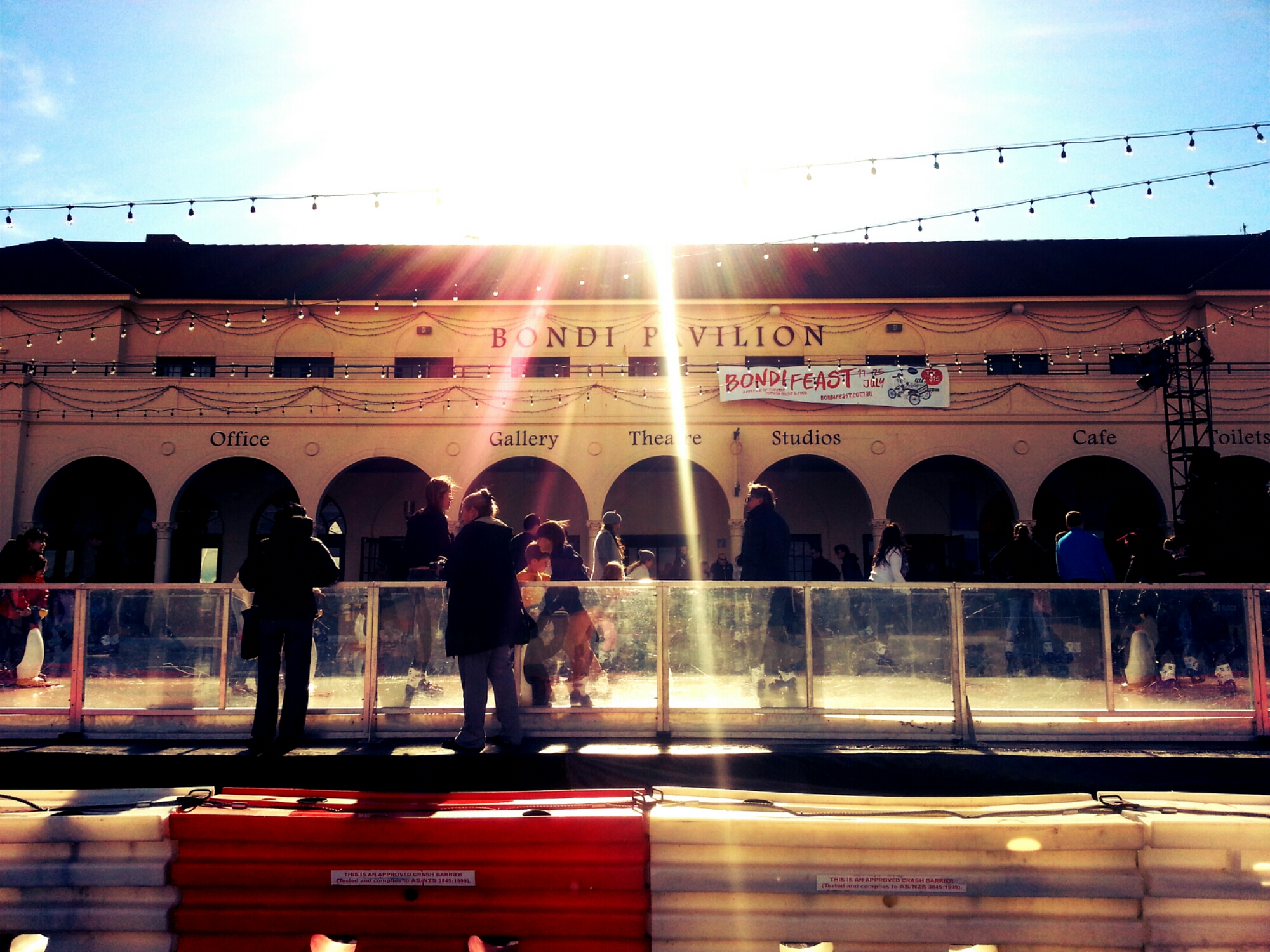
Let me explain this photo…
Riding along I see this baby Myna fall vertically out of a tree and, plop, right in front of me, harakiri.
A case of flying before you flap.

If this blog suddenly stops getting new posts then there’s a 50/50 chance that I am a victim of some cycling atrocity.
Which makes me think that there’s an app opportunity such that friends and colleagues can see that you are still alive without actually having to contact you
All there would be in the app is a dashboard that has green or red lights for the chosen people of concern.
A green light would be indicative of normal and continuous smartphone use of the risky individual, who would also have the app.
A red light would indicate that the individual is off-grid or dead.

Why you should read this blog.
This blog answers all the big questions.
Does this blog answer all the big questions?
Why does this blog answer all the big questions?
Why O’ why did I read this blog?
I hate questions in titles.
Do I hate questions in titles?
Does this blog have a question in it’s title?
YES
Finally a definitive answer to a definitive question.
If you’re proffering an opinion then can you please shove the hypothetical up your proverbial
?

Autoportaphobia; the fear of car doors.

I don’t think that I will ever agree with the current crackdown on jaywalking in the CBD.
I can’t imagine that I will ever have any sympathy for the clowns that think this is a good idea.
I doubt that I would ever be able to hide my contempt if I was ever charged with jaywalking.
For mine, the traditional non-enforcement of jaywalking laws in Australia was the definitive differentiator between us and those bible-bashing gun-toting racist idiots across the Pacific.
No matter which arguments they produce, whatever statistics they generate, or how many emotional trauma stories they retell from their back catalogue of their PTS therapy diaries, I am not with the program.
This is simply not an act that exists in the country that I imagined as my own.
I now feel like a displaced person. As though I have woken up from a dream and, although the place looks like home, the all-controlling evil genius has shifted things just enough to make me weirded-out and uncomfortable.
This is the moment when the collective – the department of transport, the police, the swill in parliament, and maybe the whole country – JUMPED THE SHARK.
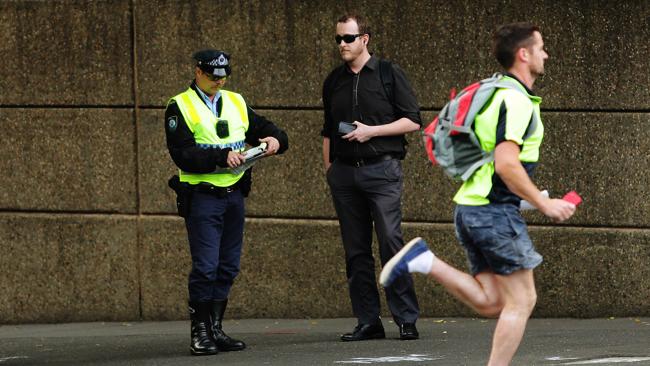
Sometime back I bought a Google Nexus 6. This is the last one of these Google phones that I will ever buy.
When I broke the screen I discovered that the local phone fixing shop (all of them) couldn’t get the replacement screens.
So I contacted Google. After a bit of fuss and bother they put me onto Motorola. After a bit more fuss and bother they put me in touch with Quantum Service and Logistics Pty Ltd, their local outsourced supplier of customer ‘support’. After a lot more fuss and bother, inclusive of the filling out of duplicate complex web based forms and waiting forever for a courier together with multiple reminders that I was waiting, they now have my phone.
A few day later they send me the email below, which has this little pearler in it;
‘If payment is not received within 90 days of this notice then the device will be disposed of in accordance with the uncollected goods act.’
So I checked the Uncollected Goods Act (who knew we had one?) and in fact they only need to give me 28 days notice before they ‘dispose’ of my phone. What this means is that they can sell it and keep the proceeds without any risk of liabilities.
This is a little cute me-thinks. As the sole source of fixes for this phone they force me to send it to them before they will quote me the job. There is no obvious or published mechanism to get the phone back if I don’t like the quote but they will happily keep the phone if I don’t pay them.
I don’t know about you but this looks like institutionalised extortion to me.


When our major trading partners move closer to implementing their plans for renewable energy (in the interests of global warming, pollution control and energy security) our coal will be just like all that other dirt that we can’t export.
Maybe there is a case for exporting it whilst it still has value.
In the interim if they don’t burn our coal, it will just be someone else’s coal that they consume.

Here’s an interesting little story – http://bit.ly/1LcWoTh
The thesis of this story is that there are a few idiots in Australia and to protect these idiots from themselves, and to protect the rest of us from them, that the nanny state was thus born and propagated.
I beg to differ.
We have in Australia a lot of idiots, the majority me-thinks, that believe that ‘the government’ should fix every problem that arises (as some highly publicised incident on TV or in the papers) by regulating against what is seen as the ‘root cause’.
This is essentially OH&S gone mad in the social-political environment. There is a whole industry of fools beavering away at engineering all risks out of our lives.
And we go along with the program. There is no mechanism to protest against it. Social media protest groups like Getup are after all simply part of the problem. Whine, protest, fix, repeat…
In Shantaram, Gregory David Roberts wrote ‘The politics of fear. I hate politics, and politicians even more. They make a religion of being greedy.’
He was right, those greedy bastards only see upside in shoving regulations even further up our orifices. They aren’t going to fix the problem. I doubt that I will ever see a ‘Scrap the Regulations’ party that garners more than a handful of votes.
Thus we have bike helmets, pub lock-outs, drinking and smoking laws up the wazoo, noise restrictions, 4 meter rules, 50 meter rules, and the list goes on ad infinitum. They are even enforcing jay walking rules now – really!
We have so many rules here that seem to stifle creativity and spontaneity and fun. And unfortunately we can only blame this on the many. The idiots.

‘Far from the madding crowd’ is a story of three little pigs.
The wolf in this story is a woman of independent means in the 1800s who has the luxury, if not the requisite training, of choosing a husband by any motive she wishes.
In this painful social experiment she first chooses Lust, then Security, but then finally settles on the third little pig, Love, whose brick house cannot be blown down.
Presumably the other little pigs, Lust and Security, take shelter under Love’s roof.
Why was this parable required in the late 19th century?
The relentless improvements in productivity that had started in the industrial revolution had by that stage ensured that wealth amongst middle classes had risen sufficiently such that philosophers could start dreaming of using all that inherent security to improve the estate of women.
Not just men.
All that these women needed, those wishing to escaping from the madding crowd of lust and security seekers, was a blueprint.
Written by a bloke of course.
A blueprint which prevails to this day. Time for a rewrite perhaps?
I had a chat to a taxi driver at the weekend about Uber.
He thinks that, as Uber disintermediates the taxi industry, the government should reimburse all those people that have invested hundreds of thousands into taxi plates and stand to lose their money.
I said that any investment includes the acceptance of risk and in the case of the artificially high and increasing value of taxi plates the risk was always a change in government regulations or some technology disruption.
The fact that some buyers didn’t understand this risk doesn’t for me excuse the concept of socialising the losses but keeping the profits private.
But, I said, good luck to them if they can extract some sort of compensation.
I wanted to say to him “The most expensive cabs in the world; smelly old rattly Ford Falcons with lost drivers and Alan Jones playing on the radio. We happily fucked over the music and movie industries because they ripped us off for decades and you expect our support?”

Query; why did we translate the beer garden but leave the kindergarten unmolested?
Somewhere in there I believe is the answer to Cat Stevens’ unsolved conundrum. Ja!

Wiki says that depression “is a feature of some psychiatric syndromes such as major depressive disorder, but it may also be a normal reaction to life events such as bereavement, a symptom of some bodily ailments or a side effect of some drugs and medical treatments.”
Other names for what people commonly associate with depression are ‘sadness’, ‘melancholia’ & ‘the blues’.
Which leads me to Beyond Blue (an Australian mental health charity). These people make a living out of getting money off the government to help people with ‘depression’. So they have to beat it up a little…they say “depression is more than just a low mood – it’s a serious illness”.
Which is it, a normal reaction to life events or a serious illness?
Depression has a purpose and that purpose is complex like all things human.
Some people on their way to serious mental illness are depressed but most people who are depressed at some stage never go onto have a mental illness.
There is no good excuse to start giving people the message that depression is bad and that if you feel depressed then you have a serious mental health problem.
All this does is further depress people and quite unnecessarily.
It’s not like you can apply OH&S rules to human emotions. You can hear the noddy level thinking “hey if we engineer out depression then people will never go on to get mental health issues.”
The complete abandonment of wisdom by those who stand to profit from logical extremism makes me depressed but I am not the one with the mental illness here.
However I am quite optimistic that if enough people read this or have similar thoughts, that the forces of evil will be overcome.

Anyone can be an optimist; dare to be cynical.
Whoops, the happiness epidemic merchants would have us saying that the other way around.
They imply that cynicism is easy. Take the virtuous path they say, the hard road, the one less travelled. That of the optimist.
Well I say, we don’t have dozens of emotions and then say we should only practice one of them, do we?
Hang on, people do say that. Be happy. It’s good to be happy. Ignore those other feelings. Shut ’em down brother.
The happiness epidemic merchants – they are all loopy.
So, to be clear, I can be both cynical and optimistic; sometimes both in the same sentence.
And neither one requires more or less work. Neither one makes life better than the other.
But one without the other; well that’s a lonely elephant on a see-saw.

I postulate that the only thing that sets us aside from other animals is that we ask the question as to what sets us aside from other animals.
If you have never asked the question (what sets us aside from other animals?) then:
1. You are one of them other animals, or
2. You feel like it’s an illogical question, or
3. You think that life’s too short to hope otherwise, or
4. You had a really good chat with a dolphin once and she asked that question

Received through the ether, this video made my day.
Dad, what’s dissonance?
The distance between two nuances Lola.

So what do we say about the driver that angrily overtakes a cyclist, putting multiple parties at risk (the driver, the cyclist, drivers of other cars coming the over way, and any passengers)?
Only to come to a standstill 20 meters down the road at the very predictable engagement with the next set of red LEDs.
Driver’s Dissonance. It’s why I stopped driving.
Here’s one mystery solved.
A report from Bloomberg’s has informed me that computer systems at banks and credit-card processors would adapt quickly (days) to allow transactions in a new Greek drachma.
However the introduction of paper money would take a longer. Introducing a new currency typically takes at least six months and sometimes as long as two years.
Maybe this is the opportunity for Greece to dispense with banknotes and go all electronic.
This way they could track and tax every single official transaction.
All their social welfare would be paid electronically, in drachmas.
Once someone has wealth in the electronic system of drachmas it would be hard to get it out into the black market running in euros. There simply wouldn’t be any transfer mechanism.
If they did this there would of course be a big black market running in Euro cash. But there would be anyway, in any scenario.
And right there is a brilliant solution to their currency issue. A perfect dual currency situation.
They could of course run spot checks on Greeks for any hidden euro cash. An on the spot penalty of 40% GST should do it.
Just because it came up in conversation the other day I would like to note that the correlation between innovation and intelligence (as measured by iQ) is probably quite linear but with a piss-poor correlation coefficient.
That is a hypothesis and not a fact. Good innovation skill is probably more strongly correlated to an understanding of error bars than it is to intelligence.

Just look at this list that someone has published.
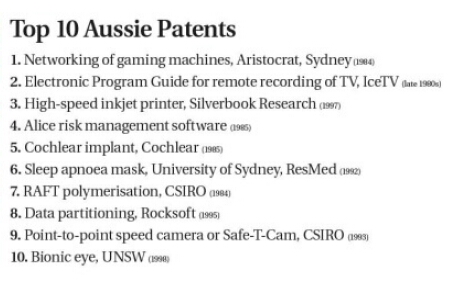
About 8 of these have expired. The inventions in the other 2 haven’t led to product at all (in one instance) or hardly (in the other).
Here is a detailed breakdown of each invention:
10. The bionic eye is not on the market.
9. Safe-T-Cam – 24 sites in Australia does not make a commercial success!
8. Rocksoft – Exit value was A$83m – towards the bottom end of venture exit values (for Silicon Valley). I have no idea what the IRR was for the investors.
7. RAFT – it’s in my field of expertise. This was the first continuous radical polymerisation (CRP) and it was licensed to DuPont. However it also turned out to be one of the most expensive CRP methods and is not a major process.
6. Resmed – tick (market cap $8b)
5. Chochlear – tick (market cap $4.5b)
4. Alice – the original anti-value patent! It’s the one that the US Supreme court used to re-set the threshold for inventiveness for abstract ideas. This one is virtually worth negative infinity and has royally screwed the market for patent assets.
3. Silverbrook – Memjet has had very limited market success especially since that ‘print’ is just about dead. There has been a massive negative IRR to all investors in Silverbrook and Memjet
2. ICE – it looks valuable on paper and the NPEs were probably very interested. Post Alice, it’s valueless
1. Aristocrat – this patent didn’t stop any of their competitors linking together slot machines – just saying…
What does this mean?
Well, firstly citations amongst patents (the basis of the compilation of this list) are a poor indicator of the commercial merit of an invention. Think of this as a bunch of pigeons lovingly cooing at each other whilst in the distance an F/A-18 strike fighter scoots off with loot.
Secondly, if this is the so-called top ten patents (by any measure, no matter how dubious) then it’s pretty obvious that Australians are rubbish at invention. What a lacklustre list. If you need to be convinced please note that Australia has about 8% of the US population. Historically in the US there has been enforceable patents for things such as the cotton gin, the electric motor, the ice machine, telegraph, the phonograph, the light bulb, the computer (electric adding machine), the aeroplane, and even sliced bread. In the drug space, a single Pfizer patent for Lipitor earned that company an estimated $105 billion. I could go on forever but do believe me, the ultimate top ten US list would be worth thousands of time more than 12x (accounting for the population difference) the value of this Australian list of most valuable patents.
Since the authors have included expired patents I wonder why they didn’t include those Aussie classics such as the Hills Hoist, the Victor lawnmower, the combine harvester, Vegemite, the Pavlova (OK, OK, it’s a Kiwi invention), yada…. Some of these inventions must have been the subject of the patent hallucinations of their mad inventors.
What about the spirit level and the water diviner I say?
The article that accompanied the patent list was in the Fin Review. The angle was that old chestnut; Australians are great at invention but crap at commercialisation. [Cue chorus from the white shoe brigade] “Dear Federal Government please give us some money to fix the problem.”
What we should have patented is a method to delude ourselves with respect to our collective inventiveness. This invention has been reduced to practice and is eminently patentable. Commercially, it’s very successful too – an eternal fountain of tax payers funds flowing to the unworthy.
I have a concept in my head (and yours) called the ‘circle of humour’.
This metaphorical circle, irregular in shape and probably spheroidal in reality, encompasses some fraction of my emotions and emotional responses to external stimuli.
Inside the circle of humour we have a ‘clutch’ (an automotive metaphor, no less) whereby our own humour is used to change gears or to buy time, in response to external stimuli and emotional responses to the same.
In essence, the larger our circle of humour, the more of the emotional self that it covers, and the better armed we are against the wilful influence of the outside world.
Humour is in fact the Swiss Army Knife of emotions. Used wisely it can protect you, buy you time and unlock all sorts of situations.
Time spent expanding that circle of humour is time well spent.
Occasionally I can’t help but rubbish the self-serving reports published by industry groups seeking more handouts from government.
Just the other day I satirised an effort put together by some self-appointed start-up ‘industry’ body.
So to be fair and balanced; I have just perused the The Dowling Review of Business-University Research Collaborations, and it’s a cracker.
I don’t agree with all their recommendations but a large fraction is quite sensible.
It’s a shame the report is British eh?
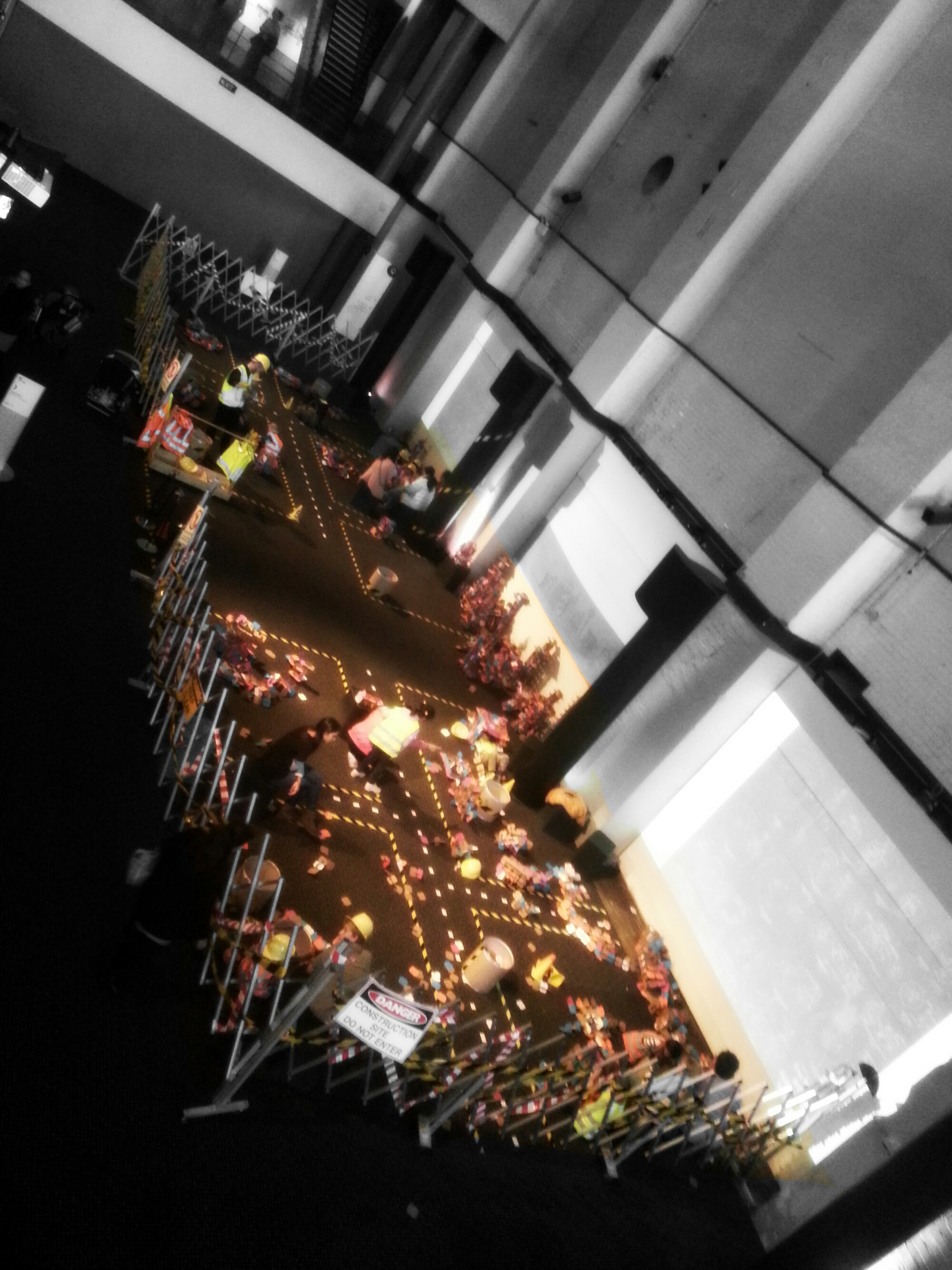
Businesses can’t vote. Their influence is limited to brown paper bags, old school ties and control of a diminishing fraction of the combined broadcast and online media.
Today’s Fin Review is full of commentary bemoaning the ‘business community’s’ view that there is a ‘lack of leadership’ in Canberra.
What this means is that the government of the day is 100% focused on pork-barrelling themselves back into power at the next election and that, it just so happens, this means implementing policies that will ultimately reduce consumer sentiment and consumer spending power.
Root cause analysis … the so-called business community is almost fully exposed to domestic market conditions because, generally speaking, they couldn’t export their way out of a wet paper bag. Even if they wanted to, which they don’t.
Why would they? The government of the day also happens to protect their share of the domestic market with all sorts of hidden import barriers and the weakest anti-oligarchy enforcement this side of Singapore.
I say, be careful what you wish for.
They might reply, it wasn’t us, it was our ancestors that started all this. Just like coalition supporters might claim that it was the English that were despicable towards the aborigines and hence they have no claims to answer to.
I say, if you are a ‘beneficiary’ then, whether you like it or not, the piper will come calling one day.
Proof positive (photo below) that the rump of the unions is disappearing up it’s own arse. My hope is that when this process reaches it’s inevitable singularity that the cartoon-right ex capita, lacking anti-matter, will spontaneously combust.
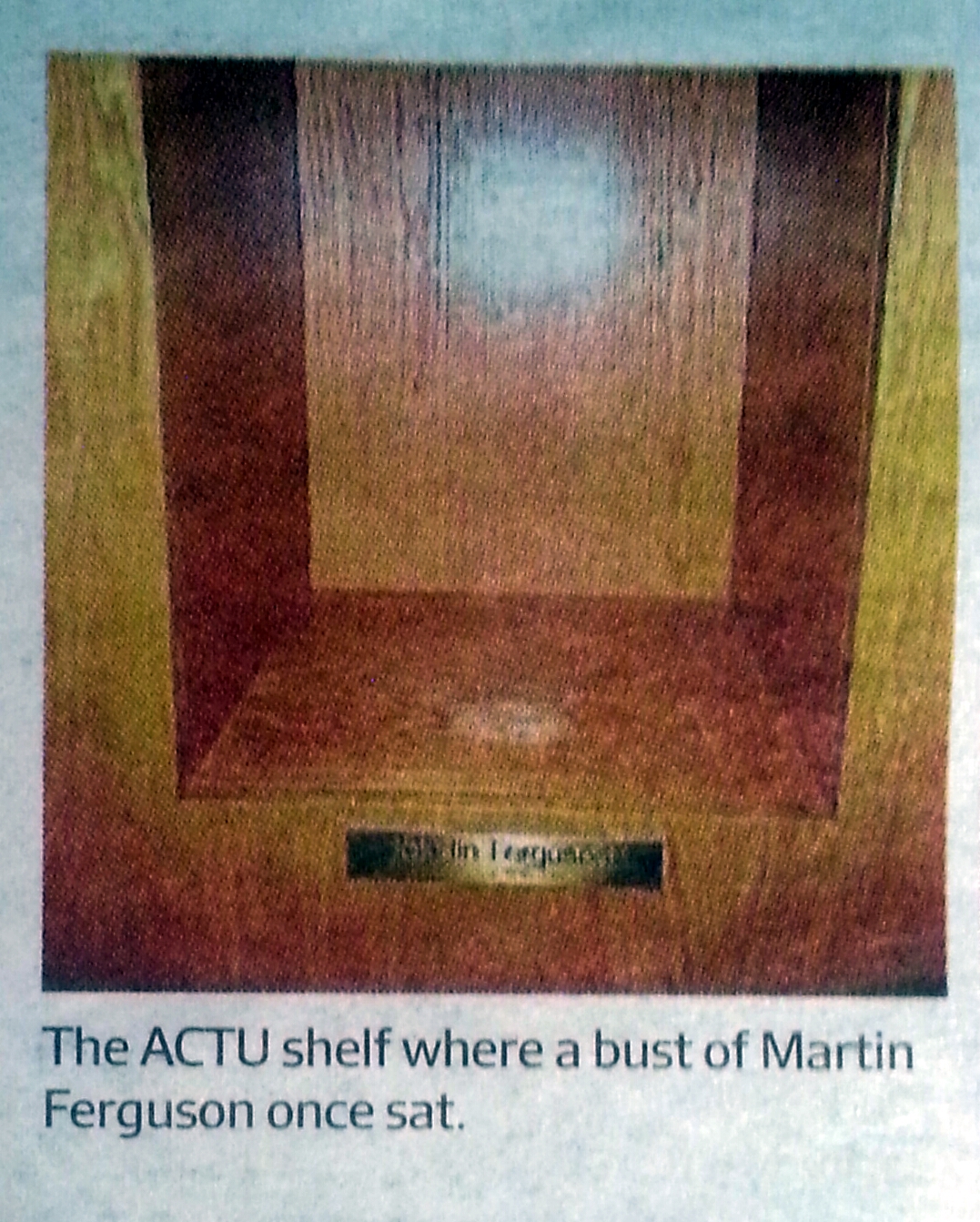
When polled, three quarters of Australians supported this proposal…

When re-phrased as per below what do you reckon the poll result would be?
“Do you support your citizenship rights being enshrined in the constitution such that no politician can, at will, strip you of your Australian citizenship?”
Ever heard of a historian that can accurately predict the future?
My advice is to also be very wary of their rearward looking hallucinations.

 offshore westerly