
Tax, Productivity and Governments
Since the industrial revolution, when systematic advances in technology were first used to make labour more efficient at turning raw materials into finished goods (whether that is coal to energy, grass to meat, or iron ore into a car) participating workers have been rewarded with an increasing ability to consume.
In fact, in most Western economies the growth in average wages perfectly tracks the growth in multi-factor productivity.
This makes sense; if the benefits of all that technology weren’t shared around there simply wouldn’t be enough consumers for all those lower cost goods to provide the required economic growth.
It’s a ‘virtuous’ circle; increased demand drives investment in technology-driven cost reductions which drives higher profits which results in higher wages which leads to more consumption, aka increased demand.
In the West, where this pattern has been trundling along for three centuries, we got to the point of universal ‘sustainability’ around 1900. At this time just about all the people were earning enough to sustain themselves in a secure fashion.
Thereafter we simply began to consume in excess of our fundamental needs. Cars, whitegoods, large houses, holidays, electronics; these are all luxury items in one context. We wouldn’t die without any of them.
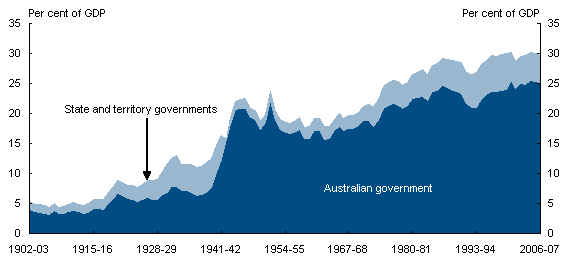
After 1900 governments also started taxing more heavily. Since the administrative technology existed to universally tax both companies and individuals it has been used with ever-increasing intention.
Slowly and surely the rates of overall taxation have crept up (as per the graph below).
Some say this is a bad thing because the more the government takes, the less individuals and companies have to either consume or invest. But I would note that the removal of that money by governments won’t kill them.
I suspect that the return on investment on all government expenditure is ZERO. That’s right, nought, nix, nothing. That’s how inefficient governments are at what they do.
But remember this would also be the case if this money was left in the hands of consumers. They wouldn’t usually invest the money either; they would consume ‘luxury’ goods; an activity where the sole function is to drive increases in demand.
Another way of looking at all of this taxation is that governments are unwittingly addressing the issue of technological unemployment by creating artificial jobs.
Currently they collect and spend around 30-40% of GDP. This won’t stop there either – as we get further towards 100% automation and artificial intelligence I suspect that only 10-20% of people will be employed in ‘real’ jobs and the rest will rely on the redistribution of wealth via the tax systems in order to participate in the consumption game.
All that the collection of taxation ensures two things; (a) continued growth in consumption, and (b) social peace which would be challenged if a large fraction of the population was living below the sustainability line (which is very different to official poverty lines).
I would note that companies don’t consume, they invest. It makes no sense whatsoever to tax them because companies are the source of all those continuing increases in productivity that drive the whole shebang.
Also companies are a lot more mobile than people and will happily shift their operations to lower taxation domiciles. For this reason alone, company taxation rates are heading to zero. Which makes sense anyway.
I do however believe that that the game will change pretty soon, for a couple of reasons:
Firstly, the ‘industrial revolution’ economic model relies on the assumption that resources are unlimited. Which they are not. As this fact become more apparent the whole model will be severely challenged.
Secondly, after company tax has gone away and as technology allows less and less people to be employed in ‘real’ jobs and more and more in government mandated jobs, there will come a point where the amount of tax one can extract from the ‘real’ workers asymptotes and a government simply won’t have enough tax receipts to distribute the proceeds (indirectly) without allowing for an official two-tiered wealth system.
This problem can be understood by considering the maximum rate that one can be taxed at. Say it’s 90% of income but of only 10% of the population (that are truly productive). A government simply couldn’t tax these people enough to feed the rest of the population unless there was a dual channel taxation and employment system (where some people earned a lot more but were also taxed incredibly highly). Politically and socially difficult, this one.
At this point governments will be helpless to address the genuine wealth disparity issues caused by technological unemployment. This may not be a crisis of relative consumption but one where some people fall below the ‘sustainability’ line. If this happens this will cause serious social unrest – it could prompt the Second Luddite Uprising.
It would appear to me that the timing of these two issues will be coincidental somewhere in the second half of this century.
The solution to the first problem may require a change to our socio-political systems. What I mean by this is that we may have to introduce a consumption tax that favours lower consumption of raw materials but at higher cost and higher levels of intellectual property.
For example, lower sales tax on goods that incorporate advanced technology that provides for long service life.
This will help lower the consumption of raw materials but will not necessarily depress the rate of improvement in technological developments.
My very odd suggestions for the solution to the second problem is twofold:
(1) Rather than let the benefits of the continued technology improvements fall into the hands of a few from which there would not be enough government revenue to peacefully distribute amongst the rest, it may be useful to allows machines and computers to earn income and tax them at 100%. That is, we should not let the profits of increased productivity fall into fewer and fewer hands.
(2) Another way to solve this problem would be to stop taxing companies by profit and to start taxing them by equity. That is, every year some fraction of company equity would end up in government hands as a means of taxation. Then the government purse could directly benefit through dividends.
 offshore westerly