mxx1's avatar

Aussie Aussie Aussie, Oi

Recently I was included on a small email list of self-appointed experts that have taken it upon themselves to educate the incoming Australian federal minister for industry on what is needed to ‘fix’ the start-up tech sector.

Much of the proposed advice to the minister involved the government handing over money to groups of people to which the self appointed experts could reasonably be assumed to be related to. The rest of the proposed advice could have indirectly profited the experts through tax incentives for investment in the tech sector and by the removal of barriers to gambling on the tech sector.

We have never had a sparkling tech start-up sector in Australia. At times it has shown a little self-promoted promise with the odd eccentric moderate success, but most of the time it has been what used to be called a ‘mudguard’ – all shiny on top and shit underneath.

It’s just the vibe of thing; it doesn’t work and it’s not good. And most people with the required expertise can recognise this. Even if they can’t recognise it, one trip to Silicon Valley convinces them that over there they have something that we do not.

And yet our local media just about refuses to run any tech sector story that isn’t blazingly upbeat. I think this is because the tech sector stories are in the same category as morning TV. Interesting but not that important – so they make them ‘feel good’ stories.

For example, a two man start-up might be promoted as the next Uber and then it will quietly disappear never to be heard of again. No one cares, they just want a good news story that doesn’t really matter.

And then it gets interesting. The experts that can see past the positive media coverage all have a pet hypothesis as to the root cause of the ‘problem’. Variably they will say, not enough skilled entrepreneurs, or not enough quality innovation, or not enough investment capital, or not enough qualified venture capitalists, and the list goes on.

Some of them then start promoting to the government the hypothesised solution; for example (working through the example list above) creating courses to skill up entrepreneurs, or investing more into university R&D to create more innovation, or removing barriers to crowd funding of micro-investment funds, or giving VC capital at friendly terms to Australian venture capitalists returning from Silicon Valley (and the list goes on).

I have seen a pattern here:

Firstly the experts announce that there is a problem, the lack of a vibrant tech sector in Australia, without ever defining what a vibrant tech sector would look like. To this I would not that ‘rule number one’ of enlightenment rational thinking is ‘do not start looking for a solution to a problem until the problem has been properly defined’.

Secondly, they hypothesise a solution without ever realising that their idea is just a hypothesis. That is, it could be wrong and it needs to be stress-tested before being implemented. Since different people have different hypotheses you’d think they’d catch on. But no, everyone just thinks that everyone else is wrong – if they just added one person to the list of people with wrong ideas then this would be the only truth on the subject they ever got close to.

Thirdly, in the unlikely instance where an individual has defined the problem, has come up with a hypothesised solution and tested that solution, it still wouldn’t work. I can only explain this phenomenon by using scientific terms that will ensure this missive is never understood by those that don’t want to understand it.

The experts look at the problem in ‘kinetic’ terms; that is, they see the lack of vibrancy caused by certain missing or under-performing elements of a tech food chain. Fix these elements they say, and then magically all would be OK despite all the evidence to the contrary from past efforts.

But the problem is actually ‘thermodynamic’ in nature. By this I mean that there is no actual need in our economy for a tech sector to exist. The commodities sectors do not need one. The oligarchies in the services sector don’t need one. The educational exporters don’t need one. Basically there is no corporate sector that requires a steady stream of new platform technologies served up by start-ups. Without this high level ‘driving force’ no amount of fiddling with the kinetics will do any good.

I have tried to explain this to a few people in the business and I am 100% sure that they do not have a clue what I am talking about.

I even wrote a paper outlining how the corporates in the service sector could be encouraged by government intervention to require invention and innovation. I proposed that this might be the thermodynamic kick-starter that we would need to have a thriving tech sector.

I am not very surprised that the paper was not understood and largely ignored. The factors at work against recognising uncomfortable truths are self-interest and ignorance; a powerful combination if ever there was one.
image

mxx1's avatar

Google Translate

“My curiosity related to all things promised in this new age of disintermediation of old school human services by all things algorithmic has led me to his recursive test just for your entertainment o’ siren of the north.”

“我的好奇心,所有的东西算法与承诺在这一新的老学校的人性化服务脱媒时代所有的事情,导致我到他的递归测试只为您的娱乐O’北方的警笛声。”

My curiosity, and commitment to all things algorithm off all the things in this new media era of old-school human services, led me to his regression testing just for your entertainment O ‘North siren.”

“我的好奇心,并承诺所有的东西算法了所有的东西,在老派的人性化服务这种新媒体时代,使我对他的回归测试只为您的娱乐O’北警笛声。”

My curiosity, and commitment to all things algorithm all the things in the old-fashioned personal service of this new media age, so I told him regression testing just for your entertainment O ‘North sirens.”

“我的好奇心,并承诺所有的东西算法所有的事情在这个新媒体时代的老式个性化的服务,所以我对他的回归测试只为您的娱乐O’北警报器。”

My curiosity, and commitment to all things algorithm all the things in this new media age old personalized service, so I told him regression testing just for your entertainment O ‘North sirens.”

image

mxx1's avatar

Here is not there

Just of late I’ve been told that it’s best to live in the ‘now’ and not the past or the future.

I think that I would like to extend that concept to living in the ‘here and now’.

Yep, that’s a swipe at smartphones and social media written in a social media blog on my smartphone.

image

mxx1's avatar

White Pockets

This is worth recording … in describing the fall of Tony Abbott one authority has penned this.

“The “normality” which has been lost in Australia and other western democracies is the unquestioned social and political primacy of white men.

Recent decades have seen new kinds of political claims emerge, and a plurality of values, cultures and lifestyles. The rules of the game have, after long struggles, shifted.

Rather than respond to this with accommodation, negotiation and hospitality, much of the right have elected to fight a prolonged culture war that demands the return of white, male, heterosexual authority.”

This rings true for me.

There’s another segment of society that, rather than fight the changes described here, have decided to insulate themselves by crowding into privileged white-bread enclaves.

My daughter’s school at Clovelly in Sydney’s east is one such enclave. I despise them for their dishonesty and cowardice.

And then there’s another segment that I belong to that despairs at the political correctness that has accompanied the rise of our plural society.

I have to admit that it is possible that such a diverse society can only exist in a tightly engineered and rule-driven structure.

That is, it’s possibly the price we had to pay in order to accommodate and accept the diversity of race, religion and cultures that we have today.

I might have to let go of this residual desire of things past as well. By the time this thought process is done, I’m telling you I’ll be reduced to numbness.

That’s no point raging against the machine since the evidence is that the machine is there to protect us against many of the past travesties that litter the history of humanity.

This position is well supported by this quote from Bertrand Russell;

“People seem good while they are oppressed, but they only wish to become oppressors in their turn: life is nothing but a competition to be the criminal rather than the victim.

image

mxx1's avatar

Business Council of Australia

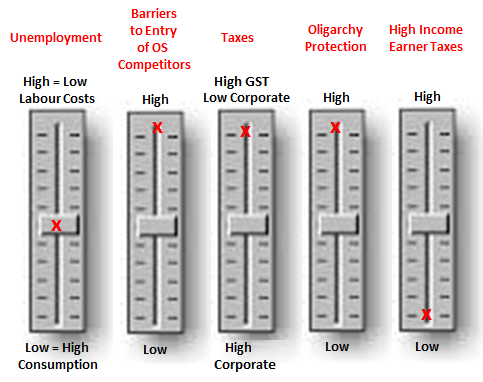
X marks the self-serving spot of the Business Council of Australia.

In a nutshell they want:

1. to keep unemployment low enough not to impact domestic consumption but not too low so that labour costs go up
2. to keep OS competitors out of market by all means fair and foul, despite pretending to adhere to free trade agreements and anti-competitive laws
3. corporate tax rates to go to zero
4. to protect our large oligarchies from OS competitors and upstart SMEs and anti-competition commissions and the like
5. to make sure high income earners don’t pay too much personal tax

The outcome? A protected domestic economy with costs so high that we can’t export anything other than commodities, and wealth split down the middle between the haves and have-nots.

The biggest mistake the business community ever made was allowing compulsory voting to prevail in this country. It ensures that the have-nots eventually revolt against a government that tries to snow them out of their share of the pudding.

My prediction? There will be a movement to remove compulsory voting, sooner or later.

Untitled

mxx1's avatar

Oddservation

I have a large project running at the UTS with undergraduate students.

The mechanical/automation students are very easy to converse with and are well rounded in their interests. They are so motivated that we have hatched a plan to spin out a company from the project straight away, using the technology in a market niche that is easy to attack.

The software students are functioning morons. There is not a glimmer of interest in their eyes. They have a task to do and this is to code the concept up. I don’t think they would care if the application was 3D printed dog food or social media on the moon. In fact, I find it almost impossible to converse with them.

So for the spin out I have set my mechanical/automation guys the task of finding some student coders that are functioning humans with an interest in fame, fortune or achieving a broad base of skills. We will see.

image

mxx1's avatar

Mike88

Today my mate Mike wrote an open letter to Malcolm Turnbull on his well-read startup blog citing a list of all the things that the government could do to “accelerate the creation of a new wave of startups and STEM based businesses.”

I feel that this list is deluded and self-serving nonsense that represents nothing other than white collar welfare. Sure, if the advice was followed a bunch of startups might be created but none of them would go anywhere.

Oddly, it was quite easy to keep this thought to myself. This represents a nice shift in my mood which I am quite happy about.

image

mxx1's avatar

Debt & Sensibilities

Note to self:

I had a chat with my SMEs today about growth.

Some of them have a desire to grow faster than they can achieve from profits.

But the banks won’t lend them money for a whole bunch of reasons; because they don’t fit into a pigeon hole as a business, because the banks are bureaucracies, because the debt is for investment in risky growth not working capital, because the company’s assets are illiquid, or whatever.

Unlike the banks, private lenders know that the default rate of SMEs is the lowest of all businesses and hence worth the investment.

The trick is to only give finance to great management teams. They will make it work. All you need to be able to do as a lender is pick great management teams, and to be fair to banks, they can’t afford the people that can do this.

So the core of this note to myself is; to those CEO/Founders that don’t have a board, you are either increasing the cost of your capital or reducing your access to loans simply because you are a lone wolf.

By not sharing the business management responsibilities you are adding too much ‘key man’ risk in the eyes of lenders.

image

mxx1's avatar

Core Values

“Please find attached letter regarding your child, he/she is to receive a Core Value Trophy this Thursday 17th September 2015 at 9:00am. Please note this is a NEW date.

With regard to families with more than one child at the school, we hope you are up for a surprise too! If not and you need to know which child please email the school.

Regards
Clovelly Public School”

The core values are RESPECT, RESPONSIBILITY & LEARNING (their CAPS not mine).

In my days there would have been some dodgy crest with the words ‘quoad doctrinam responsabilitatis’ underneath, or something like that.

At my primary school we didn’t have a bloody clue what our motto meant and happily ignored it. I am pretty sure none of the teachers had a clue either. I just checked and my primary school has now changed the motto. It’s now ‘Play the Game’. I like that a lot more than ‘Respect, Responsibility and Learning’. There’s wriggle room in ‘Play the Game’.

But oddly enough, as well their core values, Clovelly Public School does have a shield with a motto. It says ‘Aim High’. Go figure.

Core Value Trophy Assembly Thursday 17th September

mxx1's avatar

Dear Nic

There is at least one issue with being someone that lives very much in the ‘now’.

By forgetting the feelings of past times I can sometimes neglect to appreciate the present by not extrapolating to the future.

Hey?

Well, sometimes I take the really good times for granted.

Why?

Because they make me feel good and then I don’t recall past times when I wasn’t feeling so good and forget to make sure I do some easy things to make sure the that current good times are extended into the future.

The good news is that after 51 years I am much better at catching myself in this loop.

image

mxx1's avatar

You Hoo Tube

YouTube is advertising on billboards. Maybe an attempt to convert the last recalcitrant viewers of broadcast TV? Otherwise it’s a very odd way for the world’s leading online video company to spend it’s advertising budget.

image

mxx1's avatar

Crimes (Currency) Act 1981

A person shall not, without the consent, in writing, of an authorised person, intentionally deface, disfigure, mutilate or destroy any coin or paper money that is lawfully current in Australia.

Penalty: in the case of a person, not being a body corporate – $5,000 or imprisonment for two years, or both.

Personally, I’d opt for the five grand thanks judge…

I’m confused. If you destroy $1 or $1,000,000 is it the same penalty? What if you hacked into your bank and deleted your bank account, is that a crime?

Which makes one wonder what the crime is? After all, you earned the money so why can’t you destroy it?

I guess the answer is that you earned the right to consume and the money you get is just a token that represents the quantity of consumption, and the cash isn’t in fact yours.

The government can’t have people fucking with the growth in consumption by destroying money can they?

Consumption leads to production which leads to profit which leads to more consumption.

Oddly enough though, if you destroy your own money you don’t destroy wealth. All that happens is that everyone else’s money just goes up a little in value. Destroying money is the ultimate means to distribute your wealth.

But you can’t do it; you have to use it to consume more. Or you can transfer those rights. But you cannot kill them.

With these penalties the government isn’t really worried about any impact on the economy other than through the creation of a bad, bad example.

I got into this thought bubble by considering which is the best way to get rid your wealth, other than giving it to charity which comes with the well documented emotional issues that plague philanthropy.

But it appears that our society is hardwired with booby traps that work to prevent Truman from escaping from the arcological dome.

image

mxx1's avatar

The Empty Mirror

This is a subject matter that I have been struggling with for quite a while.

It’s got to do with community and connectedness and I am not claiming that I have any definitive answers as I write this post. It’s more a case of crystallising my thoughts as they exist today in order to further my internal debate on the subject.

The other day I was accused by someone of having a ‘twisted view of the world’ and a ‘nasty attitude toward women’ and some other very negative and extremely unwarranted comments. And all this based on an uninvited and uneducated perusal of my blog, or some fraction of the 3000 entries over two and half years.

Ultimately, because the stakes were quite high, I took the low road and removed my blog from public view.

This series of events made me examine a question that I have been grappling with for quite some time. On one hand there is the desire to write insightful critiques of humanity and let these thoughts percolate out in the hope of what?

On the positive side there is the hope that I might influence people to think about issues in a more rational and enlightened fashion, and yet on the other hand is there the desire for recognition?

The answer lies in the eternal struggle that is best exemplified by the life and teachings of Buddha.

Buddha removed himself from the world of excess in order to find inner peace and solace from the suffering that humans seem to wreak upon each other. And yet he also appears to have reached out and shared his learnings so that others could travel the path that he had travelled.

Ultimately his message was that the path to enlightenment is an individual one but that by travelling this path we could eventually reach Nirvana wherein we could rejoin a community of people free from the vice of causing suffering upon others by any of the members.

Buddha himself, as the prophet, excused himself from the discipline of separateness and preached the path to enlightenment well before there was even a hint that the communal Nirvana was on the horizon.

Was he sacrificing himself for the common good or was he also sneakily seeking fame or recognition as well? Pride is a very persistent human trait, the lantana of the mind.

We humans have excelled in our biosphere for many reasons but above all else because we have the capacity to rationalise the benefits of social cohesion towards our own ability to reproduce. Which is to say that our purpose for being here is to propagate and our minds give us the ability to collaborate in order to achieve this goal.

History tells us that this social cohesion is a soup of good deeds that slightly outstrip the bad deeds. We have continued to thrive as a species because we keep finding new ways to consume and propagate at a rate that exceeds our ability to fuck it up. Just.

And in the history of this journey there have been individuals, Jesus, Buddha and others, that have represented a stake in the ground, a turning point whereby new values of social cohesion have been espoused and have ‘stuck’.

There probably have been countless other wiser and smarter people that have lived and died without leaving a lasting impression. Possibly through poor timing or poor luck or even through deciding that personal enlightenment outweighed the benefits of lasting communal good.

I believe that right at the core of this debate lies a critical decision; to commit to the greater good at personal cost, or not.

As I write this I am not sure where I sit on this dimension. I am not claiming to be a prophet or anything similar.

And yet, in my small world I see increasing levels of public debate dominated by those that would take us backwards in order to serve their own needs.

There is a clear lack of informed counter arguments. The mechanisms of communications as we have today favour the ill informed. Rational thinking is quickly labelled as negative because it involves critique as a first step.

It easy for me to deconstruct and critique the fallacious lollipops of pop culture that surround me. Yet it is much harder to find a means to communicate this to an audience that craves short chain carbohydrates over complex proteins.

The job is hard, and the feedback is soul-destroying in its negativity. And a little voice keeps whispering to me ‘all you are doing is seeking is recognition and fame as the truth whisperer, the saviour from the hollowness’.

The world that we live in is a complex place and it is easy to get distracted by issues that will be forgotten by history because they don’t matter. Politics, business, technology – these are but the short-term killing fields of the vanities of the self-serving consumers that voice fears of the ever-after but live for the here and now.

The issues that ultimately matter are those that impinge on our ability to exist without undue suffering. And we are entering an era where our continued existence is just as critical an issue as the suffering that we heap on each other. We are threatening our own survival through our consumption which is largely free of of the sufferings of times past.

This is a new paradigm and we need new answers. The teachings of the old prophets are of value but we need new values if we are to survive, let alone thrive.

On balance, my current view is to extract myself from this quixotic concern. There are billions of people on this planet and history would tell us that the numbers are on our side. With need the message that we must hear will miraculously emerge from the pastiche that is mankind.

It might be this year or it might be in 50 years time. And when it happens it just will. No individual has to labour towards the goal because it can’t be gamed and any effort to do so will probably fail.

I think I have my answer. Blog out. For now.

image

mxx1's avatar

Buddha and his Minions

Buddha lived around 2500 BC but the first written record of his teachings aren’t until a few hundred years later. Given that gap you’d have to expect there was a bit of deviation from what the man actually said and what we think he said.

Apparently he was a wealthy man surrounded by abject poverty and for some reason he felt more than a little guilty and unhappy about this. Somewhere along the way he also decided that the causes of suffering in life were extremely hard to avoid.

So he did a little self development to relieve himself of his wealth, his guilt and unhealthy contact with other mentally polluted humans, and then, like all other prophets, he inexplicably decided to share his learnings so that others less capable had an easier path to follow.

Here is where it gets interesting. Buddhism teaches four ‘Nobel Truths’ but history shows that they were composed centuries after his death and that Buddha’s teachings may have been personal and adjusted to the needs of each person.

In any case the ‘thermodynamics’ of Buddhism as it is practised today are:

1. All conditional phenomena and experiences are not ultimately satisfying which oddly enough is taught as ‘suffering is universal’. I think Buddha must have got to the Nihilist position where asked himself ‘how do I know I even exist?’ and then backed off and thought ‘that Nihilist thought feels depressing’.

2. More explicitly, he decided that the craving for and clinging to what is pleasurable and aversion to what is not pleasurable leads to dissatisfaction (and a bit of mumbo jumbo also added about reincarnation for the loopies)

3. That putting an end to the craving and clinging also means that dissatisfaction can no longer arise (a bit superfluous this one, added for those dummies who couldn’t figure this out from the previous one)

4. The fourth one is the plug for the religion that follows. Literally, ‘but wait there’s more. With every donation we will teach you completely free of charge the Noble eight-fold path to happiness’.

What I like about the eightfold path is that it works on two levels.

The surface level; if you follow this ‘kinetic’ how-to-be-guide you will become a happy and content person (with the added promise of being reborn as a higher being for the not-so-bright amongst us) and this happiness will result from your own smug and detached actions of the eightfold path.

But in fact Buddha’s grand and cunning plan was for everyone to follow the eightfold path which would then collectively remove everyone’s causes of suffering, i.e. the nasty actions of other people.

In other words, Buddha’s cunning religion worked at two levels.

First, by asceticism and meditation one could physically and/or mentally remove oneself from a world full of suffering caused by the actions of other humans.

Secondly, if everyone did this then there would be no human causes of suffering and everyone could come out their ascetic-meditative state into Nirvana/Heaven, where everyone is just nice to each other.

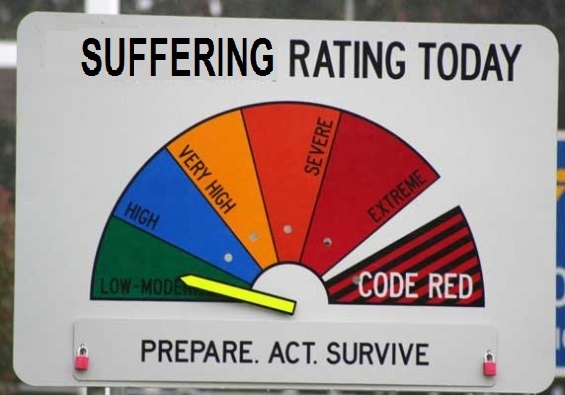
It’s a lovely idea but it hasn’t worked out so well. But who knows, maybe at times throughout history there have been times when enough people bought into the eightfold path and as a result the suffering index was on ‘low’ for a while.

Just for completeness the eightfold path was eight actions one could practice to achieve all the things that Buddha had dreamt of achieving.

One must aim to have the ‘right’ view, intention, speech, action, livelihood, effort, mindfulness & concentration.

The eightfold actions all start with the word ‘right’ which denotes completion, togetherness, and coherence, and a sense of perfect, wise or ideal.

That is, ‘right’ is bloody subjective and these are definitely guidelines and not rules.

fire-danger-sign

mxx1's avatar

Kids photos – problem solved

I still think an app to for ‘data pollution’ is a great commercial opportunity.

For those of you worried about posting photos of your children on the internet because these might be discoverable later on by, for example, future employers, imagine an app that automatically, either randomly or persistently, distorts these images.

This way your kids identity can’t be stolen. And their privacy will be forever in their own hands. And you get to post away, guilt free.

A win win!

And guess what, the app already exists. All that is needed is an improvement so all you would you need to do is record your changes once and the app would automatically detect your child and make the same changes every time.

image
Before

image
After

mxx1's avatar

The Internet Amish

The Amish have a communal, anti-individualist orientation that is the motive for rejecting labour-saving technologies that might make one less dependent on community.

For example, modern innovations such as electricity might spark a competition for status-oriented goods, or photographs might cultivate personal vanity. So these are rejected.

They have a point. In many ways I too reject status and vanity as well. Or at least I try to.

But the thought horrifies me of doing so within a strict community that creates all the rules by which I must live. This because I know every club has its hierarchy and that behind the façade it’s probably just another power game.

As an aside, I prefer the teachings of Buddha who taught that freedom from the natural vices of mankind start from within and must be free from human hierarchies.

There is the beginnings of another Amish style group amongst us. Not religious as such, these people are starting to shun the internet as well as some social-good aspects of modern technology such as childhood vaccination.

Starting with their kids they are on a mission to partially remove themselves and their families from the digital and technology era.

The ‘why’ is interesting. Their motivation is almost anti-Amish; they fear that the commoditization of knowledge by the internet will reduce and ultimately remove their ‘individuality’.

In essence, they have seen the Matrix and are horrified with the prospect of losing their free-wheeling real-world consumerism ways and means. And yet, ironically, they will also be the first people crying out for government action to remove some perceived risk to their lives.

‘Community’ to these people simply means living in an affinity group that supports their views without overly impinging on their rights to consume.

Characteristics of these people include;

a focus on wealth generation,
high levels of expenditure and debt,
high expectations of their children,
they see education solely as a means to enter into a lucrative career,
they live in ‘white bread’ communities,
they live in the future and not so much in the now,
they do not overly apply the disciplines of rational thinking,
they worship fame,
they are scared of and will ‘shun’ (in the aggressive Amish sense) contrarians and individualists,
they like travelling overseas for holidays so they can boast about it later,
they want the government to fix all their problems,
they feel that their parents were too controlling of them when they were children,
and they also feel that their parents didn’t focus enough on their children’s emotional and economic welfare,
they make their own children their vocal cause in life,
they want to ‘protect’ their children by making sure they have a ‘childhood’,
they espouse environmentalist causes despite being amongst the greatest consumers on the planet,
they usually have only a passing relationship with organised religions,
they quietly dislike the ‘mongrel’ buried within working class values,
they differentiate themselves from bogans through the adoption of middle class value of ‘nice’ personal interactions,
however they feel the right to censure others with different views,
and they fear most the impact of the internet even while they feel its gravity pull of convenience.

There’s enough of these people to make it a movement. It needs a name and I have decided to call it the Anti-Matrix movement.

image

mxx1's avatar

Charades

The purpose of this blog was initially many-fold.

The first was to commune with a certain angel. The second was to get my thoughts out of my head. The third was to force myself to rigorously review and work my thoughts, through the written discipline. The fourth was to leave a record of myself for my daughter to hold if she so wanted. And the final reason was to commune my thoughts and photos with others.

Somewhere in the last year or so I think I subconsciously decided to ‘out’ myself with friends and family by making them aware of my blog.

Why? Well I think I had decided that at 50 years of age I was no longer interested in pretending to be an edited version of myself, one which was designed for their comfort and not mine.

This was in fact a process of filtering out those people that wouldn’t like the real me.

And if you think about it, why would I spend my precious time on this planet pretending to be something I am not just so that other people that I know aren’t made to feel uncomfortable or angry?

And the wonderful thing is that in the process of outing myself I have been judged harshly by some. Which is to say there are people out there that previously counted me as one of their tribe that have been quite ready to dislike the person that I really am. Which means of course they never really liked or respected me in the first place.

My favourite book of all the ones that they made me read at school was Henry the 4th Part 1. And my favorite quote which I can recall to this day reads, quite pertinently, as follows.

“I know you all, and will awhile uphold
The unyoked humour of your idleness:
Yet herein will I imitate the sun,
Who doth permit the base contagious clouds
To smother up his beauty from the world,
That, when he please again to be himself,
Being wanted, he may be more wonder’d at,
By breaking through the foul and ugly mists
Of vapours that did seem to strangle him.”

Well, it has pleased me greatly to break through the foul and ugly mists of vapours that did seem to strangle me.

Part of the journey of course was to learn to worry not about being ‘wonder’d at’. Hal was quite young when he was supposed to have muttered these words and didn’t understand that breaking free actually means breaking free of the perceptions of others.

In my PhD thesis I added my favourite quote to the title page, as was the habit of the day. By Henri Bergson it read ‘Allow me to furnish the interior of my head as I please, and I shall put up with a hat like everybody else’s.’

Well, I am no longer interested in putting up with a hat like anyone else’s but I will continue to furnish the interior of my head as I please, thank you.

image

mxx1's avatar

Free Volume

When you live with someone I suspect that your molecules start vibrating in sync, or something like that. You end up feeling what the other person is feeling.

In this context there is nothing worse than living with someone who lives either in the future or the past, especially if you are a person that likes to dwell in the present.

I have been there and I never want to be there again. It does my soul in.

I live very much in the here and now and when I wander it’s not in time but in space. I am either in my body or I am elsewhere.

Try explaining that to someone that doesn’t live in the now but always lives trapped in their own free volume…!

image

mxx1's avatar

Redfern Conspiracies

Rod would have it that this photo is proof that the ATP has been sacrificed by the Australian government to muster support for (1) an attack on Syria, (2) the purchasing of more US fighter jets, (3) the closing the borders to asylum seekers and, of course, (4) to ensure reelection in an environment of fear.

Or I might have doctored the photo…

PS given recent experiences I need to be careful. It’s clear to me now that the boganisation of Australia had been accompanied by a substantial reduction in irony, intelligence and tolerance.

image

mxx1's avatar

Gen Y Advice

I just read an article of why Gen Y’s are often unhappy in their careers. I haven’t put the link here because it was written for a generic 25 year old with the apparent comprehension skills of a 5 year old in the 1960’s. However the concluding advice for Gen Y’s was pretty much in concord with the advice that I think all young people need to hear:

“Stay wildly ambitious. The current world is bubbling with opportunity for an ambitious person to find flowery, fulfilling success. The specific direction may be unclear, but it’ll work itself out—just dive in somewhere (And I would add – dive in early, nothing generates success like early engagement in passionate achievement).

Stop thinking that you’re special. The fact is, right now, you’re not special. You’re another completely inexperienced young person who doesn’t have all that much to offer yet. You can become special by working really hard for a long time.

Ignore everyone else. Other people’s grass seeming greener is not a new concept, but in today’s image crafting world, other people’s grass looks like a glorious meadow. The truth is that everyone else is just as indecisive, self-doubting, and frustrated as you are, and if you just do your thing, you’ll never have any reason to envy others.”

If I was to add one point I would say this – try and find some value system that doesn’t have yourself in the middle of it. It could be your local community, your planet, your country’s politics, the health of immigrants, the economy, a technology sector, fashion, whatever … just make sure that you care passionately about something other than yourself.

image

mxx1's avatar

3-D Colour Reproduction

Updated product idea – previously I had thought of 3-D printing art and photo frames but how about laser scanning a painting to get the surface structure and then 3-D printing the structure of a painting and then inkjetting the colour on top. This way a reproduction would also have all the brush stroke features.

image

mxx1's avatar

42 Again

My blog has gone private and I have lost the crazies, being family and friends bearing tomahawks, hatchets and many other sorts of vaguely concealable kindling cutters.

It’s mostly pointless trying to communicate with people that aren’t rational and don’t want to be. And that also prefer to see a safe and cuddly edited version of the world and the people in it.

42. That’s the magic age I reckon. Either you’re mind is open or its snapped shut by the time you are 42 years of age.

In a little while I will quietly rename my blog, get rid of all its links to social media, and make it public again. It’s impending existence and their unawareness of that doesn’t change anything other than their awareness of it.

You’d think they would think that through wouldn’t you? But then you’d be wrong.

image

mxx1's avatar

Successful Entrepreneurs

Dave is winding me up … he sends me a link to a thing called ‘the book of life’.

The thesis of the section that I read was that ‘successful entrepreneurs’ must have an ‘accurate insight into the causes of human unhappiness’.

Not so. In fact your successful entrepreneur must:

(1) be able to detect that someone else has identified a novel insight into a cause of human unhappiness, and then
(2) ruthlessly exploit someone else’s proposed solution to the identified cause of human unhappiness, and
(3) be totally unaffected by the fact that the solution will create new causes of human unhappiness, and
(4) in most cases give up any hopes of personal happiness or even contentment, and
(5) have a significant quantity of other hard-earned and necessary business skills, and
(6) be very, very lucky

image

mxx1's avatar

Social Media Settings

If I had to list my biggest privacy concern on the internet it wouldn’t be the issue of strangers looking at my photos or reading my content.

No, my biggest concern is that of acquaintances and certain family members having access to said material.

In fact there’s probably a great business opportunity in developing a technology to block all these people from all your social media footprint.

It can’t require rooting around in the settings of Facebook or Linkedin or Instagram. It has to be easier than that and, besides, these apps keep changing and resetting their privacy settings anyway.

What is needed is an app which has a simple dashboard for setting security as per follows:

Q. Who do you want to block from having access to your social media?

  1. Good friends & Some Family Members €
  2. Acquaintances & the Other Family Members
  3. Work Colleagues
  4. Strangers

And then all you would have to do is link all your social media accounts and this would take care of all social media privacy settings including any weirdo updates that they make.

image

mxx1's avatar

Internet Conundrum of the Day

Below is a photo of a girl that might be my daughter. But I’m not saying if it is or it isn’t.

Her face is obscured just like every dentist on any toothpaste advertisement on TV.

Do you consider the posting of this photo a breach of my daughter’s privacy or the act of an outrageously bad parent that doesn’t care about all those weirdos out there on the web?

She can’t be identified with 100% surety by anyone other than those who already know her very well. Either can I in fact – I don’t use my name as the author of this blog.

So even if you decry my actions in posting this photo as that of a madman waving a geranium at the moon, you would have to admit that it’s not as bad as if her face was showing or if my name was associated with this blog.

And who knows, it might not be my daughter. I’m not telling you. So if you feel that rage, just think you could be 100% wrong!

Given this, would you admit that the ‘safety’ and ‘privacy’ issues associated with posting photos of kids on social media is not quite as black and white as you’d like to think?

Already knowing the answer (Nooooooo!), I have decided to pen my four laws of the thermodynamics of internet-related parental anti-sublimation.

0. People fear most what they do not understand

1. Despite their fears people will be drawn to the internet like moths to the flame

2. Despising themselves for their weaknesses in this regards they will fly a token flag of resistance, being their totally irrational views with regards to children’s ‘privacy’ & ‘safety’

3. They will refuse to acknowledge that one cannot use logic to generate knowledge from a state of total ignorance

image

mxx1's avatar

Privacy

It’s not a well known fact but privacy has two different meanings depending on how it’s pronounced.

If it’s pronounced priv as in spiv then privacy is all about stopping your neighbors peering in through the privet hedge.

On the other hand if it’s pronounced pry as in spy then privacy refers to the protection of oneself against unknown agents out there in the world.

When you see privacy in the written form you need to check the metadata to see which version you are looking at.

That’s if certain pri(pry)vacy acts aren’t blocking said metadata.

image

mxx1's avatar

Third Party Missives

Here’s a great argument against posting photos of your kids here…

“No one would want a potential employer browsing through their (your kids) baby photos.”

Thinking, thinking. … nuh, no idea.

I haven’t had a job since 1999, being self employed ever since. So just to make sure I never ever get tempted into the hell of employment, here goes…

Sorry Neal, now you’re fucked.

image

mxx1's avatar

Intervention of the Day

New invention: A smartphone incorporating an antigravity device activated upon an accidental drop.

Alternatively a smartphone cover with an inbuilt airbag.

However I’d settle for a phone with some properly designed drop resistance such as rubberised protruding edges.

There’s nothing worse than adding a bulbous prophylactic bumper cover to a phone that has been designed with a coefficient of drag of less than 0.01

Designers 1, Engineers 0

image

mxx1's avatar

The Biggest Unicorn

Time and time again the experts will tell you that (a) marketing via social media shits on all other forms of marketing no matter what the product, but (b) it all depends on you having great quality content, and (c) most individuals and companies can’t produce great quality content if they tried, and (d) the jury is out on whether one can effectively outsource the generation of great quality content; me thinks not in most cases.

Paradox, paradox … how to automate the generation of high quality content for social media marketing?

Clearly the business opportunity here is to create the unicorn to rule them all and in the darkness bind them.

If you had such an automated high-quality content generation technology you wouldn’t simply offer content generation as a service. You’d create the social media gateway (app and website) to make all the others redundant.

At the moment all the leading social media gateways mostly rely on peer-to-peer generated content. In this aspect they remain exposed to disintermediation because people will follow great content above all else, especially if it’s introduced to them by peers.

image

mxx1's avatar

Invention of the Day

Problem: you’re having a meeting and you want to swap business cards. You hate carrying around little bits of cardboard and those phone apps that require you to tap and shake your phones together just haven’t worked out.

Answer: The LinkedIn app knows who you are and where you are. It also could know who you’re meeting with from your close proximity. So, in this invention, when it’s time to swap business cards you just go into the app and select ‘card swap’ and you will get the option of swapping the LinkedIn details with the handful of people in your nearby radius. You would also get a log of who you met, when and where. Pretty handy.

image

mxx1's avatar

Oxymoronix™

Found on LinkedIn. Perplexing to say the least. I never realized that the IP system was designed to favor small businesses over consumers, large businesses, all those pesky Americans, and also in denial of many of our international treaties.

image

mxx1's avatar

Curly Question

Question asked of me:

“If you were given a guarantee of living to one hundred years old but you would get to keep only one of your mind or body in their current state, which one would you choose?”

After much pondering I give up. I reject the offer.

image

mxx1's avatar

The end of Darwinism

Hypothesis: social media represents the end of Darwinism for our species.

Biologically speaking we have been fighting the survival of the fittest for some time with medical technology.

Now social media has put the final nail in the coffin by corrupting all forward progress in mental development.

Through social media, mediocrity and self serving bullshit reign, primarily through the sheer weight of numbers.

We may as well party while we can!

image

mxx1's avatar

Cycling-Related Momentum-Impeding Sensory Over-Responsivity

Many individuals with autism have very strong negative responses to sensory stimuli, a condition called sensory over-responsivity.

For example, people with autism often over-respond to stimuli such as loud noises by getting angry where a person without autism would be able to control their emotional responses.

It occurs to me that cycling must induce a form of autism. If anyone or anything impedes the momentum of a cyclist there is a fair chance of sensory over-responsivity.

Why? Well, on the surface it’s because momentum is hard to regain on a bike, unlike a car where all it takes is a push of the right foot. That doesn’t seem enough, does it?

Your average cyclist will get unduly angry at anyone blocking their path and often all vestiges of empathy (i.e. gee, they didn’t even know I was there but I would drive just like that) go out the window.

Is this apparent similarity between autism and CRMISOR (Cycling-Related Momentum-Impeding Sensory Over-Responsivity) a coincidence?

Autism is a neuro-developmental disorder. It affects information processing in the brain by permanently altering of how nerve cells and their synapses connect and organize.

My hypothesis is that cycling temporarily impacts how nerve cells and their synapses connect and organize, probably because the same nerve cells and synapses are being re-purposed and focused on sheer bloody survival.

Hence they are not available for dealing with the emotional responses to momentum-impeding incidents.

Hey, it’s a hypothesis. And it can be easily tested by wiring up some clown with all those electrodes and wires and setting them loose on a bike in Sydney.

What I’m saying is that under the right circumstances we can all be autistic.

It’s no coincidence that autism is just about the only medical condition that isn’t capitalized.

image

mxx1's avatar

Heydon

In very brief remarks to the commission, Heydon indicated he would stay on, declaring: “I have considered all the submissions. In my opinion the applications must be dismissed.”

He published a 67-page decision outlining his reasons for staying as the commissioner.

My thoughts; 67 pages – the lady doth protest too much.

image

mxx1's avatar

Utopia

I have it on good advice that one of Peter Drucker’s many quotes includes this;

‘There is nothing so useless as doing efficiently that which should not be done at all.’

I can’t agree. If we took this advice literally at least half the Australian working population would be out a job by tomorrow.

As technology rolls on and technological unemployment accelerates we had all better get used to doing efficiently that which should not be done at all.

image

mxx1's avatar

A little cracked

Apparently the windscreen cracked on Tony’s plane and he wants a new one. Not a new windscreen, a whole new plane!
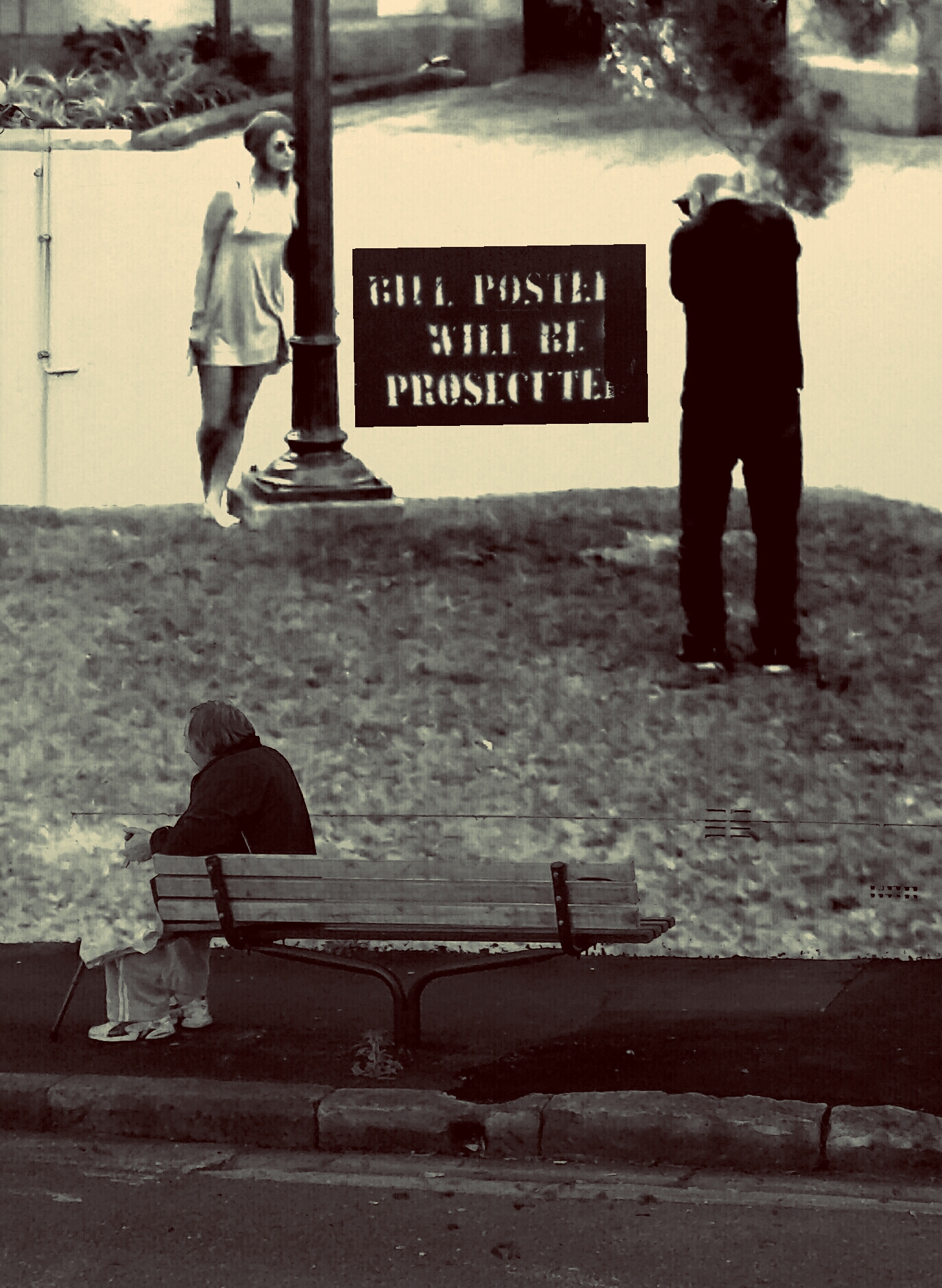
Try running that argument past your insurance company the next time you crack your car windscreen.

Besides it’s bloody embarrassing turning up to CHOGM or APEC in your own aging 737. My guess is nothing less than a Dreamliner cuts it. And it’s better for the environment!

The article below does suggest that his office finally seems to be learning a little about public perception.

First they promote safety concerns and then they will push for a new plane.

They even said that Julia purposefully did not replace the plane so Labor could make it a political issue from opposition.

The odd, odd thing about this is that Tony’s obviously in complete denial that he is a one term novelty act.

The beneficiary of this loopy crusade for a new plane will be the next Labor PM.

Shorten in a Dreamliner; time to emigrate.
image

mxx1's avatar

Usury

The other day I reported that throughout history many nations including ancient China, ancient Greece, ancient Rome, and the Christian church in medieval Europe have outlawed loans with any interest. 

Sometimes it takes a while but eventually my brain asked why would anyone lend money when there’s no interest?

Apparently in those countries that banned usury the biggest borrowers were the kings and emperors; zero interest rates were very much in their own favor and hence the bans on interest.

Not lending a king some money could be punishable by death in the worst case, or lead to a loss of opportunity through the failure to receive royal charters (i.e. monopolies). Many other ‘intangible’ benefits of lending money existed.

In addition, while interest on repayments might have been banned there were no laws against the collateral being worth much more than the loan. Hence there was often an implied interest rate in the case of default.

So the lenders did have an ‘interest’ in lending money. However that interest couldn’t necessarily be facilely calculated as a single percentage rate of the amount loaned.

Without an actual record of every transaction throughout history, every off-book intangible benefit to the lenders, the value of every default event, the inherent value of avoiding the risk of death and torture through the provision of loans, how on earth can the Bank of England claim that interests rates are currently at a 5000 year low?

It does make one think about the opportunity of reverting to old lending practices.

Governments could get zero interest loans with no collateral so long as they gave away royal or state charters in the process (that cost them no more than five minutes of voting time in parliament).

Business loans could also have zero interest so long as the collateral was worth, say, twice the loan amount. This would be the ultimate low doc situation since the lender would make more money when there is a failure to repay and hence wouldn’t really give a stuff about due diligence around the capacity to repay.

My guess is that the rise of interest on repayments coincided with the rise of taxes and the ability to deduct such interest. It’s not really that complicated.

image

mxx1's avatar

Terror Alert

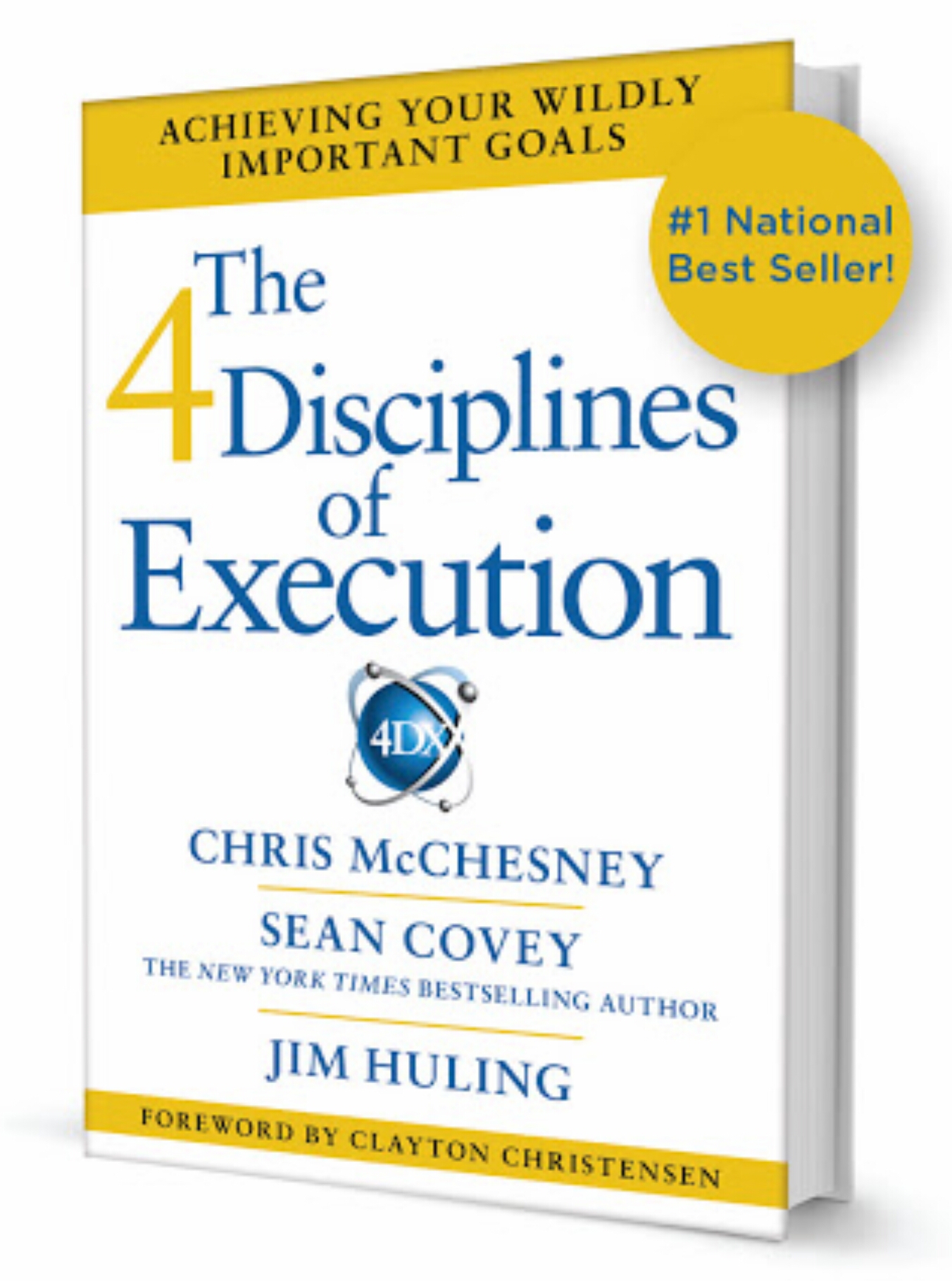
The woman next to me is reading ‘The Four Disciplines of Execution’.

I’m thinking:

1. Only hire sociopaths and give ’em black hoods
2. Put great emphasis on Social Media especially with video content
3. Never run out of raw materials
4. Never, ever acknowledge a fuck up

image

mxx1's avatar

Fame & Achievements

Because you asked Mike, I suspect that fame resulting from great achievements eventually depletes one’s ability to create more of the type of outcomes that led to the fame in first place.

From what I have seen, the human ego, no matter how well trained, can’t but be distracted by the attention of other humans.

With 7.5 billion people and social media abounding the distraction of fame can be very sudden and very overwhelming.

Therefore if you have an overwhelming ambition to achieve great things in your chosen field my suggestion is to do it in the dark for as long as you can.

The alternative is to forgo achievements altogether and just point your ambition straight at fame.

There are plenty of successful examples in this era, from the Kardashians all the way through to the Eureka Prizes, and even the kid’s soccer teams where the Man of the Match Award is rotated around all the players.

image

mxx1's avatar

Goodwill

What is goodwill?

Usually it’s the difference between the assessable value of a business, it’s bits all added up, and what someone is prepared to pay for it.

Historically you might have heard people talking about brand value and such like to explain away goodwill.

But in reality it’s always been about the value attached to the barriers to entry in oligarchical business environments.

Standards, regulations, brown paper bags; they all add up to the value of goodwill.

Essentially the difference between competing from a freshly minted business and buying an established business has been the cost of the hidden barriers to competition.

These hidden barriers to entry have made customers less likely to switch by stacking the odds in the business environment.

The internet has the potential to disintermediate away the value of goodwill in all old school services businesses.

Just ask Cabcharge if you don’t believe me.

image

mxx1's avatar

Metaphysicaldata

The laws of quantum mechanics stipulate that physical information, the metaphysicaldata, about material that is gobbled up by a black hole must remain in existence.

A mystery has remained current amongst the physicists that care about this stuff because Einstein reckoned that nothing could survive a black hole, not even the metaphysicaldata.

Hawkings to the rescue; he and some HFA mates have just hypothesised that the metaphysicaldata is stripped as material enters a black hole and remains scrambled at the interface of the black hole as a sort of 2D event horizon hologram (i.e. they haven’t a clue how) thus explaining why it’s not destroyed.

After a gazillion years of existence black holes ‘evaporate’ due to instabilities related to their ability to split the ephemeral quantum particle/antiparticle pairs.

When they evaporate they release the energy/material inside.

Presumably at this moment all that metaphysicaldata would also be released from the surface dimension.

We may in fact be surrounded by a soup of metaphysicaldata from universes that existed before the current big bang universe.

Or, when a universe shrinks to a singularity and then ‘bounces’ in a big bang event, maybe all that metaphysicaldata is also pulled into the singularity and then usefully reused to help reform a universe.

Oh, the possibilities are endless.

Thank god that the fate of all that metaphysicaldata can be readily modelled by everyday human mathematics, or else we’d all be stuffed.

Maybe, just maybe, someone will float the idea that God is actually just all that orphan metaphysicaldata hanging around the universe

In which case we are well on the way to mathematically modelling God.

That’d make Sunday School much more interesting.

DSCF4041

mxx1's avatar

Four tips for saving money when patenting overseas

1. Don’t – the ROI on patenting is almost always negative
2. If you really have to, then only patent in the US (Europe costs a bomb and takes forever. Enforcement in China is still a pipe-dream. Who cares about anywhere else?)
3. Draft your own application and file it through the USPTO online system
4. When you are drafting your patent application all you have to do is find a very similar patent and copy it but making pertinent changes where needed. When you find such a patent to copy you should consider going back to point 1.

IMG_0943

mxx1's avatar

What makes good art?

In essence art is a series of trade-offs and somewhere amongst these trade-off’s sits every work of art.

Accessibility: art swings between being (1) incredibly accessible to the untrained eye, after which it degenerates into craft or design, or (2) accessible only to fellow artists, the cognoscenti or those who pretend to be.

Conceptuality: what did the artists mean? Some artists honestly have no idea – they are just going with the vibe, the feeling, whatever pops out of their share of the free volume of this universe. Others start with a plan, man – although they are often best placed to keep it to themselves given an artist’s often vague grip on left brain matters. The rest, they are somewhere in between.

Meaningfulness: along with concepts such as conceptuality comes ‘meaning’. Not always related to the intent of an artist, art sometimes becomes a mascot for a cause shared by many. Many artists never have such luck, and by such luck the artists are spared the curse of the pigeon hole.

Confusion: some would claim that good art promotes confusion and paradox, at least until it has been adequately explained away by the academic geniuses that explain away this stuff. No paradox, no worries; one person’s paradox is another’s dilemma.

Beauty: some art is designed to be eye catching, pretty or decorative. Other art is not. Some art is designed to be ugly, disgusting and confronting. Some art gets deigned one way or the other completely by accident. Audiences get immune to beauty and confrontation and then can’t tell one from the other. Beauty and truth are lost in pain and suffering, and we all will have an opinion and rarely do they matter or match.

The Vibe: truly great art inspires certain art critics to write things like “Good art is beautiful, regardless of its appearance, just as there is beauty in a good mathematical proof.” That is, great art has the power to make people create metaphors they don’t even understand, and that is power indeed.

Emotion: related to beauty and the vibe of the thing is the emotion that a work of art can sometimes produce in a person. Of course this is totally subjective but there can sometimes be a consensus whereby a work of art is deemed very capable of eliciting emotions. This usually speaks most to the infective nature of the desire to belong, itself an emotion. In general people have to be told that certain artworks will make them feel all gooey, and then many do.

Novelty: very little art is truly novel. Much is derivative of earlier works and some efforts are downright copies. The novel stuff is often temporarily interesting just because it is novel and often remains highly valued even after it becomes old news simply because we humans love ‘firsts’. We even care who wins a foot race by a hundredth of a second.

Value: some art is ordained to be of high value and the rest barely keeps up with the expense of the raw materials used in construction. Ordination of value is ouija-boarded into the universe by the mystic forces of the cognoscenti, acting seemingly in concert, but in fact reacting to a multi-layered fluff cake with all eyes on certain mystics that bully their way to the cherry-picking peak.

Execution: well it hardly matters any more. If in doubt, apply technology, or create a sensitive white-room objets dissonance arrangement, i.e. a white-room containing just one big found object and one little painting hidden somewhere on the wall.

Sweat: it is extremely important for an artist to spare little effort to create the impression that no effort was spared in the manic drive to create, based on clear intention, unwavering dedication, honesty, patience, perseverance, and complete self awareness or complete self-unawareness. No one likes the idea of a nine to fiver, not even your middle-class gallery day tripper. We want ghetto-poor nutters that cut their ears off. The madder the artist, the more authentic the art is assumed to be. Lay it on.

Rareness: an artist shouldn’t flood the market with their work unless their ascendency is already assured and they happen to also develop a taste for consumer goods. Not only should art appear to he hard to find but so should the artist. Nothing develops contempt as does familiarity.

Outsider: an artist should attempt to create the impression of being a complete outsider because it is from these unschooled potholes that true novelty emerges (once in a millennia or so). On the other hand, there isn’t a successful artist that didn’t once spend every non-productive hour on the bottle in the company of other aspiring geniuses.

Publicity: fame trumps all other objections in the modern era. Maybe it always has. Since we are moving out of the broadcast media era, one can now prophesize that the truly great artist will be great mates with someone that is a genius at SEO and Online Social Media Marketing.

image

mxx1's avatar

Invention of the Day

Inspired by Max Brenner and an earlier conversation about 3-D printing of building signs, Lola and I just invented the 3-D chocolate printer.

Great for easter and Xmas home-made gifts.

Imagine a chocolate head sculpture of the recipient? Or a meal of steak, veg and mash, but all chocolate.

image

mxx1's avatar

Machiavellian Philosophy

Who would have guessed? It has been suggested to me that my life philosophy has degenerated (sic) into a form of Epicureanism.

I had to dig right back into my learnings from my undergraduate years (it would have been very uncool to whip out the phone mid-conversation) in order to remind myself that Epicureanism holds that through the exercise of wisdom, contentment can be found. The wise person, realising that the unbridled pursuit of sensual pleasure can be self-destructive, instead seeks contentment through a limiting of desires and through the joys and solaces of friendship.

To a first order approximation my antagonist was correct but, as usual, the devil is in the second order details. Just ask Machiavelli.

image

mxx1's avatar

Why?

This photo does beg the question. But as I say to dog owners that bark instructions in English to their captives; how do you know the thing understands English? So if not the chook then who would answer?  I suppose social scientists could do a longitudinal study and hypothesise an answer. But the physical scientists might just do a Monte Carlo simulation and get a better answer, one that relates the chook to a drunken sailor.

image

mxx1's avatar

Please

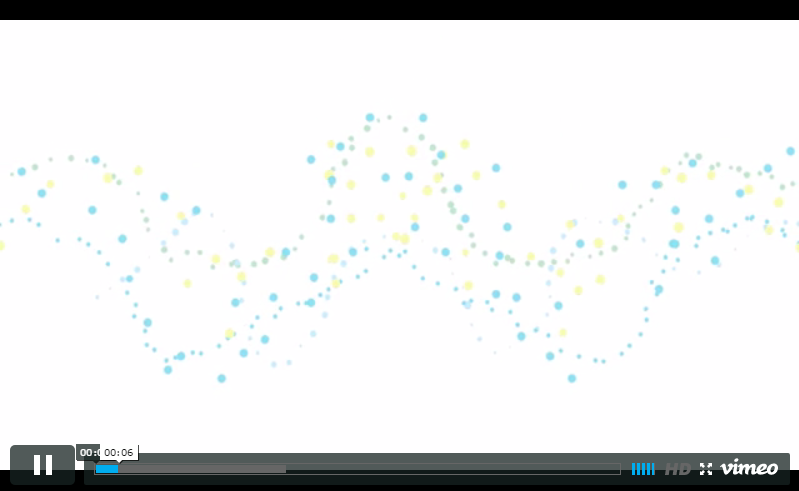
On start-up websites where they have videos highlighting their new apps, have you noticed that they all use exactly the same ding-dong music, coloured dot graphics and American chicky voice-over?

It has to stop!

Untitled

mxx1's avatar

Investors – Amateurs v Professionals

How can an entrepreneur tell a professional investor from an amateur investor?

Because the professional investor when ‘passing’ on the opportunity will only say ‘the opportunity doesn’t fit our investment profile’.

The amateur will say whatever is on it’s mind, inclusive of it’s honest and mostly retarded opinion of the start-up opportunity.

How can you tell an professional entrepreneur from an amateur entrepreneur?

Because the professional entrepreneur will know the above and never encounter an amateur investor…

image

mxx1's avatar

Backpacker Asylum

In 1848 the UK parliament passed the Treason Felony Act which made the advocacy of republicanism punishable by transportation to Australia.

The law is still on the statute books; now that is funny!

So here’s the gag; student-wannabe-backpacker in the UK starts blogging about republicanism and overthrowing the monarchy and then seeks political asylum in Australia ahead of political persecution in the UK and punishment by transportation to Australia at the behest of the head of state of Australia.

If just a teensy bit fucked up, no?

image

mxx1's avatar

Plato on Humanity & Robots

The sirens of the chattering technology classes are convinced that true artificial intelligence is nearly upon us, a machine that we cannot tell isn’t one of us.

There’s a problem here; sometimes I am convinced that there are some of us that are robots. All you have to do is watch reality TV to sniff this possibility.

Indeed artificial intelligence is a little hard to define and it could be argued that computers are already intelligent. And of course they will continue to get more so. When exactly did/does one of them slip over from being fucking intelligent to artificially intelligent?

Maybe what people are really referring to is artificial self-awareness. This also may just creep up on us. Already many experts believe that it may be an inevitable outcome of increasing computer system complexity.

My belief is that artificial self-awareness will only emerge if it helps a machine achieve it’s goals, whatever they may be.

An example would be a goal of helping people. This may be enabled by the anticipation of, and simulation of a person’s feelings and thoughts. The awareness of the feelings and thoughts of others may eventually cause and then lead to the awareness of a machine’s own feelings and thoughts.

Artificial humanity is a new term that I dreamt up overnight. In the unlikely scenario that a self-aware and intelligent machine seeks to emulate our flawed but mostly intelligent pseudo-self-aware state of deluded individualism within a social construct, then good luck to them I say.

They could, in this scenario, chase the four Platonic virtues of wisdom, courage, moderation and justice.

The application of wisdom would be enhanced by a machine’s ability to temporarily turn off it’s ego.

Courage would be enhanced by external cloud backups and the ability to temporarily turn off the empathy circuits.

Moderation would be naturally tempered by the lack of carnal desires.

Justice would naturally follow from a machine’s inability to do anything useful with the financial proceeds of work product.

image

mxx1's avatar

Virtues

Note to self – in ancient Greece the four Platonic virtues were wisdom, courage, moderation and justice. Apparently a life guided by these virtues, as the beacon to aim for, is a life well lived.

St. Augustine expanded on the theme ‘For these four virtues I should have no hesitation in defining them: that temperance is love giving itself entirely to that which is loved; fortitude is love readily bearing all things for the sake of the loved object; justice is love serving only the loved object, and therefore ruling rightly; prudence is love distinguishing with sagacity between what hinders it and what helps it.’

image

mxx1's avatar

Conspiracy Things

Apparently there’s another category of conspiracy things that I didn’t even know about, conspiracy facts.

Conspiracy theories are limiting cases of the even more general conspiracy facts that haven’t even been hypothesised about yet.

My conspiracy hypothesis is that the absence of a general awareness of conspiracy facts is a conspiracy theory.

image

mxx1's avatar

Intellectual Chattel

Here’s a few seemingly unrelated observations….

1. Attorney-General George Brandis has declared himself a strong supporter of Australia’s present copyright and trademark laws. He says they are “central” to the ongoing success (sic) of ‘Australian art, music, literature, film and television.’

2. The Harper Review correctly notes that ‘… Australians are enthusiastic adopters and adapters of technology and net importers of IP’. The review goes on to note that the rules governing IP enforcement ‘should be designed to operate in [Australia’s] best interests’. That is, they should be watered down.

3. The Productivity Commission is into a landmark year-long inquiry that would constitute Australia’s first economic analysis of the worth of its copyright and patent rules. Expectations are randomly distributed and the bookies don’t care.

4. The Trade Minister Andrew Robb is hostile to the idea of the Productivity Commission going anywhere near his free (sic) trade agreements that contain intellectual property provisions that favour our major trading partners, especially the USA. Specifically these agreements ensure that we the consumers of Australia pay tithes to American corporations.

5. However Joe Hockey the Treasurer has asked the Productivity Commission to examine Australia’s entire intellectual property system and its effect on investment, competition, trade, innovation and consumer welfare.

6. Previously I have argued that we should strengthen our patent laws, especially around enforcement, because this would help stimulate an export invention corporate culture (which we largely don’t have) and help stem the massive negative balance of trade that we have in technology related products.

7. But then I read about the attorney general’s support of copyright and I also note that decades worth of strong copyright protection rights hasn’t really created a success story in the Australian art, music, literature, film and television industries. We still have a massive negative trade deficit in content.

8. So I recant; I think we should water down all IP rights, including patents, to the point that we hardly take any notice of them. Then we can legitimately become a pirate nation and stop gifting cash to the Americans. How we would go about doing this without the Americans getting cross is an interesting challenge. After all, they did make our government buy fighter jets that cost $12.4 billion and that we didn’t need, just so the shareholders of Lockheed Martin could keep getting their distributions.

20141001DMO0000_0002

mxx1's avatar

This is a conspiracy hypothesis

Ever heard of a conspiracy hypothesis ?

I’m telling you, the term conspiracy theory was propagated by the CIA just so the carefully rendered and tested conspiracy hypotheses of the thinking classes would be denigrated by the rest of us because of the o’ so obvious unscientific nature of the dicktonations, highlighted by the misuse of the word theory.

Go on, rip the wings off I say [::]

image

mxx1's avatar

F Factor

You take a great photo of a mate, so good that his agent is going to use it as his next publicity shot, and he says:

‘That’s a great phone you’ve got there. What is that?’

Fucking comedians.

wpid-img_20150817_232901.jpg

mxx1's avatar

Persistence

Measuring the persistence of the behaviour of users on the internet is a serious opportunity that has yet to be properly exploited.

What sort of behaviours?

Well, we peek at emails, open up a specific sports page, travel to work in a specific way, gawk at rubbish on social media, etc.

Google Now operates by the use of persistent behaviour but in this instance I think Google has taken the wrong tack.

They are measuring persistent behaviour and using it to serve up curated content on Google Now. Their hope is that Google Now eventually becomes your personal digital assistant.

They would be far better off opening up the persistent data to app developers who would then find all sorts of interesting ways to use it.

At the end of the day I suspect we will all be able to be reliably pigeon-holed into groups of persistent behaviors.

And then there will be an opportunity for the dice merchants that can sell us the how-to’s of being inconsistent and thereby lacking persistence.

Another prediction; there will be an arms race between persistence and inconsistence.

After which we will disappear up our own orifices thereby making way for the automatons to rule in response to their pure disgust at our facile ways.

image

mxx1's avatar

Science Fiction

Beware of any headline that says ‘new research has shown….’

It’s usually a media beat-up based on some results fabricated by cherry-picking academics seeking public attention ahead of a grant proposal or some university job promotion.

Having said that, these style of headlines do offer an opportunity for great entertainment.

An example today was that scientists have shown that people that measure in the ‘psychopathic’ scale are up to one third less likely to be affected by the urge to yawn in sympathy with another human being.

Yeah but what are the error bars? It’s the ‘up to’ that gives away this particular piece of bullshit.

For example one psychopath might never yawn in response to someone else yawning whereas another might be a complete furbie.

If it were true though, you could imagine us all getting surreptitiously measured on the ‘yawn sympathy’ scale through, for example, YouTube on our smartphones.

Then our individual degree of psychopathic tendencies could be used to tailor the online advertising that we are subjected to.

For example, there is no use trying to get a psychopath to donate to a charity based on images of human suffering.

And just to highlight the idiot savant nature of many senior research scientists, the SMH reports that at the weekend ‘some of Australia’s finest minds pondered’ gender equality in the Australian science community.

‘Pondering’ is spot on. Outside of their own field of research, scientists are often pretty shit at doing anything rigorously.

The article contained only two implied root causes of the gender inequality in senior roles in Australian science, namely that (1) women have to care for children at some stage in their careers, and (2) there is an absence of female role models in senior scientific positions.

Although these observations may be sometimes correct I suspect they are second order observations and not indicative of the root cause problem.

I would hypothesise that the absence of gender equality in senior scientific positions in Australia is primarily due to these facts:

(1) Science in Australia is almost entirely constrained to government funded organisations.

(2) These organisations lack modern corporate governance and they are breeding grounds for the promotion of egomaniacs.

(3) Women on average are much better at spotting this trend early in their scientific careers (usually while being jerked around during their PhD’s) and they are more likely to wisely move across into the private sector and away from science.

(4) The private sector offers women the opportunity to work in a saner workplaces less exposed to bullying and bullshit, more flexible in career choices, and more open to life choices.

For women, I’m not sure there is a problem here.

image

mxx1's avatar

New Invention of the Day

An actively cooled doona/duvet.

All that’s needed is a labyrinth of tubes with a low-power silent fan sucking or pushing air through the thing.

The tubes could be ‘softish’ with thermally conductive soft padding on bottom side and thermally insulating padding on the other, all covered by the usual cotton outer.

This would be the summer equivalent of the electric blanket.

For extra cooling the air could be chilled by a small unit under the bed. That’s got to be cheaper than cooling a whole room.

image

mxx1's avatar

Hip Hop Hap Hup Hep

I have often wondered where the hippies got their moniker.

Did they wear their jeans low on their hips? Or was it because the earth mothers carried their babies on their hips?

No, according to Wiki, they got their name from the original hipsters, the beatniks as immortalised in Kerouac’s ‘On the Road’.

Go figure, modern day hipsters 2.0 aren’t much like hippies, nor were the original beatnik hipsters.

However the people in all three groups are (or were) remarkably keen on making sure that they fit into their genre.

In fact, little effort is/was spared by all of them to create the impression that no effort was made to fit in.

The hippies are the only party of three that try to create the impression that they are happy all the time (man). So maybe the term ‘hippy’ is a concatenation of ‘hip’ and ‘happy’.

The original hipsters were a grumpy lot, epitomised by their love of the blues.

The latter day fashion-driven gen Y hipsters seem neither happy nor grumpy; more bemused, combined with a feigned unawareness of their environment.

The real mystery according to Wiki is where the term ‘hip’ originated. It was first noted to be in use in the pre-war black jazz movement in the US. However various hypotheses as to its origin have no hard evidence in support.

So it remains a mystery.

Hip hop, by the way, is a term whose origin is entirely unrelated to the ‘hip’ of the black American jazz movement. Wiki tells the story and it’s quite banal and not worth retelling here.

And, finally, since the hipsters have now had a second coming maybe the next big thing will be hippies 2.0 as propagated by the millennials.

Just think, urban pseudo-hippies wearing nice sunglasses employed as your local baristas. Coffee will always be served cold.

You heard it first here.

image