mxx1's avatar

Argument v Debate

I have always distinguished between a debate and an argument.

For mine, a debate involves two reasonable and/or rational people that are prepared to consider and even adopt the position of another, even if the chances of this happening are very slight. Nothing is ruled out. Debates can be emotional, but the intent is never lost on either party.

An argument on the other hand involves at least one party that has no intention of ever adopting the position of the other. This of course infuriates the other party and emotions can spiral out of control. Arguments usually end in stalemate or false declarations of conformity, when one party becomes too exhausted to continue.

mxx1's avatar

The Five Types of Jealousy

According to someone or other, there are three types of jealousy. I make it five.

(1) Symptomatic Jealousy is a consequence of a major mental illness such as paranoid disorder, schizophrenia, substance abuse, or organic brain disorders.

I call this Mad Jealousy. ‘Nuff said.

(2) Because of personality disorder or strong sensitizing experiences, some people who aren’t on the wrong side of the DSM are especially sensitive to self-esteem or relationship threat. They experience Pathological Jealousy.

I call this Addictive Jealousy because it’s actually driven by a desire to avoid psychological pain. Ironic that, because it’s counter-productive in many instances.

But, and this is key, the psychological pain caused by the fallout of Addictive Jealousy is, for the sufferers, preferable to the threat of experiencing whatever the primary psychological pain is that they are avoiding, no matter how unlikely this is.

(3) So-called Normal Jealousy occurs in people who are neither sensitized nor suffering from a major mental illness. I’ve broken this into three categories.

(3A) Compulsive Jealousy is driven by an anxiety that the future will be different to the present, when it comes to personal relationships.

On one hand, this is completely defensible. And yet the habit can be quite compulsive because it requires a crystal ball.

Unfortunately we humans are randomly useless at forecasting on emotional matters; we usually don’t know this and tend to either be over-optimistic or under-optimistic. Compulsive Jealousy is of course an example of the latter.

(3B) Compulsive Jealousy can morph into what I call Prophylactic Jealousy. You can think of this as akin to some real world version of the movie, Minority Report. The sufferer imagines a future crime by, for example, a spouse, and then explains to the future criminal what their punishment will be if the crime does occur. This is an attempt to circumvent the future crime altogether. Proposed punishment can range from ‘I will be upset’ to ‘I will be angry’ or ‘I will leave you and take the kids with me’.

I believe that sufferers of Prophylactic Jealousy need serious counseling. They are suffering from a compulsive habit that crosses over into something from the DSM, and also causes a lot of pain for others and for themselves by placing much unnecessary strain on relationships.

(3C) Having said all that, I’d say that there is a fifth type of jealousy, Defensive Jealousy.

This one kicks in only after the damning facts are known and real, and doesn’t require the imagining of a crime of the heart.

This type of jealousy is a mechanism to protect the self against future harm, on the principle that leopards will almost always have spots.Of course, on rare occasions leopards get dipped into chlorine bleach. Getting it wrong on these occasions is a statistically acceptable risk to those acting upon the principle of Defensive Jealousy.

The definition of “future harm” here is critical. Each of us could weigh up the pros and cons of a situation quite differently. Some would go with their gut, and yet others would let to rational mind have a bat as well. Some might reason themselves into realizing that they have nothing to fear except fear itself. We are all different and we are all coming from different places, with different intents. There is no ‘right’ way to live, just better ways for you and me, as compared to what we are doing now.

Disclaimer: this blog is simply an attempt to describe what I have observed around me on the subject of jealousy. Nothing written here should be taken as evidence that I condone jealousy in any of its five forms. However it would be delusional to pretend that jealousy doesn’t exist; and hence, noting that it does, there is much merit in cataloging the types of jealousy so that one can more efficiently deal with it when it arises, in yourself or in others.

wp-image-1687985028jpg.jpg

mxx1's avatar

Obsession

What do you call something that is addictively desirable until it is obtained, thereafter becoming less and less valuable until it is essentially worthless?

Well it’s not a thing at all. It’s a psychological condition. Let me explain in the context of a cheating husband.

If a husband cheats again and again, then it is likely that he’s got a deep addiction for something, and it is certainly not the thing that is addictively desirable until it is obtained.

On this, the holy side of the DSM, most people that have a sexual addiction also have substantive negative beliefs running around in their skulls.

They may feel unworthy or they may feel that no one can genuinely love them.

These feelings have causes. And effects. And they are the bullseye of the target, if change is desired.

A deep sense of insecurity drives addicts to compartmentalize their sexual and intimate lives, thereby avoiding intimacy altogether in some instances

After all, being intimate with a spouse requires that one feels worthy of such love.

In some cases, cheating can serve to temporarily make the addict feel more powerful and less insecure.

But more importantly, the addict feels that he has nothing to offer other than his sexual attractiveness.

He will be addicted to flirting and inappropriate behavior. He will be irresistibly drawn to people that find him attractive.

These addicts will continually seek to sexualize all relationships, even business relationships.

Each new affair will quickly become an unwanted intimacy. The addict will move on, and then on, and on again.

phil

mxx1's avatar

Not the Matrix

It would appear that 13 year olds are now of the mind to pair up in a virtual fashion.

And when I say fashion, I do mean fashion; it is quite fashionable to have a boyfriend or girlfriend.

But the current interpretation of the conjoined ‘friend’ is rather virtual in nature.

A couple will communicate by text or through a messaging app, but actual face to face meetings are minimised or altogether avoided because they are yucky, messy, or something else altogether; I know not what.

This phenomenon has also assisted in the rise of vibisexuality in the matrix. Driven by images of female pop stars kissing other female pop stars, some young girls have decided to have their virtual affairs with other girls. There’s no feedback loop to hoop.

My prediction is that these 13 year olds will continue to have their virtual relationships even as they get to that age where something else could be desired.

You can see them now; 30 years old with virtual husbands and wives.

They will live apart but communicate continually through apps.

They may even each have virtual presence with the other through holograms that move and speak.

When it comes to sex, procreation and child raising, well, technology will allow this to be outsourced.

And the kids can be then be virtual, computer generated, thereby solving the world’s population problem.

So it’s not quite the Matrix that we are looking at it here. After the next generation everyone will be virtual with no messy bodies to look after.

mxx1's avatar

Dog’s Breakfast – example

This is a true account of what just happened…

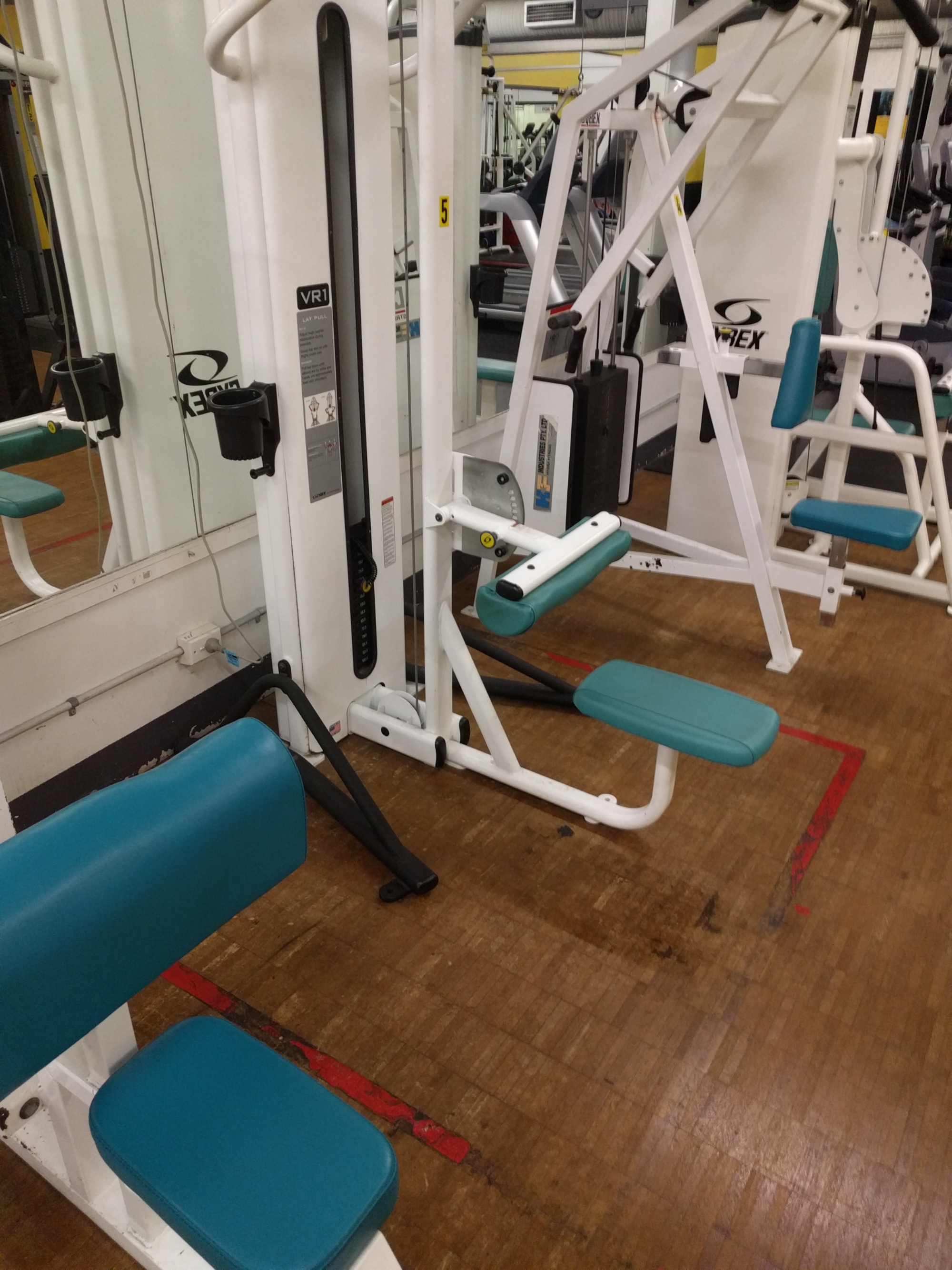
[Scene] in the gym. 

I’d just finished using the lat pull machine and got up to to use the bicep curl machine to my left. The woman on the cable rowing machine on my right said:

“I was going to use that machine next”

“?” I just looked at her in confusion.

“I won’t be long” she continued. Meaning that it wouldn’t be long before she finished with the rowing and started doing her planned bicep curls.

“Are you running late for a meeting?” Me, trying to be helpful.

“No, I just don’t like waiting”

At which point, without a word, I inserted my headphones, cranked the volume, and started on my bicep curls. Aka option (1).

mxx1's avatar

Dog’s Breakfast

I really do believe that some people are genuinely all worked up about the inhumane injustices wreaked upon some animals – chickens and dogs mainly, but also to the odd pig and cat, and even the occasional more exotic critter.

But whence comes such emotions? (assumption alert) Asymmetrical Anthropomorphism; that’s the problem here.

That is, people with psychological issues that are sublimating away their imbalances by assigning human characteristics to (thereby) unfairly treated animals; hence creating a facile diversion away from dealing with their own shit.

The only evidence that I have for this assertion is (a) the mad look in their eyes, and (b) their complete inability to rationally discuss such matters – see explanation below.

You can always tell when someone is mad. First, you pick a subject that they are passionate about and then start a discussion whereby the goal is to list the assumptions that they have made to arrive at their position, assuming that they did so rationally (which they did not).

Half-way through the process they usually lose their shit and storm out of the room. Or scream at you and hit you. Quod erat demonstrandum.

Now you can’t remove with logic what was not put there with logic in the first place. So if you find yourself dealing with someone that is suffering from Asymmetrical Anthropomorphism (or similar) there are only two options:

(1) You completely ignore them, or

(2) If that is not possible, then you have to consider violence. It’s a case of hurt or be hurt.

fruit

mxx1's avatar

Karma Sutra

Now as a woman is like this or like that,
according as she acts and according as she behaves, so will she be;
a woman of good acts will become good, a woman of bad acts, bad;
she becomes pure by pure deeds, bad by bad deeds;

And here they say that a person consists of desires,
and as is her desire, so is her will;
and as is her will, so is her deed;
and whatever deed she does, that she will reap.

Whatever bad deeds she reaps, she will not do
and as she does not, by her will;
and her desire will follow;
and whatever she desires, that she will reap.

– Brihadaranyaka Upanishad, with mods by me.

img_20160117_014851_20160117015508830_20160117015951257

mxx1's avatar

Odds Off

​Overheard on the Tannoy…

‘He took a big risk and it came off. The American people like that.’ 

‘What? Taking a risk?’ 

‘No, the risk coming off. That’s seen as leadership.’

That’s so odd that it’s probably true. A whole nation that has no simpatico with regression. 

My guess is that we all have to worry when their luck finally runs out, as it just has.

mxx1's avatar

Ronald

My mum asked me what I think about Ronald Trump.

She said Donald and I said Ronald. I think it suits him better. Ronald it is.

She can’t figure Ronald out because she’s convinced there must be an agenda.

I countered that it doesn’t matter; Ronald’s agenda, as it haphazardly emerges, will reflect the will of the majority of the American people, even the ones that hate him.

Ita ut sit.

mxx1's avatar

Prosody

The French must hate Google.

Phil has a little of the French in him and just last night he started to muse upon the subject of gay speech.

You know, the queenie voice that some gay people affect. And then, years later, they don’t. 

Brian was the example and Tony was the counter example. Time was on the x axis and the night was young.

Rather than go the French route of debating the subject for hours from a position of complete ignorance, I cut Phil off and just Googled it.

The answer; prosody and perceptions of integration in a causal model of queenly persistence. 

That’s my three-minute condensed milk summary and it just about explains it.

There’s not a single topic of beer conversation, and I mean not one, that hasn’t been the subject of some dodgy PhD.

The French though, they don’t want answers.

They want to wallow in the process of pondering all the options for all the solutions that could ever be imagined. Out loud.

If only they could constrain their addiction to problems that don’t have actual known answers, they’d be world beaters.

In the meantime, thank you Google.

mxx1's avatar

Forecax

Predictions of the future have been on my mind of late.

For all of us, a good fraction of our efforts are aimed at framing the future in our own favour.

This requires some insight into the probabilities of this and that occurring.

And we can do this because of two rules:

1. Many things happen tomorrow because they happened yesterday. They always do.

2. For those things that don’t conform to this rule, we have been collectively placing constraints around them for centuries, such that they do.

I still believe that we all conform to the mean when it comes to our futures, as expressed in the present, when it arrives. The mean of the futures of people, that is.

That said, there is a distribution around the mean which is impacted by the distribution in a non-linear fashion. 

Ours goes to eleven … and your’s just might go to twelve if you try hard enough.

Ennui. There’s a word I haven’t used for a while.

The French own it but misuse it. Well, that’s harsh. They know what it feels like but have the least chance of all God’s children of explaining it’s source.

I believe that ennui derives from rule 2 above.

So if you are lucky enough to have arrived at ennui then you know what to do; stop taking advantage of those constraints that guarantee tomorrow but that also limit your downside risks.

That’s easier said that done because, like sugar, it’s a hidden addiction. Step one is awareness. After that, you’re on your own.

But here’s a tip; try to give up forecasting, planning and even contingency analysis. Anything, everything, all of it. 

You’ll be surprised how often you do it, once you force yourself to be aware of when you do.

mxx1's avatar

Diminutive Musings

​Siddhartha is claimed to have said; “Words do not express thoughts very well; everything immediately becomes a little different, a little distorted, a little foolish.”

Well, every rule is disproven by the exception I guess, Sid.

In the same breath he went on to say: “And yet it also pleases me and seems right that what is of value and wisdom to one man seems nonsense to another.”

A displeasing nonsequiter, for mine.

Sid was clearly a smart-arse. And you can’t be a smart-arse and a prophet at the same time.

I said.

mxx1's avatar

Desire

Query: is it completely natural to desire what one has not?

Deconstructing the proposition…

First, one has to notice the object of attainability.

Then, one has to admire it.

After which, things get curly.

Some will desire to have it and some will not.

Those that don’t may simply feel unworthy.

Or they might assume that their attempts at ownership will be unsuccessful.

They may feel that they are alright just as they are.

They may even forecast the consequences of ownership and assess the benefits as undesirable, all things duly considered.

mxx1's avatar

Eeeyu

The European Union’s fundamental values are respect for human dignity and human rights, freedom, democracy, equality and the rule of law.

That all sounds good in a vaguely American way, but it looks awfully guide-linish and aspirational. Not much for the common person to align to there.

Ironically, it’s the mismatch in social and cultural values between the member states that is the root cause of their issues. Not surprisingly, these aren’t really referenced at all in the EU’s fundamental values statement.

For example, their espoused freedoms resulted in the removal of internal borders. This is great for travel but has created issues in the labour markets that has lead to increased racism. The problem here is that the folks that weren’t in a position to take advantage of the freedoms were the ones that suffered as a result of them. I’d call that an unnecessary polarising effect.

A free market is a wonderful thing unless that leads to unwanted erosion of cultural identity, regional losers in the economic battle zone and a general reduction of society to consumerism. If you’d have asked many people whether they wanted to become consumer slaves to the detriment of other values, family for example, they’d have said no.

The EU aims for sustainable development based on balanced economic growth. Not even close; only the northern countries have cultural values to match this aspiration.

It would have been sensible to slowly develop a free market but with a clutch in place to prevent excess trade or capital imbalances between the regions. To put it bluntly, the profits of a trading excess to a region should have been required to be invested in that region until things were evened up.

The EU would have been well-placed to find and articulate a set of genuinely shared cultural values and then have used these as a wedge towards the slow organic development of a proper union.

Right now the EU reminds me of an old Ford Escort that I once owned, an ill-conceived product of English and German engineering, financed by the Americans with the French sales & marketing team looking on in despair. It was sold all over Europe but loved by no one.

My particular Escort ran, but just. Missing one cylinder (the UK) and full of rust, my feet got wet every time it rained, and I was always surprised that it kept running. Until it didn’t; one night on a German Autobahn it started overheating and it was with great relief that we (me and the car) managed to limp home to Eindhoven.

But it never started again and I had to pay for it to be removed and scrapped. I am pretty sure that no one wanted any of the parts.

download

mxx1's avatar

Random Political Discourse

Streek says:

“Life under social entropy elevates being optimistic to the status of a public virtue and civic responsibility. In fact, one can say that even more than capitalism in its heyday, the entropic society of disintegrated, de-structured and under-governed post-capitalism depends on its ability to hitch itself onto the natural desire of people not to feel desperate, while defining pessimism as a socially harmful personal deficiency.”

I vaguely agree but would position it slightly differently.

The madness of desirable happiness is the preferred tool of marketing that drives consumption which is fuelled by debt, which in turn relies on predictability in economic growth that is underpinned by political stability and ever-increasing productivity which stands upon the shoulders of technology and, most importantly, the unsustainable consumption of resources.

The more parts in any construction, the more risks of systemic failure. And our daily food and water, amongst much other fluff, relies on one awfully complex machine.

Just a suggestion here; the problem that we are facing isn’t whether our economic and political systems are up to the task of maintaining the status quo. No, the issue is whether they will be able to adapt to the changes ahead without either substantial bloodshed and/or a reversion to genuine and widespread unhappiness.

To some degree, politics matter. I suspect that we’re best placed to get the Trumps out of our system now when we can afford to. In a decade or so, hopefully we’ll be properly educated as to the uselessness of false prophets and turn to leaders of genuine merit.

Frankly, I don’t care or even pretend to be able to predict whether that post-consumption future is driven by class, race, national, corporate, regional or transnational interests.

The future is as predictable as the past is explicable. That is, not very, unless one is deluded or inherently conservative.

And it’s the conservatives that we need to watch out for. They want to constrain the future with visions of the past. I don’t think that we can afford the the luxury of such unnecessary constraints.

mxx1's avatar

Brown or Wet

It’s a trend.

In the Guardian there’s dozens of articles written anonymously by UK scientists, and now their spouses as well, whining about all aspects of their lives.

Once a revered profession, it is now of diminishing social and commercial importance and constrained by guild-like structures that enshrine poor social skills.

It is also inhabited by idio savants that cannot reason themselves out of their own unhappiness, or a wet paper bag.

In that last statement there lurks a root cause.

mxx1's avatar

Causation v. Correlation

In my experience, unlucky people have a habit of kicking the can down the road and a general ignorance of all things statistics.

Which makes one wonder … is the corollary true? Do lucky people deal with important things immediately and appreciate that regression to the mean is the first law of human dynamics?

I guess so. They just happen to have a different mean to the unlucky ones.

mxx1's avatar

Framing

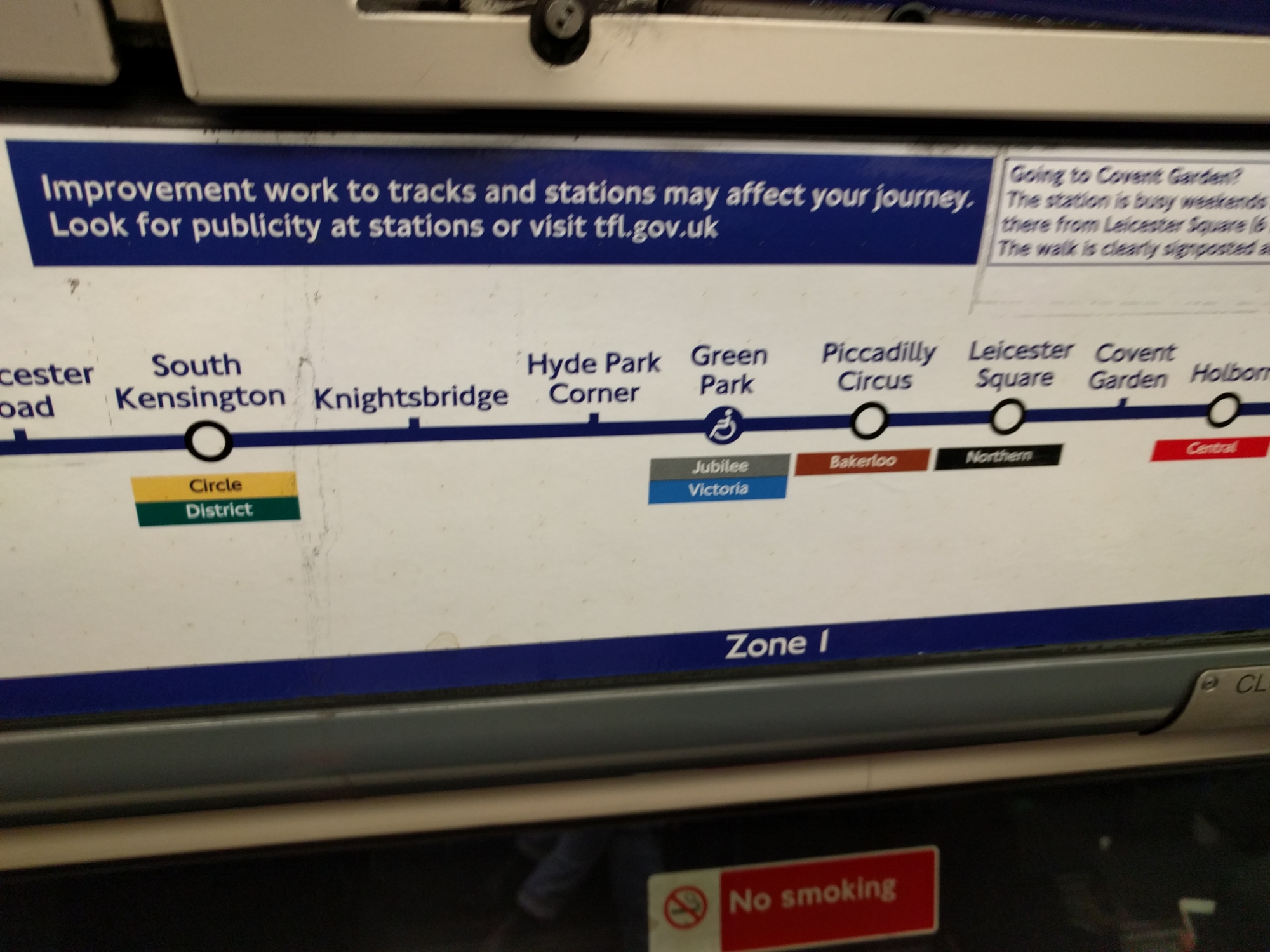
Here’s a classic example of ‘framing’ – the tube operators in London label ‘maintenance’ as ‘improvement work’. 

Alternatively, on the Tannoy they say ‘planned engineering’ just to emphasise that the thing isn’t randomly breaking down; which it is.

They aren’t fooling anyone. Even the most casual of observers will note that it’s a toy rail system that is about 50 years past its use-by date.

Any imagined improvement would require a complete replacement. Even the maintenance seems a tad optimistic. The system barely works, and then only sometimes.

Right now the staff seem intent on ensuring it doesn’t work at all. Rolling strikes protesting against tourists, me-thinks.

mxx1's avatar

Craft Rotary Blur

Why this morning, of all mornings?

I have what could only be labelled as a craft beer hangover. The poor bloody English; they think ale is normal when in fact it’s completely avoidable.

Back to the narrative; I was just woken by an adherent of the Japanese high rpm rotary engine fucking movement. In the room next door, or upstairs; I couldn’t tell.

Starting at 4,000 RPM, he finished about ten minutes later at 10,000 RPM, complete with a high pitched crow call (faaaaaaarrrrk).

Ok, so I’m awake. No way to reverse that unavoidable fact. A shower, that’ll fix it.

Problem number two. I can’t find the reading glasses and things are blurrier than usual, due to the craft fucking ale.

But I can discern that the English still can’t do bathrooms. It’s a cargo cult; they know what they should look like, probably from magazines, but they have no idea how they should function.

How does one explain constant water temperature to a moron? Or that the toilet buttons shouldn’t need an instruction manual. That drains in shower baths should be able to cope with a standard shower pressure and not allow the bath to fill up. Or that clingy shower curtains aren’t appreciated by anyone.

Back to the primary problem. This one is universal. The smallest writing on the little bottles is of course the description of the contents. Who wears their reading glasses in the shower? Yeah, right.

Have you ever heard of shampooing conditioner? Me neither.

Two Panadol and back to bed. I’ll pretend it didn’t happen and that it doesn’t exist.

mxx1's avatar

Centre Unhinged

For some odd reason I find this fascinating.

Centrelink, Australia’s social welfare cash agency, has new software that is sending out debt notices based on prior over-payments.

The maths in the software is incorrect and does not conform to Centrelink’s own rules.

It doesn’t allow for periods of employment and non-employment. It just uses annual averages, and thus incorrectly sends out large debt notices to people that are often penniless, and sometimes ill-equipped to handle the complexity of the issues.

Could such a basic error be caused by utter imbecility, or was it done on purpose? Who knows. This government appears devoid of all sense of humanity and this is seeping down into the agencies.

But I do know this. The unfairly treated recipients of these debt notices aren’t going to be treated well.

I’d like to see one of them declare bankruptcy, and then sue the agency for damages after showing that the debt notice was usurious and incorrect.

Which makes me wonder why they don’t treat unemployment benefits as they do HECS.

One could just rack up a debt and then incur an extra tax increment when employed, one that works to repay the debt.

Oh hang on, we do that already, in reverse. We pay tax and if we’re ever unemployed we benefit from the national insurance scheme. Well we don’t actually; many people simply can’t stomach Centrelink.

The benefit of the HECS debt approach is that it would turn recipients into customers and thus curb Centrelink’s mad and bad ways.

They could even build this debt into an estate tax; the government could recoup all unpaid benefits from the estate as a primary charge in all circumstances.

None of this would address the issue of multi-generational unemployment. But it wouldn’t make it worse either.

Usefully, the gig economy will rise to prevent people being unemployed. Diving an Uber, delivering for Deliveroo, freelancing on line, and other cash earning options; these will allow people not to panic when they lose that job.

Maybe the concept of unemployment needs to be replaced with the concept of a minimum wage. Which Finland is just trialling.

My idea. If one works a minimum number of documented hours then your earnings are topped up if they fall below some threshold, with no debt.

If you work less than the minimum number of hours, then you get unemployment benefits and it’s debt.

Companies of course would rush to underpay people, so I’d make corporate tax rates linked to pay rates in companies, or earnings rates in gig companies.They’d figure it out.

It all sounds very tiring. I’ll leave it to people that care more than me.

mxx1's avatar

The Undoing of Undoing

I’ve just learned that I’m different to most people in a way that surprises me. 

Apparently humans, as a means of coping, have a habit of ‘undoing’ bad things, using the imagination.

For example, if a relative dies in a car accident, someone might wish ‘If only so-and-so hadn’t taken the new route to work that day.’

In fact, this habit of undoing has rules. 

The undoing must be something that could have ‘reasonably’ happened.

In the car accident example above, a less reasonable yearning would have been ‘if only cars had never been invented’ or ‘if only aliens had swooped down and kidnapped him the day before’.

This habit of undoing, I recognise it from people that I know, movies that I have watched and books that I have read. 

But until this day, I’ve never noticed that I do not do it. 

My brain just says ‘you may as well fantasize that the problem never existed, for all the good it will do’.

In fact I judge it to be feeble-minded to fantasize away the impacts of reality in this way. 

I’m guessing that there is also a price to pay for this facile luxury; the more one practices undoing, the easier it is for one to be deceived by ‘framing’.

Framing is the practise of fooling people with tricky descriptions that dress up, say, a potential loss as riskless gain.

This is from the school of psychology that says that people don’t choose between things. What they do is choose between the descriptions of things.

Undoing and framing – they both rely on temporal misdescriptions. As does Donald Trump and any Hollywood movie.

In the case of undoing, we have a misdescription of what might reasonably have been different in the past. Framing is the misdescription of what might reasonably be otherwise in the future.

So there are two aspects to this phenomenon. The scope of the misdescriptions and the degree and sign of non-temporality.

We actually live in the present and things are what they are. But people, to a greater or lesser degree, live in the past and the future, and this gives them the luxury of misdescribing things. 

Because, although things are what they are, that is only true of the now. In the past and in the future, things can be anything because they don’t really exist. 

It’s a fine line that people draw here. If their imagination is too outlandish, too unreasonable, then they cannot use or share their interpretations of the past, or meaningfully constrain the future, or prepare for it.

As in all things human, this habit of using reasonable temporal misdescriptions must be the most efficient means of using our limited processing power for the purposes of surviving and procreating. That’s a given. 

I suspect that we live in fractal-like social environment. It looks at times free-willish, chaotic and random, but if you pull back and view it from the right distance then it’s got a certain familiar look and feel to it, no matter the era.

And no wonder, if we distort our current existence with the same limited set of reasonable temporal misdescriptions. That would bring us back around to where we started, time and time again, with no competitive disadvantage.

Myself, I think it’s more lucrative to imagine away at the future and leave the past well enough alone. But I guess I’m mostly alone in this view. 

In fact, more and more, I’m leaving the future alone as well these days.

It’s not just about living in the now. Another important aspect of ‘personal peace’ is to avoid the process of creating temporal misdescriptions, for whatever reason.

To do so requires that you face things as they are, thus removing subconscious dissonance, leaving the soul to settle amicably with reality, no matter what it brings.

The best course of action, the most likely truth, is that things are what they are. Now, in the past, and in the future.

If you accept this, then the power of reasonable temporal misdescriptions is removed. Then you will find that you stop the process of imagining them, and find yourself here in the now.

As a side effect, you will also find movies almost unbearable to watch. They are usually examples of vaguely unreasonable temporal misdescriptions.

Before doing all this though, you might be well warned that you will be at a competitive disadvantage in the competition for resources. You simply won’t be arsed. 

So make sure that you are well stocked up beforehand, or that you can live very leanly.

Postscript – the eastern cults that practice ‘removal’ from life as a path to enlightenment; it’s just occurred to me that they are cargo cults. They practice lean living in the now without reasonable temporal misdescriptions, but ironically without the enlightenment as to why they are doing so. It’s all backwards!
mxx1's avatar

Plenty of Fish

One of the most powerfully sad emotions that a human might feel is the loss of a partner through a breakup.

There’s two aspects to this; the loss itself and the regret that things could have been different if one had just behaved a little differently.

It is wired into our souls to want a partner. For having and raising kids, and for survival.

By why all the regret for losing the one that we had? Especially when the evidence suggests that there may be plenty, ca. billions, of options out there.

Well, we all believe that we are in control of these things. That our own behaviour determines the success or failure of a relationship. We feel regret at our own failings, or what could have been ‘if only’.

And then there’s the myth that the best part of a relationship is the first part. Deep down, very few really believe this. Otherwise they’d be jumping for joy at a break up, ready to go again.

Many of us recognise that humans are risk averse. What this means is that there has developed, in evolutionary terms, a greater desire to avoid loss than to attain gains.

In fact, humans are so wired against loss that it’s bloody amazing that relationships break up at all.

Oddly, this can be explained away by maths. As a second order effect, humans do actually have some obscure awareness of odds and probabilities.

In the case of a relationship, if it’s crap for at least one party, eventually this overrides the fear of loss. But this usually happens long past the point where the break could have been made rationally, to the satisfaction of a third party.

And, even so, the decision-making party is punished with emotions of guilt and loss.

So you see, maybe the maths aren’t so fucked up as they seem. The less than certain benefits of leaving the relationship are just offset by the calculated net present value of the emotional costs of leaving.

Rather than suggesting that humans are irrational because of all these emotions, one might be better placed to consider that humans are actually quite good weighing up the risks and benefits to their emotional futures.

Being risk averse is simply a consequence of our ability to forecast certain negative emotions far more accurately than uncertain future positive emotions.

And I say uncertain future benefits because we can imagine hundreds of futures, but many of these are worse off than the present. There’s simply more ways to imagine a messed up future than there is a Hollywood ending.

Indeed, we are better at imagining futures that are closer to our current situation. There’s a greater probability that these imaginings are correct if less has changed, or so we believe. And if we are currently unhappy in a relationship then the imagination is skewed towards futures where, even though things are changed, we remain unhappy.

One might wonder why we developed so. I’d say that in prehistoric times that the balance in the forecasted values of emotional losses and gains accurately reflected the best outcomes in terms of the survival and growth of the individual and the species.

It must be so; evolution is a brute force numerical algorithm that searches for and finds the best solution, every time. When I say time, I mean millennia not the years of your life. It’s not about you; never was and never will be.

Today, however, we have got ahead of evolution. We have engineered so much risk out of our daily lives that our assessment of the emotional and physical costs of risks and gains is all askew.

So when we assess the judgement and decision making of ourselves, and that of others, we appear irrational. However all we are is retarded! Recalcitrant, if you want. You get the idea.
My guess is that this will correct itself in time. Either we will over time evolve to assess these risks and gains differently, or we will miscalculate ourselves back to prehistoric times.

In the meantime, if you want to escape the sometimes misery of being human, all you need to do is to convince yourself, all mantra like, that your future is not constrained by your past.

In Venn diagram terms, your future is a circle, happily with no overlap with that of your unhappy past or present.

This takes advantage of another quirk of human nature; if something is said often enough, or by many people, or both, then belief may follow. 

Belief is a mechanism that short circuits other mechanisms of judgement and decision making. I’ll write this one up another time.

mxx1's avatar

Brisbanites

​Never in my life have I encountered a group of people that get as angry as the Brisbanites do when another breaks the rules.

There seems to be a general acceptance that anger in such circumstances is A. justified, and B. free from the risk of personal harm resulting from retaliation. 

As a result, it’s like being in primary school with a bunch of library monitors, all wearing their badges proudly and ready to dob you in for the most minor of indiscretions.

Wherefore comes such anger? After admittedly very little thought, I have concluded that the suburbanites of Brisbane are the most locked-in that I have encountered. 

They have everything one could hope for, except any sense of freedom or freewill. They have unwittingly sold their souls to the consumption devil and they are subconsciously seething at the unfairness of the honey trap.

Hence they lash out at anyone that seems to be skipping along, ignoring the lobster traps.

The absence of any fear of retaliation upon their expression of disgust can be explained by their collective physical and mental uselessness.

They couldn’t fight their collective way out of a brown paper bag and they don’t really believe that there are people that can. 

In summary, they are like the flightless birds of New Zealand; dumb, fat and free from predators. That is until the Maoris turned up.

mxx1's avatar

Brief Encounter

Walking my bike through one of the pedestrian malls in Brisbane, I found myself in a cross current to the majority of the swill.

Because I was targeting a specific cafe, my aim was true. There’s was not.

A meandering and oblivious family, one mother and three kids, seemed intent on blocking my path.

They unwittingly zigged when I zagged, and zagged when I zigged.

As a result my front wheel passed close-ish to one of the kids, maybe a metre at the closest.

The mum belatedly noticed my presence and the metre; a sudden look of rage passed over her face.

She controlled it and we all moved on.

What wherewith do you say? A brief reminder that everyone is at the centre of their own universe and that the whole thing is a mirage.

mxx1's avatar

Ocean Shores

What one can teach one’s kids, if one has the courage:

Learning how to make big decisions is better than being a victim of the avoidance of them.

That all bad feelings eventually pass, and are replaced with better ones.

That being able to sustain mental stress is a skill in life, but not one to be used just to avoid making decisions.

mxx1's avatar

Fractal

The gap between wisdom and fear can be tiny, and due entirely to discipline and rigor in early learning, which itself is a binary thing that can often hang in the balance, chaotically impacted by small events of unnecessary importance. 

mxx1's avatar

Cats Cradle

I’m not very good at predicting the future.

I’d say my mean is somewhere near the mean of likely-random guesses.

Which suggests that any explanation that I have for past events is delusional. This is just the process of forcing a hypothesis onto cherry-picked memory points, and then avidly avoiding all testing of the model.

So all that I really know is that I don’t know anything when it comes to predicting the future or explaining the past.

Which is in itself pretty useful because it gives me a leg up on the competition.

However, when it comes to discussing the outcomes of schooling choices for your daughter with a co-parent who confidently explains the past and predicts the future, things get more complicated.

How do I tell her that she is far more likely to be wrong than right, but her guess is as good as anyone’s? That’d confuse her, and she already thinks I’m mad or bad, or both.

Me, in the absence of reliable foresight, I pump for convenience over conniptions. 

mxx1's avatar

The Bernadi Act

​I suspect that we are going to have to ban politicians from tweeting, facebooking or any equivalents, with immediate expulsion from parliament as the price of a breach.

I would say that this is the flip side of their so-called parliamentary privilege; social media non-privilege.

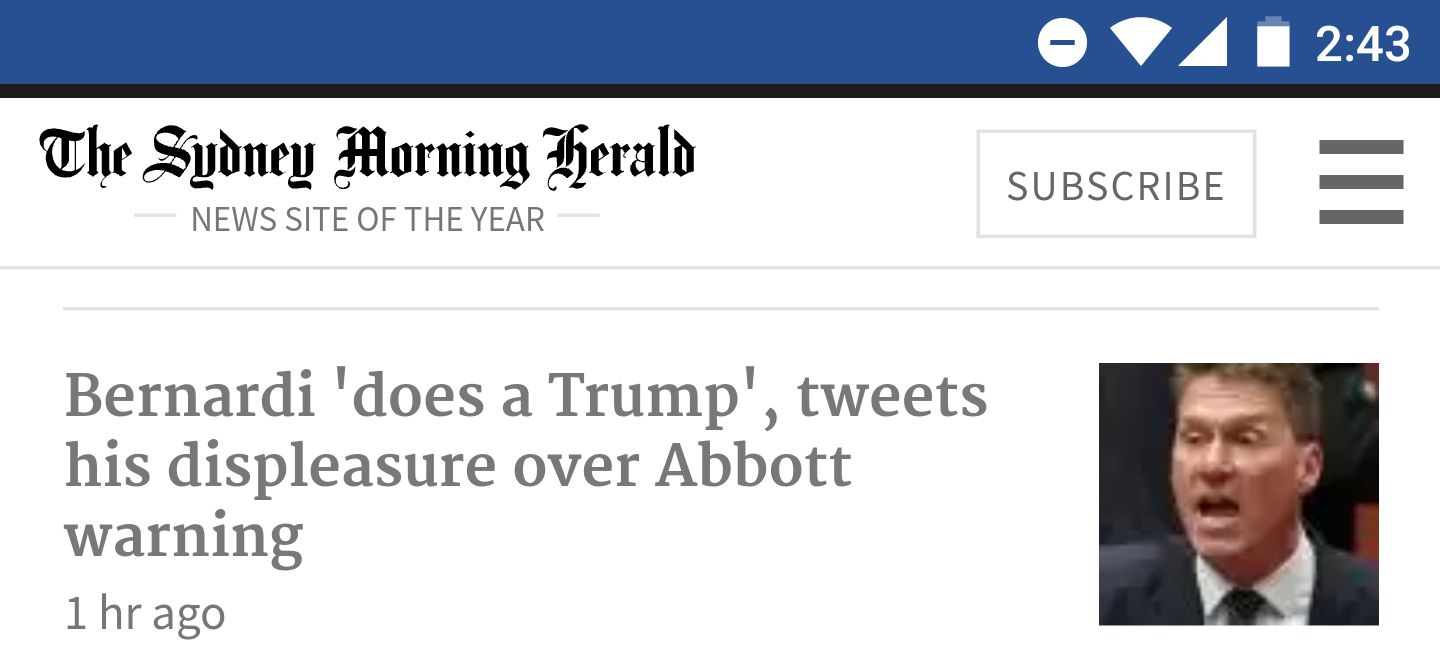
After all, some footballers are now banned from such actions by contractual agreement. This because the NRL has realised that footballers, like politicians, are basically morons intent on bringing the game and themselves into disrepute.

Oddly enough, such a ban might actually improve the stock of politicians. The likes of Trump would refuse to enter politics due to a prior addiction to social media.

mxx1's avatar

Bluetooth won’t connect

Last night, automotivating all of 5 minutes late to pick up my daughter, I found myself speeding through the back streets.

I noticed, then calculated the risks and benefits, and slowed down. 

The cost of being 5 minutes late was far outweighed by the potential cost of having an accident, the chances of which increase substantially with speed, especially in small urban streets. 

On the bike in Sydney, every morning I observe, and often dodge, mothers in SUVs, running late to drop their kids off, and seemingly incapable of doing the risk calculations. 

It’s not that they can’t do the calculations. Rather, they don’t do the calculations. 

Their ability to engage the rational part of their minds is essentially stunted by the fight-or-flight mode that they get into. 

The problem is not one of their tendency to rationally miscalculate the odds. 

No, it’s an emotional miscalculation of the importance of the task at hand. 

Or, better still, an emotional miscalculation of the consequences of failure. 

It must be a hangover from prehistoric days when all we did was survive, so the emotional calculations probably weren’t far wrong. Every task was very important. 

Stress plays a strong part in people’s inability to engage the higher and more rational parts of the brain that enable the emotional factors to be assessed more rationally. 

The more stressed, the less able. It’s a non-linear affect that can get out of control. Stress leads to more stress, which further disables the rational circuit breakers.

The only solution is to tackle the stress part, which isn’t easy because it mostly requires that one’s whole lifestyle needs reassessing.

For example, the SUV tank commanders could let their kids walk to the local public school, take a hit on the status front, find some genuine friends instead of school mother acquaintances, take a job for the love of it, ditch their finance sector husbands, and move to a lower cost but more pleasant area which is more fitting to their reduced incomes.

That looks harder than giving up sugar actually. But in life, often the sugar gives up on you first.

mxx1's avatar

Thermodynamics of Human Nature

Little tasks, we are often very inefficient at performing them. 

Let’s say I want to fish out my extra phone battery from my very crowded bag.

I know it’s somewhere near the bottom, and the bag is stuffed full. 

The smart way would be to pull everything out and retrieve the battery after I’ve sighted it.

But yet I don’t. I put my hand in, dig around and hope for the best. 

One times in ten, I get lucky and out it comes on the first fish.

But over ten attempts it will be, on average, much quicker to empty the bag, each and every time. 

In our Newtonian world we always regress to the mean. No matter what the task.

But our Darwinian minds are wired towards short cuts.

One explanation is that we are lazy. This is possibly true; all it means however is that we conserve energy by default.

A better explanation is that it just doesn’t matter because, since we are all the same and we don’t suffer a competitive disadvantage amongst each other by being so inefficient. 

That is, we do not adopt the products of learning unless it is disadvantageous not to do so.

I believe that there are two primary forces that oppose each other; conservation of energy and competitive advantage in our biosphere.

You could label these as the laws of thermodynamics of human nature;

1. Humans will always tend towards conserving energy. 

2. Humans will only expend more energy on a task than is usual if they believe that that they are at a competitive disadvantage by not doing so.

3. Dodging a competitive disadvantage must offer an energy bonus that is greater than the cost (as compared to the default unlearned action) for it to be generally adopted.

So, to the kinetics. 

How do we become convinced that there is a better way of doing something as compared to the default approach. How do we convince ourselves that the higher energy approach is more efficient? 

The answer of course is that someone else is displaying an advantage, and we copy them. 

Or, as a pioneer, we stumble upon the advantageous approach and take advantage of it. And others notice. 

So, you will see, we do regress to a mean. But that mean is the mean of human activity and not the mean of efficiency. 

This discourse does beg the question though; how do pioneers do what they do, seemingly at odds with these laws of human nature? 

Well, with enormous effort and training. 

A small fraction of society has become convinced that there is always a better way of doing something as compared to the default approach. 

They have noticed that other pioneers are displaying repeated advantage, and simply copy them. 

So you see, even the pioneers are acting consistently within the laws of thermodynamics of human nature.

mxx1's avatar

Fortitude

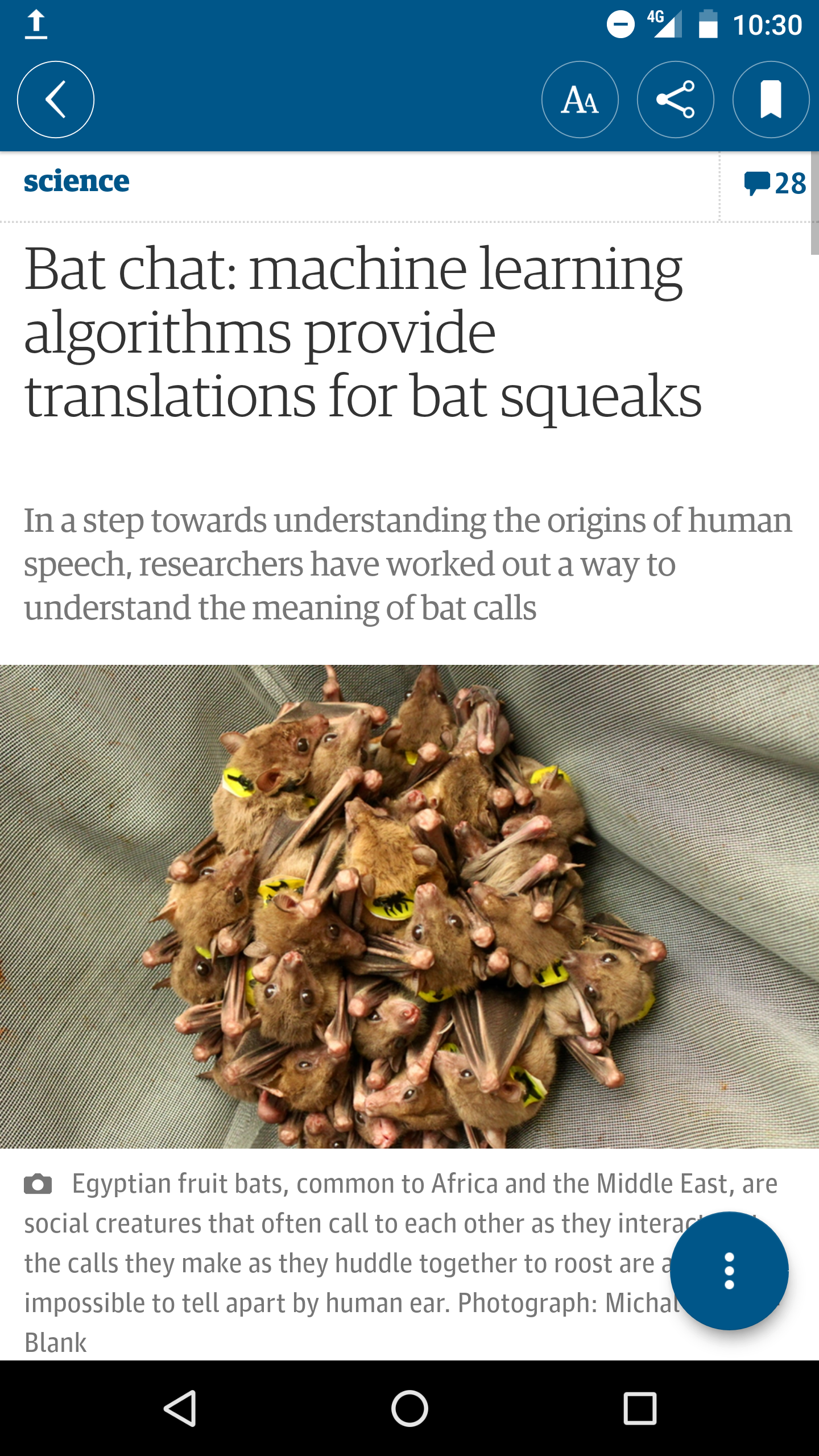
What bats and people argue about; sleep, food, perching position and unwanted mating attempts.

What bats and people want; sleep, food, perching position and successful mating attempts.

It would seem to me that the answer to life, the universe and everything all comes down to the difference between ‘unwanted’ and ‘successful’.

Let’s call it luck or good management, maybe both, each of which is maximized by fortitude. 

Fortitude, not 42. 

Mystery solved! You can thank me later. 
mxx1's avatar

Batty

Some scientists have deconvoluted bat squawks and discovered that they are arguing most of the time (I could have told them that; I have the fuckers out in the backyard).

In the bat world there are apparently just four different bones of contention: sleep, food, perching position and unwanted mating attempts.

Not too different from us then!

They argue all night sometimes, the bats do. No wonder sleep is an issue. They must be grumpy buggers, trying to sleep with all that noise at close range. 

With no natural predators (in Australia at least) the smart bat would find an unfashionable shrub to sleep in, alone. Thus removing sleep and perching position from the equation.

That would leave the smart bat far more rested for unwanted mating attempts and food poaching.

T’were I a scientist of the bat kind, I’d do an experiment in bat socio-engineering. I’d train a few super bats in the new ways, using CBT or old school Pavlovian behavioral therapy.

Surely my super bats would thrive, take over with a Darwinian flourish, and we’d all get some sleep. 

mxx1's avatar

Filip McNugget

This morning, when follopping through the aerodrome, I had this premonition that the visage was about to crackle.

It was surreal, so much so that I expected shorts in the technology; image distortions, funny little electronic noises, maybe even a view to the other side, behind the mirage.

Fat, unhappy, anxious, over-crowded and a tad confused. That’s how I would describe the scene. Consumerism about to commit egocide.

The stress of over consuming and the burden of family communing; the whites had the eyes.

Other isms are mostly about unfairness. But not this one. It’s rooted in the madness that is the fear of death.

Of course, it’s crack. There’s no correlation. But there is far less hope of enlightenment when this particular path is trod.

Same prognosis with the worst possible symptoms.

It’s time is just about up anyways; self correcting, this one is.

mxx1's avatar

Isms

I ​reckon that when it comes to ‘isms, that if you’re still trying to convince others then you haven’t fully convinced yourself.

As in, atheism, socialism, capitalism, communism, feminism, sexism, etc.

Except jism, of course.

mxx1's avatar

2017

Stresses that I am under at the moment: 

1. The ex-wife that won’t settle with me, so I can’t move on. Truthfully she scares me in an odd way. I’d very much prefer her out of my mind. 

2. My daughter’s mother is planning to steal my daughter interstate, against my daughter’s will. I will then get to see my daughter just once every now and again. I have to take it to court. 

3. Work; it’s looking sound for a while. But I have some major strategic initiatives that I have to execute and I’m not that interested any more. Actually I’m bored shitless and the stuff I have on the side, it too is boring. I’m over business and tech, it seems.

4. Brisbane. I very much want to move to Brisbane full time to be with Nic. I’m not sure how to pull it off until I can sell the business 

5. Nic. She really is wonderful, as are her kids, but I’m scared that if I can’t make it work with her, them I’m pretty fucking useless and I may as well retire to that trailer park.

6. I’m in a funk and having troubles getting out of it. Really having troubles.

What’s going well?

1. Work, as per above could be a lot worse. 

2. Friends; I’ve whittled them down to the keepers.

3. Fear and loathing; consumer madness. It’s under control and will on the way to quasi isolation from the froth and slobber around me. 

4. Communications; my desire to write and talk and be an admired smart person has dwindled to almost nothing. This is liberating. 

5. Means; I still have them and this buys liberty.

6. Lola, what a great kid. 

7. Mum and dad; still healthy. 

Oddly, I’m grumpy and occasionally angry too. I can tell from my reaction to road bicycle car madness.

My mission for 2017….

1. Sort out Joanne 

2. Sell BT Imaging 

3. Move to Brisbane 

4. Secure Lola’s custody or buy a place in Ocean Shores 

5. Figure out a new mission in life that isn’t business or technology. Lola suggests that I become a private detective. Its the best idea yet. 

Oddly, just writing this has helped. A lot.

mxx1's avatar

Kindle Limited

It turns out that Kindle Unlimited actually means limited access to about 35% of all their books, specifically the ones that hardly anyone is interested in.

They chuck in a handful of high profile books to reel the punters in and then it’s all just crap after that.

I found this out by signing up to a 30 day free subscription only to be surprised that I was slugged for 2 books that I subsequently bought (thinking they would be part of the subscription).

This might seem clever to Amazon but it is fucking stupid. I will never ever be silly enough to subscribe to anything that they ever offer me again. I don’t trust them now.

The moral to the story is to never let an MBA graduate near a spreadsheet.

untitled

mxx1's avatar

Sex, Lies & Videos

​From the daily rag…

“The company’s chairman and owner Kerry Stokes was looped into the phone hook-up from his Beaver Creek ski [really] property in Colorado, where he is spending Christmas.

Insiders say he [Tim Worner, the CEO with the bunny boiler problem] was asked to answer two key questions.

The first question, the insiders said, involved words to the effect of: “Tim, have there been any other relationships like this with anyone from the company?”

The second question was about whether he had “ever done drugs in a work context”. [The bunny boiler revealed sexual encounters fuelled by coke]

It is understood that Mr Worner’s answer to both questions was a firm “No”.”

He had a choice to die there in the meeting by telling the truth, or to lie and drag it out, praying for a miracle.

I guess the man that would pump for the former answer wouldn’t be in the situation in the first place.

mxx1's avatar

Her

Very little crushes the spirit like a handicapped child.

Dreams of success and advancement are replaced by resolve and disappointment.

Bitterness lingers and happiness is fleeting, coming in small bursts of reprieve. Just enough to keep you moving, or not.

All your relationships are tarnished. You feel judged and pitied, both. And shame.

As parents, you rally. But time reveals that this race never ends. 

The two of you, you are truly alone, and it’s hard not to blame each other.

The other child, the normal one, is greatly affected. There’s nothing you can do about that. 

Eventually he’ll leave, and you’ll do what you can to expedite that. 

Leaving you there with each other. And her.

mxx1's avatar

Colours

My dream last night;

I do believe I was living in my grandmother’s house in Summer Hill, a narrow terrace house on a narrow street. 

My room was upstairs at the front and my parents were living below. In truth, when I lived there as a kiddie, they were in Europe for a year and more.

Odd this; my drama right now is that my daughter’s mother is attempting to take my daughter inter-state at exactly the same age that my parents temporarily abandoned me.

Back to dreamtime Summer Hill – as ever, I was an emotional law unto myself, keeping to my room and my counsel. 

There were shops at the end of the street and neighbours to talk to. Even an introvert felt connected.

At some point the downpipe of the house across the road, that was very rusty, broke off and hit our house, before crashing into the street. I watched it fall.

This caused a temporary black out and a big bang. Frightened, my mother moved from the downstairs front bedroom to the second one. And sent my dad looking for the cause. 

After tip-toeing to the back of the house, so as not to disturb my mother, I told him what had happened. We went exploring across the street. 

On the street there were derelict people that we had to walk around to inspect the ruins of the downpipe. And piles of rubbish. 

Later on, possibly years, the street was clean and I was out talking to friendly and prosperous neighbours. 

Then the road surface was leveled by the council with cement. Much to look at and much to comment on, during this process. Natter, natter.

I was told that it was going to be asphalted in colours, with no footpath other than that indicated by colour. 

Gentrification. Maybe it will all end OK.

But it’s still the same front gate that I used to swing on, 45 years ago. 

mxx1's avatar

Diamond Stylus

When I met you on the street
My heart skipped a beat
Later I wondered, did yours?

You were with your husband
So non-descript
A banner for your love

I didn’t get a text
An email
Or a message

You cut me
Way back when
Feelings, no

You decided
For reasons
The fears of my reason

mxx1's avatar

The Three Zingers

I’m observing that people, in this era of excess, are driven mad by a small number of factors;

1. The gap between what they could achieve and what they do achieve. I call this the ‘equal opportunities’ myth.

2. The gap between what they can comfortably consume and what they actually consume. Let’s say it’s the ‘debt stress’ issue.

3. The failure to enjoy the simple pleasures in life and instead concentrating on the marketing-driven confections. The ‘woods and trees’ problem.

And that’s it. Three simple issues that if faced honestly can turn living hell into heaven until now.

Another way of looking at this, in the time dimension, is;

1. Sleep more.

2. Work less, and enjoy it more.

3. Minimise consumption when you’re not doing either 1. or 2.

mxx1's avatar

Wait!

Elizabeth: Wait! You have to take me to shore. According to the Code of the Order of the Brethren…

Barbossa: First, your return to shore was not part of our negotiations nor our agreement so I must do nothing. And secondly, you must be a pirate for the pirate’s code to apply and you’re not. And thirdly, the code is more what you’d call “guidelines” than actual rules. Welcome aboard the Black Pearl, Miss Turner.

mxx1's avatar

Heroes

It’s a little odd, not having any heroes. 

Not a single soul that I can observe and think ‘there but for the grace of God, go I.’

I still care what people think of me, although much less than in times past. And it’s diminishing quickly, by design.

But there is not a single person that I aspire to match, either in their deeds or thoughts, for two reasons;

Firstly, so many people that one gets to observe are driven by the perceptions of others, a cause which I am diligently acting against.

Secondly, this leaves nowt, by definition. I don’t get to see the others. My guess is that very few of them, if any, have a clue.

Heroless. A new word, blogged to myself for the pleasure of no one.

To be honest, now that I can be, there must be a hint of madness in this desire to free oneself from the social norms. Almost by definition.

The threads that keep me attached are getting fewer and finer. I can feel it.

I hope I can hold on until the end. If not, I guess I’ll just have to suck it up, whatever it is.

mxx1's avatar

Mmmmfffggh!

“Unemployed at last.” That’s how my all-time favorite book begins.

“Private at last.”

That’s this blog from now on. I’m free to write what the hell I want.

Damned be the perceptions of others, and damned be my interest in those perceptions.

Chook off, the lot of you!

mxx1's avatar

Madness

Ok, so there’s a homeless man that is clearly mad, by any definition.

Deliriously  hopping around outside of a fruit and vegetable shop, highlighting to everyone, and to no one at all, that his own display of goods on the pavement is far superior.

My view is that he is mad for two reasons.

One is that he has departed from the norms of behaviour to such a large degree. 

And, two, because he still wants to interact with people.

Those that are out of sight and don’t care about us, the ones that we hardly believe exist, they aren’t mad. 

Just enlightened.

mxx1's avatar

Redactive

When I’m in social environments, much of the time, say 99%, I find myself actively supressing the voicing of thoughts that pass through my skull.

The reasons are various; but usually it’s because I judge the audience to be either incomprehensible or disbelieving.

And yet, from time to time, even that 1% concocts to indigest. Trailer park anyone?

mxx1's avatar

Honorary Dickhead

No good deed goes unpunished. It’s one of those rules that is disproved by the exception.

Being nice to one’s family (for example) by attending a niece’s graduation at the ANU, only to find out that:

(a) by some miracle, 7 tickets to the event were obtained instead of the usual 2, so I couldn’t wait outside in the bar. And,

(b) Kevin Rudd was receiving an honorary degree and was also the guest speaker.

Kev drove me to sleep within two minutes, but not before I heard recycled rumours of impending doom. 

(Sotto Voce) Kev’s the man to fix it.

mxx1's avatar

Pinyada

So many minorities, so uncompassionately passionate about their minority reports.

“Australian monarchists have reacted angrily to news that the prime minister will speak at an event hosted by the Australian Republican Movement, going so far as to predict it will trigger a split within the Liberal party.”

Is Malcolm about to thwack the pinyada that is modern Australian politics?

I certainly hope so. For his sake and ours. 

There’s only so many dingoes one can accommodate in the sheep paddock before one must exit, locking the gate behind.

mxx1's avatar

Round Up

It has been said that “a lawn is nature under totalitarian rule.”

Not so in Australia. A lawn here is simply the lesser amongst other evils; concrete, pavers, a garden, bush, or a pool. 

Oddly, all are more work than grass. Even concrete. Oh, let me name the ways.

But let me say this; all lawns are all grass, but not all grass is all lawn.

Keep your lawn and your political metaphors, you poor fools of the northern hemisphere.

Still, with all that said and noted, in future you won’t catch me having to make such an observation.

The odd languid splash of the Round Up; that’s it, me being inexplicably generous to a landlord that I don’t even know.

mxx1's avatar

God

Now that I’ve got my hands on a clutch of free app developers, I’m thinking of an app called ‘God’.

It will have two simple elements:

1. A Twitter-like messaging system that allows all God’s followers to share their thoughts. But more importantly, enabling a hierarchy to emerge amongst God’s followers, with a few of the least thoughtful garnering the most airtime.

2. A Google-like search bar that doesn’t return any results.

mxx1's avatar

Rule of and by the by Law

Last week, for some inexplicable reason that I didn’t question, I was upgraded to the first class Emirates lounge in Dubai.

More of everything, is all you could describe it as. Except people.

I got chatting to some American dude at the pig trough.

Super wealthy, he was connecting through Dubai on his way to somewhere or other to meet his own jet.

I guided the conversation towards his stated desires regarding the accumulation of more wealth, which he assured me he wanted to do, through his hedge fundy ways.

Hedge funds, by the way, are a pot of committed funds that can be exploited in almost any way the managers see fit. Why ‘hedge’ is anyone’s guess, however I am sure that once, a long time back, that they did have something to do with hedging.

My hedge fund friend already has pretty much all he could ever want; a few houses around the planet, a yacht, a jet, four ex and current wives, a few children here and there, a few sports cars, and unlimited entertainment expenses.

What he really desires, and this is my effort at paraphrasing his contorted efforts at describing his aspirations, is freedom from the rule of law.

Simply stated, he feels that his money should somehow buy him the freedom from the constraints of law that bind all of us. He didn’t state it thus, but it is what he meant.

You can see this desire in action in many non-first world countries. China, for example, where the party elite rule by law, but they themselves clearly are not as subject to the rule of law as their minions.

So here’s another prediction; as the Gini index shoots up in the West (because a minority is getting super wealthy) I expect these wealthy minorities to turn their efforts towards freeing themselves from the rule of law.

This goal will be best attained through some sort of control of the political process. My guess is that this process has well and truly started. But it has a long way to go.

2014_Gini_Index_World_Map,_income_inequality_distribution_by_country_per_World_Bank.svg.png

mxx1's avatar

Sheit

Our gub’ment has done it again, god bless them.

By ruling out an emissions intensity trading scheme they have added uncertainty to a sector which has already been described by the Australian Energy Council as ‘almost unbankable’ and ‘visibly deteriorating’.

Whoever thought that the role of government was to create policy certainty that encourages private sector investment? Not our mob, clearly.

It’s a good thing that renewables are already cheaper than the alternatives.They should have just said that and left it at that.

But I fully expect the nutters to go the whole hog and put subsidies in place for coal generation.

I’m not joking.

The trouble is that they have mates that own coal mines but none that own factories that make solar modules or wind turbines.

mxx1's avatar

Recap

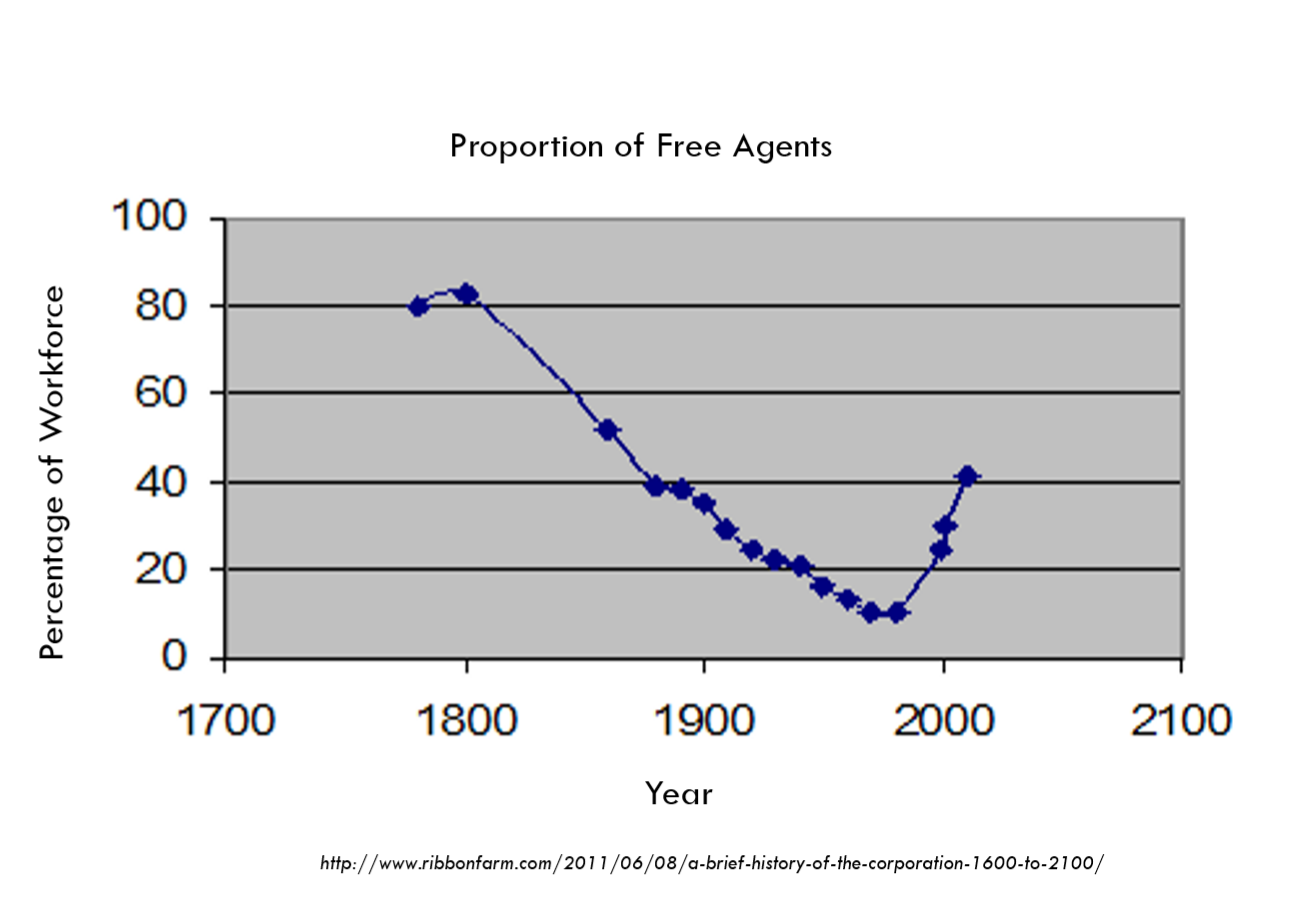
​A free agent refers to a person that works independently, rather than for a single employer.

Free agents include self-employed workers, freelancers, gig econonomy folks, independent contractors and casual workers, that together represent about 44 percent of the current U.S. labor force.

The trend towards free agency is driven by technology in two ways.

First, new technology permits companies to reduce their labour force whilst increasing productivity. This effect derives from both automation and outsourcing, which is itself enabled by technology.

Due to competitive pressures, companies are compelled to reduce costs and increase productivity in this fashion. This trend seems to be accelerating along with the rate of development of new IT solutions.

Secondly, new technology allows individuals to make a living as free agents through the ready availability of technology tools.

Free agents are the most likely to be under-employed and/or under-paid since (1) the supply of free agents is increasing, (2) the technology tools that they use are generically available and controlled by companies that exploit them to the maximum value, and (3) the rate of increase in demand for free agents is itself slowing as technology automates many tasks.

Case in point. A corporate upper middle manager that loses his job after successfully restructuring his corporate employer’s business to an outsourcing model. Then he struggles to find another similar job because the supply of his genre far outstrips demand. He turns to Uber for cashflow and because he is self employed, is not subject to minimum hourly rates; his are on par with 7-Eleven’s franchisee’s casual employees. At the same time Uber is working as hard as it can to replace all of it’s drivers with automated cars…

My view is that almost half the population in the West is feeling a little dislocated at the seemingly sudden loss of what used to feel like a sense of security with respect to the means for consumption.

And the other half ought to be worried just the same because this whole trend is putting downward pressure on consumption, leading to an auto-catalytic mess.

According to Karl Marx, modern capitalism was headed for an ultimate crisis of what he called “overproduction.”

Marx thought that the capitalist use of technology would extract surpluses from the labor of the proletariat. Because the proletariat would not be able to afford these surpluses this would lead to greater concentrations of wealth and the progressive immiseration of workers.

Clearly Marx thought that misery was a relative concept. And I think he was right in this regard.

In any case, overproduction didn’t happen last century primarily because labour, especially skilled labour, was the key input into increased productivity. Labour pay rates thus increased and relative misery was avoided.

It may happen this century though; the capitalist use of automated technology may extract surpluses from resources, leading to greater concentrations of wealth and the progressive immiseration of the free agents.

If enough of the middle classes get pushed downwards into nouveau peasantry then democracy may be the victim. 

After all, a large middle class is a necessary requirement for democracy; the presence of a small one doesn’t cut it.

mxx1's avatar

Schafted

​Ernest Gellner had a theory on the origins of early nationalism; it was a response to the identity dislocation that occured as societies modernized. 

Specifically the transition from Gesellschaft—the small village—to Gemeinschaft—the large city.

I’m wondering if the current rise of Western nationalism isn’t also a response to identity dislocation; from an employment culture to a casually employed culture, resulting from technology unemployment.

mxx1's avatar

Post Liberal Democracy

The players that led to the development of modern Western liberal democracy…

The Conservatives; large landowners, and particularly those making use of repressed labour, were almost everywhere authoritarian opponents of democracy.

The middle classes, defined in occupational and educational terms rather than by level of income, tended to support the liberal part of liberal democracy. That is, they wanted legal rules that protected their rights and particularly their property from predatory governments.

Conversely, the working classes were more interested in the democratic part of liberal democracy, meaning their right to participate in politics.

Peasants, where they perservered, were socially conservative and easily led or bribed into action against their own interests. Racism and nationalism were always good standby tactics to coopt their ill-will; still are.

In this age of full voting franchise and rampant technology, thr working classes are devolving into a new under-employed peasant class of easily led and easily bribed voters. And it’s the conservatives that are doing the leading and the bribing.

So when it comes down to it, despite appearances of fragmentation, the political landscape is shaping up to be a dog fight between the conservatives and the middle classes.

With each political or technology battle lost by the middle classes, more of them will be pushed into the bog with the nouveau peasants.

That’s the plan anyway. The conservatives want their land and their cheap labour, whether they need the latter or not. It’s how they define themselves.

If they get what they want then it’s back to the future. The last hundred odd years of liberal democracy may eventually be seen as an historical aberration enabled by an unbridled use of finite resources.

mxx1's avatar

Asocialality

Forecasting is a skill that must be well practiced. 

And I’m not taking about Nostradamus-style predictions of future events.

I’m referring to the art of understanding the likely impacts of self-serving behavior.

The more self-serving that one’s behavior is today, the less self-serving it is, in the long run.

Simply stated, people learn to dodge the users. Even if that is just an emotional dodge rather than a geolocational dodge.

There’s nothing sadder than a selfish individual that doesn’t understand their own loneliness.

And often it’s not even their own fault; selfish parents, the wrong influences, faulty wiring, solar flares – the history of little events at critical moments.

Some of them will even subconsciously divine and abuse this empathetical view. 

Your job is to cut them off. There’s never any upside in feeding an addiction, for anyone. 

Just occasionally the contrary is true.

mxx1's avatar

Fat Pizza

I’ve read quite a few media reports that are blaming ‘fake news’ for Trump’s win.

I say ‘blaming’ because, for some, Trump is worse than a bad thing, and they’re bad losers.

My view is that fake news on the internet generally just preaches to the converted and has little direct influence.

However, when broadcast media picks it up and runs with it, that’s different. Who’s at fault here I wonder?

And then you have our politicians making up fake news, almost daily. 

The Australian Minister for Immigration actually said on TV;

“The reality is Malcolm Fraser did make mistakes in bringing some people in the 1970s and we’re seeing that today.”

Malcolm was a people smuggler on the side? Who knew?

When asked to clarify these remarks (in Parliament) the Dutton replied;

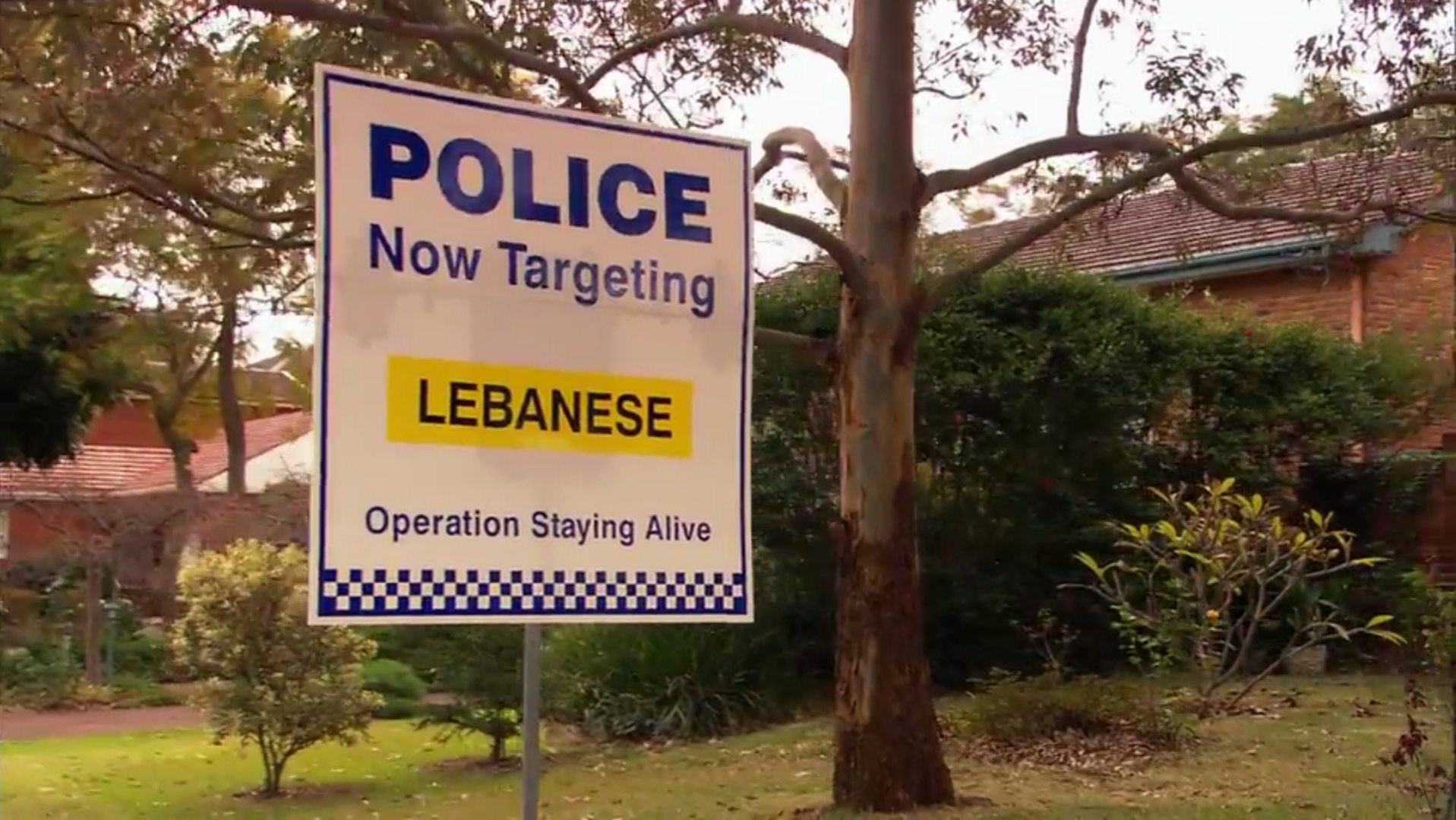
“The advice I have is that out of the last 33 people who have been charged with terrorist related offences in this country, 22 of those people are from second and third generation Lebanese Muslim background.”

Grammatically, so wonderfully  incorrect; I wonder where this bloke emigrated from?

What purpose this missive? I’d suggest it’s fake news. No policy change will follow. It’s just the government letting the rednecks know that they’ve been listened to and appeased.

Both sides of politics are awfully worried that they’ll lose votes to One Nation or similar.

So their solution is to walk on both sides of the tracks at the same time; conjuring up fake news and doing what they always do anyway, skewing wealth distribution towards their interest groups.

Which is simply a dumb notion, born out of their inherent lack of wisdom. It won’t work and it’ll be a painful process for them (and us) to learn this.

I do wonder to what degree people believe or care about any news, including fake news?

Gravity is worth considering. I tried this test with my administration staff; I asked them whether a heavier object falls faster than a lighter object.

Now, they couldn’t recall the actual answer. But they did recall, from high school, that it’s a trick question and hence got the right answer.

Which is to say, human intuition can be wrong, very wrong. Only those at the extremes edges of sanity get out of high school without accidentally learning this piece of wisdom.

I guess what I’m suggesting is that one doesn’t have to be highly educated to know that bullshit is rife. 

And in my experience the average Australian is pretty good at spotting bullshit. They might not admit it, they might play with it, have fun with it, tolerate it, and even suck it up.

But eventually they snap.

mxx1's avatar

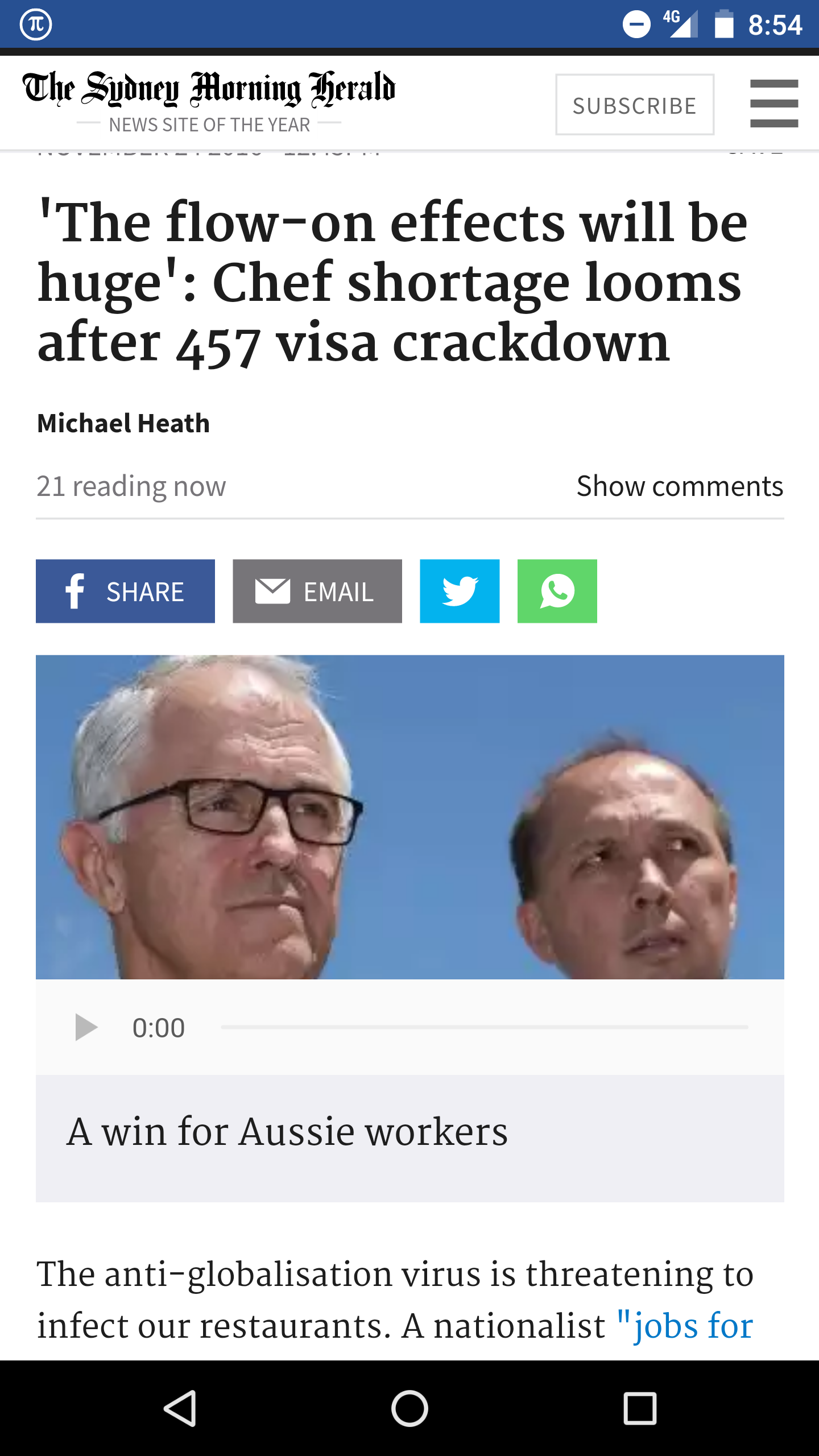
457 Dino

I blame Trump. Everyone blames Trump. Now he’s even impacting the quality of our dining experiences.

The article says ‘not enough Australians want to become chefs, hence the need to import them’.

C’mon, pay them more and let supply and demand sort things out!

There endeth today’s lesson in media hysterics.

mxx1's avatar

Imbalances

In the psych world there’s a hell of a lot of disorders. 

To me ‘disorder’ implies a departure from order. To that, I say, society has order but us humans, in our heads, we would have a serious disorder if we were to believe that a lack of disorders leads to mental order.

To highlight this point, a computer has no disorders and hence no personality. Which, as an aside, might suggest that the AI guys would be well placed to start programming in personality dimensions through behavioural traits, and then also mental disorders.

A name is just a name I guess. But I am starting to suspect that a mental disorder refers to an individual’s impact on others, society if you will, rather than on the individual itself.

The giveaway is that there’s precious few improvement classes promoting mental order. Happiness and wealth, yes, but order, no.

The spectra of the many, many dimensions of mental disorders supposedly swings from 1-11 for each of them. A score of 11 in just one of them and it’s likely that you’re barking mad.

In truth, a score of 11 means that you have a strong personality trait that makes it hard for you to function in society, whether you accept that or not.

There’s no zeros in the pack and the sane folk all have a score in each and every column.

That doesn’t sound like order to me. More of a balance, or better still, a lack of an imbalance.

In summary, your imbalances are our disorders.

So why make this point?

Well, if things aren’t going so smoothly for you, there are two courses of action: (1) modify your imbalances through the usual process of therapy and drugs, and/or (2) delete their disorders by removing yourself from their society; then you need to find a more amenable bunch of people to hang out with.

mxx1's avatar

Comedy explained

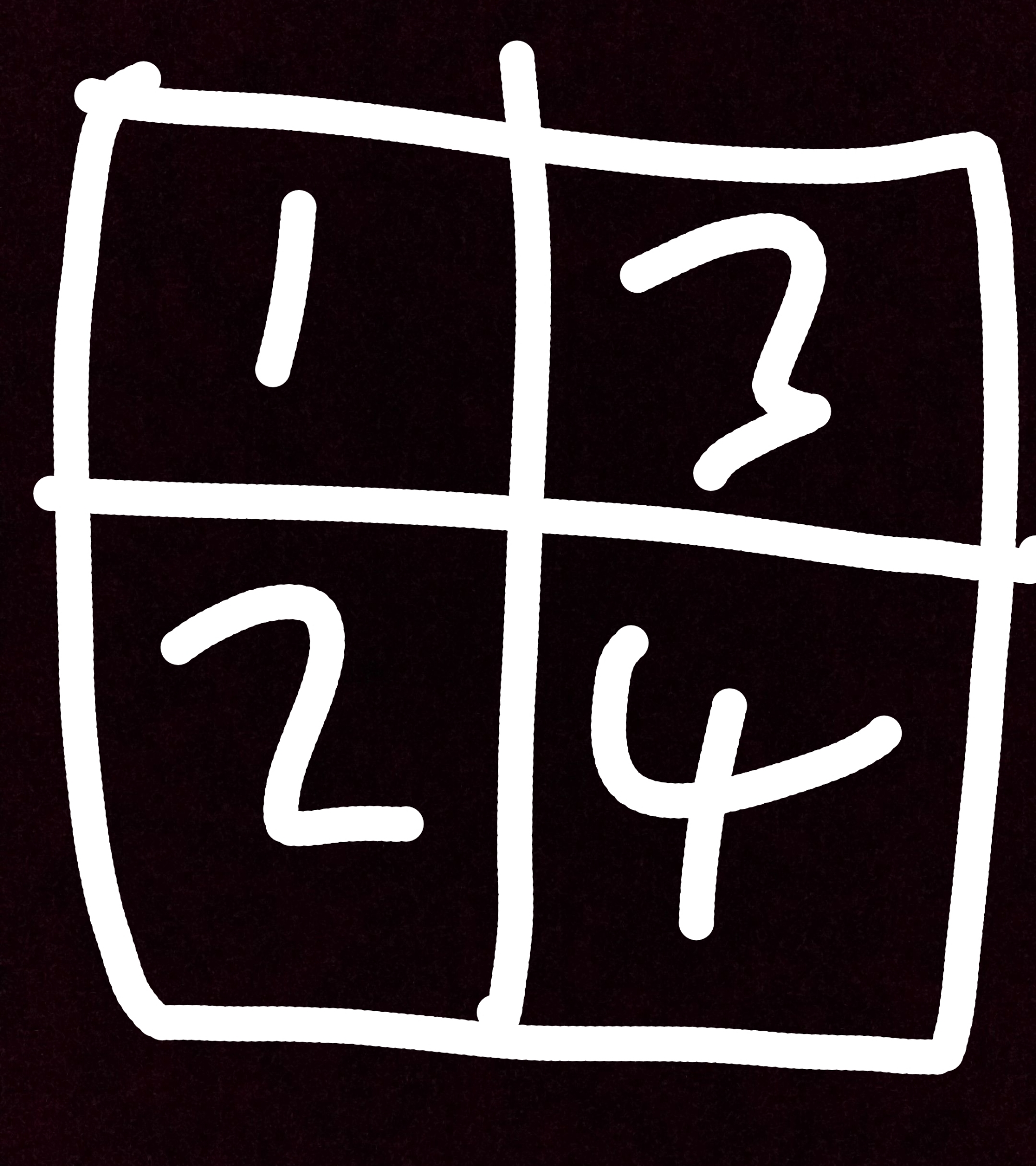
More on the Dunning-Kruger effect; with reference to figure below.

Quadrant one represents those suffering from the Dunning-Kruger effect, namely a cognitive bias in which low-ability individuals suffer from illusory superiority, mistakenly assessing their ability as much higher than it really is. Dunning and Kruger attributed this bias to a metacognitive inability of those of low ability to recognize their ineptitude and evaluate their ability accurately.

Quadrant Four represents the Dunning-Kruger corollary, namely where high-ability individuals underestimate their relative competence and erroneously assume that tasks which are easy for them are also easy for others.

Quadrant Two represents low ability individuals that know they are crap.

Quadrant Three represents high ability individuals that know they are good.

Guess which axis is where comedy lives?

mxx1's avatar

Good Morning Sunshine

What happens when a whole society suffers from the Dunning-Kruger effect? 

I’d say you’d find a few high-ability individuals that supress their relative competence so that others erroneously assume that tasks which are easy for them (the high-ability individuals) are also easy for the others.

mxx1's avatar

QR

I’m pretty sure that Brisbane’s trains are actually one big Quixotic experiment that is attempting to prove Zeno’s paradox.

It can’t be controlled from Queensland; they pretty much can’t spell ‘theorem’ up here.

No, there’s something quite alien going on. I’ll get to the bottom of it one day.

It’s a shame there’s rats on the arrows. More’s the pity that I’m one of them. Collateral damage I guess!