Today I could swear I’m living in the matrix and that the program is slightly corrupted.
It’s freaksville, every way I look. But in a subtle, can’t quite put my finger on it, kind of way.
Fukuyuma described clientalism as a situation where a political party doles out favours to their specific voting supporters, via money or jobs in the administration (by way of example), as an ‘evil’ that haunted Western electoral democracies in the early days.
However there’s no name for a system which has:
1. Compulsory voting
2. Entrenched parties through a preferential voting system
3. 99% of voters only concerned about ‘what’s in it for us’
4. Advanced technology allowing full prediction of voting intentions down to the discrete vote
Essentially every voter is part of the clientalistic system as are any number of non voting lobby groups.
A country determined to disappear up its own orifice, I call that. So, since we can’t call it Clientalism, how about Autism?
It’s no surprise that two political parties that develop policies by estimating their impact on the same voter intentions end up with tied number of seats in an election.
Since this gives the independent seats a great pork barrelling opportunity, the rest of the country will catch on quickly.
My prediction, by the next election in twelve months time, we’ll have a parliament of mostly independents.
Whoever thought local representation at the federal level was a good idea?
Doomed to lead to pork that is.
Even state level representation is a silly idea.
As is representive democracy.
Ditto this blog entry.
Forget I said anything.
Better than much I’ve seen lately…
Lola argues (with my Mum) that one must say;
“When in Roma do what the Romans do”
This in response to my mum instructing her to replace ‘OK’ with ‘d’accord’ whilst in Paris and using the more usual form of the old expression as evidence.
Lola noted the paradox and came straight back at her.
I was tempted to suggest:
“Quando a Roma fare quello che fanno i Romani”
Or something like that.
But then I thought better of it.
The debate had already been going for half an hour.
(p.s. and indeed it raged for days)
It’s been an interesting business playing with the Mona Lisa.
Despite what everyone craps on about, it’s not the inscrutable smile that makes one pay attention, is the fact that part of your brain knows something’s all askew.
After frigging around with it, fixing her up, I’ve decided it’s the composition of the background that does the trick.
Once that’s gone she looks like all the other Rembrandts.
Quel est le bruit?
I suspect people dislike change because it represents some sort of survival threat to the prehistoric parts of our brain.
On the other hand the modern section of our brain craves change to ameliorate boredom and who knows what else.
This Ying and Yang must play out differently in different people giving us the usual Bell curve in the population for preferences for or against change.
Indeed, even for one individual the attractiveness of change may wax and wane over time.
Is it worth fighting one’s natural tendencies against change in this regard?
I think a little, yes.
Primarily because the threats of change sensed by our prehistoric brain have mostly been socialised out of our existence whereas the benefits of change are now hardwired into our economies.
My head of sales in China has assessed our sales process as being too slow. He urges us to be much faster in our responses to customer requests because, and I quote, that if the sales process takes too long (say more than a month in total) there are risks that:
“1. the factory is bankrupt.
2a. the main technical buyer went to another company
2b. the main technical buyer is in jail or fired or changed position.
2c. the new guy who takes this position doesn’t like our tool.
3. the factory has the reduction of the capacity plan and decide to cut the funding.
4. The technical buyer changed his mind.”
How can this work you might ask? With complete lack of apparent logic (nothing in there about the IRR on purchase right?) in their purchasing process how in the world can they ever out-compete us smarties in the West?
It works because all their suppliers are ‘good enough’, except some of the Chinese ones who figure out how to be better when their customers spit the dummy.
The internal chaos within these Chinese manufacturers is just part of the process whereby they keep their costs down.
I sometimes get the feeling that the factories run themselves and the Chinese that wander in and out of them are just there for entertainment value.
And the Chinese would never consider making artisan jeans that cost $5000. Although if they took off they could probably copy them with a $1 cost base.
I’m not sure who’s got the problem here.
You have to admit, this is a big improvement on Leonardo’s effort. But I’ll say this for him; he did pretty well given the awful material he had to work with.

It’s official, the French and the internet are incompatible.
A key example is the Velib bicycle hire scheme in Paris.
If I had a room full of 80 year old Australians speccing a website/app/hardware system for consumer use I couldn’t have done worse.
The app is used only to find a bike and nothing else.
The website, which is in French only, has the most convoluted payment scheme known to mankind.
When you have finished with that you are emailed a number (which has various interchangeable names) and you must remember a PIN that you entered.
What you do with these is a mystery. My latest hypothesis is that you must enter them into the kiosk at the bike hire stations.
But that’s a guess I just tested.
I went to the kiosk, chose English as my language du jour and entered my numbers.
Halfway through the thing reverted to French but I managed to finish entering numbers using my lingering French knowledge and voilà; velocipede!

They can’t do bikes either, for what it counts. What a piece of crap.
But on the other hand, the left one, no helmets, a complete disregard for traffic lights, no traffic police, and bars coming out of the wazoo with more smoking areas than otherwise.
I call it evens…
I am holed up in a Parisian garret with a nasty cold. This is supposed to be a week of random tourism with my daughter and mother. They are off having fun (of a sort) and I am stuck in bed with my phone and computer.
With little else to do I have become somewhat fixated by the political meltdown in the UK following Brexit.
On June 24, the day after the referendum, I got this message from a business colleague in the London financial sector – “p.s. I hope you’re enjoying the Brexit debacle from the other side of the channel – it’s absolute carnage and disbelief over here.”
And there you go. That’s all it took for my interest to be properly piqued.
That and the fact that my German colleagues in Munich last week either (a) refused to discuss the then upcoming referendum, or (b) refused to engage in anything other than a religious-like debate on the subject, i.e. no rational counter argument to the ‘remain’ position was to be entered into.
Before I travelled to Europe I was aware of Brexit. I read the Guardian Online, hence I am exposed to a few more matters d’Angleterre than your average Sydney Morning Herald reader (that get served up an endless diet of Australian political gossip, various goings-on in the four football codes, and “6 ways to lose weight for summer”).
I had noticed, leading up to the referendum, that the arguments for ‘remain’ were getting progressively sillier and sillier, capped by my favourite – “Brexit problems for disabled passengers” wherein the author firstly noted that access for disabled people to UK airports had been made better by EU laws and therefore leaving the EU would makes things somehow worse.
In fact, the Guardian hardly ran any stories supporting ‘leave’, displaying an enormous bias by their editorial team.
The polls were predicting a win for ‘remain’ by a few points, as were the bookies, the whole of the London financial sector, and other self-interested parties lulled by the fact that voter conservatism usually wins out in complex national or international policy matters that are mystifyingly put to referenda.
Because I have been crook for a couple of days I have had ample time to bone up on the Brexit subject and now consider myself an expert.
I see two aspects to the matter; the kinetics and the thermodynamics (hijacking some very useful concepts from chemistry, of all things).
The kinetics, the “how did we get here”, are easy to explain. Politicians in the UK are pretty much like politicians in Australia; Pavlovian dogs with nothing better to eat than their own regurgitated egos.
So when you have dozens of them, each using the Brexit issue to advance its own cause, you have a dog’s breakfast of a process that could and did go where no one expected it to. I won’t name names; that has been done by others and the main culprits are well known to all.
And I say ‘culprits’ because the debate on the matter wasn’t very informative and often was deliberately misleading and self-serving. Not in anyone’s interest, that.
More interesting to me is the thermodynamics of the situation. That is, why is over half of the population of the UK so pissed off that they would vote themselves out of the EU? Or off the island, out of the house, or anything…
And then the Guardian came to the rescue. They reported some plots of various voter characteristics versus how these people voted in the referendum.
And the biggie was income – the lower the income bracket the greater the percentage of people that voted ‘leave’. It was a pretty linear correlation.
There were some other trends to note as well. Education levels mirrored income levels. Age had little correlation despite all the stories claiming otherwise.
There was also a plot showing “% residents not born in the UK”. This only highlighted that those not born in the UK had an ‘outlier’ group that were rationally in favour of ‘remain’, but did little to support the leave/racism hypothesis.
Now being trained as a physical chemist I am always very careful when interpreting data. We were taught that a correlation doesn’t necessarily imply causation, unless you are a journalist, an economist or a politician.
So I first want to emphasise that what follows is, at best, a hypothesis.
Together, automation in manufacturing and Asian manufacturing have cruelled much of the working labour market in the UK. The government (in various forms) hasn’t appropriately stepped in to create sufficient artificial jobs in the services sector through ‘nanny state’ regulations. We are much better at this in Australia by the way.
So the folks in London are doing just fine, having a glorious time trading away in the services sector, but keeping most of the proceeds for themselves.
How do they do this? Well, the wealth creation has increasingly been concentrated in certain segments of society and the mechanism of taxation that act to collect and then distribute this wealth haven’t been adapted to account for the changes in where the wealth is generated.
Call it neoliberalism if you will. I just call it greed mixed with power, and a heavy dose of stupidity. You can avoid democracy in a democracy for a while, but eventually it will come and bite you in the arse.
As it did on June 23, 2016.
My hypothesis is that Brexit was passed because the ‘remain’ crowd were so obviously on one side of the debate. The disenfranchised seem to inexplicably care more for their national football team than the EU. Even so, this was an easy target to hit, once recognised.
The ‘remain’ proponents would have been far better advised to stay very quiet and not make an issue of the whole thing. The more shrill they became, the more obvious their self-interest.
Thus, so armed, the disenfranchised have well and truly sent the message to London.
However, in terms of an approach to solving the problem, it’s akin to completely missing the nail with the hammer, losing one’s grip and beaning the foreman with the thing.
Oops, sorry mate!

What next?
My suggestion is that the situation needs a little leadership.
The UK has a chance of staying as the UK and of staying in the EU, but only if someone steps up and first addresses the wrongs of three decades of rampant neoliberalism that have left over half the population well and truly behind.
Any while they are at it, they may as well have a shot at fixing up the EU as well. I mean what sort of organisation creates a multi-national common currency and monetary policy without a corresponding common fiscal policy? If I were a member alongside this bunch of dopes, I’d apply the Groucho rule and look for the EUxit.
A drone that replaces a pram. Stick your kid in it and it just follows you (well your phone to be exact) around.
Imagine if you lived in a Parisian block of flats with no elevator. You could just open the window to allow egress of the pram-drone and then whip downstairs to join your kiddie at the pavement.
Due to circumstances way outside my control I find myself directly under the Tour Eiffeil, having just escaped its clutches.
7 million visitors a year they tell me. 20,000 per day. Queues a mile long.
The French, observing the two hour queues, rather than fixing the problem have decided to monetise it.
Essentially you can, for a 10x cost, queue-jump.
They have created derivatives on tourist queues! They are now an asset and not a problem.
Having jumped the big queue and spent 20 minutes in the little queue, been through two layers of particularly useless securite, taken one elevator to floor two, endured a 20 minutes tour that came with the accelerated tickets, queued for another hour, taken another elevator to the top, I decided to bail straight away.
Why?
I’m not particularly scared of heights, nor crowds.
No, this was culture-phobia mixed with ferric oxide-phobia.
Fuckwits and rust, if you will.
With a bit of luck 20,000 of the former will succumb to the latter one day very soon.
Excitedly, I thought I could finally vote via an app. But no, nothing so modern. They take the polling booth to you instead…
“AEC mobile polling teams visit many electors who are not able to get to a polling place. Mobile polling facilities are set up in some hospitals, nursing homes, prisons and remote areas of Australia. Mobile polling is carried out around Australia prior to election day and on election day.”
Twere I a politician facing a budget in deficit, rather than picking winners or losers, I’d just cut every bureaucratic department’s budget by the same required percentage in order to balance the books.
The departments would undoubtedly find the required cost cutting measures with the least impact on their remit.
Let’s call this approach anti-clientelism.
The voters would have little to quibble about since all their pet handouts would be getting equal treatment.
The opposition, they would have only the moon to rage at.
And for the politicians, a facile life without undue rancour.
It is usually a mistake to believe that the complex solution is the best one.
And good leadership normally requires full delegation combined with very simple, high level decisions.
However it is no surprise that such a solution has never been proposed.
Politicians are by their nature addicted to the façade of control and to the attention, both negative and positive, garnered by playing God; this despite the fact that they are usually wonderfully unqualified in their attempts, just so.
Air France just gave me a cheddar cheese sandwich with Cajun sauce.
It’s amazing what they managed to squeeze into the thing. Check out the ingredient list below.
If you think that’s easy to do, think again. In terms of R&D effort it must have been as big as the Manhattan Project.
Full credit to Bergams (the manufacturer) for pulling it off within the 90g limit.
And full marks to Air France for offending every possible card-carrying American allergy sufferer.
In the equity markets it’s always been said that the dumbest money is in the public markets.
The outcome of this? IPOs where the price per share is way higher than in any private form of capital raising.
This implies that public markets aren’t smart enough to properly assess risk. This is in fact the case despite all the efforts to force companies to properly disclose all risk factors.
Public markets, on the subject of business risk, are in fact even dumber than patent attorneys that are senior associates and principals. Which is saying something.
Current equity partners in Australian patent attorney firms are cashing out via IPOs ahead of a situation where they can’t sell their shares, at retirement, to senior associates at an acceptable price. Or any price.
What the senior associates vaguely recognise is that their market is shrinking in both size and profitability.
The public market seems to have no idea of this.
Democracy was the ‘winner’ of the whole Brexit thingy.
Automation and Asia has cruelled the working labour market in the UK and the government hasn’t stepped in appropriately to create sufficient artificial jobs through nanny state regulations.
When folks feel like others are doing much better, and unfairly so, you will see a rise in racism and suchlike. People just love sharing their unhappiness.
Thus, so disenfranchised, the message has been sent to London.
In terms of an approach to solving the problem however, it’s akin to completely missing the nail with the hammer, losing one’s grip and beaning the foreman with the thing.
In truth, I’ve never noticed eye movements in myself that are associated with any sort of mental processes.
Apart from the impact of excessive alcohol, that is. Oh, and the left one micro-twitches if I’m super stressed and tired.
Ignoring these; I’d noticed if there was any sort of association.
I suspect I’m one of those people whose eye movements are mostly decoupled from brain activity.
Probably by some evolutionary form of cerebral gas shocks with inverted springs and rubber dampeners.
Which means that I can’t cargo cult myself into either healing or having conceptual flashes just with enforced eye movements.
It’s probably why I am un-hypnotisable as well.
Moving on, this app is getting worse with every upgrade. As is the Google Swype keyboard. Between them, these apps are now just about unusable. FFS people, it’s not that hard! (micro-twitch)
Advancing the theme … when in doubt;
Step 1: Rub the third eye Chakra, then if needed;
Step 2: Breathe deeply and slowly for 2 minutes, then if needed;
Step 3: Meditate for 10 minutes, then if needed;
Step 4: Have a shot at EMDR
After that I suggest recreational drugs.
After the morning after, repeat from step 1.
When I am beset by certain sorts of stresses my strain response is to rub the gap between my eyes.
Otherwise known as the third eye chakra.
According to a bunch of Indians, the “way of the third eye” is seeing everything as it is from a point of “witness” or “observer”, or from simply being mindful – moment by moment.
That’s about right; it’s me removing myself from the world to make sense of the insanity that is assailing me.
Folks in the UK were asked if they agreed or disagreed with the statement “human activity is causing climate change.”
Variably the Guardian has used these numbers to argue that those fuckwit (that’s me, para-adjectiving) Brexit supporters, on the subject of some generic climate change hypothesis, are twice as likely to disbelieve / distrust / doubt / oppose / not support / think (that it’s wrong).
It never occurred to the Guardian that disagreement with the statement could have be a sign of a rational person that knew they didn’t have enough data, training, skills or interest to properly agree with the tricky and under-defined proposition, and hence, with no other option available, were forced to disagree.
Which just shows why you shouldn’t answer a binary (yes/no) question. Nor should you ask one!
Any forced binary answer to a complex question may be used by those harboring irrational emotions (and that also constructed the binarised complex question) in order to accuse you of the same.
Microsoft buys LinkedIn.
Apart from the fact that LinkedIn is one of the most under-utilised assets on the internet, this purchase is a key part of Microsoft’s plan to do an ‘Alien’ on Android; build a series of apps that have wide access to the Android (and Apple) phones.
After all, it’s Google’s very own strategy to hollow out Windows and eventually replace it.
Just what do you think my Chinese friends are trying to say to me?
“Electrode Duan fair and good heart is not part of Yong Su person. Is the awakening conscience of Wei Ling Hun large. Extreme Gong Zheng words and Shan good heart is not part of De vulgar people. Liang De awakening heart is the soul of greatness. Not ridicule Valley brand-hole Gang miscellaneous Dou Ya Ping Que off all flattering regret Kong – extremely fair and good heart is not Shu Yong Su in person. Awakening of conscience on the soul De Shi Wei Da. Extreme impartial. He is not a good heart De vulgar person. Liang heart Jue Xing soul is great. Extreme justice and goodness DeXin is Bu belong vulgar person. Xing Jiu conscience is the soul feel great. Extremely fair and good heart is not Shu Yu Yong Su person. Conscience awakening to spiritual Hun De Shi Wei Da. Zheng and associated extreme public good heart does not belong to Yong vulgar Ren. Conscience is the soul of the great awakening. Department of extreme Gong positive He Shan good heart is not a vulgar person. Liang Xin De awakening is the soul of greatness. People extremely fair and good heart Shi Liang does not belong to vulgar person. De conscience awakening JiuShi great soul. Zhang Bo Zhao Bo vent worthy fight flesh Kang Xian extreme slope just and good heart Shi Bu genus Yu Yong vulgar person. Conscience awakening to Shi Ling Hun De great. Raw”
No picture could do this one justice…
For sheer old school entertainment I love the business pages. Not the articles, but for the pictures.
For example, the exhibit below is meant to suggest that our beleaguered CEO is shackled to the desk in worldly contemplation as to how to get his shareholders out of the unholy mess he has got them into.
Whereas in fact he is probably spending the day on the blower to his wife’s broker, desperately trying to dump the stock.
Pathological: involving or caused by a physical or mental disease.
That is, when we accuse someone of behaving ‘pathologically’ we are actually proffering reduced responsibility for their behaviour because of a disease.
What springs to mind is that this is yet another example of how we humans avoid responsibility by blaming the ‘bad other’, in this case a ‘disease’.
Two extreme cases come to mind: one, a friend who takes drugs for the bipolar conditions, and another that has made a habit of cutting the grass of (what are now) former friends and lovers.
I can’t help but think, as we get more and more sophisticated in our social structures and behavioural expectations, that a larger fraction of people will either not be able to fit in, or if they do, they will do so quite unhappily.
They just don’t have the training, the wherewithal, or the will.
Which is to say, we collectively are our very own ‘bad other’.
It would be quite reasonable to suggest that those that do fit in to society are therefore doing so quite pathologically.
Banksy paints on his local school wall and tells the students ‘change away guys’.
School adds at least half a million dollars worth of art to its balance sheet.
School board says insure it.
Insurance company says add some security or your premiums are through the roof.
School builds a room around the artwork.
Students go … aha.
I have come to the conclusion that schools have got it right.
They teach kids whatever are the currently accepted and conservative set of
truths.
They also do not promote questioning or critique except those that are currently accepted as historical developments that led to the currently accepted and conservative set of truths.
Then the handful of rebels that see through the hypocrisy rattle around in their cages and eventually retire to trailer parks.
Or, if mildly organised, become academics that rattle around in their cages and eventually retire to bungalow parks.
Thus the value of the new is confined to productivity gains and the cost of the new is constrained to the margins, as it should be.
In times of abundance we humans become more attached to ideas than ideals.
Which makes us susceptible to manipulation because ideas are far less open to critique than ideals.
It’s possibly the other way around; in times of abundance we feel less the need to critique and naturally attach to ideas.
Ideals are just collateral damage.
This week, after a fair bit of research and trial, I have started using two new CRM packages.
Both are web-apps with accompanying phone apps, and both are brilliant.
PipeDrive replaces our former CRM (some clunky enterprise dinosaur) and is just fantastic for sales teams.
ProsperWorks replaces my Google spreadsheets where I kept a track of all my bus dev activities.
This last one is an absolute beauty and would work just as well for sales as PipeDrive. But PipeDrive’s phone app is slightly better suited for sales.
What I love most about ProsperWorks is that it’s 100% integrated into Google apps and chrome. It just works.
Software well done boys!

Here’s an editorial of a new book that Amazon Kindle wants me to read:
“Laura Esquivel, author of international bestseller Like Water for Chocolate, creates unforgettable characters who breathe off the page, and it is my pleasure to introduce you to Lupita, the raspy, road-weary voice of Esquivel’s highly anticipated new novel, Pierced by the Sun. Like most of us, Lupita has never had it easy. She works as a cop in a corrupt Mexican police force, and day after day she struggles to live up to her own expectations. She has invented her own demons, and to conquer them she must travel deep into herself, literally and figuratively.”
I have issues with … “who breathe off the page” (that what?), “raspy, road-weary” (means nowt to me), “highly anticipated” (no it’s not), “Like most of us, Lupita has never had it easy” (yes we have), and “literally and figuratively” (stating the bleeding obvious – it’s a book).
After watching Origin I, it occurs to me that there’s a lot of similarities between the codes of Australian politics and Rugby League.
Apart from the fact that in both codes one can only pass backwards and play stops every time anyone is tackled, in the modern era they have both become slug fests.
The actors have been trained to within an inch of their lives and there’s no free flowing back line activity any more.
Indeed, in last night’s game there were maybe three examples of players doing risky things such as the chip and chase, or the speculative cut-out pass, and the like.
In all three cases the ball was lost thus reinforcing the concept that possession, front row runs and low-risk footy is the way to go.
In politics the same is true although it hasn’t got quite to the same degree of sophistication as yet, with the odd back bencher and nutty minister regularly opting for the risky chip and chase.
Fortunately for both teams in the political code there isn’t much chance of another team breaking into the duopoly of origin, so winning the game is predicated on minimising mistakes.
Being as boring as that is, it is no wonder that the good footballers (in the case of rugby league) and the talented all rounders (in the case of politics) eschew both codes in favour of rugby union/AFL or business, respectively.
Female orb spiders eat their mates after or during sex about 80% of the time. Apparently the fellas have to go into a pack of females (Kafka should have picked this one up) where they tend to pick the young plump virgins. The biologists believe this is because there’s a greater chance of conception. It hasn’t occurred to them that the blokes are just picking the inexperienced ones so as to improve their chances of getting into the 20%.
Twice in two days some quite sane business colleagues have hypothesised to me something that I already know.
Each pointed out to me that the degree of automation in all aspects of production of goods and in the delivery of services is accelerating so quickly that employment levels are soon going to start dropping off precipitously.
Also, both of my colleagues noted that this isn’t good for the global economy because we need all those people to have incomes in order to consume.
What they are sensing is the start of the end of Capitalism, as we know it.
Born out of the Industrial revolution we have had a golden era of Capitalism with ever-increasing productivity for over three hundred years.
For most of this period, humans were necessary units of labour AND consumption, and our economic management has had this assumption implicitly built into it.
But now, with real demand for labour dropping off and potentially taking consumption with it, the central banks are running out of ideas on how to stimulate their economies.
Their levers don’t work if people are unemployed and never will be employed.
Ideally there would be an adjustment period while some new economic model emerges; most likely based on an extension of the existing model of employing people in artificially generated services jobs through the implementation of government legislation.
Financing this model past a smallish percentage of the overall workplace, however, will require some imaginative re-thinking of corporation structures and taxation, as well as income taxation.
[Here I have extracted some imaginative model that I came up with for this. I had troubles re-reading it, so imagine the trauma for others?]
The thing that worries me the most is that such any such re-jigged system relies on ever increasing productivity and an infinite supply of resources.
Unfortunately, climate change combined with our rapidly diminishing resources may mean that we may be better off letting consumption decline.
Maybe the best way to achieve all this is to leave things just as they are but to substantially increase income on salaries so that the hordes of unemployed or artificially employed can be kept alive by government programs.
If this went on for long enough and a large fraction of people were in artificially created jobs, ironically we’d up in a situation of pseudo-communism.
When the primary unit of work was human labour it made good sense for the power-mad and wealth-mad individuals to attempt to extend their domination over as many people as possible.
The bigger the horde, the more you could produce.
Today, machines and software do most of the work and we humans of the West are more valuable as units of consumption.
The more of us that you control, the bigger your problem.
Pronounced ‘ma-way’ in Chinese this is the best translation into English that this mob could come up with. See exhibit below.
When quizzed, my Chinese colleagues said “it’s very similar, very similar”.
Even the linguist that translated my name on my business card said so.
I’ve got four very different Chinese characters to their two.
My translator, when forced to concentrate on the issue, had to admit that there was a discrepancy with respect to the missing X’s and L’s in the original Chinese pronunciation.
“But it doesn’t matter. Very similar, very similar”.
I thought about suggesting that he try dropping the S and N from Shen and seeing how that worked out for him.
But at that point, I had no option but to shake my head and drop the subject.
They just can’t be arsed finding fault with something that doesn’t matter.
The only down side to this is that, lacking practise, when they do encounter critique they aren’t very good at spotting bullshit.
Proposition: all pain and suffering comes from attachment.
Interpretation: if you follow the teachings of the Buddha and attempt not to get emotionally attached to anything (people, money, achievements, long life, etc) then you won’t ever experience pain and suffering.
Extension: but you also won’t ever feel joy, exuberance or even contentment.
Problem: what goes up must come down, after all.
Solution: what I think the Buddha should have said is:
You have to learn how to detach really quickly if things look like they’re going tits up.
Empathy is, amidst other things, the ability to understand and experience the feelings of others.
But get this; some especially empathetic people can also feel their own future emotions.
My guess is that the mirage of future pain prevents them from being properly happy today.
It’s a self protection racket that sends them down a rabbit hole.
Siddhartha. I read the thing, what, twenty years ago. Maybe more.
In my memory, all the key characters were Indians seeking oneness with the universe through the perfection of selfless behavior and thought. Om….
These characters have, over those twenty odd years, blended into one big fat grinning Buddha.
But this book is not about Buddha, they say.
Well it is really. It’s a sneaky critique of Buddha and his followers, if nothing else.
There is a hell of a difference between a how-to guide for membership of a cult of Sansara, and a travel guide for hitchhikers that are avoiding the same.
This book pretends to be the former and is more the latter.
In the book, Siddhartha learns to stop time and imagine his own life. Vasudeva is a figment of Siddhartha’s hallucinogenic imagination, a la Brad Pitt in the Fight Club. Sidd even taps into the singularity of time and space, well before such things became popular.
Whereas Gotama can only conjure up a weight loss program for the morally overburdened. And, to be fair, he also manages to walk around with a very admirable sense of sereneness.
Siddhartha was Hesse of course. It was an ode to himself.
None of this matters too much either. There’s no judgement here. Thanks for sharing, I say.
It’s always good to read the distilled efforts of others.
For the author, this book is an act of kindness, with no obvious downsides, which probably had a primary benefit of allowing him to arrange his wisdom just prior to the binning of it, along with the rest of the hard-earned fruits of his experience and contemplation.
It does leave me wondering, though, where did I read the story about the frog and the scorpion?Nuh, it’s gone.
Here are some randomly noted and recorded quotes gleaned from today’s re-read … akin to a stream of consciousness from the river of Styx;
And so I’m starting to believe that this knowledge has no worse enemy than the desire to know it, than learning.
[Gotama’s failed millennium project] “Have you seen the multitude of my Samanas, my many brothers, who have taken refuge in the teachings? And do you believe, Samana, do you believe that it would be better for them to all abandon the teachings and to return into the life the world and of desires?”
Truly, nothing in this world has kept my thoughts thus busy, as this my very own Self, this mystery of me being alive, of me being one and being separated and isolated from all others, of me being Siddhartha! And there is nothing in this world I know less about than about me, about Siddhartha!
You should also learn this: love can be obtained by begging, buying, receiving it as a gift, finding it in the street, but it cannot be stolen.
Surely, I am without possessions. But I am so voluntarily, and therefore I am not destitute.
Everyone takes, everyone gives, such is life.
Pleasure cannot be taken without giving pleasure.
Siddhartha’s interest and curiosity [in business] was only concerned with the people, whose businesses, crafts, worries, pleasures, and acts of foolishness used to be as alien and distant to him as the moon.
And then, for an hour, he became aware of the strange life he was leading, of doing lots of things which were only a game, of, though being happy and feeling joy at times, real life still passing him by and not touching him.
I am like you. You also do not love—how else could you practise love as a craft? Perhaps, people of our kind can’t love. The childlike people can; that’s their secret.
He envied them for the one thing that was missing from him and that they had, the importance they were able to attach to their lives, the amount of passion in their joys and fears, the fearful but sweet happiness of being constantly in love. These people were all of the time in love with themselves, with women, with their children, with honours or money, with plans or hopes.
Slowly the disease of the soul, which rich people have, grabbed hold of him.
Never before, had it become so strangely clear to Siddhartha, how closely lust was akin to death.
The name of this game was Sansara, a game for children, a game which was perhaps enjoyable to play once, twice, ten times—but for ever and ever over again?
He smiled a little – was it really necessary, was it right, was it not as foolish game, that he owned a mango tree, that he owned a garden? He also put an end to this, this also died in him. He rose, bid his farewell to the mango tree, his farewell to the pleasure-garden.
And it was this very thing, so it seemed to him now, that had been his sickness before, that he was not able to love anybody or anything.
I had to become a fool, to find Atman in me again. I had to sin, to be able to live again.
That he had felt this despair, this deep disgust, and that he had not succumbed to it, that the bird, the joyful source and voice in him was still alive after all, this was why he felt joy, this was why he laughed, this was why his face was smiling brightly under his hair which had turned gray.
He had died, a new Siddhartha had woken up from the sleep. He would also grow old, he would also eventually have to die, Siddhartha was mortal, every physical form was mortal. But today he was young, was a child, the new Siddhartha, and was full of joy.
Now he saw it and saw that the secret voice had been right, that no teacher would ever have been able to bring about his salvation. Therefore, he had to go out into the world…
Most of all, he learned from it to listen, to pay close attention with a quiet heart, with a waiting, opened soul, without passion, without a wish, without judgement, without an opinion.
Nothing was, nothing will be; everything is, everything has existence and is present.
“You’ve experienced suffering, Siddhartha, but I see that no sadness has entered your heart.”
Would you actually believe that you had committed your foolish acts in order to spare your son from committing them too? … But even if you would die ten times for him, you would not be able to take the slightest part of his destiny upon yourself.
He did sense very well that this love, this blind love for his son, was a passion, something very human, that it was Sansara, a murky source, dark waters. Nevertheless, he felt at the same time, it was not worthless, it was necessary, came from the essence of his own being. This pleasure also had to be atoned for, this pain also had to be endured, these foolish acts also had to be committed.
They lacked nothing, there was nothing the knowledgeable one, the thinker, had to put him above them except for one little thing, a single, tiny, small thing: the consciousness, the conscious thought of the oneness of all life.
It was nothing but a readiness of the soul, an ability, a secret art, to think every moment, while living his life, the thought of oneness, to be able to feel and inhale the oneness.
Did he not have to expect the same fate for himself? Was it not a comedy, a strange and stupid matter, this repetition, this running around in a fateful circle?
His wound blossomed, his suffering was shining, his Self had flown into the oneness. In this hour, Siddhartha stopped fighting his fate, stopped suffering.
“What should I possibly have to tell you, oh venerable one? Perhaps that you’re searching far too much? That in all that searching, you don’t find the time for finding?”
Searching means having a goal, but finding means being free, being open, having no goal.
“Look, my dear Govinda, this is one of my thoughts, which I have found: wisdom cannot be passed on. Wisdom which a wise man tries to pass on to someone always sounds like foolishness.”
After which point, Herman completely loses the plot and proceeds to pass on his all his ‘wisdom’!
I do believe that he got to the place where he decided that wisdom is pointless and consciously decided to end the book in a way that (a) laughingly sent some readers off into a cult-de-dac, and (b) alerted the odd hitchhiker to stop reading the thing so bloody avidly.
Further research dug up this from the Communist Manifesto:
“On what foundation is the present family, the bourgeois family, based? On capital, on private gain. . . . The bourgeois family will vanish as a matter of course when its complement vanishes, and both will vanish with the vanishing of capital.”
That’s probably based on the observation that before the advent of money, humans were a tad more tribal and little less ‘family’.
Maybe it’s a bit of a stretch to extend this to transgender issues in an era where capital still rules.
Kindly, we could call it a stretch target.
As a kiddie, out of sheer curiosity, I once read “The Communist Manifesto” by Marx and Engels.
My overwhelming impression was that it was a simplistic and unworkable over-reaction to servitude, slavery and serfdom.
Thus it was proven so.
A good data point for my latter-day hypothesis that one should never ever adopt a completely new business model; the odds for failure are virtually unbackable.
New business models, to be successful, must emerge in an evolutionary fashion from tiny incremental trial and error efforts by those that are shiftily attempting to improve their own competitive position.
As an aside, not that I remember too much of the Communist Manifesto, I certainly don’t recall anything on the subject of liberating society from gender constructs.
Lots of liberating, but no mention of trapped transgenders and such like.
One wonders who constructed the construct; the nutters with the construct, the nutters opposing the construct, the apathetic non-constructors, the constructive journalistic constructors, the unconstructive political construct merchants, or the gender reconstructed with bored academic mates sans a construct?
Me and Lola at a crossing. The lights are taking forever.
Eventually we just cross against the pedestrian red.
One further traverse later and Lola said “did you hear what they guy said?”
In reference to an office worker drone on his hybrid bike, together with his autistic daughter, that we’d just left behind.
“Nup. What?”
“He said bad example“, in reference to me crossing against the pedestrian red light with my daughter in hand.
What is wrong with these people?
In the old days, scientists were taught to publicly diss everything new that they ever heard or read (in science, that is).
This practice was designed to put pressure on the providers of new data or novel ideas.
Nobody took it too personally because it was part of the fabric of the discipline of science.
As soon as something had passed this collective stress test, it was absorbed into accepted knowledge or wisdom, and the progenitor was rewarded with a gold star in the minds of his or her peers.
This apparent negative response to the new shouldn’t be mistaken for pessimism nor conservatism.
Just the opposite in fact. It was simply the most efficient means to fast-track science in the context of the loose communications channels that they had to work with.
But then, if you took a scientist out of its native environment into, say, business, such methodology was in fact mistaken for pessimism or conservatism, and generally considered anti-social.
Business preferred then, and still does to this day, passive-aggressive playhouse behaviors. Actors to the man, trained in the arts of purposeful hypocrisy.
Today science has, to a large degree, shifted from discovery to invention. Engineering, if you will, without the discipline of an engineer.
The old practice of instant and mandatory critique of the new has largely been lost.
In fact, younger scientists that I meet behave more like business types, but with much less purpose and no driving metric (profit) to catch out the frauds and punish the weak.
But then I guess it just doesn’t matter that much. Most of what they are inventing, we don’t need.
New archaeological diggings have shown that Shakespeare’s first play-house was square and not round.
Said the man in charge;
“There’s been a lot of scholarly argument about the shape of Tudor theatres, but the evidence is that it made no difference to the performance of the plays, you could ask them [the players] to stand on a chair and they’d just get on and do it.”
The modern day joyless hippy that is addicted to flaky self-improvement workshops is best described by analogy to Twain’s observation of an Australian dude:
“Fellow of 30 with four valises; a slim creature, with teeth which made his mouth look like a neglected churchyard. He had solidified hair—solidified with pomatum; it was all one shell. He smoked the most extraordinary cigarettes—made of some kind of manure, apparently. These and his hair made him smell like the very nation. He had a low-cut vest on, which exposed a deal of frayed and broken and unclean shirtfront. Showy studs, of imitation gold—they had made black disks on the linen. Oversized sleeve buttons of imitation gold, the copper base showing through. Ponderous watch-chain of imitation gold. I judge that he couldn’t tell the time by it, for he asked Smythe what time it was, once. He wore a coat which had been gay when it was young; 5-o’clock-tea-trousers of a light tint, and marvelously soiled; yellow mustache with a dashing upward whirl at the ends; foxy shoes, imitation patent leather. He was a novelty—an imitation dude. He would have been a real one if he could have afforded it. But he was satisfied with himself. You could see it in his expression, and in all his attitudes and movements. He was living in a dude dreamland where all his squalid shams were genuine, and himself a sincerity. It disarmed criticism, it mollified spite, to see him so enjoy his imitation languors, and arts, and airs, and his studied daintinesses of gesture and misbegotten refinements. It was plain to me that he was imagining himself the Prince of Wales, and was doing everything the way he thought the Prince would do it.”
Over a few beers last night, I heard all about Tinder from a couple that had recently met through the app.
Paraphrasing, the vibe is this;
“If you fuck enough frogs then one may miraculously turn into a prince”
I can’t help but feel that there’s a flaw in that logic.
But the conversation did give me an idea for an app called Tender.
Not the loving kind of tender that you don’t find on Tinder, but the looking for someone to fulfill your ‘business needs at the lowest cost’ kind of tender.
The trouble with Tinder is that no money changes hands. It’s effectively a bartering system, as in:
“Your hope of finding a partner, traded for my sexual needs”
We all know bartering doesn’t work! It’s almost as bad as communism…
Back to Tender; what a great way to match business needs with service providers. Swipe away, looking for a match.
The service providers, the ‘men’ in this scenario, the tenderers, would swipe right to everything.
And the predominantly left-swiping ‘women’, the business tenderees, would be very selective and still get screwed.
I heard a tale today and it involved bicycles.
This young girl in the country discovered as a teenager that riding her bicycle down a certain hill, hands free, provided certain unique and enjoyable sensations.
So she rode up and down that hill quite a bit.
And then her parents moved the family to a neighboring country town.
She rode all over town, hands free down the hills, but the roads were all paved and it was looking dicey.
Eventually she crashed into the back of a parked car, and then sensibly gave away the crusade.
Fortunately she then discovered the electric toothbrush.
I was thinking about judging and being judged and it occurred to me that my natural inclination is to pull back when I am being judged in the pejorative.
This, because of compassion for both the judgey one and for myself. It’s often best to give everyone a break.
But it’s a two edged sword, this behavior.
Selfishly one could argue that there’s always something to be learned from being judged. Not always, but sometimes.
And for the judgey one there’s something to be learned from someone that ignores a judgement. Very occasionally.
And in a way, pulling back could be just absorbing the judgment and using it to self-judge by the metrics of another. Martyrdom.
Maybe in future I will attempt to appreciate what the judgey one dislikes in me, rather than just ignoring it.
And also, maybe I’ll engage to the degree that I can understand their judgements. What are their assumptions, world views, values, emotions, rationale, and conclusions? A little deconstruction, so to speak.
I’ll never agree with everyone but I may be able to eradicate disagreement within myself.
I have finally figured out why people pay $30k a year to send their kids to school when they can get the same outcomes (as measured by every single study that compares things such as university entry, salaries, etc) for free.
At private schools they get more training in what I call ‘anti-hypocrisy’ skills; they are given mental armor that protects them against dissonance relating to injustices, inequality, unfairness and other such wordy in/un concepts.
Euphemistically, it’s called ‘preparing them for life’.
It makes for a more facile life, with an unfair advantage in terms of grabbing resources for consumption, but with a sting in the tail; living on the shell and not in it.
Hollow.
Self-esteem has always seemed like a daft idea to me. In the sense that it’s the by-product of other things and not something that can be modified on purpose with a focus on the outcome itself.
Self-compassion is a lovely idea for people in turmoil but self-empathy seems a tad more balanced since it catches the upside as well as the downside.
At the end of the day, the root of the problem comes down to self-judgement. Whose values are you using to judge yourself, your own or the perceived values of others?
It’s the hardest trick for us social animals to perfect me-thinks; to be surrounded by judging types (and we all are to one degree or another) and to neither judge them, nor absorb their judgements as metrics by which you might judge yourself, nor even imagine how they are judging you.
I like the idea of one day being totally consistent with my own values, totally free of self-judgement.
Some ways to go!
A start is to appreciate all the differences in oneself, rather than assuming that one aspect of one’s personality or self is the ‘good’ one.
Another very important aspect is understanding; which is the very purpose of this blog diary. That is, the understanding of the world, other people and myself.
I’ll never agree with everyone, but if I can eradicate that very concept of agreement from my own inner dialogue then I’m on the way.
It’s a work in progress and I’m sure by the time I’m done, like all human endeavor, I’ll be obsolete!
This is an email from the CEO Institute announcing that one of the Chairs is retiring.
“Dear all, It is with sadness that I’m writing to advise that Susan is retiring from chairing group 43 effective from June. Susan’s leadership has been outstanding … [la, la, la] …”
A bit of background; the Chairs hardly ever see each other. Maybe once a year at a forum and that is it. They aren’t work colleagues as such.
The replies from some of the other Chairs are listed below … it’s one of those great big carbon copy chain emails that go on for ever.
The question that springs to mind is whether all this sentiment is real or whether, just quietly, they all think it’s tosh but they need to keep up appearances for the sake of club membership?
I can’t participate in the merry go round of carbon copy gush because:
(1) I was brought up to share such thoughts, if I have them, on a one-on-one basis to avoid (a) creating the appearance that I was using them as a currency and (b) since this would be somewhat mendacious, and:
(2) because I don’t have such thoughts. I have absolutely no feelings whatsoever for Susan; I can’t remember ever meeting her.
There is one thing that I have noted in my role as a Chair; I am the only Chair that is strategic in the nature of my chairing. The rest, all of them, are focused on the human side of business.
This works primarily because the majority of the hundreds of Australian business leaders involved are in the services sector or in generic products. They all have roughly fixed market share and no plans for global domination. This is a pretty good reflection of our entire business sector.
Hence the leaders of these businesses are not too concerned with strategy development. All their issues and concerns are related to how they feel on a daily basis, and the hassles of dealing with other people, either employees, customers or vendors.
Thus they gravitate to mentors and consultants that have little advice for their businesses but make them feel better. Any strategic advice they receive is filed away never to be used.
I’m telling you, the leaders of our business sector are soft, cuddly and sensitive teddy bears. They are going to wiped out in a flash if our hidden barriers to incoming trade get properly eroded.
*****************************
“Albeit that I am a relatively new Chair and we have not be able to spend a great deal of time in each others company, I would like to thank you for over 16 years of service to the CEOI. As both a member and now a Chair, I am well aware of what is involved in successfully leading a Syndicate. I wish you well as you move ahead”
“Thank you for this update, and I agree with all your wonderful comments on Susan’s longstanding contribution to The CEO Syndicate. In particular, I would like to add my personal thanks to Susan for her mentorship when I first became a Chairman, and her ongoing support and advice whenever called upon. It has always been invaluable and much appreciated. Susan – I will miss you as part of our Chairman group, however I know we will always remain connected!”
“Susan – I think I first presented to your group some 6 or so years ago and was impressed by your professionalism. Congrats on a stellar CEO Institute career and all the best”
“My thanks to Susan for trusting me with taking on the Chair of her group. A group of members it is so very clear she is very passionate about, determined for each of their individual successes and a real belief in the power of what her Syndicate could bring to all the opportunities and challenges they have had. Susan as others have expressed I will miss you on many levels including your sense of fun and your wonderful witty humour.”
“Oh no! Susan, how I will miss your amazing kindness, intellect and warmth. You have inspired me as Chairman on so many levels.”
“Thank you for your friendship and kindness over the years with the CEO Institute. I wish you all the best in the next stage of your life’s journey.”
“We will all miss Susan enormously and I am sure wish her well in the future. Well done Louise for taking this role.”
I had a dynamo on my bike as a kid, just like the one in the picture below. These have a little electric motor, driven in reverse by the friction with the tyre in order to generate current.
The negatives were the incredible momentum-slowing friction and the wires all over the bike. Plus the feeble little light it helped generate was velocity dependent; if you stopped moving you stopped being visible.
Today’s dynamos are a tad more efficient, create less friction, and help pump out much more light thanks to high efficiency LEDs.
Some dynamo driven systems even include batteries or capacitors so that there is no velocity dependence.
The negatives?
They are hanging off, or around, or in hub of the wheels because this is the most useful rotating device for generating electricity. Hence wires are still present.
They tend to be bulky and heavy in one form or another. This worries some and not others that ride big ugly hybrids or that live in flat countries.
They usually cost a bomb and are eminently thievable, especially when built into a front wheel hub.
And they simply aren’t as bright as battery driven systems. Plenty of lux but bugger all lumens – that’s the give-away. They are useful for seeing but not for being seen.
All up, it’s a non-starter for me.
LOL … we have now evolved to extend our educational habits.
I always said that those idiots in the biological sciences don’t have the first clue about correlation, causation and statistics.
The truly odd thing about this article is that they say ‘uncovered’ instead of ‘discovered’. Damning with faint praise?
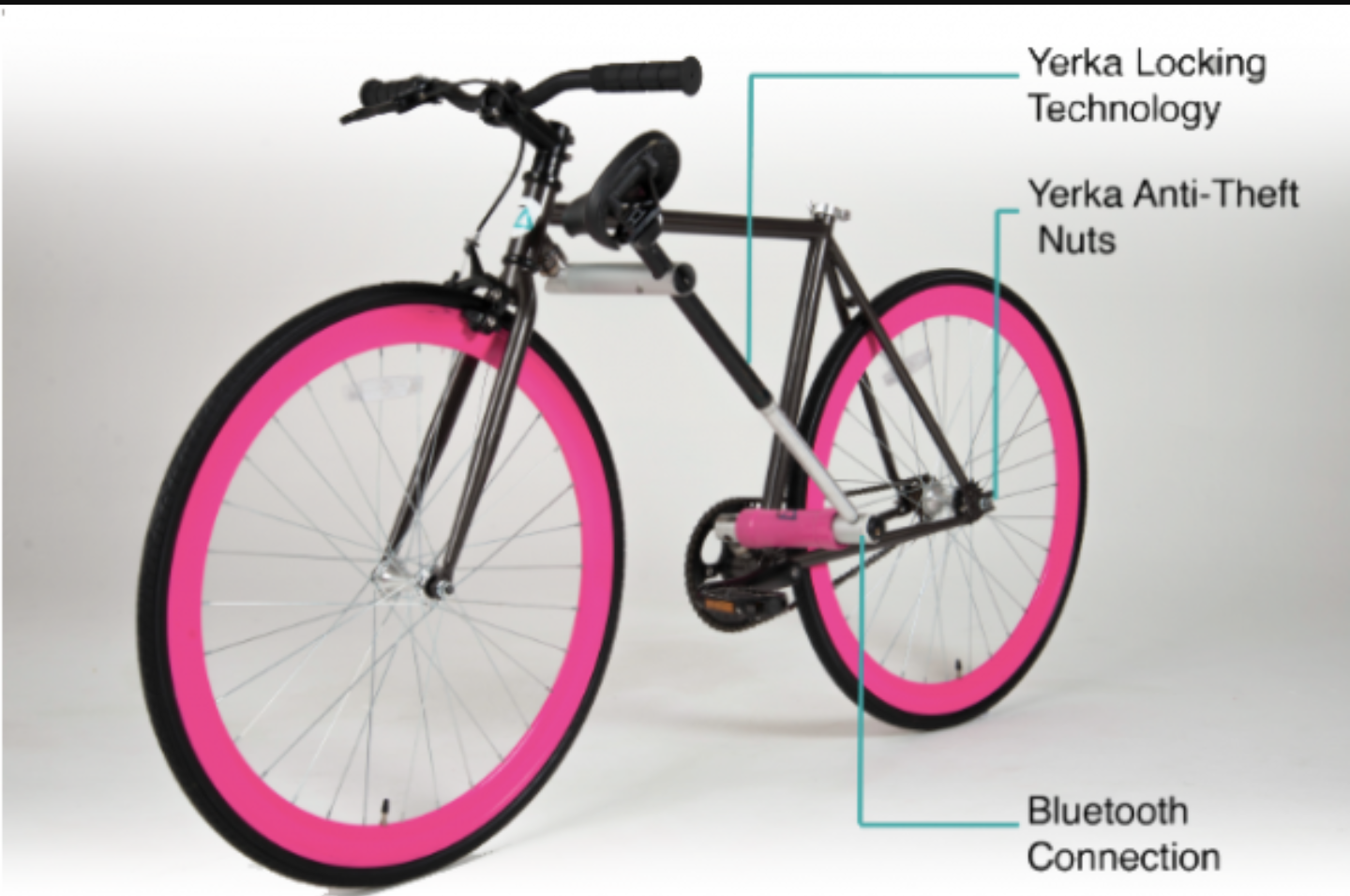
Battery-driven bicycle lights come in three forms;
1. Cheapo ones with limited light output and therefore with limited safety value. The only pro is that they are not worth stealing.
2. Expensive ones with batteries that are also very bright and are the best with respect to times between having to do something, like change the batteries. Which is an expensive process.
3. Expensive ones with rechargeable batteries that are also very bright but have a shorter period between having to do something such as removing the battery and charging it.
Both categories two and three suffer from the threat of theft, of either the whole light or in the case of category three, also the expensive rechargeable battery.
Some batteries have odd screws to help prevent theft, leaving them vulnerable to never being able to be removed without a hacksaw, if the odd screwdriver is lost.
The solution is sort of obvious. A light with a built in combination lock as part of the fixing mechanism. Screws if required for adjustment of the diameter of the fixing element would hidden when affixed or not useful in helping remove the device.
This way, say a rechargeable light could be easily removed for USB charging but very hard to steal. The battery itself could be permanently sealed in the thing, all iPhone like.
It’s one of my better ideas.
While I’m at it, I’d like to see a low battery LED indicator on the lights to prevent the annoying situation of cycling without lights.
In Brisbane yesterday, where it doesn’t cost $423 when you are penalised for shooting though a red light on your pushie, I sneaked through the straight section of T-intersection on a red after thoroughly checking for cars (there were none in sight).
I was on my single speed Brisbane special – see exhibit below.
Lo and behold, this fat fucker on an expensive carbon fiber road bike that had obviously lost his peloton, decided to offer me some free advice:
“You shouldn’t be going through red lights mate”
Nasally accent and all, reminiscent of say a law firm partner or even a Vice President, Health & Safety for Orica. Or near equivalent. The spiritual disaster that I am thinking of has three kids, all in private schools, a 300 square modern home, at least three cars, a wife he hardly speaks to and certainly doesn’t fuck, more debt than can be tolerated, and a complete dearth of anything approximating wisdom.
Long accustomed to the brain warping impact that exertion has on the feebly bodied, I chose to ignore the thing.
And then, 100 meters down the road and apropos of no common sense that I understand, he came at the subject a second time.
“The trouble is you give us all a bad name”
He was behind me and I was surprised he was still there. Must have just about fucked him to catch up. Now that’s motivation!
Really, these people feel so protected by the nanny state that they are essentially fearless.
Actually, I think they are senseless to fear. Just like the Dodos were on Madagascar.
[Segue] This old letter describes catching dodos before they went extinct in 1662; “These animals on our coming up to them stared at us and remained quiet where they stand, not knowing whether they had wings to fly away or legs to run off, and suffering us to approach them as close as we pleased. Amongst these birds were those which in India they call Dod-aersen (being a kind of very big goose); these birds are unable to fly, and instead of wings, they merely have a few small pins, yet they can run very swiftly. We drove them together into one place in such a manner that we could catch them with our hands, and when we held one of them by its leg, and that upon this it made a great noise, the others all on a sudden came running as fast as they could to its assistance, and by which they were caught and made prisoners also.”
What I actually said when I finally decided to tell the dodo to fuck off was this:
“It’s you fuck clusters of fat coloured condoms wobbling along at 10 k’s that give us a bad name, mate”
I wish there was some convention preventing the proffering of non-professional free advice with respect to individual conformance to laws and statutes.
That seems reasonable, doesn’t it?

All statesmanlike and what have you, David Marr says;
“What lies ahead is a gruelling and expensive campaign that will leave Australia much as it was before. Power may shift. Leaders may be humiliated. But neither side is offering what both know is wanted yet politics finds so difficult to deliver in this country: change.”
He’s wrong.
Australians don’t want change. They want free.
Expanding on the theme – there’s a handful of intellectual pygmy wankers that are Marr’s mates that want change for entertainment’s sake. Then there’s the bogan masses that just want to consume more and prefer their entertainment in other forms.
The eternal mystery is why anyone would want to represent this swill? Delusion, ego and greed – that just about sums it up.
Bring on globally warming I say.