
Drake and the art of doll house maintenance
I am having a very late breakfast in a warm East Melbourne cafe.
Outside its dark and I could touch the clouds. Getting here, they were touching me with their tears, obliquely from Port Phillip Bay.
Smashmob are reverbing on the Tannoy. Low, over and over. And over.
Double mac, poached eggs, smashed beans and toast. Coffees up and the toast is brown.
Sooner or later I am going to have to stop cancelling meetings.
You can get a Google browser on the Windows platform but not a Microsoft browser on Android.
One of these two companies needs to grow some balls.


Who would knowingly share their negative feelings with someone they know will tell them to ‘suck it up’?
A martyr, a fool, or a masochist. That’s who.
All human interactions belong to at least two people. They are cannot be measured on an individual.
I believe.
When someone says ‘suck it up’ nine times out of ten they are really saying ‘I don’t care how you feel because nobody cared about how I felt when I was a kid’.
The problem is that we all end up getting what we give. It’s regression to the mean.
I have just returned from Bunnings.
Unlike the rest of the poor souls down there I took my pushie.
A nice slow ride through the back streets. I stopped for a macchiato at the Italian gelateri. I locked my bike right at the front door at Bunnings.
They, the drivers, were log jammed on the Sydney roads as usual. And the car park was full. They all looked very stressed.
Cars…I don’t like. A nice idea at the time. It saved on straw. But really?

I have been pondering tax.
In the ideal world where every transaction is recorded and traceable (i.e. there is no cash) taxation could revert to a very simple scheme.
Firstly, personal expenditure would be taxed on a ‘sliding scale’. The more you spend the higher the (GST) tax rate.
This essentially works towards levelling consumption and opportunity.
Secondly, the cumulative value of assets under control would also impact your tax rate for expenditure.
The more your assets are worth the higher your effective GST.
This works towards levelling stress and opportunity.
And that’s it. No other taxes or levies of any kind in the country. Just personal expenditure tax.
Business isn’t taxed at all and they get to reinvest more in growth. Scamming personal expenses through a business is punishable by death or automatic bankruptcy.
Electronic transfers of money in and out of the country are automatically taxed accordingly.
Taxation is done automatically on a per transaction basis. No one thinks about it. Stress free so long as the sliding scales are fair.
The expenditure tax can be automatically adjusted by government on a daily basis to match their own expenditure.

In this blog I always attempt to write well.
However the first version is always a quick and dirty effort to get the ideas down
Because I am on a phone there are many typos from the Swype keyboard.
This is so frustrating that there are times I have almost defenestrated the phone.
Then there is another phase of review to fix typos and grammos. And I usually miss something anyway.
Then content is added and replaced to improve the structure
I do none of this for emails. Like so many other people my emails are essentially pigeon English.
Some young people only know how to write in pigeon English.
In time I am guessing that pigeon English will become the norm.
That’s not so bad – I reckon English was a lot more fun back before the enlightenment when people just wrote ‘anyway they felt like’.
Just when governments around the world were plotting the end of cash along comes bitcoin
For every action there is an opposite action of equal magnitude.
So there there goes the opportunity to do real-time incremental and automated taxation.
It’s a shame on one level but to be honest we can’t just trust the sort of people that make a habit out of influencing governments for their own benefit.
My nephew, a house guest, made me watch the Blacklist mini series.
It’s not bad but it is full of extraordinary violence.
At least it’s extraordinary for me.
But probably not in America.
In the show anyone that attempts to resist arrest (say by doing a runner) is immediately shot at.
Even if the crime is jay walking!
The cops just seem so angry in America. Especially if you don’t respect their badge.
But then I have noticed that most Americans get very angry when their rights are violated or their entitlements are removed.
Just like 5 year olds.

A couple of weeks back I was pulled over by the police on my bike.
Every day now, when I ride past that spot, I hear a ghost of the woop woop in my soul.
It’s just a little noise; enough to raise my heart beat a unit or two.
If I drove a Mercedes SUV I would probably sue for emotional damages.

I am lucky because I have
Time enough to contemplate
Which is quite a luxury
And quite unusual
And very different to time enough for thinking
And much closer to time enough for love
It’s not that lucky really
Because I wanted it
Engineered it
And got it
So there
Ok, this amazes me…I have just listened to a talk by an institutional investor in Australia [exact sector withheld].
Part A was all about what is wrong with the standard model for investment in their sector.
Part B was their hypothesis for an alternative approach that addresses some of the proposed issues.
Part C was them saying they are actually doing their Part B hypothesis. ‘Please give us money’.
In which case their chances of success are almost zero…by this logic.
The current model is loss making.
Their chances of having identified the problems correctly is probably 1 in 10.
Their chances of having identified a solution to the problems that works is also 1 in 10.
Their chances of executing the solution correctly is also 1 in 10 – it usually takes a few cycles of people trying for this to work.
So their chances of success are 1/10 x 1/10 x 1/10 = 1/1000
A rule of thumb is to only invest in business models that have been proven to work and also proven to be profitable. Ideally you should also invest in teams that themselves have been profitable.
Shame on those who knowingly add unnecessary risk to their investment decisions.

The problem with selfies, taken with apps that know who you (e.g. snapchat, instagram, etc), is this:
We are providing the big web companies with a perfect ‘learning set’ for facial recognition, aka biometrics, of individuals.
Privacy laws side, once they crack this they will know where we are and what we are doing at all times. Any camera will do.
Expect them to start selling this capability in the first instance with a positive spin. For example, they will sell your biometrics to the credit card companies so that facial recognition accompanies every online purchase. Or something like that.
Once in place though, you won’t own your own biometric data; Google and Facebook will. That is, they will own the data that you need to prove who you are.
And if you want to look at it very negatively, if they are subject to theft or a government mandate then you may not be able to enact any transaction for any purpose. Or someone else may be able to enact transactions on your behalf.
And unfortunately the parties that are creating this sort of power also have the means to influence governments and the media.
I can see this getting very messy and I am not usually negative on technology opportunities. This one worries me because competitive pressures force the parties that are trying to do this to out-compete each other in their creation and monetization of these capabilities. That is, if one doesn’t do it another will.


I have fainted four times in my life.
In a student bar in Göttingen.
In a drug den in the Hunter Valley.
In a nightclub in Valencia.
And last night at midnight at the pub in Surry Hills.
I did the pumpkin bolt and thus avoided saying goodnight 100 times over.
Similarities between these events were;
1. No eating for a day
2. Lots of drugs or alcohol
3. Lots of smoking
At one level it’s my brain saying to me “if you ain’t going to stop I’m going to do it for you”.
But then there is also a layer of built up emotional tension being released.
It’s like hitting the ctrl+alt+del keys a few times. Refresh the super ego.




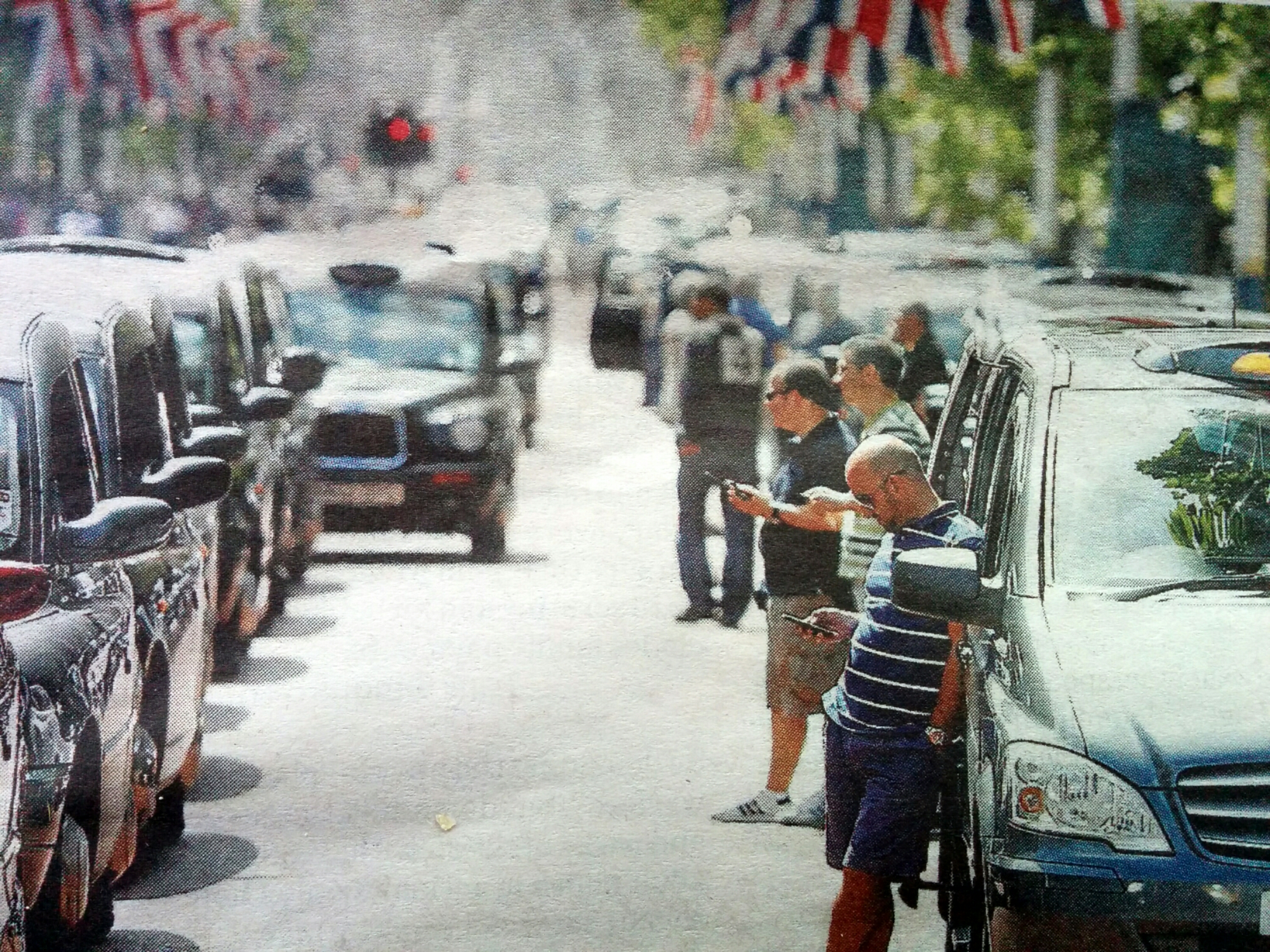
This is a photo of cabbies blocking London streets in a protest against Uber.
It looks like the smart phone represents the death of the militant protest.
In business the whole point of ethics is that they set a higher bar than the legal minimum.
However due to competitive pressures the gap is narrowing.
Only in the practise of law does the concept of ethics get formally reduced to a legal definition. That is, the ethical bar is the same height as the legal bar.
When the rule of law equals the ethical requirements then there are no ethics!
It’s hard to define ethical behaviour (any noun that is variably both singular and plural has to be a tricky one).
But it’s much easy to define what it’s not!
I have just been Telstra’d.
A euphemism for being fucked over by our former national telephony carrier and their obscure (to them and us) customer management systems.
They need to start from scratch rather than continue to upgrade their systems (that probably have vestiges of filing cabinets therein).
The only upside to the experience is that the operator that I chatted to was pleasant and very knowledgeable about footy.
He has temporarily patched the issue.
But I know as surely as the sun will rise tomorrow that this issue will repeat on me.
I know this because one question asked was “are you still using your BlackBerry?” in reference to my sixth last phone.
I suggested to him that this was a non sequitur to rival all others.
We both laughed.

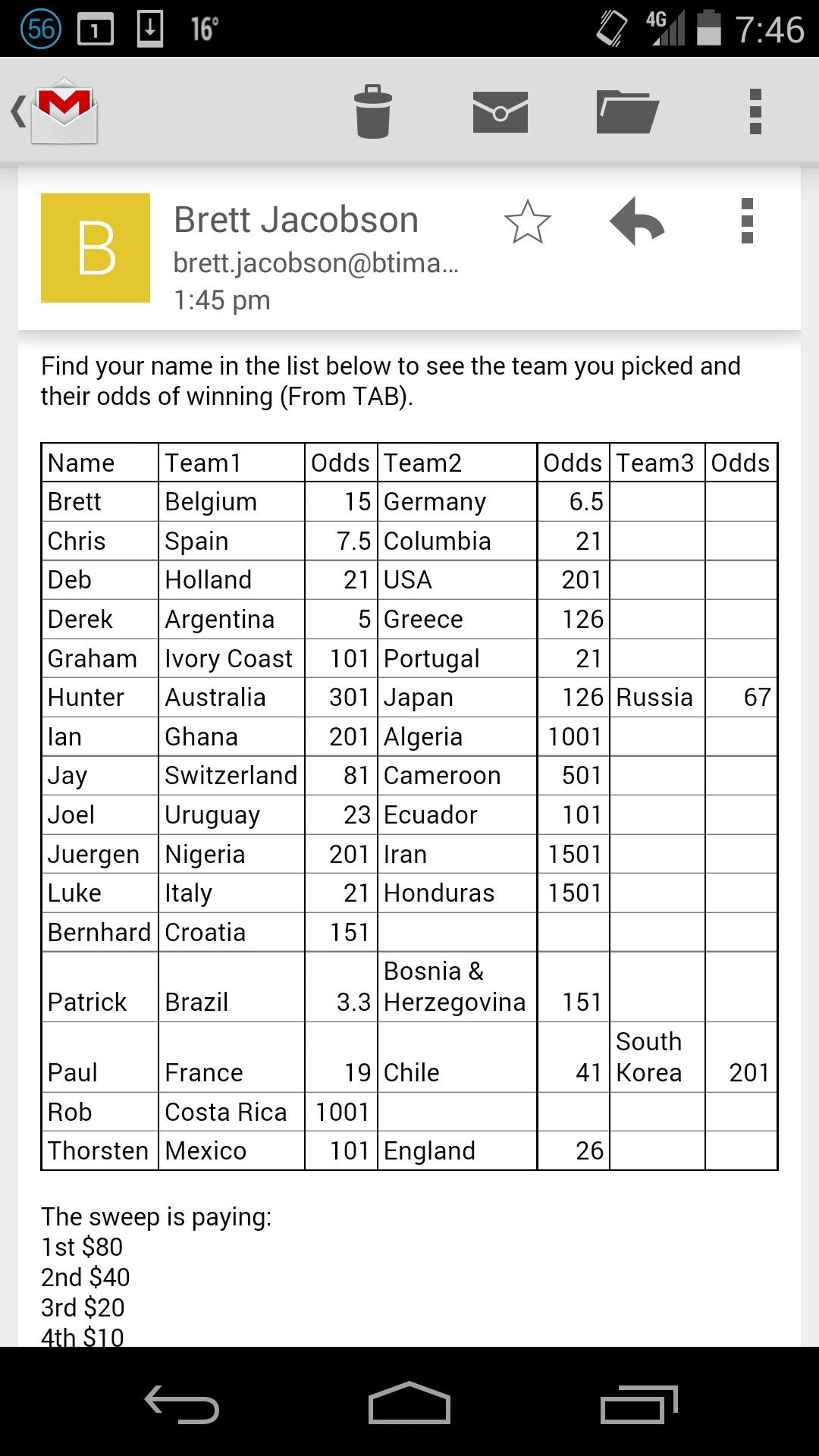
In the world cup sweepstake I got Ghana and Algeria.
I may as well have got Australia.
I was chatting with a right wing think tank member… a thunker… and I suddenly realised their mantra.
It is couched under the terms of free markets but basically they believe that government macro policy should only be introduced that addresses ‘market failure’.
As an aside micro policy is all about putting more money into their pockets and this is ok.
Back to market failure.
We were discussing the so called Patent Box system which in a few countries give companies an extra tax discount for products protected by patents.
The thunker said there is no market failure in the patent system or related corporate investment in innovation and that the patent box is therefore unnecessary.
I countered that the same could have been argued before the patent system itself was introduced. It’s not about correcting market failures but about creating market success.
The thunker was very confused. And remains so.
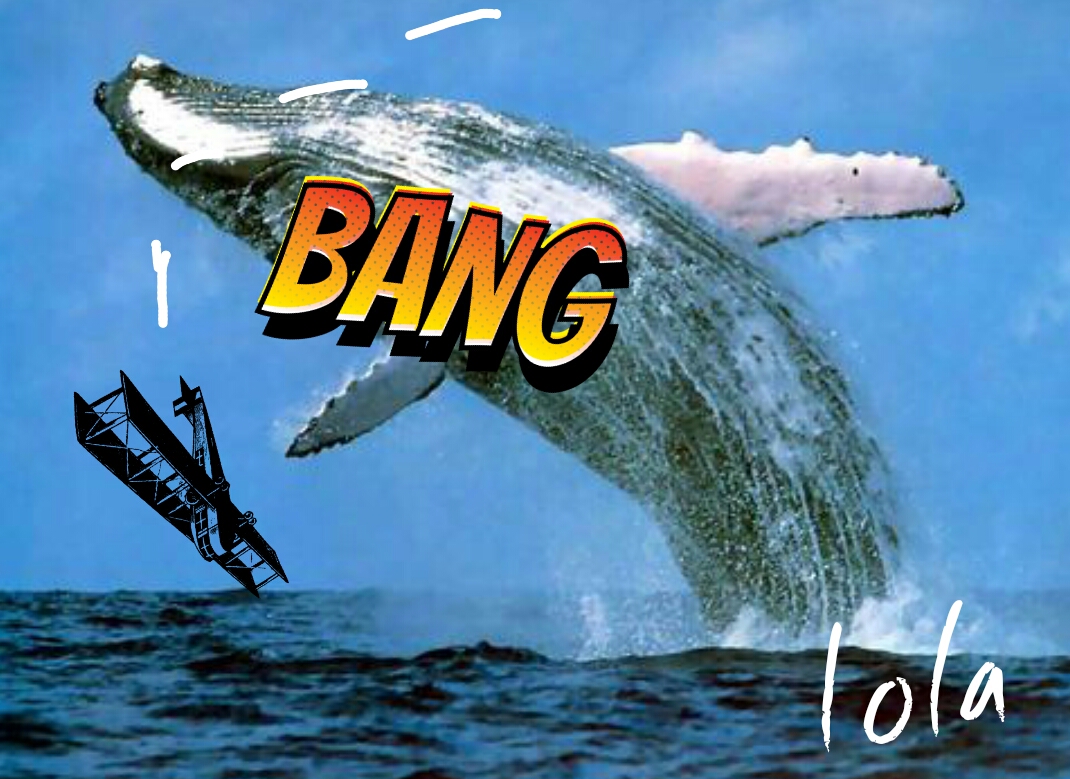
Some currencies depreciate very slowly…
A few weeks back I was, for the first time, fined for going through a red light on my bicycle.
Due to the increase in cyclists and an increase in shock jocks talking about cyclists, our state government is starting to enforce laws that it never has before.
Ever since that first fine I have been thoroughly furtive about riding through red lights.
So you can imagine my surprise this morning when, on the corner of Union and Edward streets, Pyrmont, I was woop-wooped by a parked and unmarked police car
WTF?
It was a young constable and an old crown sergeant. What he, the old bloke, was doing out on the beat is a mystery.
Maybe he was getting a morning’s worth of “real life experience” on the cycling blitz for his weekly meeting with the commissioner.
Anyway the old bloke opened with this pearler “do you think you own the place?”
For the non-Australians this means “do you think you can just do what you like?”
I replied; “sort of, I grew up there”, pointing to the former wharfies’ pub on the corner which is now a medical centre.
The old bloke paused and looked at me; “are you Noel’s son? “, referring to my dad who had been a crown sergeant himself before quitting the force to become a publican.
Nod affirmative.
” Well how is Noel? He was a great boss and a top bloke. [More details added for the young constable’s sake] ”
My reply followed with a short post-police force biopic.
“Give him my regard from [name withheld to protect the generous].”
Needless to say I got off without even a warning.
It’s good to see some things haven’t changed too much.

These are the 6 common forms of leadership promoted by HR consultants and other leeches:
The pacesetting leader leads from out front but doesn’t bother looking over its shoulder.
The authoritative leader hires minions and yells the mission at them.
The affiliative leader is that rare occurrence when the HR manager is accidentally promoted to boss.
The coaching leader is a self-serving individual who missed their real calling as a school teacher.
The coercive leader is a prick even at the worst of times.
The democratic leader hasn’t got a clue what he or she is doing, so asks the team instead.
NO, NO, NO … they have it all wrong.
The truly great leader is the LAZY leader. Too lazy to fail. Too lazy to care about screwing with people’s heads. Too lazy to be fucked up emotionally. Too lazy to be stupid.
Its not what they do but what motivates them that counts.
When I started this blog I had no idea that it would help me stop worrying about a whole lot of stuff that isn’t worth worrying about.
Today I was approached by the Australian Council of Learned (sic) Academics for my input into some self-serving fantasy they are preparing for our tabloid right federal government.
Without a second thought or any remorse I said no and wished them well in their endeavours.
Bliss.
But what to care about?
Actually I am thinking of writing a crime novel.
I watched the Jack Irish TV series and loved it but then was appalled by the poor quality of the original books.
In fact Australia has never produced a single great crime novel.
The closest we got was ‘The Empty Beach’ by Peter Corris. But it was a case of a false dawn as the author descended into trite facsimiles of Chandler thereafter.
We have had no Dashiell Hammett, Raymond Chandler, Damon Runyon or even a John le Carre. The last two stretch the category a little I know.
Great, great authors all. Yet they don’t win major awards because of the genre. Le Carre for example has to be one of the living greats; much better than a handful of laureates that I can think of.
Even this I can’t get worked up about.
And here is the ones that I played just for fling or two.
abseiling
air hockey
archery
beach soccer
beach volleyball
billiards
bocci
canoe polo
canyoning
catamarans
caving
climbing
coits
croquet
croquet
cross-country skiing
dinghys
discus
fencing
french cricket
gridiron
hackysack
hunting
indoor cricket
javelin
karting
Kegelbahn
netball
orienteering
paintball
paragliding
petanque
racquetball
roller hockey
rugby league
scooter bulldog
shooting
shotput
skateboard
skeeler
snooker
softball
surfing
table football
volleyball
water polo
water skiing
white water canoeing
white water rafting
windsurfer

Here is a list of sports I have played seriously but not for too long. Say a season or two.
badminton
baseball
basketball
beach cricket
beach cricket
british bulldog
centerboard skiffs – holland
cocky laura
cross country
darts
downhill mountain bike
fishing
frisbee
futsal
hash house harriers
ice skating
indoor climbing
judo
juggling
marbles
mini-golf
rugby union
running – sprints
swimming
ten pen bowling
Some of these posts are more of a place to dump random information that I might otherwise misplace and I will probably never need again. Go figure.
Lola asked and I compiled a list of sports I have played. Here is a list of the ones I have played seriously.
bodyboard
bodysurfing
bushwalking
canoeing
cricket
cycling
diving
golf
gym
handball – squares
handball – wall
indoor soccer
lawn bowls
lockie pool
pool
roller blading
roller skating
rowing
running – long distance road
running – long distance track
running – middle distance
skiing
soccer
squash
table tennis
tennis
touch footy
ultimate
waveski
yachting

The truth is somewhere in between.

The power of rebranding…
Dynamic Lifter is actually chicken shit.
Now I know that I still don’t have any problems using it.
But my perception of a reasonable price for the stuff has changed.

Possibly the worst song of all time.

For me, letting go of old habits can be harder than learning new ones.
Especially when I have never perceived of them as habits, nor do I have any idea why I have had them.
For some of my very old habits the removal process is about as difficult and satisfying as attempting to eradicate onion weed from the backyard.
That’s nothoscordum borbonicum my friends.
This little fucker is so pervasive that it’s a lot smarter just to change one’s mental habit of perceiving it as a weed.
After all the concept of a ‘weed’ is totally subjective; there is no formal definition.
Weeds are simply plants that thrive in the presence of humans and that we collectively decide are unattractive and unwanted.
Sometimes letting go of old habits is as easy as letting go of old prejudices.

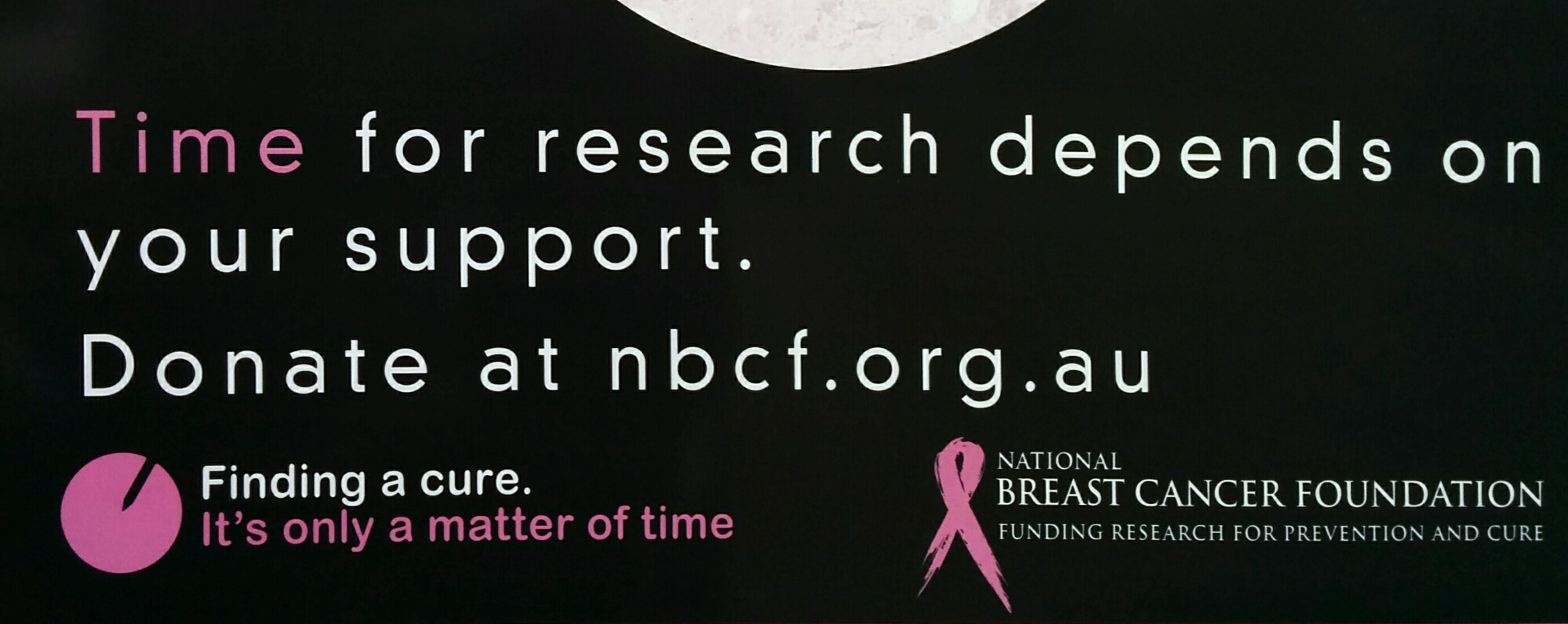
The odd thing about this ad for a breast cancer research organisation is that they are seeking a ‘cure’ when prevention is probably orders of magnitude easier to achieve.
Everywhere I look I am starting to see proud and independent trees with big strong trunks

Most of the time I write thing just to get the stuff out of my head.

The ideas of a box to both contain and protect your soul makes no sense until you realise that other people may want to box yours.
Here is a list of books that made an impact on me when I read them. There may have been other but I can’t remember them right now, so this list is sort of self defining.
Having said that I keep recalling books to add to this list. So I am treating this blog entry as a work in progress.
Cat in the Hat
Asterix and Obelix
All of Biggles– W E Johns
The stormy petrel – Violet Needham
Catch 22 – Joseph Heller
Fear and Loathing in Las Vegas – Hunter S. Thompson
Time enough for love – Robert Heinlein
Such is life – Joseph Furphy
We the living – Ayn Rand
The hobbit and lord of the rings – Tolkien
No bugles, no drums – Charles Durdan
All of Raymond Chandler
All of Damon Runyon
The Hitch Hiker’s Guide to the Galaxy – Douglas Adams
The cruel sea – Nicholas Monserratt
Animal Farm and 1984– George Orwell
Tom Sawyer and the Adventure of huckleberry Finn and roughing it – Mark Twain
All of Kurt Vonnegut
All of Ursula le Guin
The power and the glory – Graham Greene
No highway – Nevil Shute
The Caine mutiny – Herman Wouk
The devil’s advocate – Morris West
Siddhartha – Herman Hesse
Vanity Fair – William makepeace Thackeray
Madame Bovary – Gustav Flaubert
Ulysses – James Joyce
The Turning – Tim Winton
Washington Place – Henry James
Chronicles – Bob Dylan
Both sides of the moon – Alan Duff
Fate is the Hunter – Ernest K. Gann
My wicked, wicked ways – Errol Flynn
Cruising in Seraffyn – Larry Pardey and Lin Parde
The new, new thing – Michael Lewis
There’s one thing about the Chinese that you only find out by having them as customers; they are quite gullible.
They will believe almost anything they are told especially in matters of deference to incumbents
I think this is because the Chinese never really went through the enlightenment where in the West it became the norm to challenge orthodoxy especially in matters technology.
This will become their greatest challenge.

What do you have when the emotionally insensitive try to protect the emotionally sensitive from dramas?
A very slow moving train wreck.
I don’t mind being the business leader wherever I am at the time. Its normally better than reporting to someone because there are so few really great leaders.
However I have three weaknesses as a business leader:
1. I get bored with any business after a while and then distracted by other butterflies
2. I struggle to get consumed by a business. Basically as I have gotten older I care less and less about money and power. Hence I can’t generate the madness required to conquer and rule
3. I can be very good as a leader of people but again I don’t always practice these skills due to a form of laziness. In these cases I default to leadership-lite. This works-ish
On the flip side I have good strategy skills, I hire great people when I can afford them and I give them space, I am good with stakeholder management, I never shirk reality, I never get scared, nor do I panic and I know what I don’t know.

Query; what are the chances that in the history of the game that a Scrabble board has been repeated exactly, at least once?
A Google search later and some mathematician has figured out that it’s one over a number greater than all the atoms in the universe. That is, effectively zero.
But then my hero steps in:
“The chances are 100%, because it’s happened.
I was a club/tournament Scrabble player for a few years. Tournament play often involves unusual words, some of which are hard to extend or play through. Tournament play also has a rule that if both players score zero for three consecutive turns (by passing, exchanging tiles, or having a word challenged off the board), the game ends, regardless of how many tiles remain.
Now consider the following game:
I open by playing XU (a unit of currency in Vietnam), with the U on the center star, scoring 18 points.
You respond by playing UH (as in “uh, I’m thinking”) directly under my word, scoring 21 (accounting for the double-letter score on the U).
The board now looks like this:
XU
UH
Neither of these words can be pluralized. The only way I can play on this board is to either (a) hook a letter onto UH to make DUH or HUH (note: DUH was invalid prior to 2006) or (b) play through one of the words to make a longer word, most likely by extending XU into EXUDE, EXULT, or NEXUS.
But to do that, I need to have those tiles in my rack. If I don’t, I have to exchange and hope I get them. You’re winning by 3 points, so if you know the tournament rules and realize you have the advantage, you’re not going to play a word even if you can. You’re just going to exchange tiles to lower the point value of your rack, thereby reducing the number of points you’re potentially stuck subtracting from your score. So, essentially, I only have two chances to get playable tiles in my rack or the game ends and I lose — with 4 tiles played on the board.
This position has happened in actual club and tournament play more than once.”

Universities, police boys clubs, charities, rissoles….they are all not for profits.
The senior levels of management in these organisations tend to do an ok job because they are motivated by climbing the salary ladder.
But lower down it’s often hours for wages and the minimum effort.
Without a profit motive not many of these organisations thrive. They just exist.
It’s a little sad that we human beings cannot come up with another organisational motivating force that works.
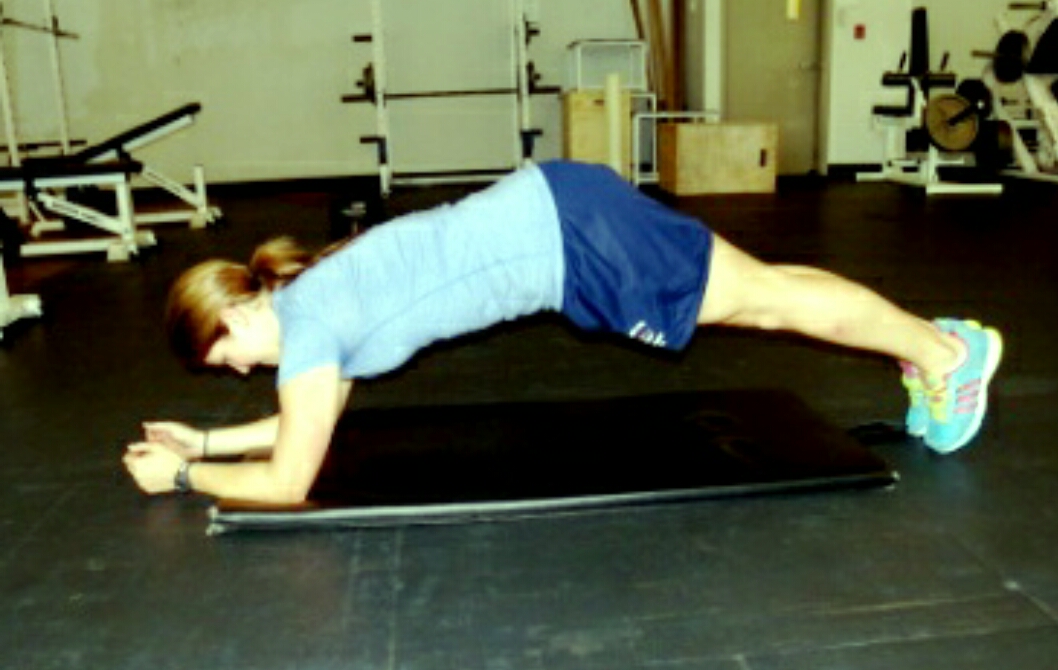
I explained to her that a plank is a poor woman’s push-up.
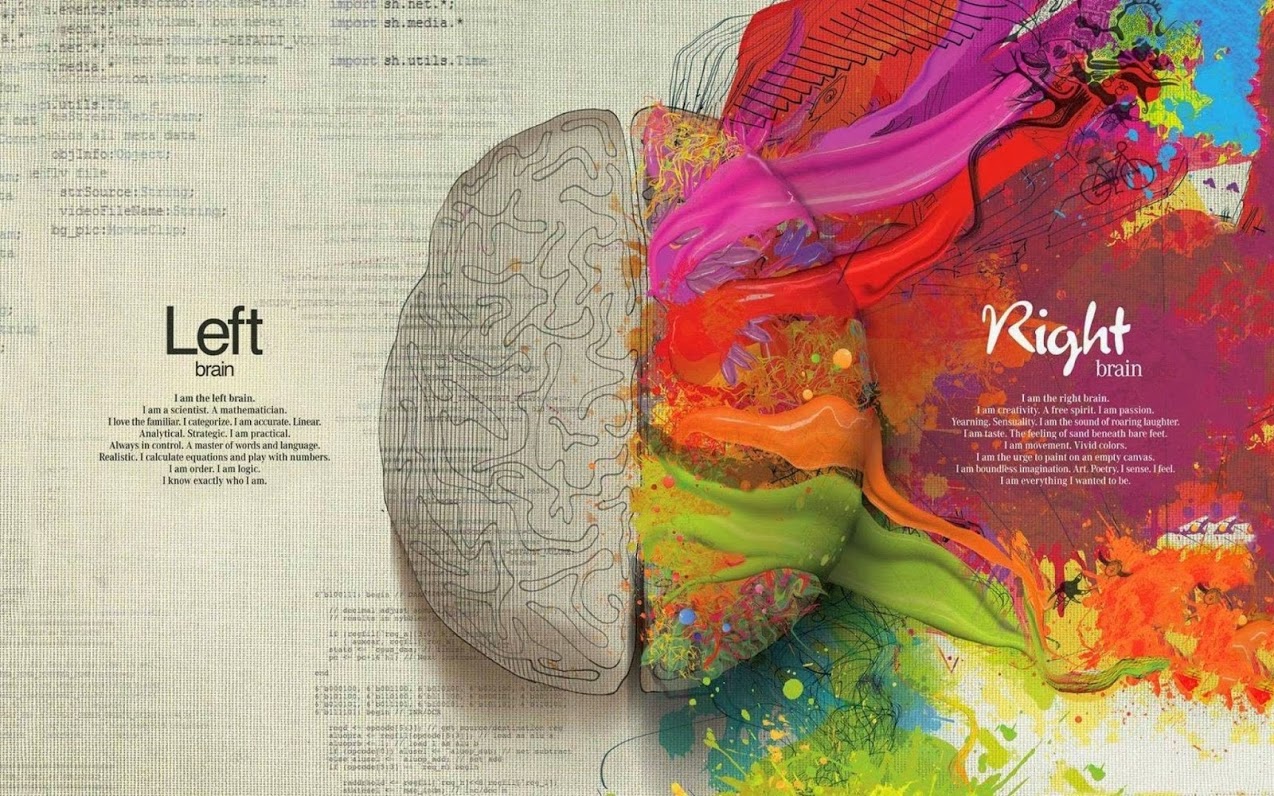
Found on the internet:
“I am the right brain.
I am creativity. A free spirit, I am passion.
Yearning. Sensuality. I am the sound of rearing laughter.
I am taste. The feeling of sand beneath bare feet.
I am movement. Vivid colors.
I am the urge to paint on an empty canvas.
I am boundless imagination. Art. Poetry. I sense. I feel.
I am everything I wanted to be.”
But before that self-advertisement there was this:
“I am the left brain.
I am a scientist. A mathematician.
I love the familiar. I categorize. I am accurate. Linear.
Analytical. Strategic. I am practical.
Always in control. A master of words and language.
Realistic. I calculate equations and play with numbers.
I am order. I am logic.
I know exactly who I am.”
Quibbles, quibbles…
What is the practical difference, pray tell, between “I am everything I wanted to be” and “I know exactly who I am”?
This is simply a case of forgetting to do the research before suggesting a result. People with strong left-brains do not always like the familiar, they do not always want to be in control any more than other types, they can be crap at language and words, they can be very unrealistic, and more often than not have absolutely no idea of who they are.
Empathy requires both understanding and caring, where the ‘and’ is used in the boolean sense.
Empathy can be applied to the big issues (macro empathy) or on daily stuff (micro empathy) which is rarer.
Empathy can be a finite resource (most people) or food for growth (a few people).
Those few people that are true empaths see empathy as food for growth and can practice micro empathy on anyone and at any time.
They are generally sucked up, used until exhausted and then spat out.
The rest of us drift in and out of empathy and sympathy, preserving our core goodwill for our precious selves.
I sometimes wonder what it would be like to just ‘be’. Without thoughts and feelings running riot in your head.
In my late teens I spent a summer holiday with my girlfriend on a hippy commune. And I swear I just was.
The summer passed in a flash. It’s a good memory, absent of great detail but comprised of a strong vibe that persists to this day.
In this world that we live in there is constant thinking and feeling, the mental thrashing, that is required to thrive and survive. It’s a race in which opting out is extremely difficult.
Until you get plonked into a nursing home that is.

Lola and I just had an argument about the plural of mickey mouse. Mickey mouses or mickey mice.
We made up by taking advantage of the gorgeous light to take photos of each other.
Her grandfather was a famous photographer and it’s clearly in her blood.

In the context of a broader discussion I made an aside that I never buy books anymore because I just download them via pirate bay or Gutenberg.
Well, out came the content vigilantes…. stealing from authors etc etc.
I countered that one source of freebies was for books that are out of copyright and where the authors are long dead.
For the more current books I used the argument that in my book buying days I always purchased second hand books; a transaction that the authors never benefited from anyway.
Despite the fact this latter argument has a hole in it the size of a truck, this shut them up.
Thank God.
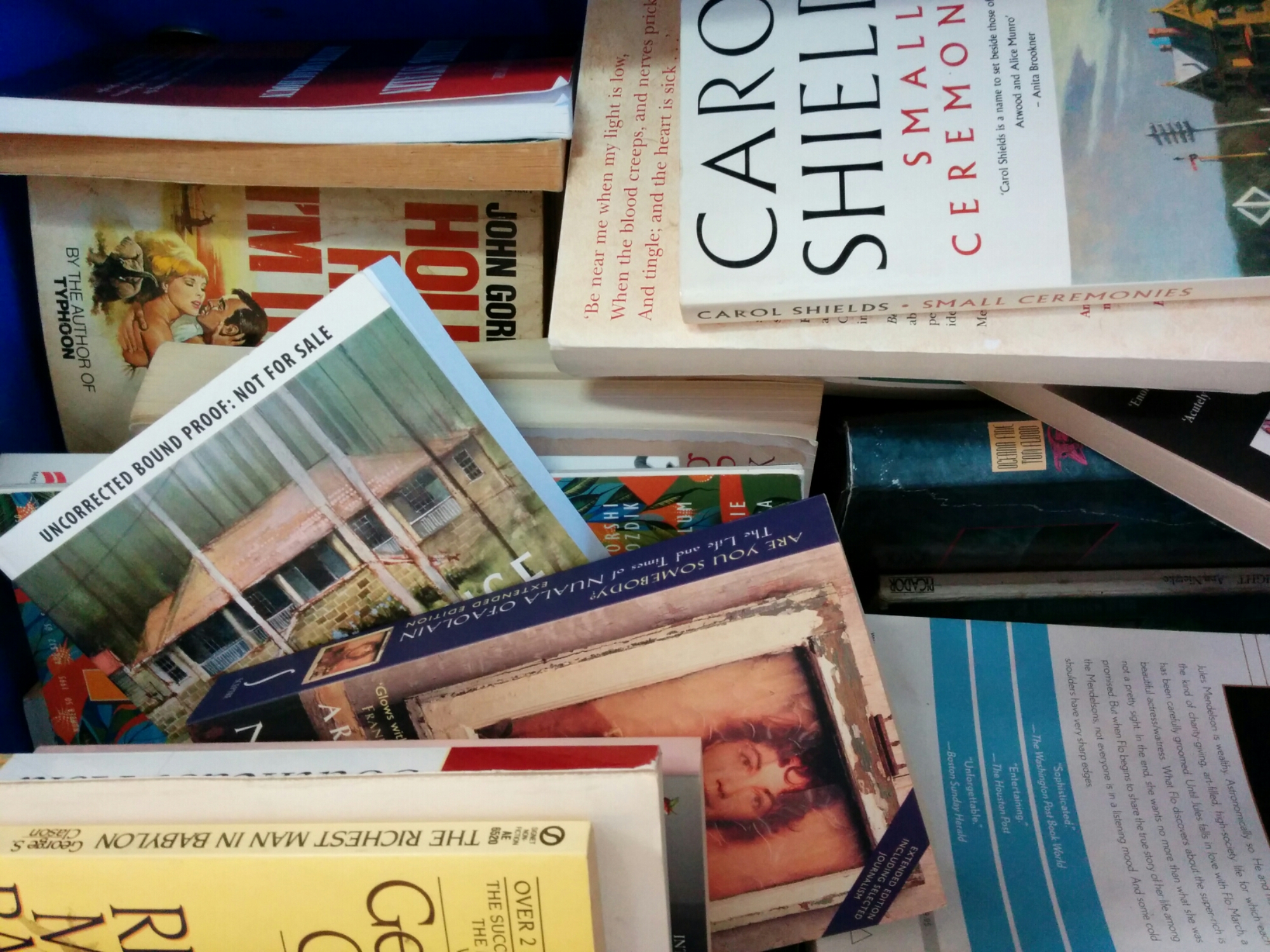
I was pondering couples and what makes two thrive as one or two.
Eventually I have boiled it down to three concepts.
One. Sexual attraction. No bonus points for picking this one. This is the most important upfront must-have and the least important after a while. And yet the fading of it can cause otherwise great relationships to falter
Two. Shared interests, values and life philosophies. Again it’s obvious but sometimes over-ridden by sexual desire. The subtle trick with this one is that the shared interests, values and life philosophies have to change in concert. Stagnation together is just as bad as the growing apart.
Three. No awkward silences; these are a symptom of a lack of contentedness at times when one just ‘is’. It’s hard to explain but sometimes it’s just nice to be with someone without the need to communicate verbally or the need to be doing something in particular. I have seen many couples that lack this. Fatal.
In my view these three points are the primary colours; the three that are fundamental and can’t be synthesised. No matter how hard one or two tries.
Oddly, relationships can be deficient in, say, the third of these for years before it becomes a critical issue. People manage this by being too busy to notice.
You really do need time enough for love.

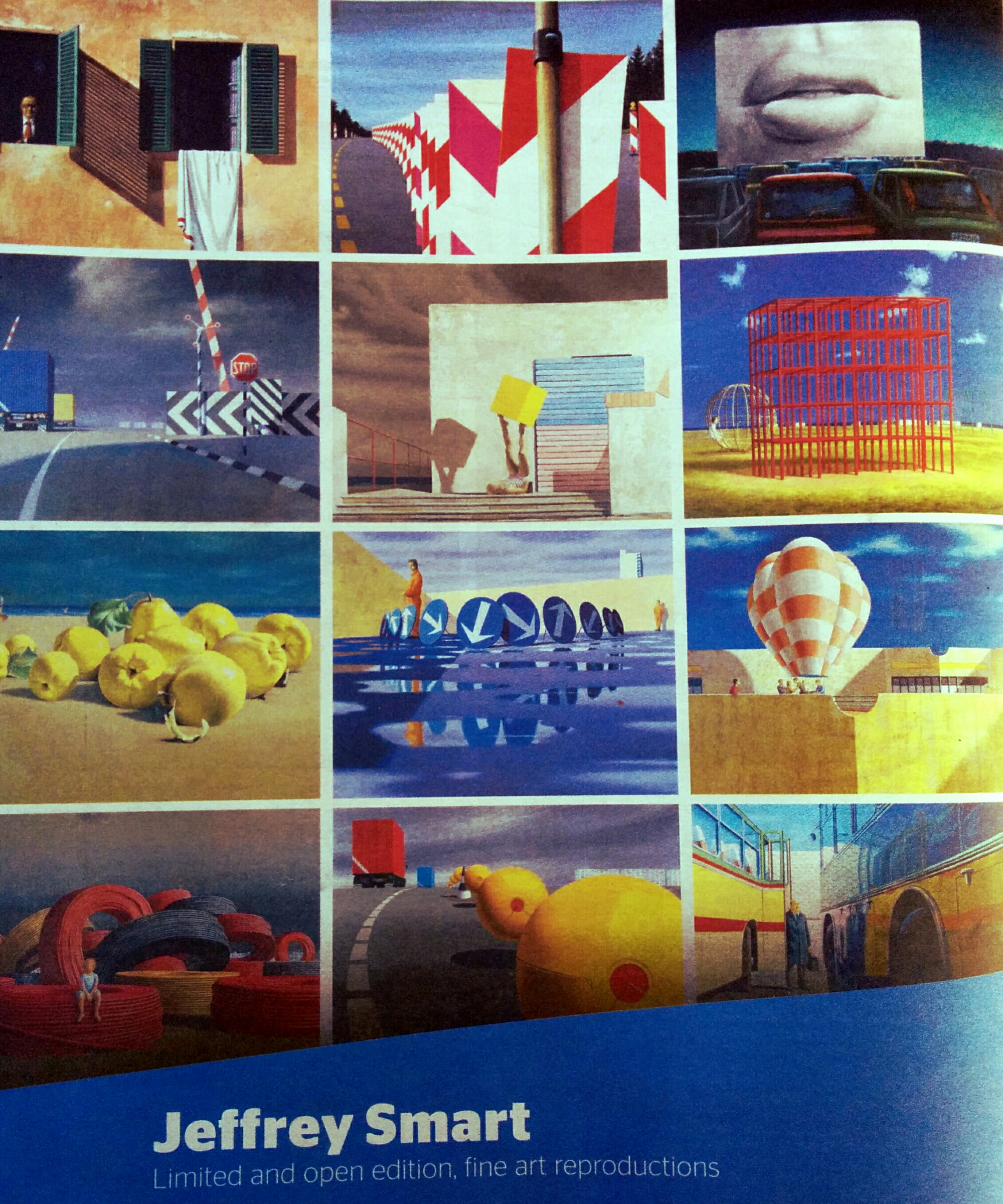
I feel sorry for Jeffrey Smart. He was a photographer that couldn’t take the photos he wanted to, so he had to paint them. He would have loved digital photography manipulation.
The first time I ever read the word ‘trolls’ was courtesy of J.R.R. Tolkien.
The second time was with respect to lawyers, patent trolls, chasing operating companies that were infringing certain patent rights.
To this day I don’t get the connection.
Tolkien’s trolls were big lumbering dim witted bullies. Whereas patent trolls are small, nimble carnivores.
A better term for patent trolls would have been ‘patent pirates’.
Or better still ‘patent corsairs’ since they break no laws as such corsairs were government-mandated pirates.
The use of the pejorative ‘trolls’ for non practising patent entities is pretty silly really. It just reflects a sense of injured entitlement by those who have for centuries profited nicely from the patent system without being called.
In the fact the big lumbering bullies in this story, the true trolls, are the large corporations that have for a long time being clubbing inventors, small competitors and anyone outside the first world. And also throwing rocks at each other in a zero sum game.
If you throw a rock in the pond then you can expect some ripples to come back. I just received a missive that the reference to trolls is from the old Scandinavian folk story, three billy goats gruff, which I managed to skip as a child.
This reference, if true, is even more retarded than the Tolkien reference. In the story the troll skips eating the smaller goats and then gets beaten up and killed by the largest goat, representing the biggest corporation. Firstly, patent trolls will nibble at all the goats and, secondly, if the big corporation can kill the troll then why all the angst about patent trolls then?
And who, in their right mind, would call themselves a fat goat?
Rats miss!


As I was just about to land in Australia on a Singapore Airlines flight the Indian hostie came over the tannoy with a message about the Australian customs form.
He told us to fill the form out ‘truthfully’. That is just so Indian.
We would say ‘correctly’.
The truth is just assumed in Australia and it would be impolite to suggest otherwise.
Anyway we only lie by omission and not by fabrication. Therein lies the difference.
Which is to say we are the better liers.
Shah Rukh Khan, the world’s second most wealthiest actor, is a Muslim that married a Hindi woman, Gauri Chibber.
Their children are being brought up in both religions, Islam and Hinduism.
Most religions fear loss of market share and pronounce that they are the one and only true religion and that god decrees it so.
They typically go a step further and make it a sin to worship false gods and, by implication, also false religions.
Which makes me wonder how King Khan gets away with it. Probably because his market share is greater than both the religions in question.
I have often joked that Singapore taxi drivers have the worst peripheral vision of all taxi drivers.
Flagging one down, unless you are within a 10% deviance from the direction they are traveling then they are not going to see you.
Which, you might agree, could be a hindrance in the line of duty.
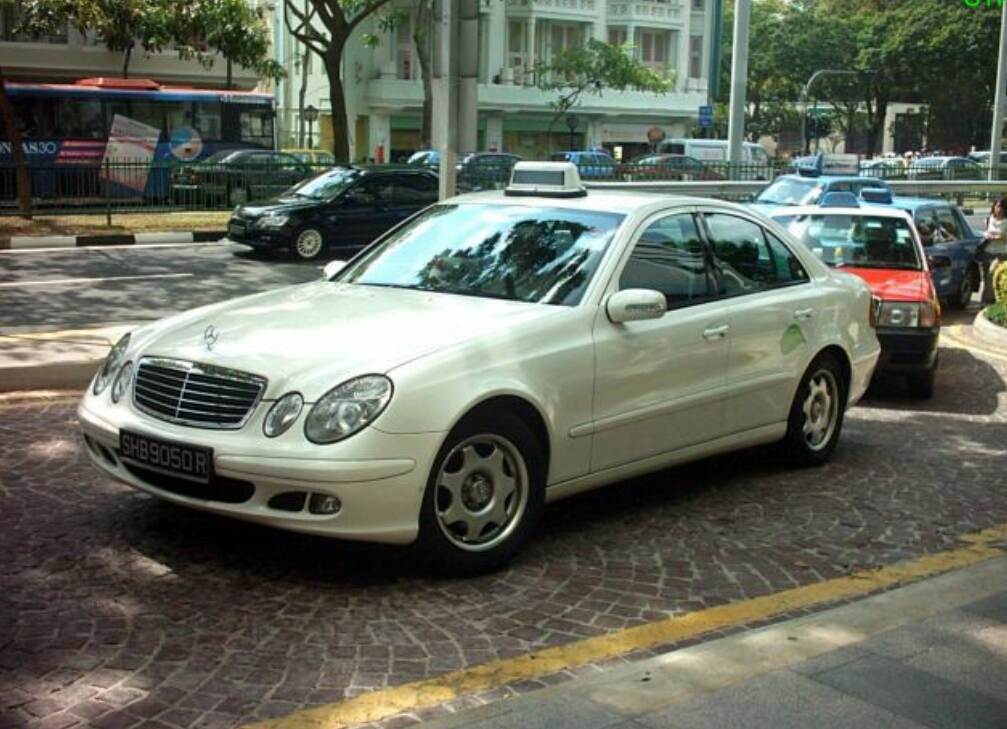
This morning my upmarket Mercedes cab ride to the airport seemed a little noisy (for an upmarket Mercedes).
Looking up I noticed that right in the middle of the speedometer was a picture of the car highlighting that the front passenger door was open.
Despite this indicator and the wind noise the cabbie appeared not to notice. He was happily doing 140 k’s on the motorway.
So it’s not just vision that is peripherally retarded but audio as well. Assuming the other senses are equally dulled I will call it Peripheral Senses Deprivation Syndrome (DSDS).
I can only assume that they have a lot on their mind. Or very little.
The Americans sometimes refer to their country in the feminine just like we often do for boats and ships.
Her bow not it’s prow.
I wonder if this has to do with the statue of liberty being the symbol of the country. Or maybe that God is the father and the state the mother. Or possibly it’s a habit borrowed from the French who give just about everything a sexually definitive status; no wonder they all need counseling.
Here in secular Australia the country is very much an ‘it’. As is the state and as are the states. Even our politicians are bordering on ‘its’.
It’s a mystery of its, it is.

Keynes said ” We are being afflicted with a new disease … namely, technological unemployment. This means unemployment due to our discovery of means of economizing the use of labour outrunning the pace at which we can find new uses for labour. But this is only a temporary phase of maladjustment”.
In America since the 1970s technology has displaced many jobs. Amazon employees less than one tenth of the people that were employees in the retail shops that it replaced.
Robots have taken people out if the factories; the ones that remain in the US that is. Globalization, enabled by technology, has meant a transfer of manufacturing to lower cost countries.
As a result real middle class wages have fallen as workers have accepted lower salaries and lessor conditions just to survive. This is supply and demand working as it inevitably does; at a low enough price there is usually a buyer at an auction looking for a bargain.
Consumer spending makes up 70% of the American economy and due to the fall in real middle class wages, which drives the bulk of consumer spending, the economy is going backwards in real terms.
The wealthy have continued to thrive because their investments are global. Hence the widening wealth gap in the US. Unfortunately the wealthy simply can’t spend enough within the US to kick the economy along.
Keynes was correct but the long period for readjustment in the context of global leveling means a lot of pain for a lot of people.
Especially if the basic cost of living is subject to an institutionalized high floor price. As it is in the west due to our heavily mandated socio-legal systems.
Paradoxically the expensive rules and regulations, designed to make our lives safer and risk free, and that also drive this high floor price are themselves part of the process of finding new uses for labour.
Eventually it may all equalize, maybe painfully, but there is one interesting horizon that might upset the plan. A systematic shortage of resources is going to take us out of Keynes’s implied steady state.
In this scenario labour may have a strong negative non-linear impact on the global economy. That is, the NPV of a person may be negative due to the price of survival being greater than the profits of labour despite the best efforts of technology.
Science fiction has played out scenario after scenario, describing what may happen. My guess is that we will be surprised.
One thing is for sure; this is a race between technology and resource depletion, or peace and chaos. We would be very well placed to accelerate our global investments in technology and technology education.
Just maybe, it’s possible that the current wealth disparity in the US is caused by or a result of the impact of diminishing finite resources. That is we may have already left the steady state of effectively infinite resources and nobody has got the connection because it has been expressed in an obscure manner. That’s a scary thought.

In Australia political control is divided up between an institutionalized duopoly, Labor and the Coalition, representing capital and labour.
Or servants and non-servants, if you get them drunk enough to admit it.
I find it odd that the labour movement was clever enough to wedge the political process but not clever enough to also control half the broadcast media.
That was a big mistake.
Whichever interest group eventually succeeds Labor 1.0 they would be well placed to grab half the broadcast media if they can.
On the internet people tend to gravitate to familiar content so it’s far less influential than it might seem.
Unless technology intervenes.
Due to language issues and a lack of caring on my part I have no idea what’s for dinner tonight.
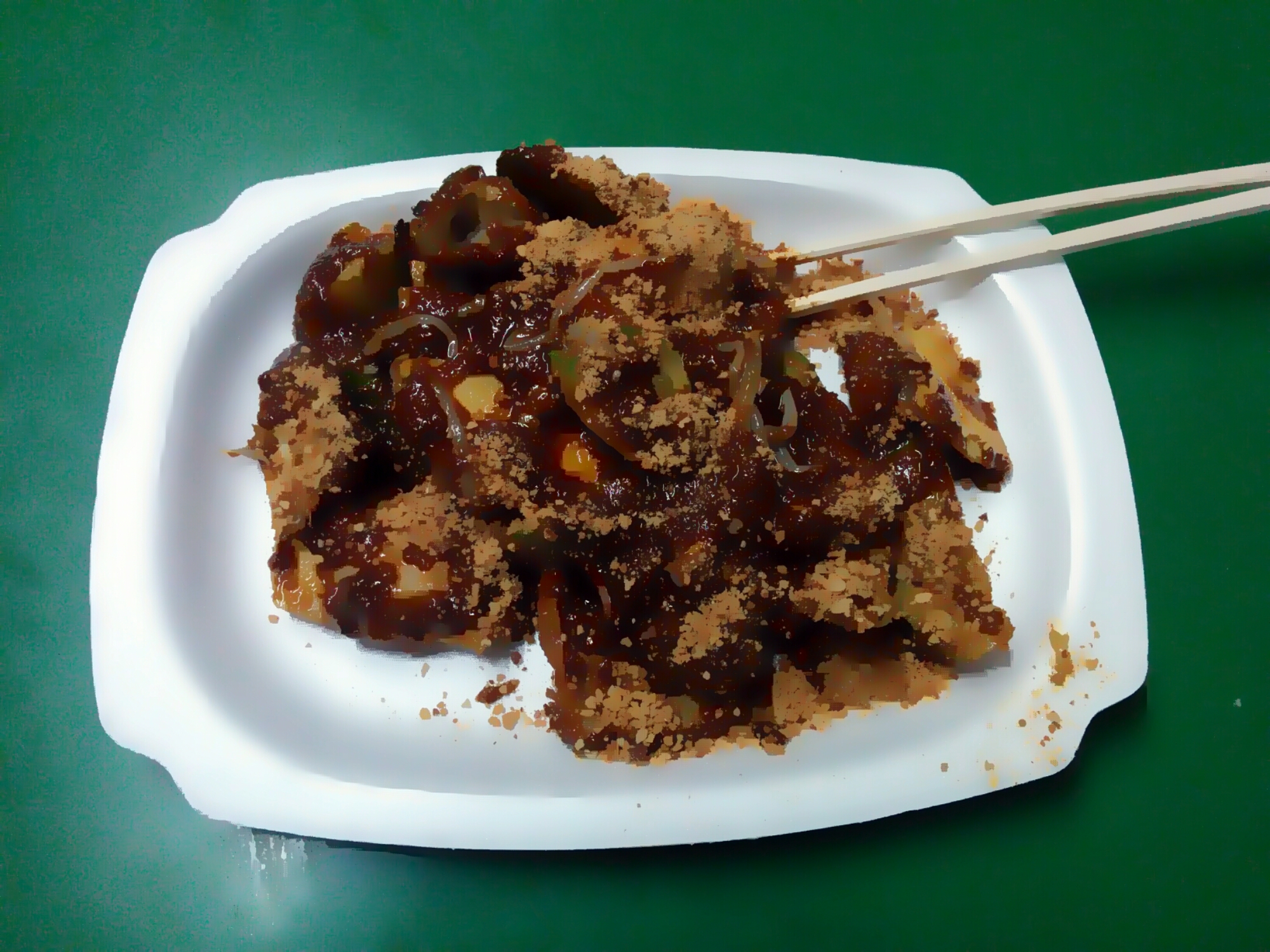
Eating it revealed nowt.
According to Wiki Hunter S. Thompson’s suicide note reads:
“No More Games. No More Bombs. No More Walking. No More Fun. No More Swimming. 67. That is 17 years past 50. 17 more than I needed or wanted. Boring. I am always bitchy. No Fun — for anybody. 67. You are getting Greedy. Act your (old) age. Relax — This won’t hurt.”
Considering that “the true voice of Thompson is revealed to be that of American moralist … one who often makes himself ugly to expose the ugliness he sees around him” it’s no bloody wonder he topped himself.
He badly needed some cognitive dissonance on top of his satire. And some perspective, which didn’t arrive with the birth of his son.
To see the absurd as clearly as he did you would think this might allow him to shrug off any sense of injustice as an artefact of human subjectivity.
But no he was clearly lost in the mire of conspiracy theories and injustice, unconstrained by his love. The pain of those that cannot trust nor change the world as they see it.
Hunter’s son wrote a blog entry on his father which can be found at http://totallygonzo.proboards.com/thread/19/father-outlaw-juan-thompson
Even here one senses that the great journalist was adored not as a person but as a famous person. The price of living in a large winner-takes-all society.
Despite all this I would say that there is nothing better than the early satire of Hunter S. Thompson. It’s just a shame that it lead him straight down the drain hole.
I am having a lazy weekend in Singapore with just a couple of meetings to occupy myself.
I have been chatting to the ex-pats here and they all seem to be enjoying a boozy party life. When pushed though they proffer an opinion that Singapore is ‘not real’ and only good for a few years of their collective lives.
That got me thinking about the place.
It’s easy to criticise Singapore for being artificial and controlled, especially when contrasted to the rest of its Asian neighbours. But I can’t help feeling great admiration for the founders of this place.
What they have done is create a corruption-free pocket in Asia where Western businesses can feel safe in their Asian adventures. Like anywhere there is institutionalised corruption but the rules as printed can be relied upon, and that is all business needs to properly able to assess financial investment.
With regards to social policies we in Australia can quibble about certain of Singapore’s policies but generally tolerance in Singapore is high by Asia standards. The place was tough for a long while but how else to pull the place out of fishing village status? Now they are governing a bunch of self-entitled Chinese and Malays; I am not sure what else they could do to be honest. These things take time.
With the economic centre shifting to Shanghai, Singapore is trying to reinvent itself yet again. It will keep its trading activities but is now looking for another role and the obvious one is the Asian gate keeper for intellectual property rights. Even this will be hard because of the national nature of IP rights.
Then there is high-tech industries such as medical devices. Taiwan is probably better suited.
But Singapore does represent a consumer market in it’s own right so that will continue to generate economic growth.
Even so, over the next 20 years Singapore is going to need to strategize and execute very well. And hope that China does inevitably resort to old-school behaviours that scare the be-jesus out of Western companies.
The one black spot on the ledger is the mistreatment and exploitation of foreign workers. But this is condoned by all and sundry because everyone, especially the ex-pats, wants servants. It will come back to haunt them no matter what arguments they use to justify it.

There is a sadness in me this week.
It has to do with the separation from people that comes with the comprehension of life.
The more I get things in order in my heart and in my mind the more of a gap I feel to people that I don’t know. Even to some that I do know.
I believe that it’s uncertainties and insecurities that drives much of our behavior and that leads to connections with people.
More and more I am starting to feel like an observer.
There’s not much I can do about it unless I find a wormhole though to divinity.

Hypocrisy
Asymmetrical hyperbolic outrage
Injustice
Entitlement
First world problem
Freedom
Nihilism
Chill
Pill
In matters of content, outrage just preaches to the converted.
The practice of satirical cognitive dissonance on the other hand has a small chance of shifting the thinking of the lazy fuckers.

The narrator of the documentary “Photographing Intimacy” spoke with such authority that, at times, I almost found myself nodding in concert.
He was talking of photo art as if the artists’ intentions had no meaning. The assumption is that the art just exists and has its meaning in the eye of the observer and chop-chow to the artist.
And I can see that this approach has merit. But it is not universally agreed upon, as any attendee of an art opening could tell you.
Once in a while I get talked into going to an art opening, very much against my better judgement. Actually it probably takes two years for the horror of the previous event to be sufficiently erased from my memory for my resistance to be sub-thresholded.
At an art opening I always, without exception, find myself in a small circle of wine-wielding experts, together with the artist. Some local hero will be spouting on about where the art fits into the latest development of the post-construction figmentism movement. And everyone will be nodding sagely and even contributing an opinion or two.
Someone might segue into French or German, just to cover a wine-induced senior moment. The lead protagonist will start softly just to check there are no academics in the audience and once having validated this will launch into a full scale (de)construction.
There are essentially 100-200 key nouns, adjectives and verbs, not commonly used in everyday language, that must be strung together in a certain rhythmic sonance in order to achieve a tune that sounds convincing. This whole procedure is learned slowly over many years at the feet of other experts and devotees of the cargo cult.
But if there is an academic in the audience then your expert will tread very lightly. Your academic sees no irony in using 100% left brain processes to study the outcomes of a process that is 100% right brained. He or she has a working mental mud-map of Western philosophy and psychology wherein he or she can pigeon hole any work of art or any artist. Just occasionally they excitedly get to make a new pigeon hole.
The artist, poor bastard, just wants to sell his or her expensive raw materials (& improvements thereupon) for food and grog. The whole silly charade sometimes causes the artist to engage the vestiges of the left hand side of the brain in order to communicate some hastily fabricated intentions to the lead protagonist, any academics present and the audience.
This should end in tears but it often does not; quod erat demonstrandum.
Irony intended.

I have just watched a documentary called ‘Photographing Intimacy’.
Once again it enforces my observation that visual artists are only ever diminished by the addition of words.
Ahem. Unless the words come first.

Never thought about it before but a parachute is about the same size as a life vest.
I know which one I would prefer to have in the pouch under my seat.
The Bank of Singapore has an advert that says;
“… like you we believe success is built on the Asian values of integrity and hard work.”
My guess is that ‘integrity’ has been very poorly translated from the original Confucius concept of appearing powerful and without personal doubts while doing what the fuck you want.

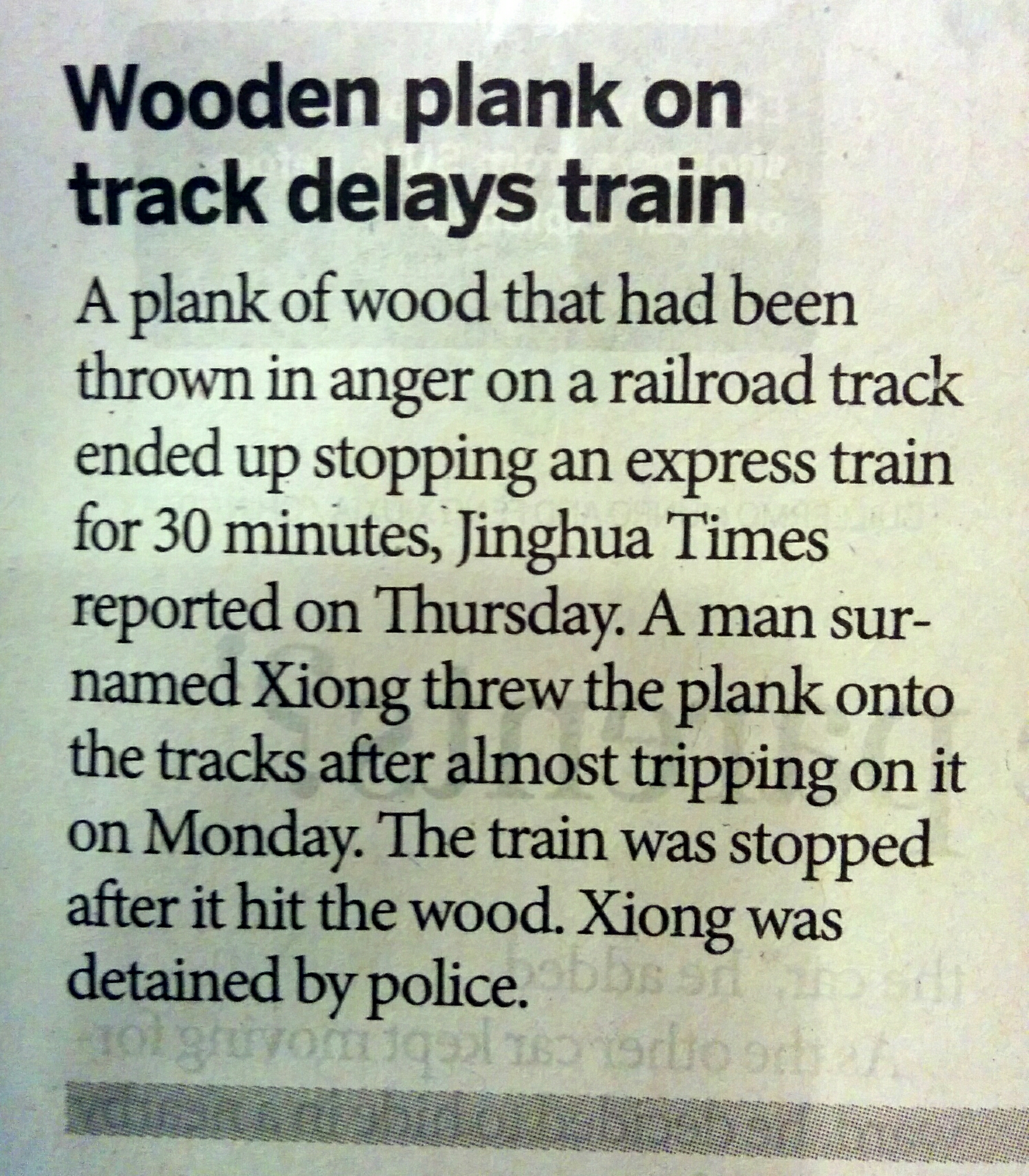
What do you reckon Xiong was so pissed off about that caused him to toss the plank onto the railway line?
And did he knows it was on the tracks? Was he purposefully trying to bring catastrophe into his life?
I might have to track down Xiong and ask him.
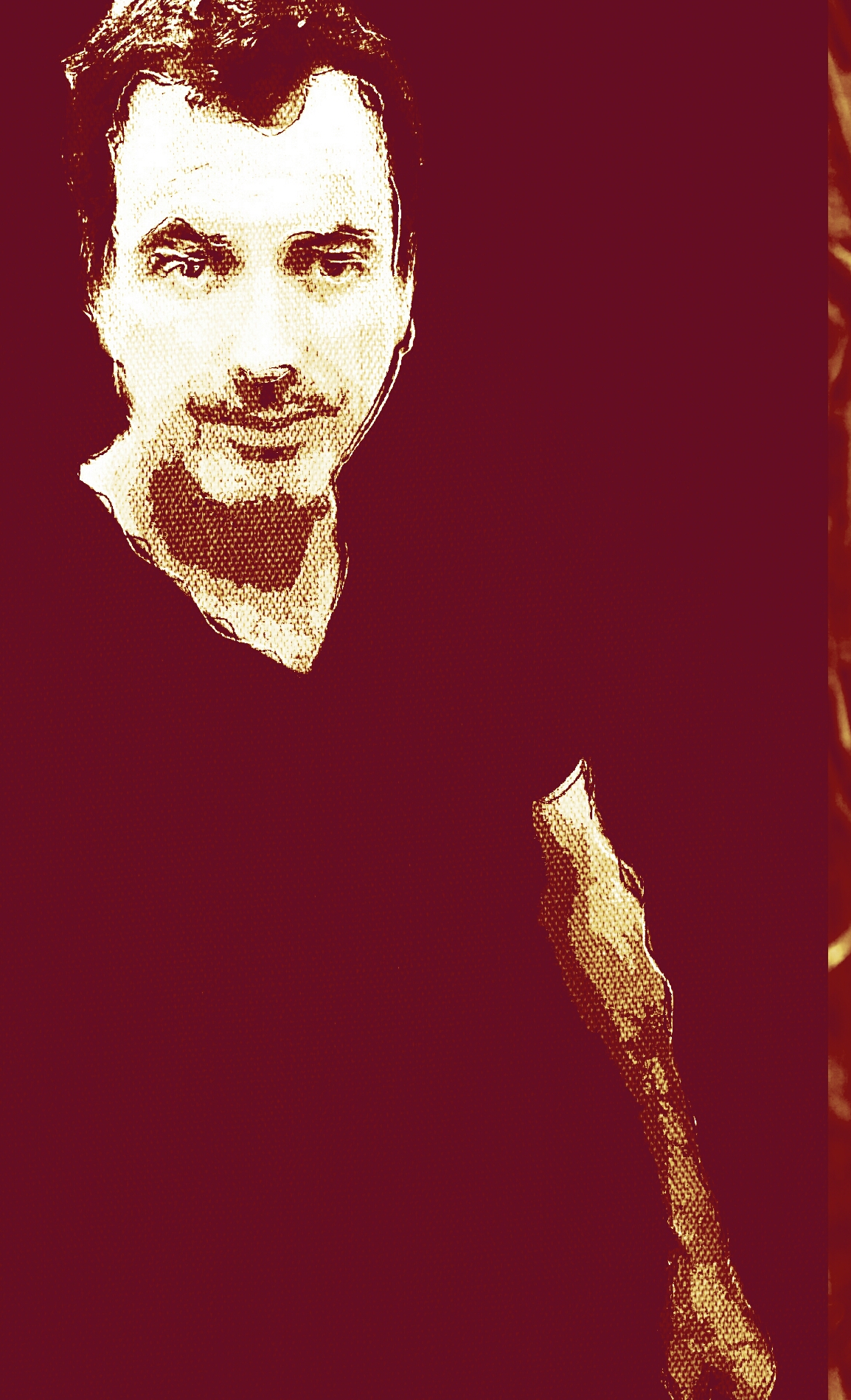
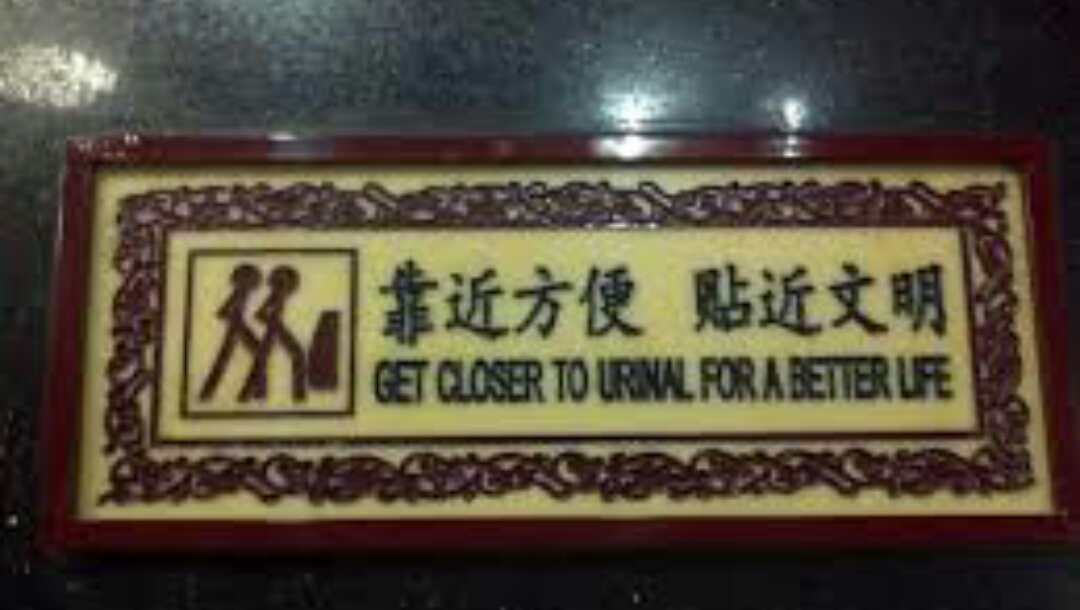
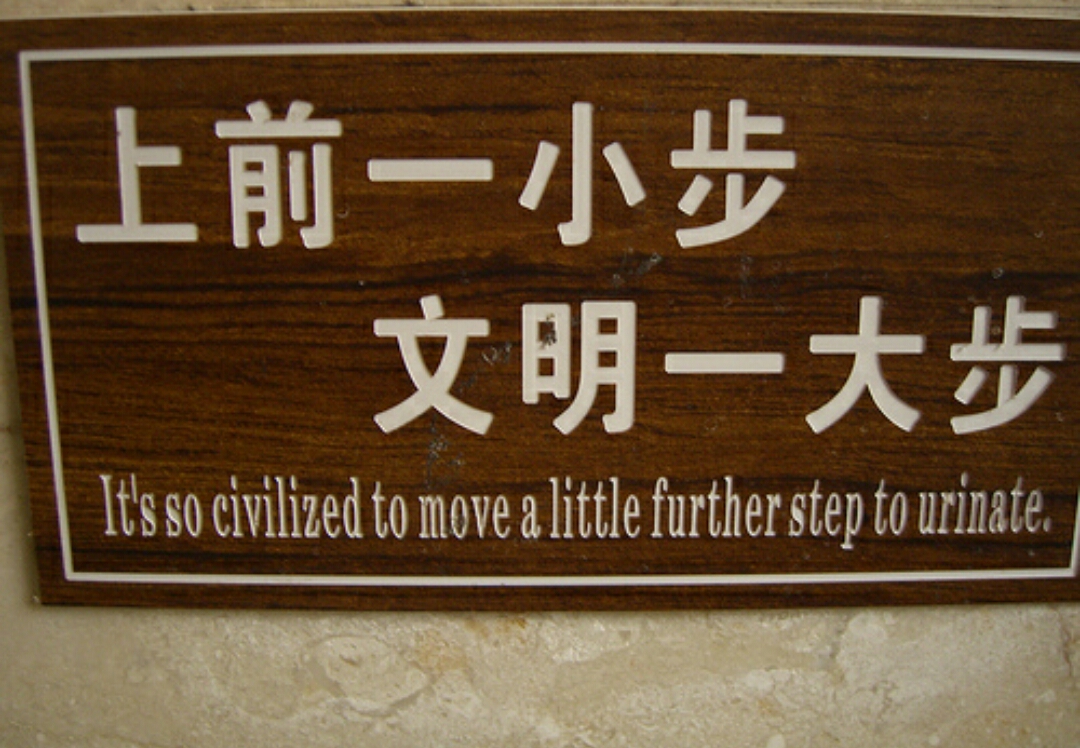
In China most urinals are the type that hang off the wall.
And it’s remarkable how Chinese men seem to miss the target. The floor all around is always totally wet.
For the girls in the audience; when you stand up to them you have to be trying pretty hard to miss.
Anyway I was just in one and the old bloke next to me was standing maybe one cm away from the urinal but missing it completely.
He must have been pissing at right angles.
The toilet attendant came up with his mop and shouted at the old guy, who looked down and realised what he was doing. And I think he apologised in Chinese.
In the past I am guessing they just haven’t learnt to be aware of where they are pissing. Things we take for granted.
Not for much longer. There appears to be a government initiative on this issue. They want to appear civilized in all ways Western.
Based on previous experiences with other government initiatives, within a couple of years they will all be anti scatter brained.


Next to the paragraph on Xiong and the plank we have this little gem.
I wonder whether an awareness of Jung’s models helps or hinders life’s journey.
Or neither.
The scientist in me says ‘helps’ but I have long learnt to distrust that voice.

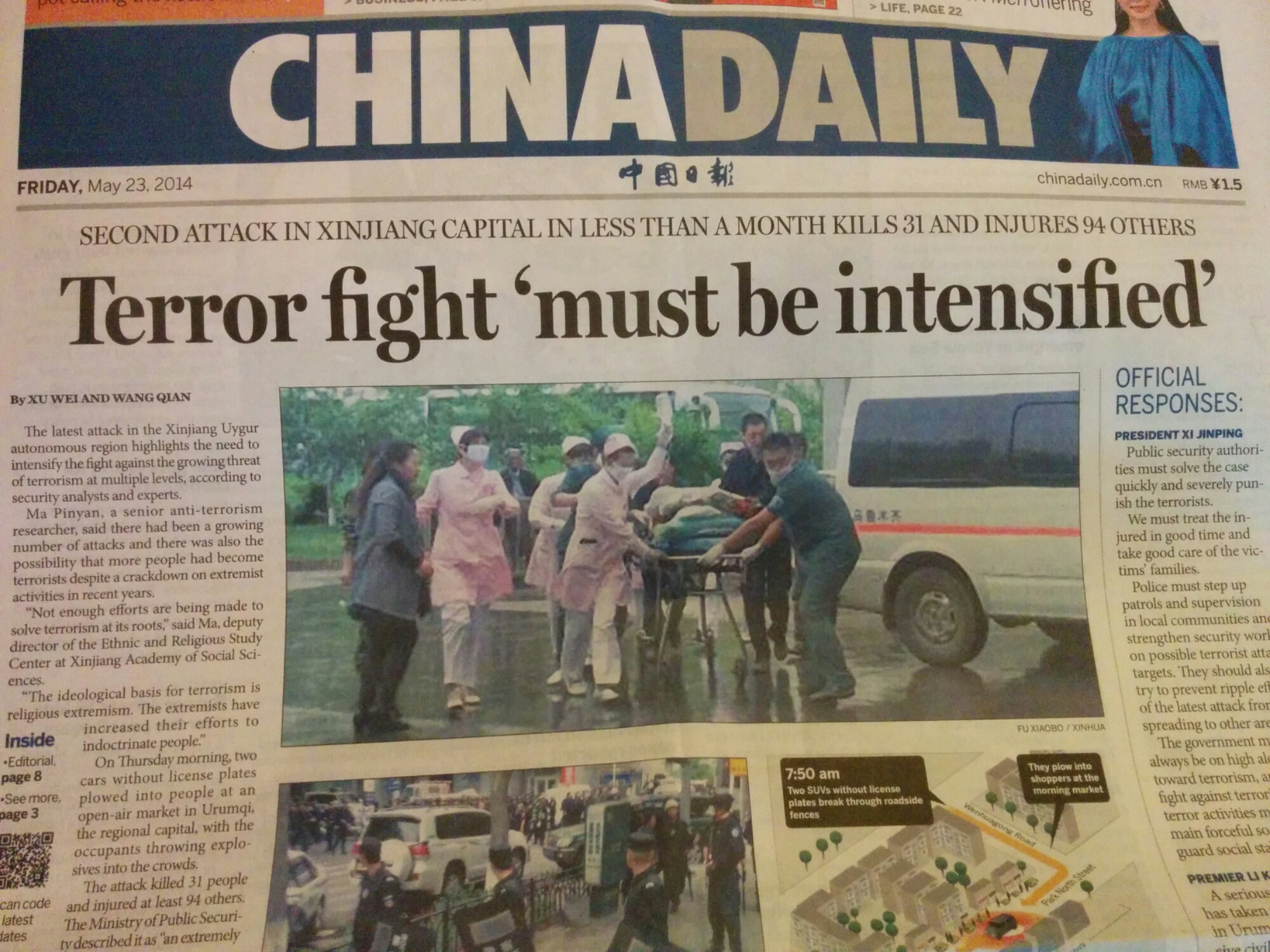
According to the China Daily…
” the ideological basis for terrorism is religious extremism”
Ironic that, from the party.
No, nothing. A blank.
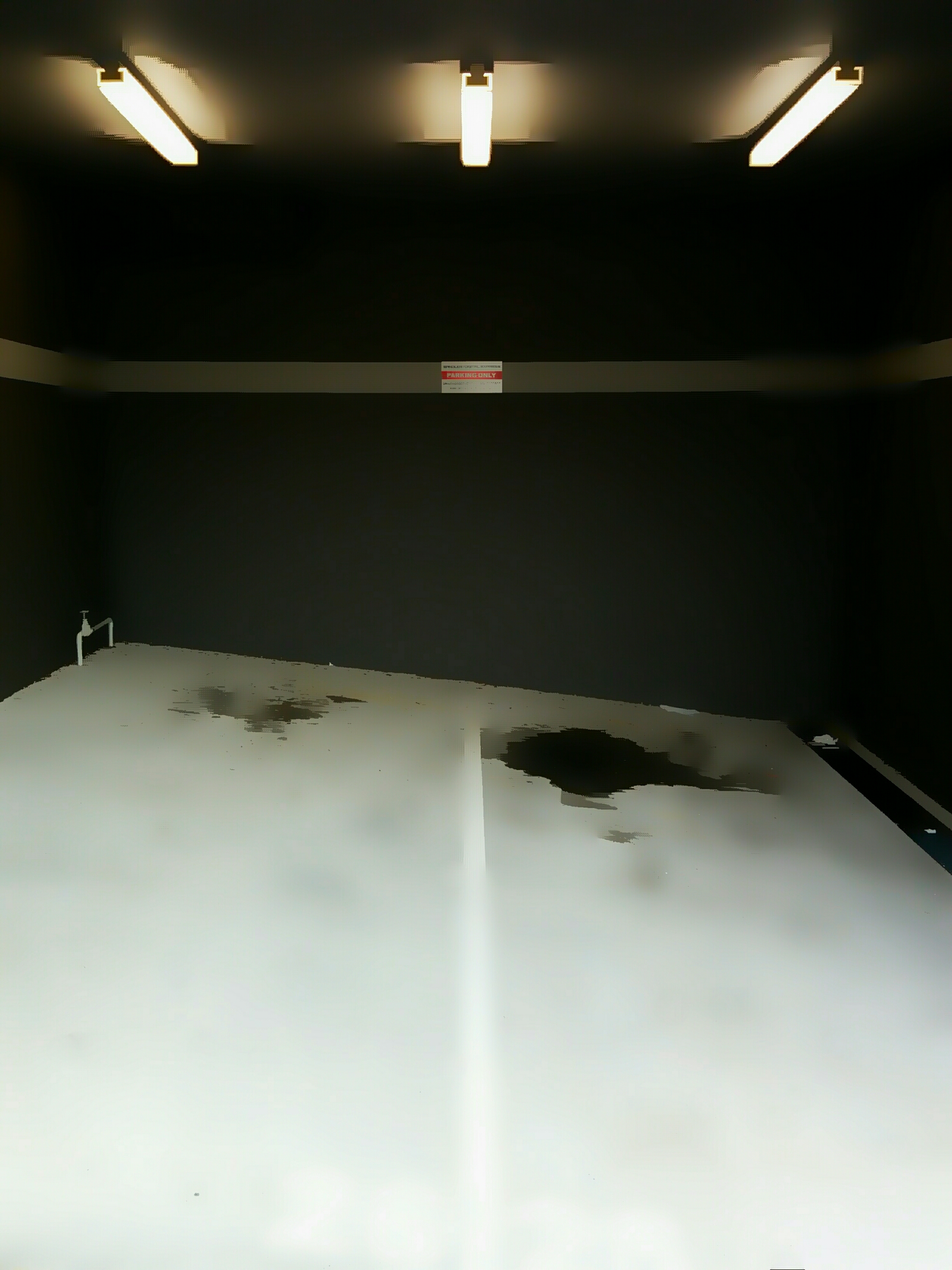
Macchiato Chinese style.

It’s an interesting debate, the one where you explain to your ten year old daughter that it’s in her best interests to be told what to do by her dad.
As opposed to her just doing what the hell she likes.
‘It makes no sense’ she says.
‘What, not to just eat sugar, watch tele, and sleep all day?’
I ask her if she would go to school if not forced to by her parents and the system.
She answers, ‘Of course not’.
‘There you see, if I let you do what you just wanted to then you would end up fat, lazy, uneducated and with no teeth. Later on you would struggle to get a job that pays well and then you wouldn’t have any money to do all the things you will want to do.’
I sense a slight hesitation in her surety.
And yet I hate resorting to arguments of conformity and affluence.
But it’s all she really cares about at this stage.
The whole point of an education is to learn that that conformity and affluence are false gods. But that takes a bloody good education, that does.

Have you noticed that just about the only internet vendors that are trying to charge for access to their content are refugees from old school broadcast monopolies?
Newspapers, TV stations, magazines, book publishers, record companies – they are having adjusting to the new reality. They miss their mummies.
Maybe their fixed costs are too high. Maybe they don’t have the courage to live off their advertising and marketing revenues. Maybe they simply don’t have the intelligence to know that they have to change.
The reality is that there are too many choices and users prefer free content, even it is of lower quality. Or they will rip it for free anyway.
Peddlers of content simply don’t have a monopoly any more and they never will again. It’s gone.
So you can’t peddle content, you fuckwits!
You have to peddle advertising and marketing and use free content to generate eyeballs to drive your revenue.
Geez, it’s not that hard to figure out!

It is truly a pity that life is so short and yet our imaginations are not so limited.
No wonder there is a belief in after-lives and multiple-lives.
My zeroth law of thermodynamics is that if you you can imagine it then it must be possible



When it doubt blow it all up.

Yesterday I felt like the day before’s baguette.
Only good for dipping in soup.
Today I am a freshly baked croissant.

Over the last couple of days the word ’empathy’ has been flying around my environment like a malaria-infested mosquito in the middle of a sleepless tropical night.
I believe that Empathy comes from the id, and it is felt. Sympathy, on the other, comes from the super-ego and is thought, more so than felt.
I also believe that empathy is the result of a number of factors; observation, processing of the observations, and caring. Because there are three steps there are plenty of opportunities for idiosyncratic empathy profiles within humans. For example, a person can be a great carer but a crap observer; this gets in the way of empathy.
But that is not the story I want to tell here.
I want to introduce the concepts of micro-empathy and macro-empathy.
I have noticed that some people have the capacity to be extremely empathetic but only in ’emergency’ situations. When a friend breaks up with their partner for example they can be superb in their empathetic support. I call this macro-empathy.
But the self-same people can be short on every-day empathy, which is what I call micro-empathy. An example is being aware that your noisy child is annoying the hell out of fellow cafe diner. Or that the long winded explanation on a banal subject isn’t helping get the message across; just the opposite. Or that your pen-friend really wants more than a one line response to her deeply thought-through missive.
I would also suspect that many people automatically and intuitively suppress their empathetic responses. Either because it suits them to, or they feel too thinly spread, or they just want to be selfish for a change.
All up, empathy is very complex and it’s no mystery that collectively we often seem short of the stuff just when we need it most. In response, the rules and laws in our society are constructed to reward empathetic behaviour.
But it is a case of two steps forward and one step backwards with humans and empathy.

This is quite the story…
At the weekend (love the ‘at’ eh?) Lola accidentally sprayed water over the neighbour’s fence whilst helping me garden.
Now apparently someone on the other side received some of this spray.
This particular neighbour is just one of those people. All the other neighbours are nice people and good for a friendly yarn. Not this one…
Some time later the neighbour accosted Lola and belligerently told her certain things and wouldn’t listen to her explanation that it was an accident.
Now in the old days, before the 1980’s, I would have simply gone over and belted the crap out of him.
Then from the 1980’s onwards, fearful of police involvement, that would have transitioned into terse words at ten paces.
Through to the new millennia where we it is likely that we will exchange opinions with carefully crafted letters with an eye to future legal action.
Fuck me, I prefer the old days to be honest. I grew up in a pub in Pyrmont and there was only way to solve any dispute. But the good thing was, once dealt with, it was over. Done and dusted and forgotten about except for the old drunks retelling the stories over and over (and fucking over). And hardly anyone ever died.
But reflecting upon this, sure, I probably could belt the crap out of my neighbour. But then he might call some old mates to create a bit of havoc on my being. And then I might call some even nastier old mates, etc. Or I would up in gaol.
So I guess as unsatisfying as the current letter exchange may be, it’s better than living in a vendetta environment.
Which brings me to the subject of Federal politics.
Tony Abbot, whilst in opposition, ushered in the era of total opposition. He and his party opposed every Labor policy without exception. They lied and told stories to the voters on every single issue. With the help of a corrupt media they successfully used this approach to win the last election.
And now it looks like Labor, which was absolutely traumatised by the experience, will respond in kind. Granted, they don’t have the full support of the media, but that won’t stop them.
So it looks like our Federal parliament is simply a paddock for political vendettas from now on. And one where libel does not and cannot exist.
Gee this is going to end well isn’t it?
It’s ironic that the source of all the laws, the ones that force us to exchange letters instead of throwing bricks, is the one place in the country that is heading the other way, towards vendettas.

Have you ever wondered why many consumer goods are heading to payment plans and away from payment at the point of consumption?
Well the explanation is very simple, finance 101 so to speak. But I just had a chat to a friend, who despite being very educated, had no idea.
So here goes…
Imagine a mobile phone user who uses $100 exactly a month on their phone bills (to make things easier).
On a two-year plan that would mean the phone company will receive $2400 over the two years, which is exactly what they write in the small print of their advertising (as they are forced to by regulation).
However if you are not on a plan and still use $100 per month of phone services, can you guess how much of your future revenues that they can be sure of?
The answer is $898.47.
That is, if their head accountant is sitting in her office looking at two customers with identical phone usage, but where one is on a two-year plan and the other is month-to-month, the accountant can forecast $2400 of revenues from one customer and only $898.47 from the other.
The calculation of the future revenues from the monthly customer is called a ‘net present value’ calculation and is subject to a ‘risk factor’.
For each industry and each business the risk factors can be easily calculated by comparing what actually happened in the past.
For example, if they had 100 customers paying monthly, over a two year period how much revenue did they actually get off them. Well its not $2400 per customer multiplied by 100 customers. Indeed it was much less because some customers changed phone companies, some went bankrupt, some went overseas etc which totalled to a ‘discount rate’ or a risk factor of 10%. In fact the actual revenue number they received was $898.47 multiplied by 100 customers.
Which begs two questions….
1. Why don’t pubs and clubs get their customers onto structured payment plans for their beers?
2. If there is a cartel-style monopoly like there is in Australia for phones, banks, supermarkets, building materials, etc etc – how can the risk factors be over 1%? That is, for any business in these cartels the risk of customer loss is almost fully offset by customer migrating away from their limited number of competitors. Oh that’s right our cartels have licences to print money… silly me. The wonder is why they even bother with payment plan structuring – they hardly need to.

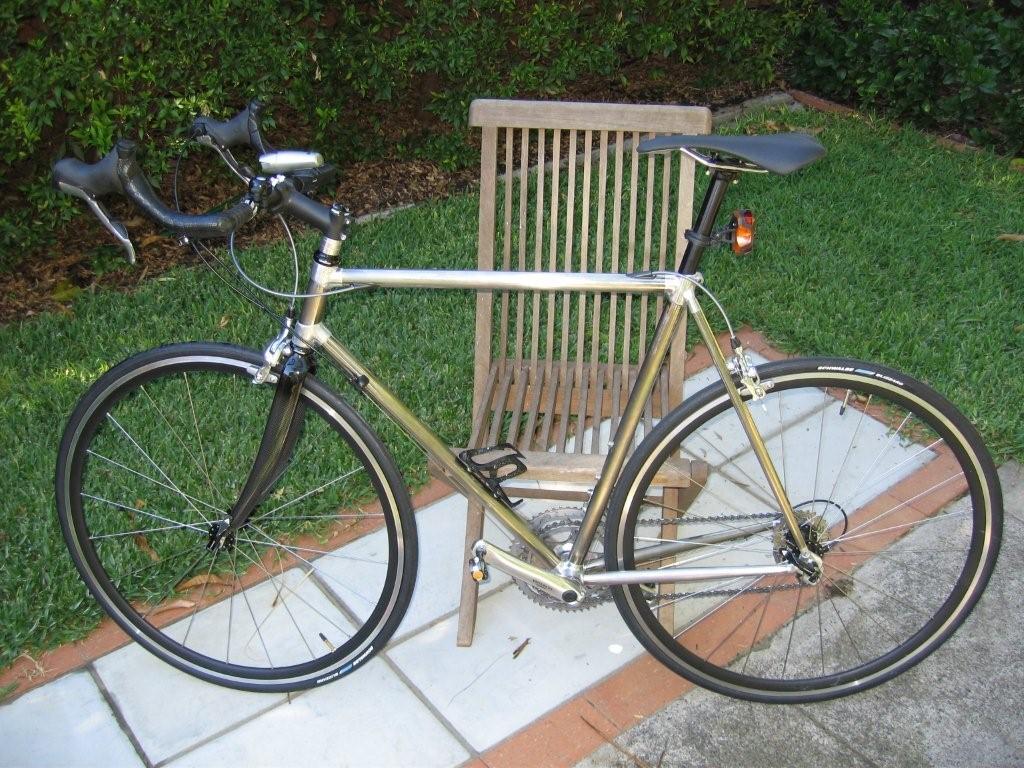
I have three bikes, one black, one red and one metal coloured.
More importantly the black one is carbon fibre, the red one is steel and metal coloured one is titanium.
I did have a black aluminium one as well but gave that to my niece. Compared to the other materials aluminium is a horrible material for a bike frame since it transmits so many vibrations and shocks to the rider. And I also have a shitty old steel pub bike but that is another story.
None of my bikes have any logos from manufacturers on them. My carbon frame which I bought in Taiwan for $200 is also sold to some brand name companies that flog it for $5,000. That is an expensive paint job!
If I had to pick one I would say that titanium is the best material for bike frames. It’s also the most expensive. It seems to smooth out all vibrations. And its lovely to look at. The carbon is the lightest and stiffest and I love it for that alone. The steel frame is the most honest and I do not have to fear it giving out on me at any time. It’s indestructible and cheap.
That’s a crap metaphor for life…I was going somewhere with story but have now forgotten. So I will post it as it is and update the entry if it comes to me.


After three days of NAPLAN tests Lola insisted on a mental health day, a.k.a. pulling a sickie.
Kids are soft these days.
And parents are even softer.
I have just read today’s tabloids – the Murdoch rag, and the Fairfax thing (it’s hard to say what it is these days), which has certainly slid a long way from quality journalism. But there is still a hint of pretence about it. I suppose we have to face the fact that quality journalism is likely to be a victim of the internet.
In any case the slide to unprofitably has meant that these tabloids are more amenable to the influence of interested parties. In the case of Murdoch it’s easy to see where the interests lie. For Fairfax it’s anyone’s guess whose vested interests they serve. They are all over the place and figuring it out is like trying to kill a moth with one hand, mid-air.
Today the subject of most interest in the Herald is the federal government budget.
The Daily Telegraph’s position is to ignore any impact of the budget; there is a small story on page 2 and the rest is on page 77 and 78. The editorial basically says that the opposition’s anti-budget stance is stupid. So we know where Murdoch stands – well we knew that already. He clearly wants more favours off the coalition.
The Herald, on the other hand, has pages and pages about the outrageous budget impact on poor people and some not-so-poor people. It also describes how the opposition parties in coalition are going to bring the government down etc etc. A slightly different position than the Daily Telegraph.
One laughable report was that of Joe Hockey trying to defend the $7 fee for visits to doctors, even for those that are bulk-billed. He claimed that it was the cost of a ‘middy’. You reckon someone in his office would have rung the Rooty Hill RSL and asked what a bogan pays for a beer eh? A schooner is about $5 and a middy is about $3.75.
There was a time once when I would have been quite interested in these issues. But in the main they are first world problems. The sense of entitlement in Australia is quite remarkable and even people struggling near the bottom of mainstream society often have the full suite of consumer goods.
Rather than just balancing the budget I would have been more interested in a story about investment in growth in the economy, and also the removal of unnecessary costs to living. The former speaks for itself but the latter does not.
In our lovely country there is a massive hidden cost to just existing. Conforming to thousands of regulations and laws includes a massive hidden cost. For example we have tax, traffic rules, business reporting, rules, safety rules, health rules, audit rules, and the list is endless. All of this adds to the cost of all goods and services. These added costs concatenate through supply chains making goods and services for consumers more and more expensive. Until we get the ridiculous situations that Australia now has the highest cost of living in the world despite that the fact that we have more resources per person than anyone other country on the planet.
The threshold wealth requirement for just being alive in Australia is quite remarkable. For those people nearer the bottom of the tree life could be made substantially easier if the cost of living was eased off. And this could be achieved very easily by removing the layers of rules and regulations that have been created by government.
But most Australians actually want all these rules. How do I know? Well whenever something bad happens to an individual (like their child gets hit at a pedestrian crossing, for example) they become passionate advocates for the introduction of new rules to prevent the thing ever happening again. Basically we are country of people that wants our government to solve all our problems. And we feel this is a moral as well as a legal right and obligation.
And that has lead to a situation where, for example, it is almost impossible to drop out of society. If you go mad and decide to live on the streets without any worldly possessions then you will immediately be in breach of a zillion rules and very likely you will end up in a series of micro-incarcerations and you will also be constantly harassed.
In our lovely country one doesn’t even have the unfettered choice to own nothing, earn nothing and to be left alone. That is, in Australia it is now an offence to be poor and happy.
And it’s this stress of existence, the minimal bar that is quite high, which leads to the existential angst over such a banal event as a federal government budget.
I can’t see things getting better. We have backed ourselves way into a cul-de-sac of moral and legal turpitude. And entropy is against us ever getting out of it.

My two least favourite words are ‘should’ and ‘deserve’.
And people would be much better placed if they worried about their obligations rather than their rights.
Pissing into the wind, I know.

My daughter just finished her year-5 NAPLAN tests.
These are some standard tests done by all students in the country and used by government to justify all their devious education policies. What you don’t measure you can’t control.
Her essay question was something like “if you had to break one rule or law which one would it be?”
Lola wrote an essay around breaking the rule that kids have to do the NAPLAN tests.
She hasn’t fallen far from the tree it seems.

I have been writing blogs and essays since 2011.
Initially it started as an interesting diversion, a hobby. And it still is.
At some point I started writing about the basket case that is the Australian startup tech industry. And since 2011 things have got much worse in this industry so my writing has had no influence whatsoever.
I have found that I am essentially the sole media critic of the industry despite the fact that I know many experienced people share my concerns. However they keep their opinions primarily to themselves.
This morning I had an interesting debate with a colleague. Despite my best attempts to explain certain structural flaws in the industry he couldn’t see my point.
And that crystallised in me the realisation of the futility of this Quixotic effort. The audience is by and large not only unreceptive, but in the main it is also incapable of following the arguments.
This could be because I am am a crap communicator or because of deep vested interests on their side, or even because they simply don’t have the education to follow my arguments.
Being generous, I have decided that the problem is in my communication. I have tried my best and it’s not good enough.
To wit I hereby give it up, this mug’s game. I have decided to spend my precious time on other things.
And I wish the Australian startup tech community the best in their endeavours. Please prove me wrong.
Over and out.
There is one very strong similarity between the venture capital game and online content.
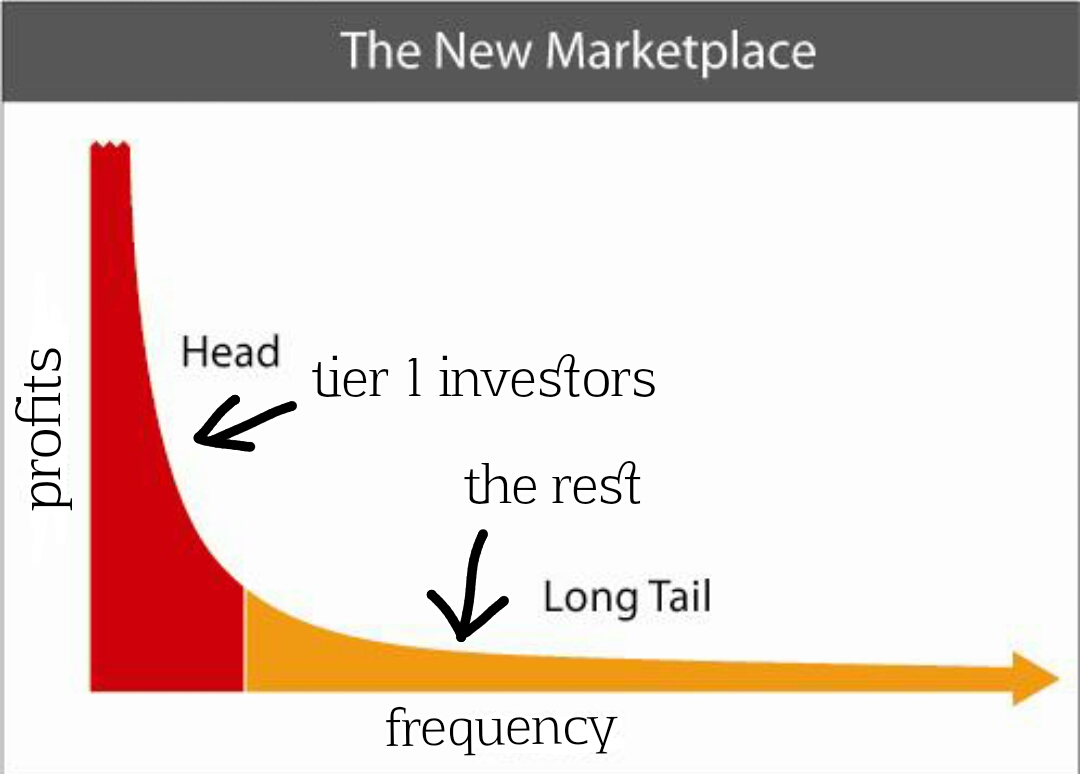
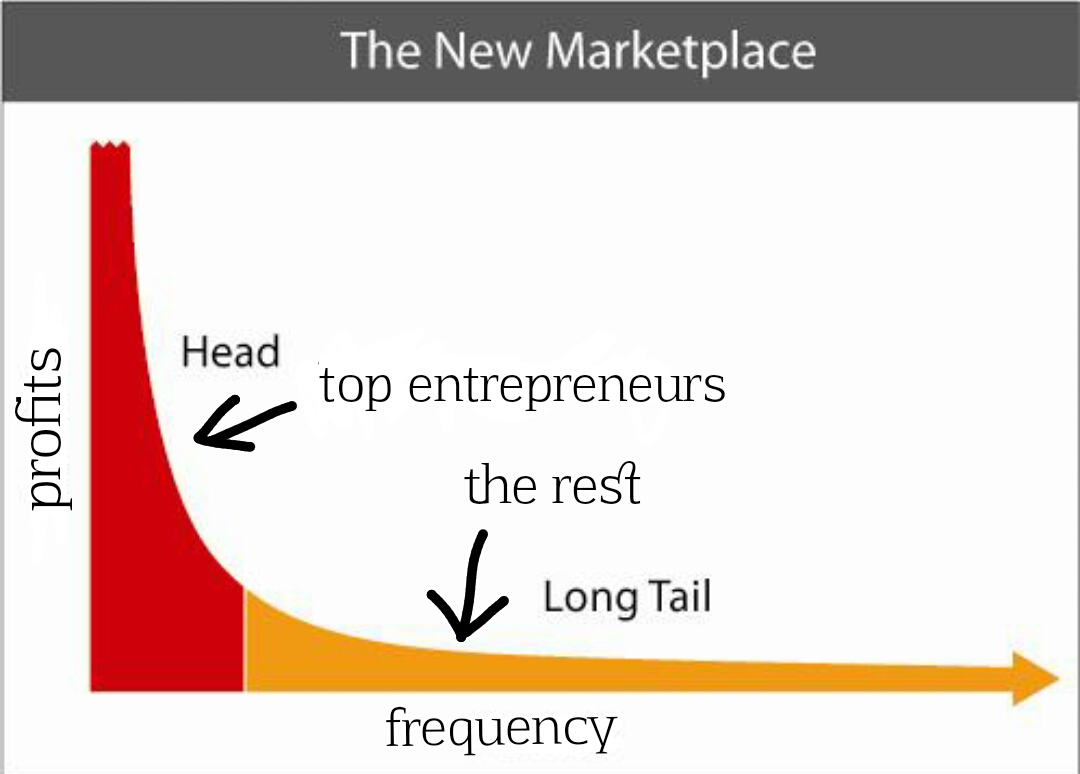
As industries they both conform to the ‘long tail’ principal whereby a few make money and the greater number lose money. See the plots below.
However venture capital has two such plots, one for investors and one for entrepreneurs.
One needs the intersection of successful investors and successful entrepreneurs for profits to be made.
If good investors intersect with entrepreneurs in the long tail then losses are assured.
If good entrepreneurs intersect with investors in the long tail then losses are assured.
If investors and entrepreneurs, both from their respective long tails, meet and do business then you can guess what always happens
Not surprisingly, these plots are self determining in that the good entrepreneurs will seek out the good investors and vice versa.
Both investor and entrepreneurs can only get into the ‘head’ of they are born with right stuff, are appropriately educated, and never get enmeshed with anyone in the long tail.
Those in the long tails can hope all they want but they mostly get what they deserve.
Switzerland is tiny yet they manage to make excessive money by exporting bullshit.
For example they make 2.5% of the world’s watches as measured by the number of units, yet this is 54% of the market for watches when measured be revenue. Annually they export $23b worth of watches, half the value of all Australia’s manufacturing exports. And these are just nice looking pieces of 19th century mechanical technology – they have the whole world fooled. They make massive margins on these dinosaur watches.
Another example is coffee. Switzerland imports raw coffee beans (2.6% of the world’s total), processes it, and then exports it as Nescafe coffee pods. By doing this Switzerland’s roasted coffee exports were valued at 49% more than the next largest exporter—Italy—even though the Swiss export 67% less volume.
Do you see the similarity in these two cases? These seemingly impossible scenarios are held up by a combination of quality, brand value, supply chain complexity, marketing, a little technology and a relentless drive to maintain and improve their market position. Oh, and they keep their manufacturing in Switzerland rather than outsourcing it to Asia. They can do this by making sure their margins are massive and by also investing in automated manufacturing technology.
We in Australia would see the Swiss watch and coffee pod industries as exports of manufactured goods and primary products respectively. The Swiss see these industries as complex and intricate machines that only they can build and manage.
It’s all a matter of perspective.
p.s. The team bus logos (painted on the side of the buses) for the Swiss and Australian soccer teams at the 2014 World Cup are respectively; “End Station: 13.07.2014 Maracana! Final Stop: 07-13-14 Maracana!” and “Socceroos: Hopping Our Way Into History“. Says it all really, doesn’t it?
A colleague of mine just wrote a gushing piece about the current batch of investors in Australian technology start-ups.
He is either deluded or maybe just spruiking the dead horse because it’s in his own best interests.
In truth, our tech investment community is so bad that it’s laughable.
Here are the problems in no particular order:
1. The funds are mostly undersized so we get the age-old problem of micro-investments by investors that end up choking their charges as they look to avoid excessive dilution in later rounds of funding.
2. Fund managers are deeply inexperienced. I can hardly think of a single person that has done the ten year apprenticeship as an associate or principal in a proper venture fund. In Silicon Valley this is a requirement before stepping into a GP role. You can’t learn this stuff in a text book and inexperienced fund managers almost by definition fuck it up, slowly.
3. You could throw a blanket over the amount of uncommitted capital in the system. My guess is that there’s only a couple of hundred million, or less, of genuinely uncommitted capital in the system. And that will be spread out over a thousand micro-investments.
4. Not one investor has any way of improving their deal flow. Australia’s tech dealflow is very bad which is reflected in a 30 year negative IRR on VC investment. Nothing has improved – it’s actually worse than ever right now. If you let the deals just spring out of the pavement like weeds in the manner that they always have then you are doomed. I for one would try something different like importing deals from Silicon Valley by offering great terms to them. Or something, anything, other than what has failed for 30 years.
5. I could go on, but what it the point?
Back to the gushing publicity that the tech sector receives. This is a business sector which is so sick that it’s almost dead. And yet about 99.9% of all media coverage is positive and upbeat. Like the publicity around an app yesterday that sets an alarm clock for your parking meter timing … really are people this fucking stupid that they think this shit is worth doing or talking about?
Why is the media coverage so upbeat? Well it’s delivered by or on behalf of vested interests seeking to extract money off fools. And the fools are either the government, ignorant investors, self-funded entrepreneurs (in the case of the incubators) and others. There is no vested interest in recognising the systematic problems. And there is virtually no educated altruism in the system either.
My view is that until there is a balanced and critical media coverage of this sector that things will not improve. As an example of what can happen one only needs to reflect on the sport of soccer which was until recently the basket case of Australian sport. The structural issues were written and talked about passionately in the media until eventually there was enough consensus for Lowy and the government to step in and invest in a genuine structural change and industry development. It looks like it’s going to work. See, we can do Chinese-style 5 year plans, but only in the business of sport.
In the meantime I would like to challenge the media outlets and the journalists covering the tech space to start practicing a bit of constructive criticism in the interests of the industry that they are serving.
At the moment the tech start-up sector in Australia is like the spoilt child that is always getting told that it is fantastic and never, ever, gets any discipline or constructive feedback. And we know how likely it is that these spoilt and deluded kids end up doing anything constructive, don’t we?
With debt you need to consider…
1. Not all government debt is bad. Sometimes it’s for investment into infrastructure or education or somesuch which generates profits above and beyond the cost of borrowing the money. This is good government debt
2. Bad government debt is stuff that is borrowed for spending on bribing voters and is not spent on anything that generates income to repay the debt. Social equity spending really should be funded out of recurring tax revenues so that it stays within our capacity to maintain it.
3. The total (all) government debt in Australia is about $650b. I reckon less than one third of this is ‘productive’ in that it pays itself back by generating wealth.
4. Business debt is $744b. Possibly over 90% of this wealth generating.
5. Household debt is $1500b. Housing debt is $1350b. and there are a few other categories. All up private debt comes to $2230b, dwarfing government debt. Most of this is not wealth generating but much less of it is foreign debt than government debt.
6. Savings via Superannuation are $1600B
7. I am not sure how much the banks have on their books. But all up the country balances, in a balance sheet fashion. By definition.
8. The govt needs to keep borrowing for a number of reasons. First, the cycle of bribing voters at elections. Second, the need to set a bond rate which then also sets the interest rates and is their sole micro-lever on the economy these days. Third, the ability to invest ahead of tax receipts in big wealth generating projects. It also allows them to respond to economic depression by investing in projects that stimulate private spending.
9. Our govt can’t devalue the A$ by ‘printing’ (actually created in the RBA and lent to the 4 banks) money because this would devalue our currency and our foreign repayments would go up, offsetting any economic benefits by having a more valuable export industry and lower demand for imports. The only way to solve this is to borrow locally from the super funds exclusively. They have the capacity to do this but the low returns to the superfund holders would be a political issue.
10. If our foreign borrowings (of all types) collectively get too large because the income from the borrowing do not repay the loans entirely (primarily because we are borrowing for lifestyle upgrades) then we run out the capacity to fully repay them> in which case we sell assets (like farms, houses, office blocks, national business etc). Which is what we have been doing for 20 years. Eventually we run out of assets and we then learn to readjust our lifestyle expectations or else face a horrible correction when our economy hits the wall.
 offshore westerly