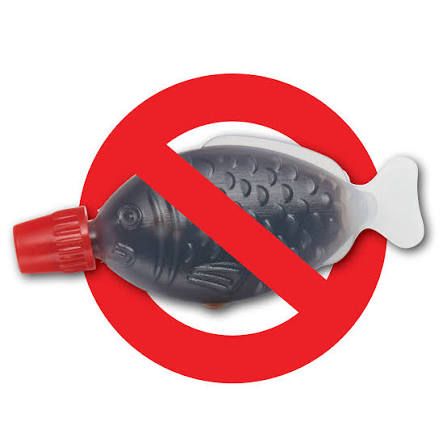
How not to solve a problem
Ok the Australian govt is about to ban soy sauce fish containers.
Me; What do we do to resolve the issue for the consumer?
GPT; The consumer wants a small, cheap, hygienic, convenient quantity of soy sauce to accompany takeaway sushi. They want to dispense it without making a mess and dispose of the packaging afterwards.
The plastic fish solves most of these requirements exceptionally well. The problem is the packaging material and its disposal, not the functionality.
The solution should preserve the fish’s useful characteristics:
- Single-serving quantity, approximately 3–5 mL.
- Airtight, shelf-stable packaging that does not leak.
- One-handed dispensing with reasonable control over the flow.
- Low manufacturing and filling costs.
- Easy distribution with takeaway sushi, without requiring the customer to carry a reusable container.
- A disposal pathway that meets applicable regulations and preferably reduces environmental impacts.
The practical options are a fibre-based sachet with a suitable barrier coating, a small recyclable container compatible with collection systems or a dispensing station for customers eating immediately.
For product development, I would investigate a paper-based squeeze sachet with a narrow dispensing spout. The critical engineering challenge is achieving oxygen and moisture resistance, reliable seals and controlled dispensing without making the package non-recyclable.
There is also a regulatory complication: NSW requires single-serving condiment packaging to be recyclable by the end of 2030, while South Australia already prohibits the conventional rigid plastic fish. A replacement must satisfy both regimes.
The first experiment should compare the traditional fish, a conventional sachet and a coated-paper prototype on leakage, shelf life, dispensing performance, unit cost and actual end-of-life disposal.
Me; Why not just have a big dispenser at the shop?
GPT; The principal constraint is takeaway consumption. Customers who eat elsewhere still need a leak proof way to transport their soy sauce.
Me; They could just buy their own soy sauce bottle and keep it at home or work. Or eat their sushi on the spot like normal people.
GPT; Yes. Customers eating immediately can use a dispenser at the shop. Those wanting soy sauce elsewhere can use their own bottle.
That eliminates single-use condiment packaging rather than attempting to engineer a disposable substitute.
The trade-off is a small loss of convenience for customers who expect complimentary soy sauce with takeaway sushi.
Me; Is it reasonable to save the planet and expect no inconvenience?
GPT; No. Reducing environmental damage will sometimes require consumers to accept inconvenience, higher costs or changes in behaviour.
The assumption that every environmentally beneficial change must preserve existing convenience creates demand for elaborate substitutes, such as Holy Carp!, when eliminating the disposable product altogether may be simpler and more effective.
The relevant question is whether the environmental benefit justifies the inconvenience, not whether inconvenience can be eliminated.
In the case of soy sauce fish, the inconvenience is trivial. The environmental benefit still needs to be established rather than assumed.
Me; there’s no evidence that soy sauce bottles end up as litter, choke turtles, help create the plastic island in the Pacific, or end up as harmful microplastics in the brain, is there?
GPT; a two page essay which essentially said “no”
When pressed the machine admitted that the only evidence for soy sauce fish litter in Australia came from one study that found 14 of them over an 18 month period on a Victorian beach.
This evidence was then extrapolated to fuck, and here we are. Anyway, I’m guessing the study was salted by the crazy anti plastic volunteers that undertook it.
Seriously, this ban is based on some evidence cooked up by a bunch of loonies on one beach in Victoria. God help this country.
In this exchange, GPT reproduced several common human reasoning failures: accepting the problem as presented, assuming intervention was necessary, optimising a solution within those assumptions and failing to examine the underlying evidence.
It generated elaborate, apparently rational arguments that concealed these failures, demonstrating that producing the language and structure of critical thinking is not the same as actually applying it.
Ironic, but not surprising, that artificial intelligence is just replicating human stupidity.
That’s the same stupidity, btw, that suspects these machines are destined to kill us all.