
Potholes
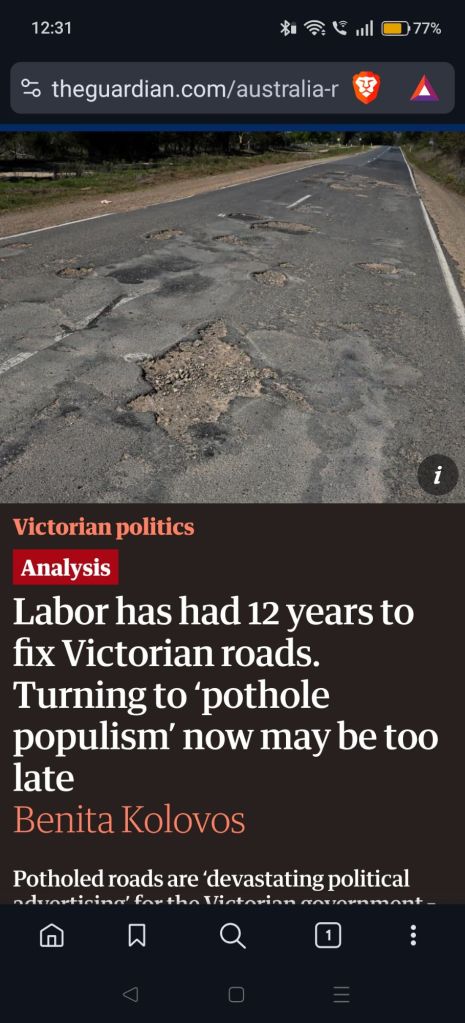
I noticed the other day that the broadcast media picked up and ran with a story about evil potholes in Victoria roads.
Roughly, the media trajectory was: existing public complaints → competing election promises → Auditor-General report → former insiders and talkback → fatality apparently involving a pothole and an old bloke on a motorbike → reports of prior warnings → RACV survey.
My nephew is all over it and very concerned about these potholes all of a sudden.
Similarly he wants to bring back coal burning power stations as well as have them introduce nuclear power plants.
He wants data centres banned.
And there’s more.
There’s a few factors at play here;
The media will run with anything that attracts eyeballs and sells ads.
The media is short of good scary content so they really push whatever shit they have.
Vested interests are quite good at getting their bullshit to the top of the list, primarily with social media manipulation.
Most importantly, the average standard of living is dropping. Which means people are disgruntled.
When they are disgruntled they will attach their little brains to any issue that is promoted, so they can legitimately bag the government of the day.
The forlorn hope is that the government will see through the subterfuge and fix the standard of living problem, as if they control the economy.
For example the Victorian government could get every street in Victoria billiard table smooth and the disgruntled would just move onto another issue.
If you think it’s bad now, just wait until the barely employed start defaulting on those mortgages for all their rental properties.
So, here are the symptoms – someone who showed no particular concern about Victorian road surfaces two weeks ago encounters repeated pothole stories on morning TV, the evening TV news and on social media, and suddenly regards potholes as an important political problem.
The missing cognition is: “Why do I suddenly care about this? Has the underlying problem changed, or merely my exposure to it? How important is this problem relative to other problems? Who is supplying this information? What would constitute evidence that the government’s response is inadequate? If the potholes disappeared tomorrow, would my assessment of the government actually change?”
But the overarching phenomenon that is worth examining is the apparent absence of the metacognitive question: “Why am I thinking about this particular thing today?”
If they could just stretch to that extra step they would find the means not to worry about any of it.
 offshore westerly