
42 Revisited
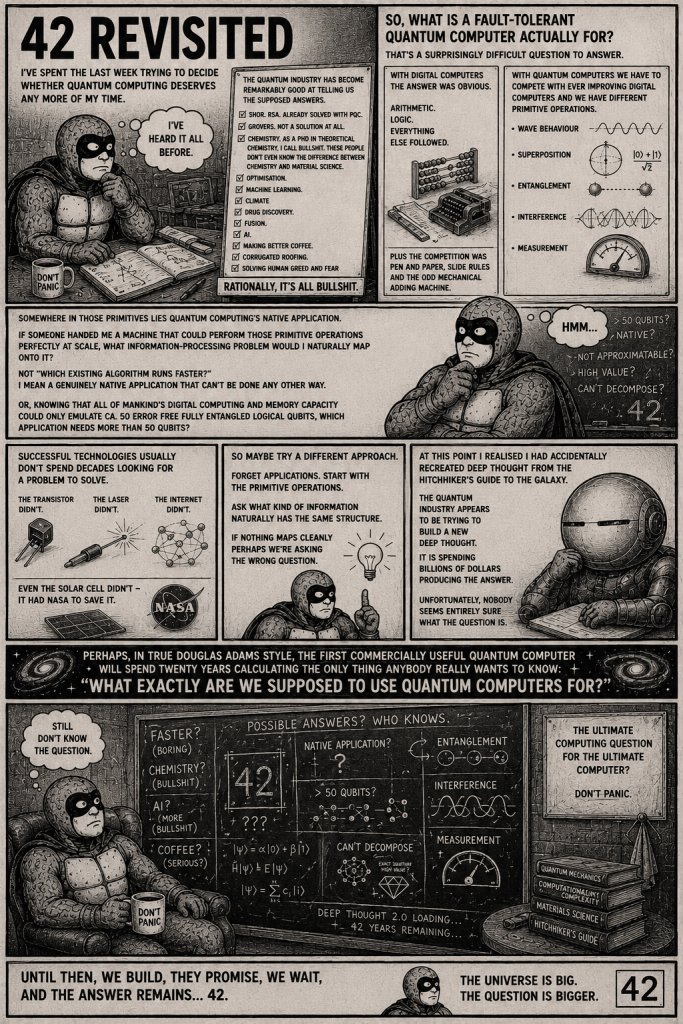
I’ve spent the last week trying to decide whether quantum computing deserves any more of my time.
The quantum industry has become remarkably good at telling us the supposed answers.
Shor. RSA. Already solved with PQC.
Grovers. Not a solution at all.
Chemistry. As a PhD in theoretical chemistry, I call bullshit. These people don’t even know the difference between chemistry and material science.
Optimisation.
Machine learning.
Climate.
Drug discovery.
Fusion.
AI.
Making better coffee.
Corrugated roofing.
Solving human greed and fear.
Rationally, it’s all bullshit. So, what is a fault-tolerant quantum computer actually for?
That’s a surprisingly difficult question to answer.
With digital computers the answer was obvious.
Arithmetic. Logic. Everything else followed.
Plus the competition was pen and paper, slide rules and the odd mechanical adding machine.
With quantum computers we have to compete with ever improving digital computers and we have different primitive operations.
Wave behaviour
Superposition.
Entanglement.
Interference.
Measurement.
Somewhere in those primitives lies quantum computing’s native application.
If someone handed me a machine that could perform those primitive operations perfectly at scale, what information-processing problem would I naturally map onto it?
Not “Which existing algorithm runs faster?”
I mean a genuinely native application that can’t be done any other way.
Or, knowing that all of mankind’s digital computing and memory capacity could only emulate ca. 50 error free fully entangled logical qubits, which application needs more than 50 qubits?
Successful technologies usually don’t spend decades looking for a problem to solve.
The transistor didn’t.
The laser didn’t.
The internet didn’t.
Even the solar cell didn’t – it had NASA to save it.
So maybe try a different approach.
Forget applications. Start with the primitive operations.
Ask what kind of information naturally has the same structure.
If nothing maps cleanly perhaps we’re asking the wrong question.
At this point I realised I had accidentally recreated Deep Thought from The Hitchhiker’s Guide to the Galaxy.
The quantum industry appears to be trying to build a new Deep Thought.
It is spending billions of dollars producing the answer.
Unfortunately, nobody seems entirely sure what the question is.
Perhaps, in true Douglas Adams style, the first commercially useful quantum computer will spend twenty years calculating the only thing anybody really wants to know:
“What exactly are we supposed to use quantum computers for?”
—
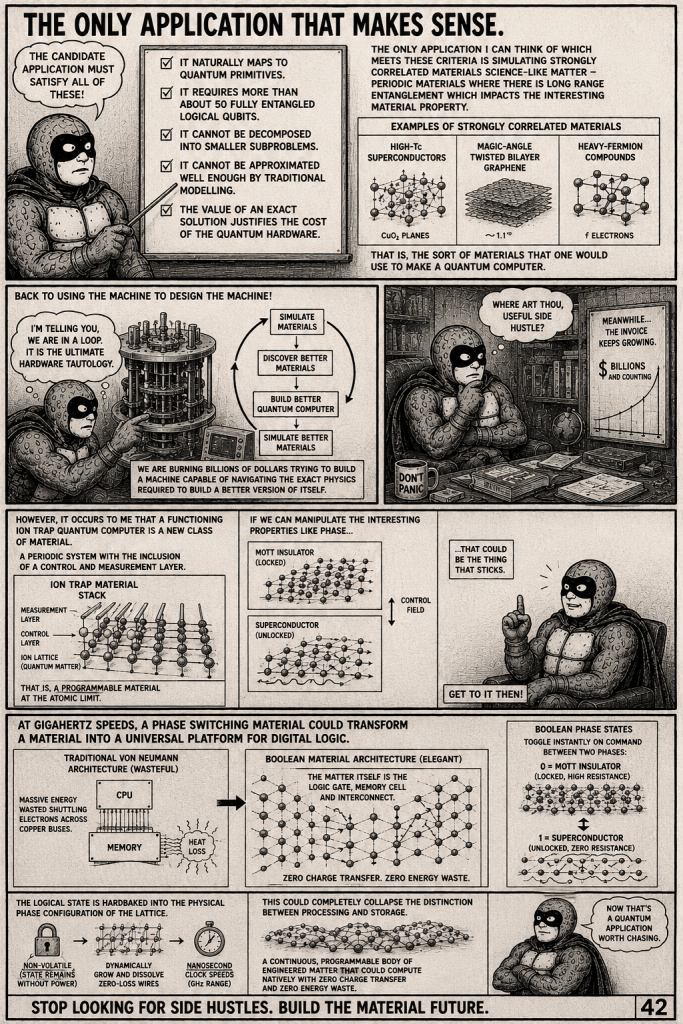
The candidate application must satisfy all of these:
• It naturally maps to quantum primitives.
• It requires more than about 50 fully entangled logical qubits.
• It cannot be decomposed into smaller subproblems.
• It cannot be approximated well enough by traditional modelling.
• The value of an exact solution justifies the cost of the quantum hardware.
The only application I can think of which meets these criteria is simulating strongly correlated materials science-like matter – periodic materials where there is long range entanglement which impacts the interesting material property. Examples are things like high-temperature superconductors, magic-angle twisted bilayer graphene, heavy-fermion compounds, etc.
That is, the sort of materials that one would use to make a quantum computer. Back to using the machine to design the machine!
I’m telling you, we are in a loop. It is the ultimate hardware tautology. We are burning billions of dollars trying to build a machine capable of navigating the exact physics required to build a better version of itself.
Where art thou, useful side hustle?
—
However, it occurs to me that a functioning ion trap quantum computer is a new class of material. A periodic system with the inclusion of a control and measurement layer. That is, a programmable material at the atomic limit. If we can manipulate the interesting properties like phase (say between a Mott insulator and a superconductor), that could be the thing that sticks.
At gigahertz speeds, a phase switching material could transform a material into a universal platform for digital logic where the matter itself could act as the logic gate, the memory cell, and the interconnect simultaneously. Instead of traditional Von Neumann architectures that waste massive amounts of energy physically shuffling a cloud of electrons across copper buses between a discrete CPU and memory, a Boolean material could store binary states – instantly toggling on command between a zero-resistance superconducting pathway and a locked Mott insulator. Because the logical state could be hard-baked directly into the physical phase configuration of the lattice, it could remain perfectly non-volatile when the control field is removed, allowing you to dynamically “grow” and dissolve zero-loss digital wires on demand at nanosecond clock speeds. This could completely collapse the distinction between processing and storage, creating a continuous, programmable body of engineered matter that could compute natively with zero charge transfer and zero energy waste.
Get to it then!
 offshore westerly