
Something for Dave
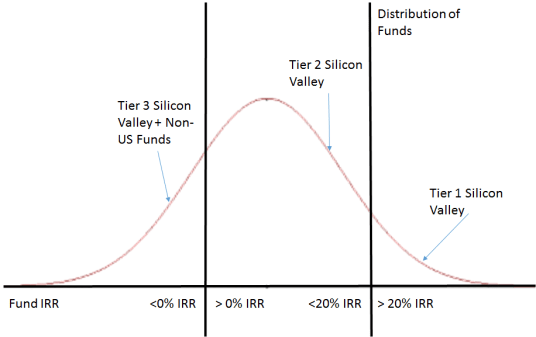
With reference to the plot below, this is how VC has worked for decades.
A small number of large funds in Silicon Valley have the best contacts, the best exits, the most money, the best reputation, hence the best deals and the consistently profitable returns.
However, these returns rely on the continued existence of the two other classes of VC that either don’t make enough profit, or even lose money (as per the plot).
What I mean is that:
- The best of deals invested in by the Tier 2 and 3 guys are picked up by the Tier 1’s that then proceed to rape the Tier 2’s and 3’s when they can’t participate in larger rounds, and
- The deals that the Tier 2’s and 3’s invest in help feed the frenzied pool of talent thereby curating the environment whereby the successful entrepreneurs and staff, destined for Tier 1 investments, can rise to the top.
In this context VC is a sot-of Ponzi scheme for those that don’t happen to get to invest in Tier 1 VC funds and manage to invest in Tier 2 and 3 VC funds.
This Ponzi scheme only works because it’s very easy to continually find new fools to fleece, like the Australian government.
And the good news; there’s enough new fools around to keep the scheme running forever. In favour of this Ponzi scheme continuing is the fact that the systematic failure of Tier 2 and 3 VC funds is often obscured by GFC’s and the like.
 offshore westerly
Sounds a bit linear Ian. You of all people should know that reality is not so convenient.
Alternatively, what was my first clue? Could it have been 10 years in pre-seed?
Your biggest fan,
Dave
All I know from a study of the data is that over the last 30 years that more money has gone into VC than has come out and YET a handful of Tier 1 investors have continued to get 50%+ IRR on fund after fund, from before the semico era through dot.com era, photonics bubble, web 2.0 era, 2008 and the unicorn era.