
The Three Beliefs of Commodity Technologies
Don’t you just love it when journalists get all excited by technology and then just get it all wrong?
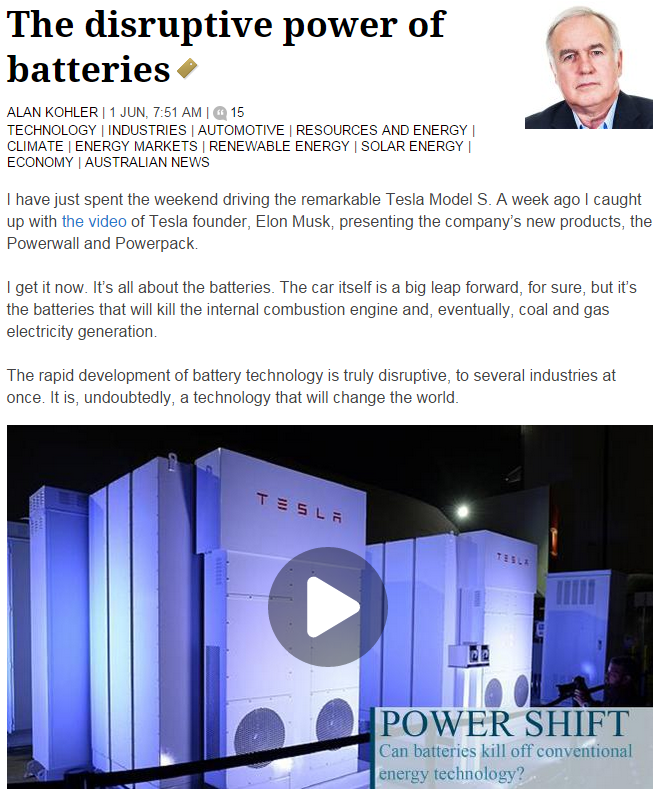
Case in point; Alan Kohler, an investment expert, waxing lyrical on the future of electric cars and electricity storage. See below.
Now he has either bought the happy high herbs being pedalled by Elon, or he has a financial interest in the things.
Batteries have been around forever. Each new generation of battery technology was introduced because it offered an opportunity for better performance at a better cost than the then incumbent technologies.
In each case, eventually, after years of development and scaling-up of production, the beneficial costs of mass production are yielded.
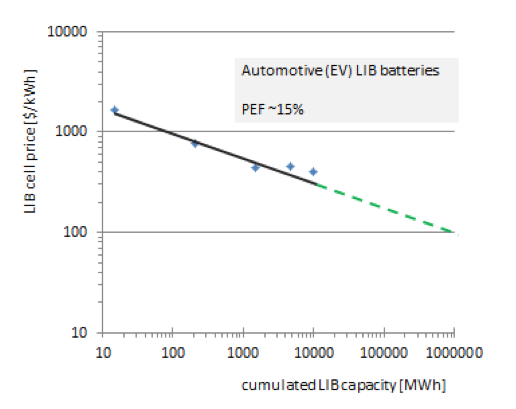
In fact, like so many commodity technologies, battery technologies follows a classic ‘learning curve’ where improvements in technology and increases in the scale of production provide a 20% improvement in cost per energy unit for every doubling of the shipped volume of batteries.
Elon’s latest histrionics for lithium-ion based batteries will not change this. They will just ensure that the learning curve is adhered to.
For the record, here my three beliefs of Commodity Technologies:
The first belief for the production of the commodity technologies is that learning curves are adhered to until they are not.
The second belief for the production of commodity technologies is that that any effort to create a sustained improvement to the learning curve is doomed.
The third belief of production of commodity technologies is that a commodity technology will be replaced when the rate of cost improvement per unit of production drops below the long-term learning curve average and stays there.
And for some reason, the magic number for most learning curves is around a 20% improvement in cost per unit for every doubling of the shipped volume of whatever the manufactured commodity technology is. This is either a reflection of some fundamental theoretical economic fact that has yet to be understood, or simply another example of what Douglas Adam’s called Bistromathics.
 offshore westerly
I read this as a general assertion of uncertainty and probability. The whole manifestation is iterative. Every theory is a moment in time, and temporarily true at best (with rare and elegant exceptions). Many a successful deal are cut over bistromatics, where, (depending on the company and what is served), intention can coalesce in a way that drives outcomes with power that can stun market forces. Stranger than fiction, Bistromathics could in fact be the mystic Entrepreneur’s secret weapon.