
Why Experts and Creatives are both useful and useless
This is worth a read – “Why experts reject creativity” @ http://theatln.tc/1Eh8Zlh
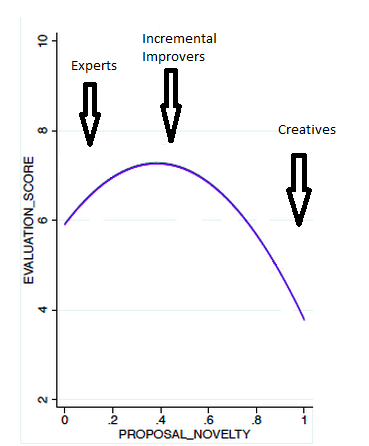
The article presents data (see the graph below) that shows that we, the children of the enlightenment, are biased towards incremental improvements.
The blue line represents the perceived future benefits versus the ‘novelty’ of an idea or a project. That is, return versus risk.
Although this is a ‘perceived’ view of risk ahead of a project being executed, it pretty much matches reality. We can say this because we, the human learning machines, have learned to collectively assess risk over many, many cycles of projects. This ‘evolutionary’ capability is in fact the basis of economics – but that is another story.
You may note that this curve is actually a transform of the usual risk-return curve. The evaluation score is related to “return” and the “proposal novelty” is just risk.
According to this graph we perceive that big new creative ideas have poorer risk-return profiles than the more incremental ideas in the middle of the graph. And very low risk (business as usual) ideas also have a poorer risk-return profile. It’s pure statistics; the enlightenment taught us all about reversion to the mean, together with the power of incremental and continuous improvements.
The article also documents that experts often have a bias against creative ideas and their progenitors. This, it is hypothesised, is because:
“A real or self-proclaimed expert [is] impatient with new ideas, because they challenge his ego, piercing the armor of his expertise”.
I would go a step further and say that people often become experts because they lack creativity. See where I have placed them on the graph below.
Creative types tend to work in an area, master some new variation and then, driven by a curiosity that always needs the ‘new’, move on to new areas, rather then hanging around as experts. Creatives are at the other end of the graph (see below).
Hence there is a natural antipathy between the two types – it’s just a personality clash. Neither of them are ‘right’ or ‘wrong’ – they are both there to do their bit and to protect the system against the undue influence of each other. And hence, sitting in between the two, the incremental improvers dominate (see graph).
Now occasionally some genuinely new idea gets funded and becomes successful – the example in the article is the iPhone.
The authors point out that is very difficult for these types of high risk innovations to get funded because of the perceived poor risk-return profile – which just happens to match the real risk-return profile based on a statistical number of prior experiences.
I would argue this is as it should be. By making it tough for super creative ideas to get funded, only the very motivated creative types get their ideas over the line. And only the very motivated creative types have the energy to offset the inherently higher risk factors of their ideas.
It all makes sense.
As a final comment I should note that broadly speaking there are two types of creatives; the conceptuals and the experimental innovators.
Experimental innovators continue to create throughout their lives, often improving with experience. Think Henri Matisse. Missing an early hit, my guess is that they often feel unappreciated early on which provides continuing motivation.
Conceptuals usually have an early ‘big bang’ period of creativity. Think Albert Einstein. After this initial bang the conceptuals either reconcile to eating a lot of dinners off their early efforts or spend the rest of their lives futilely trying to recapture the incapturable.
My guess is that many conceptuals morph into experts after the glow of the early hits has faded. Just a hunch.
 offshore westerly