
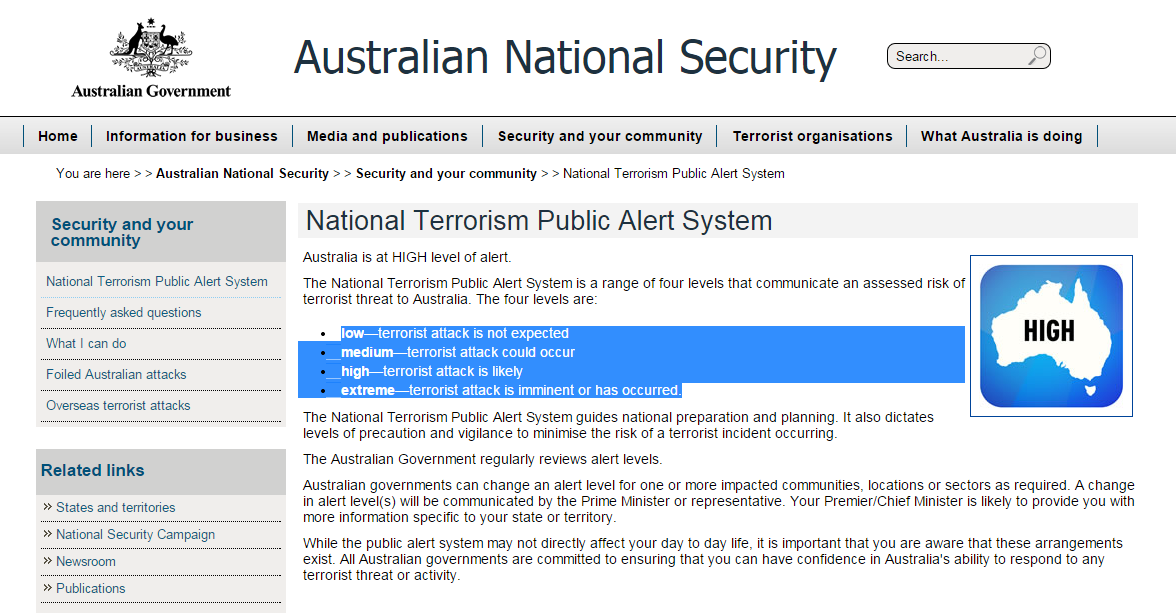
National Terrorism Public Alert System
[Scene] Sydney Taxi.
The driver has ABC news radio on. Which is a nice change from Alan Jones and his like.
I hear that there is some animated debate about our current state of terrorist alert.
A quick web search later and I find this:
“National Terrorism Public Alert System
- low—terrorist attack is not expected
- medium—terrorist attack could occur
- high—terrorist attack is likely
- extreme—terrorist attack is imminent or has occurred.”
This reminds me of our sales pipeline excel spreadsheet.
I used to let the sales guys give a % likelihood of converting suspects to prospects and then to customers.
Now if they find a new suspect this automatically gets a 5% probability, so it doesn’t over-weight the sales forecast. If it hasn’t moved up the probability chart within 3 months it is automatically excised.
If we start talking specs and terms with a suspect they move into ‘prospect’ mode and get a 33% probability of conversion.
If we are negotiating contracts they move to 66% probability and pre-customer status.
Once a contract is signed they become a customer at 100%.
After one year, the moving average of the forecast (i.e. the comparison to what we predicted versus what happened) is used to adjust these fixed percentage values for the next year.
The benefit of this scheme is that it can be measured and calibrated and also it can’t be sneakily played with by the salesmen to snow the CEO, or sneakily played with by this CEO to snow his board.
Now back to the terrorist alert system … here’s my criticisms:
1. They need to assign a time period to the alert. Even a bushfire alert is only good for 24 hours.
2. They need to assign a probability to an alert and within a time period
3. This way, for example, if they say there is a 10% chance of an attack in one week, and after ten weeks of this and there being no attacks, then they know they were over-doing it and could drop it to 5%, etc.
4. The issue with the qualitative alerts that they have is that the words mean different things to different people. Especially considering a good whack of Australians have English as a second language.
5. And ‘extreme’ is extremely silly – how can the same level of alert be applied to an attack that might be imminent and to one that has occurred?
 offshore westerly