
Postie Logic
The postman problem, as posted by a friend, relates to the most efficient route for a postman to take for deliveries of mail. ‘Efficient’ in this context means the least time to achieve the delivery of mail to say 40 or 50 houses.
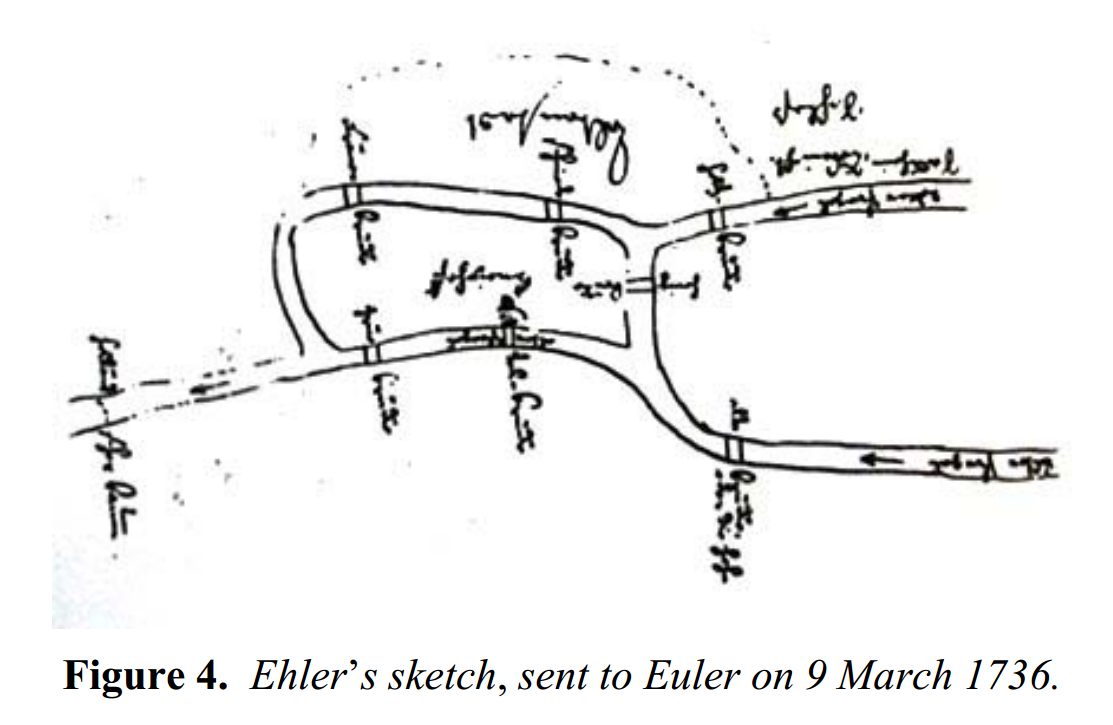
In the modern era we might solve this problem with a computer. A simple algorithm would be developed to calculate the shortest distance amongst all the options of routes; the variance between the routes being due to doubling back and the like as required to get to all the houses. I refer you to ‘The Bridges of Königsberg’ problem, solved analytically by Euler, if you are confused by this.
But a normal non-Eulerian human would solve this problem very differently. Maybe glancing at a map the postman would guess a route in a few seconds and then try it out. Over a few days with real experience on the ground he might re-calculate the route and improve on it.
It is possible that the human approach never quite achieves the computer-generated perfect solution. But then the postman knows that he gets paid by the hour and not by the inverse of the kilometre. So he doesn’t really care if he has the most efficient route.
Australia Post might employ some tech gurus to provide an internal service for route mapping using computers. But even so you would find that 9 times out of 10 the postie would find a reason not to use the most efficient route. There might be a great to spot for a smoko that is passed at the wrong time on the efficient route. Or it might entail going up a steep hill instead of down it. The people that own the computers would not recognise these factors as legitimate input into their software.
A human solves these problems very quickly by relaxing the requirements of the solution to reduce the complexity of the problem. And then feedback from trial and error is used in successive efforts to improve on the first guess. Humans sort of instinctively know where the Pareto rule is – that is, where the effort required to get a ‘better’ solution doesn’t deliver demonstrable extra ‘value’.
Or at least we used to. I have this suspicion that this type of common sense is being lost.
The description above skimmed over one critical point – the fact that a human can look at a map and guess a good (if not perfect) route in an instant. Whereas a computer would take much longer even if we relaxed the constraints of what a good solution is. How is this? Unlike a computer we can ‘see’ the whole map and visualise various routes superimposed on it and even estimate their differential length, all in a flash and in our heads.
The latest on the subject from some academics (which could be 100% wrong – it is still early days) assumes we are running algorithms in our brains, i.e. we are bio-computers, but they haven’t a clue what these algorithms are – all they know is which parts of the brains light up:
“Mounting evidence suggests that core object recognition, the ability to rapidly recognize objects despite substantial appearance variation, is solved in the brain via a cascade of reflexive, largely feed-forward computations that culminate in a powerful neuronal representation in the inferior temporal cortex. However, the algorithm that produces this solution remains poorly understood. Here we review evidence ranging from individual neurons and neuronal populations to behaviour and computational models. We propose that understanding this algorithm will require using neuronal and psychophysical data to sift through many computational models, each based on building blocks of small, canonical sub-networks with a common functional goal.”
 offshore westerly