
Ever feel like you’re getting squeezed by the nanny state?
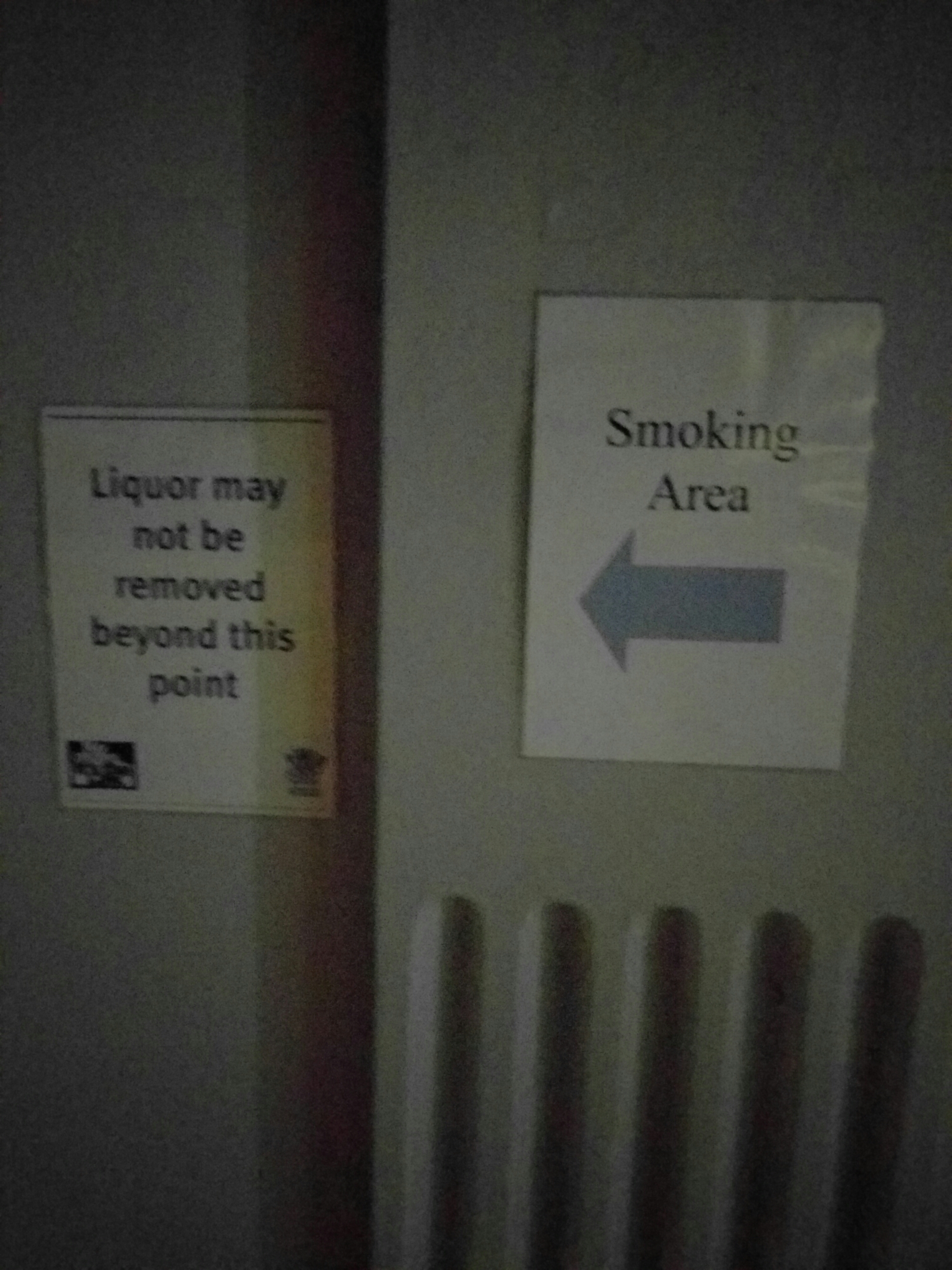


Ever feel like you’re getting squeezed by the nanny state?
A breakthrough in Syria announces the headline … with the details listed as:
“A cessation of hostilities is to come into force within a week, US secretary of state John Kerry has said.”
All good so far …
“In an agreement brokered between the US, Russia and other powers overnight in Munich, a UN task force will meet within days ‘to develop the modalities for a long-term, comprehensive and durable cessation of violence’.”
Developing modalities? In which dimension did these people never finish high school maths?
“The cessation deal explicitly excludes Islamic State and al-Nusra front against whom military action will continue.”
Oh, so all they have is agreed to do is gang up on the little blokes before they get back to fighting each other through proxies.
“Russia has not committed to end its airstrikes in Syria but repeated its insistence that it was targeting terrorist groups.”
And indeed the whole thing is bullshit since Russia has only promised to consider the vibe of the thing.
Gotta love it.

Today I had a chat to an old friend who’s a sort of university academic.
I say ‘sort of’ because this person exists from contract to contract which vary between one and three years in length, subject to research grant success.
What I got was a big whinge about the unfairness of this, viz a viz those lucky academics with full-time and even tenured employment.
I countered that I couldn’t think of anything worse than being shackled to a job at a university through some cushy T&Cs. I noted that it’s the teens not the sixties, after all.
I suggested to my old friend that rather than seeking the rotting debenture, he could look for ways to diversify his income through contract work.
Confusion at the other end.
I explained that he could have more than one contract in place at a time, and that one or more of those contracts could be from non-university sources.
I suggested that income certainty was better in this scenario and that if he is worried about continuity of personal cash flow he would be better off seeking multiple-contractibility rather than job security with its binary risk factor of temporal non-existence and CV-destroying lack of variety.
I also noted that modern IT massively enables the ability of an individual to become a genuine contractor.
I suspect that I was up against some resistance from the personality type in this instance.
There was to be no inserting of logic through the defences not constructed with logic in the first place.

Horses can recognised human emotions (only with their left eyes, LOL), new study shows!
“Karen McComb, who heads the research group and co-lead author of the study, said ‘Horses may have adopted an ancestral ability for reading emotional cues in other horses to respond appropriately to human facial expressions during their co-evolution. Alternatively, individual horses may have learned to interpret human expressions during their own lifetime’.”
Nuh, she’s got it all wrong. Humans learned to read facial expressions off horses. Before we domesticated the buggers we were all autistic frozen faces.

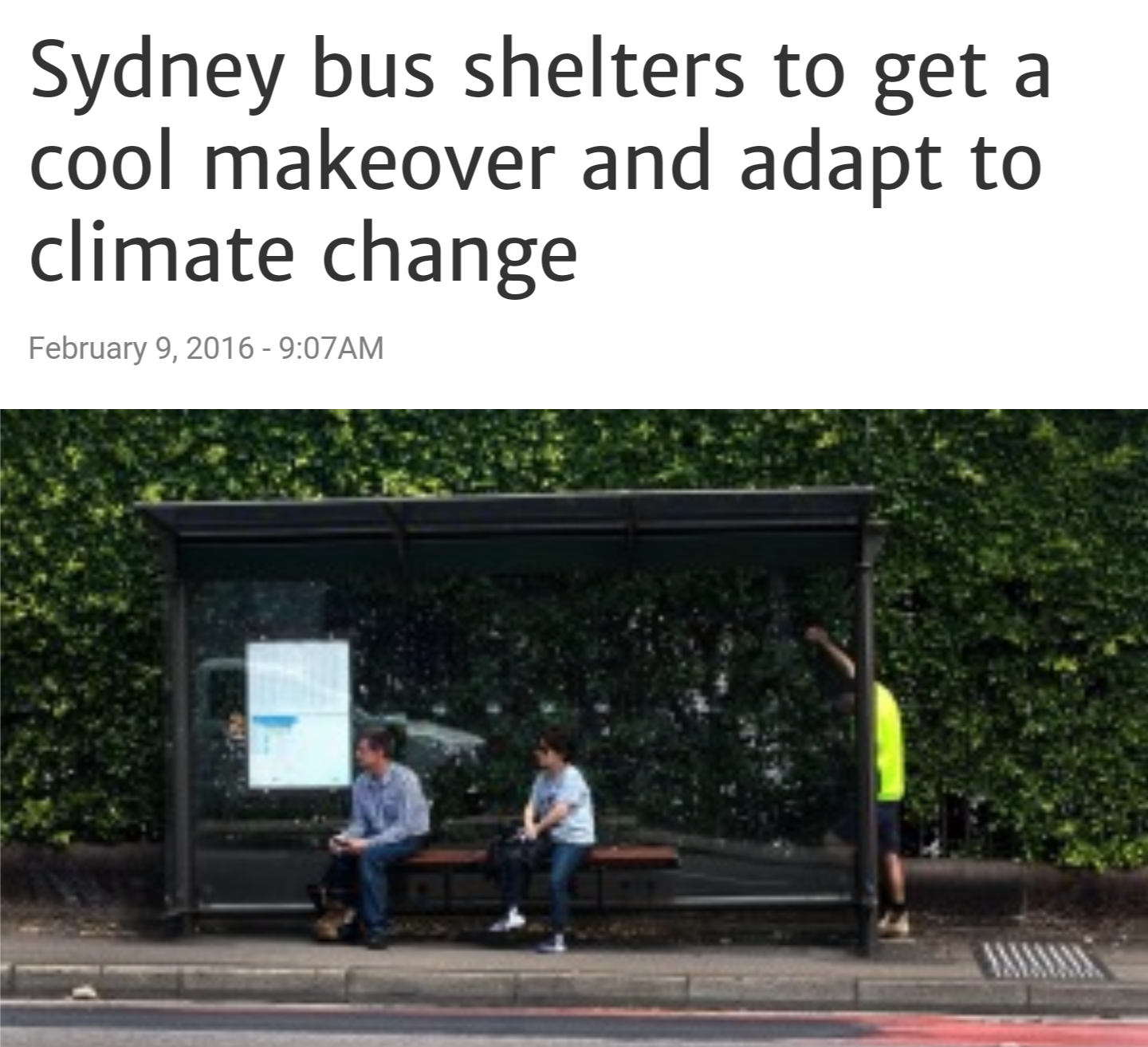
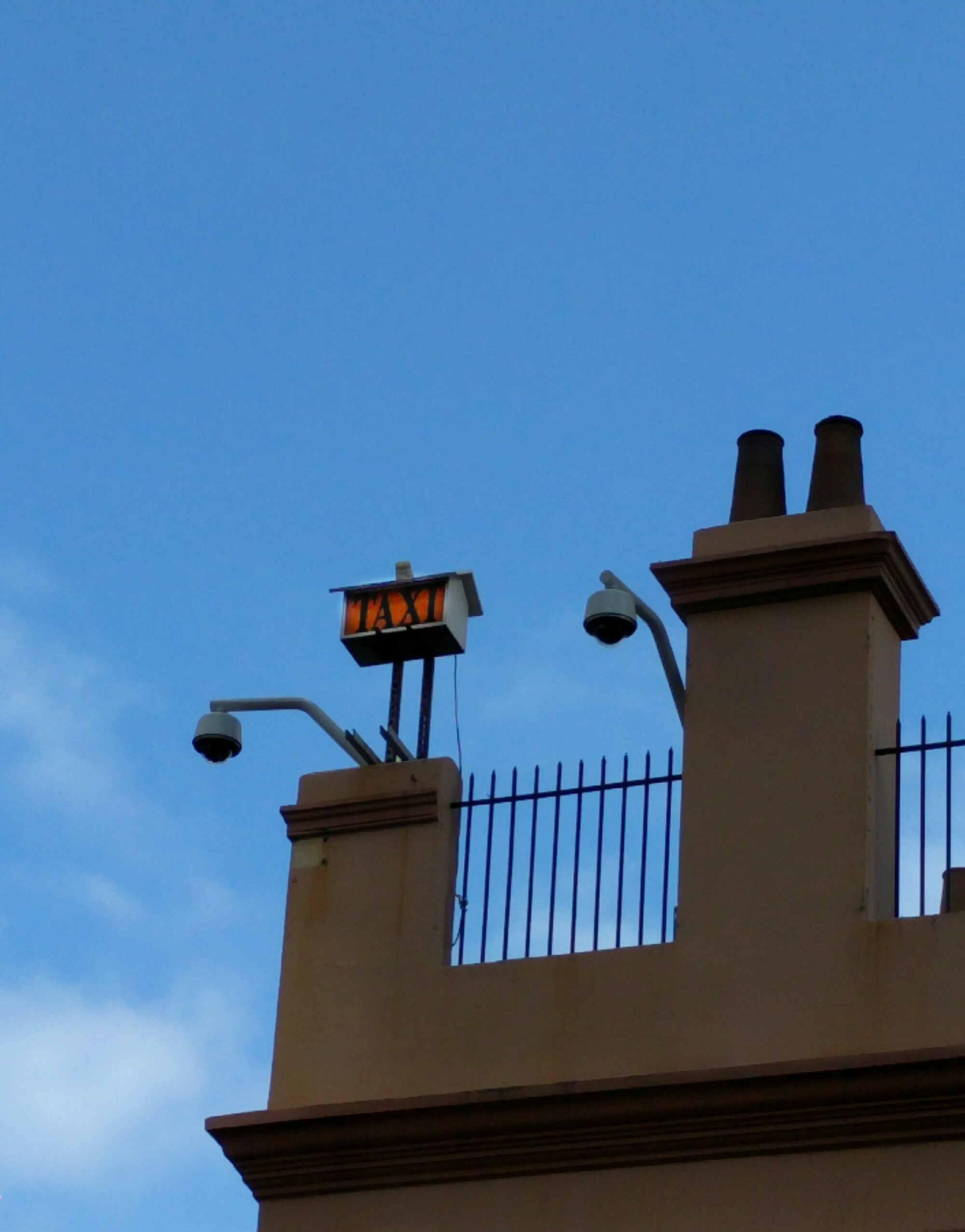
This is an odd story; there’s a competition to design a new style of bus shelter for Sydney.
Someone has finally recognised that half a glass house on the side of a busy road is a shit place to be.
In winter you get wet. In summer you get fried. At all times you get asphyxiated.
My best idea is to remove the need for visual contact between the bus and a prospective passenger by having an app that allows prospective passengers to simply state where they are going and then hit a ‘hail’ button.
The relevant bus driver will then know that he or she has a passenger to pick up at that bus stop which is identified by the prospective passenger’s GPS location.
The passenger would be alerted to the bus’s near arrival by the usual alarms. In fact the passenger could even see their bus en route on a map.
It’s just freaking Uber guys! Do it already…
Under this scenario bus shelters don’t have to be made of glass or have walls missing etc. Problem solved. They could be air conditioned. You’d know who’s in there by the app. In fact you could use the app as a door lock to keep out strangers. Etc
The editor at The Conversation writes to me thus:
“Ian, I thought you might know if there was any research on this area.
I’m not sure if it’s becoming more of a thing or I’m just noticing it but after the announcement today from Vodafone about their ‘start-up incubators’ in London, Singapore and Comm Bank’s ‘innovation lab’ in the same sorts of places, it got me to thinking what is the purpose of these places? They are couched as places to inspire innovation (and probably to capitalise on talent in these tech hubs) but I wonder whether it’s mostly a marketing thing.
Do you know if there is any research on the use ‘hubs’ or ‘labs’ like these? Either internationally or here in Aus?
Thanks,
Jenni”
I reply:
“Jenni
I am not aware of any research on the subject, however my casual observations would suggest that these corporate incubators have three functions:
1. Marketing to customers, as you suggested. I put this in the bucket of ‘profile’ marketing – where a company is trying to create a positive impression with the public. This is usually a sign that a company is in an oligarchical environment and thus it has the money and the inclination to attempt to create the impression otherwise.
2. Marketing to staff. This is an attempt to convince staff that the organisation is groovy and funky, so as to help with staff retention
3. Keeping up the corporate Joneses. Down at the club the CEOs now must have an incubator to discuss, whereas once it might have been a corporate jet. These things come and go, like fashions
You will note that usually the actual cost to the company of operating the incubators and investing in the companies is way less than the marketing budget associated with the incubator.
Also you will note that the people that run these incubators are usually wonderfully unqualified to make any sort of success out of the things.
A genuine ‘unicorn style’ success would be embarrassing in as much as there would recriminations as to how much the corporate made out of the deal; no matter what, it would be too much or too little, or something. The party with the deep pockets always seems to get sued!
Which brings me to my last point; I have checked a few of the Australian corporate incubators and not one insists that its incubator companies sign a Covenant Not To Sue – which shows an incredible level of ineptitude.
All of that is opinion, unfortunately.
regards
Ian”

I don’t really want to write this but I may as well get it down so that I can refer to it if I ever need to.
Ever heard of the GINI index? It’s a measure of statistical dispersion intended to represent the income distribution of a nation’s residents, and is the most commonly used measure of inequality.
It’s not very accurate or precise but it gives the impression of quantifying the subject matter, and it’s main purpose is to stop those morons that insist on references to academic papers from derailing any debate on the subject.
In this very context I have in my head a new index which I will call the REAL index.
It’s a measure of the ‘realness’ or ‘usefulness’ of a person’s employment.
At one end we would have a 0, where employment is totally artificial and at the other end, 1, where employment is very much directly related to basic human needs.
I haven’t come up with any specific maths but this index would be impacted by things such as:
I would say that before the industrial revolution that most people had a REAL index close to unity.
Today my guess is that it’s totally the reverse and that most people have a REAL index closer to 0.
What has happened is that increased productivity has meant fewer and fewer people are needed in employment related to basic human needs; probably well less than 1% in the West today.
This could have gone two ways; you might expect that all those people that weren’t required for critical employment would have been left to rot and we could have ended up with an incredibly two tiered society.
But, fortunately I guess, we needed all the people to have money so they could consume the outcomes of all that increased productivity in goods and services that we don’t really need.
And thus we all went up the REAL index as layers and layers of complex and quite artificial jobs were created around layers and layers of non-critical goods and services.

I tried. I really did.
For about a year now I have been subscribing to Google Play Music which is sort of like iTunes.
For a $11.99 monthly fee you can stream just about all the music you could ever want to listen to. Although I have found weird exceptions, such as Neil Young, which they don’t seem to have the rights to.
You can even download music to your phone for listening when you’re not connected, like when you’re in a plane. This downloaded music is hidden deeply in the phone in files that I couldn’t find; I guess this is to stop people posting them on torrent engines or just buying lots of music cheaply.
I have had a few gripes with this service but not enough to force me to leave.
For a start the app is sort of B- quality. Lots of stupid functionality and things missing etc. Not a show stopper but really you’d expect more from Google. The web version is even worse.
But the biggie occurred yesterday; the system just failed to charge the monthly fee to the credit card. The card was fine – I just used it for something else, so it seems their carrier pigeons were having an off day.
When I finally managed to re-subscribe all my music was ‘lost’. Which is to say my selected music and playlists are no where to be seen. I now have to go and curate all that music again, apparently.
Well they can get fucked. I am going back to Pirate Bay.
I’ve said it before; offer a good service at a decent price with access to all content, and people will happily pay. But go and fuck up the basic functionality and you get what you asked for.
Geez.

Impute: to assign a value to something by inference from the value of the products or processes to which it contributes.
As in “recovering the initial outlay plus imputed interest.”
Those high school English teachers, they’d take that transitive verb, consider the related noun and call it a implied contributive computation.
Maybe they’re onto something there.
But maybe I’m incorrectly assuming that impute and imputation are related.
In economics, the theory of imputation maintains that factor prices are determined by output prices.
Which is a fancy way of saying that the value of a good or a service is determined by the consumers, by way of what price they are willing to pay. This being instead of some calculation based on the cost of producing the good or service plus a margin.
In yet another permutation, imputed income is when someone avoids paying for services by providing the services to themselves (e.g. avoiding the cost of a prostitute with a bit of masturbation), or when a person avoids paying rent for durable goods by owning the durable goods.
An example of the latter is when someone lives in their own property and therefore passes up on any rental income they could get in exchange for not owing an equivalent amount of rent to someone else. This person also avoids paying income tax on any rental income they would get from renting the property.
When it comes to receiving company dividends in Australia, New Zealand and Malta (yep, just the three countries), an imputed dividend is where some or all of the tax paid by a company on its profits is attributed to the shareholder by way of a tax credit to reduce the income tax payable on the shareholder’s increased income resulting from the distribution via dividends.
Having reviewed all this, it would appear to me that in the world of finance and economics that any shifty transfer of an obligation is labelled as some sort of imputation.
Commonly this is known as a SEP or Someone Else’s Problem. Rather than being a implied contributive computation I would suggest that an imputation is an implied non-contributive computation.
Further, I would impute that an imputation is so-labelled to confuse and befuddle those that don’t benefit from them.

In order to consider the question as to ‘what is good writing?’, I first have to separate fiction from literature and non-fiction.
For non-fiction, good writing leaves the reader in no doubt as to what is intended and does not get in the way of consumption. It helps if the writing is elegant or in other ways attractive – that’s like added coconut oil between the sheets.
For fiction, good writing has one key goal; the ability to take the reader away and into the story, whether that is via imagery or otherwise.
Literature, on the other hand, is all about the writing first and the story second. The point of literature is to showcase fantastic, novel or complex writing. Of course if that is also in the context of an interesting story; all the better.
Horses for beaches I say.

An independent clause is often followed by a subordinating conjunction, upon which a dependent clause owes its existence.
Try explaining that to a 12 year old that already knows all this and couldn’t be arsed trying to remember what you call the things.
The odd thing about writing is that you don’t need to be able to articulate the rules of grammar in order to apply them.
Memory and the vibe of the thing will pretty much do it, in most instances.
But try doing maths without a full understanding of the rules. Not a chance.

The state high school system seems to have invented it’s own form of pre-remedial grammar and literary deconstruction construction.
The evidence?
By week two of high school I’ve seen a few examples in Lola’s homework.
This weekend’s reiteration quiz asks her to identify an ‘indirect judgement’ in a short story that she was given to read.
Never having heard this term I turned to Google. And they have no record either.
So I read the story, looking for an ‘indirect judgement’ using the common understanding of what these words mean.
Nothing. Five paragraphs later, not a clue as to what they are talking about.
They gave a clue. They sort of implied that an ‘indirect judgement’ is an implication. To me this sort of implies an unnecessary ‘indirect construction’, otherwise known as a complication.
My best guess is that they are referring to the fluff on the right hand side of a semi colon which contains the evidence for the assertion on the left.
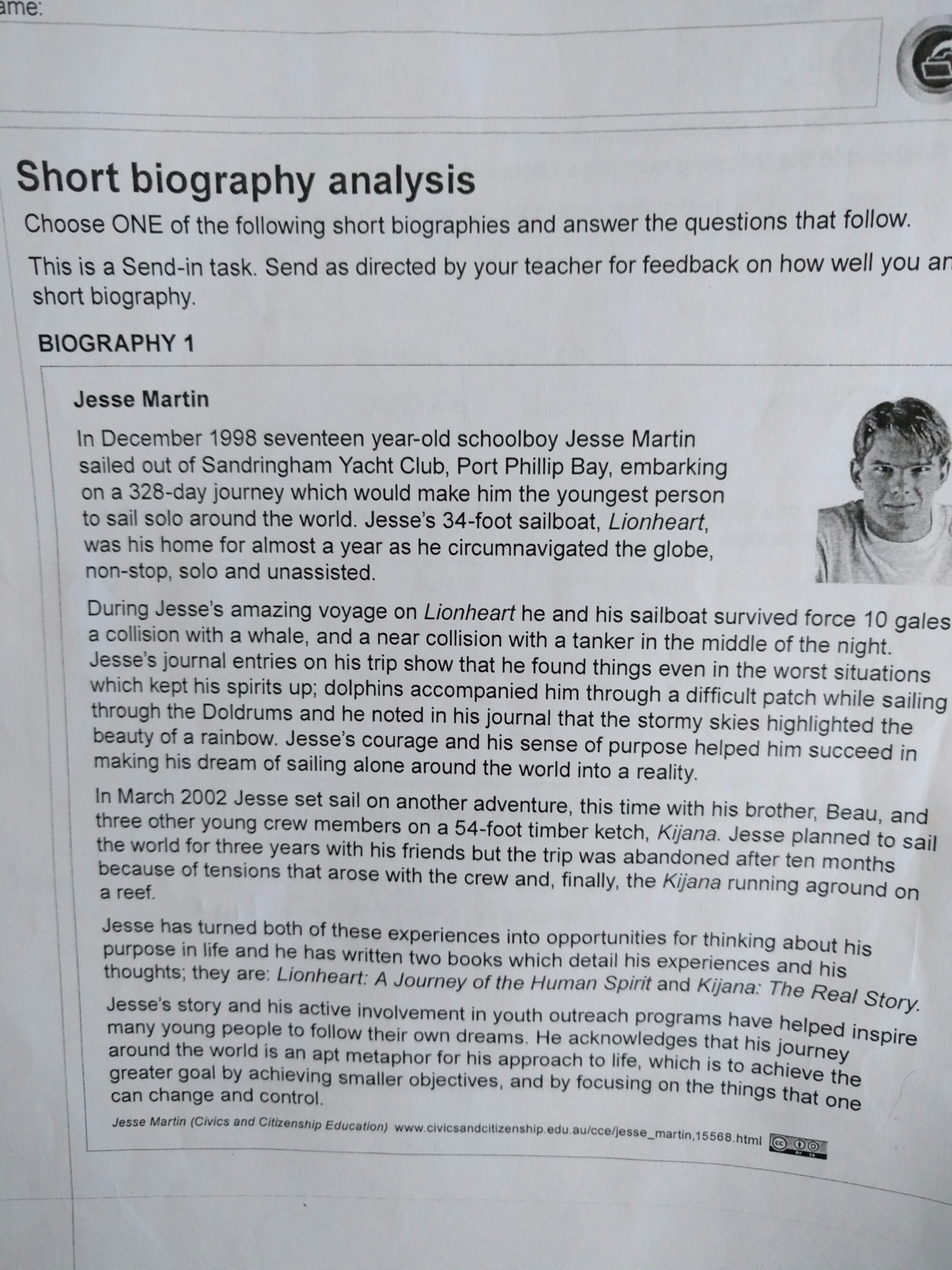
“Jesse’s journal entries on his trip show that he found things even in the worst situations which kept his spirits up; dolphins accompanied him through a difficult patch while sailing through the Doldrums and he noted in his journal that the stormy skies highlighted the beauty of a rainbow.”
I’d like to say to them, please construct your sentences with some thought … the left hand side should read;
“Jesse’s journal entries show that even in the worst situations he found things to keep his spirits up”
The right hand side barely passes the credibility test; 12 year old kids can see through bullshit.
Now I don’t have a strong issue with these guys making up their own terminology and deconstruction structure except that;
1. It won’t amount to any useful learning for anyone that intends to pursue any sort of literary career, and
2. It makes it bloody hard for parents to help their kids with their homework.
Google is now a subsidiary of Alphabet.
Last year, Google’s products such as its search engine, maps, Gmail, YouTube and Android, made up $74.5bn of Alphabet’s $75bn annual revenue.
That means that every other subsidiary of Alphabet had a total revenue of just $448m, and an overall loss of $3bn.
From automated cars to smart contact lenses, to vacuum cleaning robots. You name it, it’s in Alphabet’s loss-making whacky ideas department.
What this proves, yet again, is the failure of early and lucky success to teach entrepreneurs anything worth knowing about how hard it is to do tech.
What makes it even worse for the Google clowns is that they had access to cheap capital, their shareholder’s capital, to invest in whichever tech butterfly caught their collective attention.
Which means that the ideas that they backed were absent the professional pushback from those that manage risk capital.
I call this a double jeopardy; doomed to fail.
I hope there’s a way to short Alphabet whilst going long on Google.
One thing’s for sure; the recent division of Google and Alphabet must have been constructed to isolate the eventual losses in Alphabet.

A gym within a gym! If I went into the ladies only section do you think they’d be naked in there? Or better still is there a further fenced off “midgets only gym”. The possibilities are endless.


Quinella: a bet in which the first two horses in a race must be predicted, but not necessarily in the correct order.
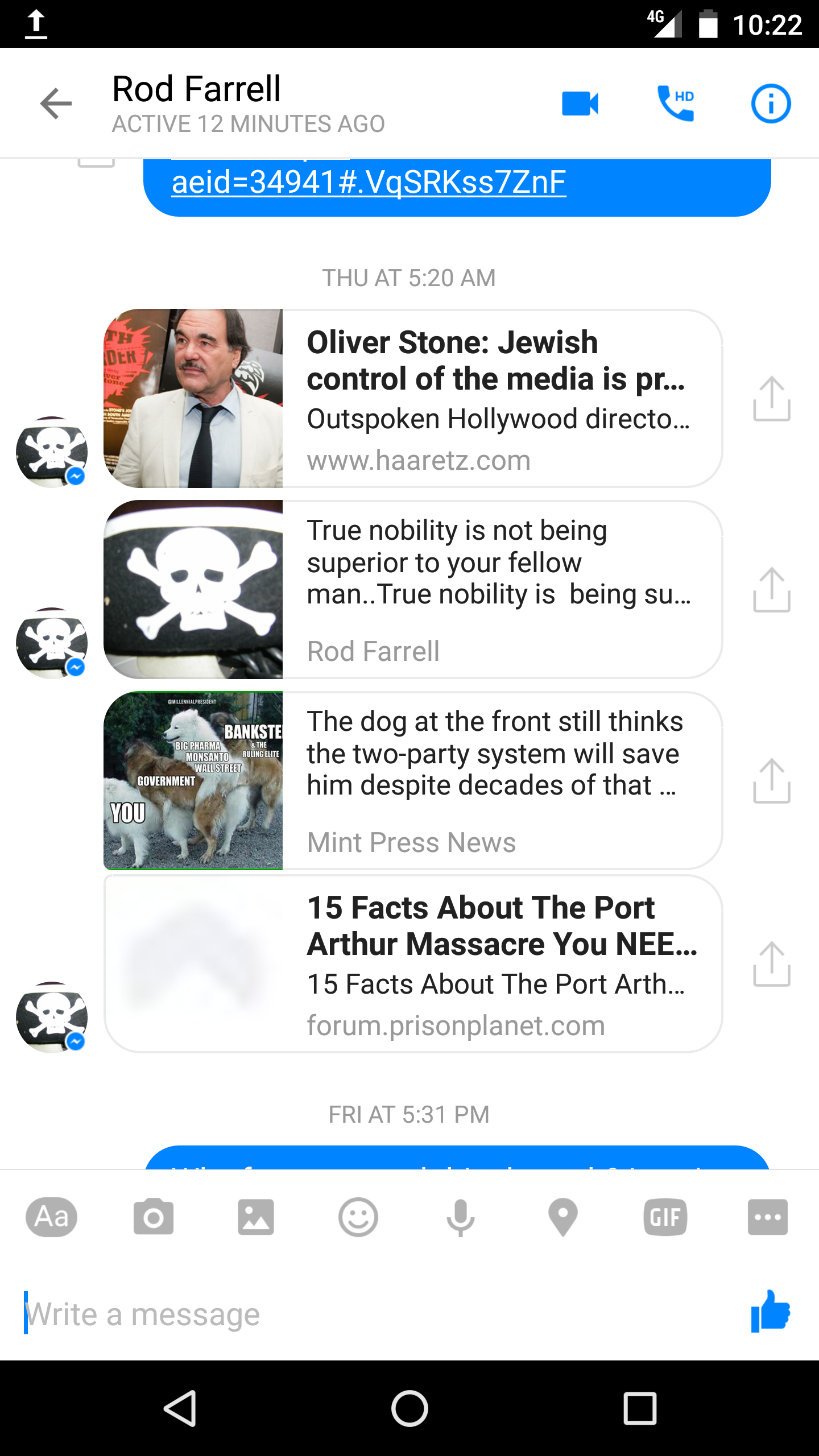
Roddie sends through another series of conspiracy theories by Facebook messenger … see exhibit below.
Exchange of messages ensued:
Me: Why for your send this through? I assign the same value to all internet information whether I agree with it or not. That is, I apply a pretty low calibration factor. The style of these entries makes me mark them down even further as they appear to be constructed by morons. Not that I think you are of course! You’re just cherry picking. Use that training
Rod: The training is the problem…..
Me: There’s good and bad in all skills. You just have to use them wisely and not exclusively.
Rod: The biggest skill is to question your own belief systems that the matrix generates…and then to have the fortitude to overcome the cognitive dissonance.
Me: Well it shouldn’t be too hard to tunnel through to a solution if you’re unconstrained by reason. In such a scenario, cognitive dissonance could itself be a cooked up emotion designed to keep you playing the game.
Rod: Dissonance is real … and tunneling takes commitment … most can’t handle the quinella.
Me: I can’t even pick the daily double since Anastasia changed her mind.
The trouble with highly developed minds is that they sometimes can’t help manipulating others.
Just yesterday my daughter was playing the ‘I’m just a child’ card. And for no potential gain other than a few extra credits in the cookie jar of future leniency.
If she’s this good at it now, how good will she be as an adult? Fortunately her behavior was pointed out to me by an highly qualified expert.
I wouldn’t say that it’s painful to be on the receiving end, but it’s annoying if you sense it and then have to work through all the possible scenarios on behalf of your often blissfully unaware adversary.
Unaware because it’s subconscious behavior. Or sometimes not; sometimes it’s habitual. Or even addictive. And sometimes just completely self-centered and greedy.
The only course of action that works to defuse this behavior is to out it. There no good that comes out of chasing a scenario around a mobius strip.
Call it. And then the discussion can go back to what everyone is thinking and feeling about a subject rather than being shanghaied by the desires of one party.
Which is exactly what I’m doing right now.

It would be fair to say that all couples argue. Who could argue with such a proposition?
The worst sort of argument is when you, the adversary, gets accused of some sort of character defect, and sometime later you get an apology. An apology for what? For voicing the thought?
When you feel like there is no point in counter-arguing then you know you are dealing with a fixed position that leaves little hope for redemption.
Which gets me to the nub of the issue. What’s the point of an argument? Is it simply a pressure release valve for the stresses of consumerism? Or is it a genuine learning experience for self improvement?
The best person to argue with is someone that realises that just about any accusation one makes about another is simply a mirror, a reflection of yourself and your fears. If it comes out of your mouth then aim it at yourself, I say.
The good ones also have ways of owning their own argumentive ways. They don’t simply blame the other person and absolve themselves from self reflection, fault and change.
Now if two such people get together then arguments can be seen as a constructive path towards a future where arguments are mostly redundant.
Dysfunctional arguments are in this paradigm simply a reflection of the combatants’ conjoint unsortedness. And such unsortedness doesn’t lead anywhere, last time I checked.
Which brings me to failure of counseling. Often it focuses on breaking such a dysfunctional deadlock.
But in fact what a couple really needs is individual skills training so they can head towards functional discord redundancy.

On certain subjects I’ve simply got no tolerance for local customs and traditions. None. Intervention required.
If I were the gubment (and this falls under the auspices of that genius Dunc Gay of the NSW liberal party) I’d let Uber operate …
BUT
I’d make them include ride sharing in their app.
That is, a page on the app where users can post upcoming rides they need a host for, or are doing in their own car, and then let other users ride share with them through the app, free of payments to Uber.
Say I’m going to Canberra this weekend. I’m only an Uber user, not a driver. I post the Canberra trip and a couple of other users want to come along. We share petrol. No money to Uber. All they did was let users share info. And no liability to Uber either.
This is called car-sharing mixed with crowd sourcing. The benefit of doing it through Uber is that everyone is already a signed-up user; having enough users is the problem that haunts all crowd sourcing concepts. Especially ones without a business model.
This would be tough for Uber to swallow because it inherently shrinks their market and they don’t get paid.
The irony in my suggestion is that Uber is doing what’s it doing, it says (ha ha), in the interests of the user. They’d say no to such a suggestion (as above) of course.
And then the government could tell them to get fucked and be seen to be doing so in the customers’ interests and not in the interests of their mates with brown paper bags in the taxi industry.
This is a blog about good politics. A how to, if you like. That is, how to be a sneaky and effective politician. Like say Neville Wran – will we ever see his like again?
And the other irony is that there’s nothing good about Uber. As Jim Clark said, the Ubers of the world are just one big asshole in the middle replacing lots of little assholes in the middle.
Once they have the market wrapped up you wait and see how they decide to exploit their monopoly. It won’t be pretty.

I’ve said before that empathy is a three-part process; the first being aware of how another person is feeling, and the second is caring about how they feel, and finally acting on that caring. Without all of these, empathy can’t be achieved.
So, to the subject of software engineers. The reason that most software, even the best software, is such rubbish is that software engineers miss the first step – that of being aware of how the users of the software might feel.
When I tell my software engineers that a way in which they have implemented a certain function is retarded because of this and that, they go ‘oh, of course’. And then change it. Usually they care about the users and have no problems changing the code once things have been explained to them.
The reason that most software is so shit is that there is rarely a person specifying the user interface that also checks and challenges the software that is supposed to meet these specs. Indeed, often a better way to do things isn’t always obvious until the first dodgy approach becomes a reality.
The reason such a person doesn’t usually hang around bossing about software engineers is that (a) it’s very boring and there are many much better things to do in life, and (b) the sort of people that hire software engineers are former software engineers that don’t have the empathy to realise they need to put such a person in charge.
In fact, the lack of empathy in the product development process of software is a pure form of rational proof of my definition of empathy. People using software; it is in fact psychology encoded into maths.
I hadn’t thought of that before. People don’t conform to mathematical models but when they interact with software they do in a sort of second-order way. You only need one side of the experiment to be mathematical for the whole shebang to be solvable. This is a way in which we could mathematically model psychology. Huh!
Anyway, I got onto this because of the stupid, stupid self-check out machines at Coles. My god they were specified and/or programmed by utter fucking morons.

I get absolutely no pleasure in finding bugs in Excel, 30 years after it was first developed.
I’d rather not be using the fucking thing at all!

Straight from Wiki –
“Effective Altruism is a philosophy and social movement that applies evidence and reason to determine the most effective ways to improve the world.
Many of the criticisms of effective altruism are the same as those that have historically been made of various forms of Utilitarianism.
These include questioning one’s ability to make a full and accurate calculation of the consequences of any action, since we have only very limited ability to predict the future.”
Well, I’d say it’s better to try and fail than to never try at all, especially if your reason for not trying is an educated scaffolding of excuses.
On the other hand, trying without first educating oneself a little about human actions and consequences seems a little retarded.
Using wealth to outsource Altruism, otherwise known as charity, might or might not help the cause but it certainly won’t help you.
I suppose my point is this; Altruism isn’t a binary issue. It’s a set of guidelines that should be used amidst other guidelines to direct one’s life strategies.
The outcomes of Altruism are twofold; the good one wants to see in the world, and the good one wants to see in oneself. The former certainly won’t improve if the latter isn’t addressed.
My argument for this assertion? It’s just the vibe of the thing.

A friend who is a Dean at an Australian university was bemoaning to me that he has inherited a department of electrical engineering, mechanical engineering and mechatronics, all rolled into one.
I said that is like having a Department of Chemistry, Physics and Material Science, all rolled into one.
Two separate disciplines and one pseudo-discipline, all under one roof.
Doesn’t make sense! Tell me, where do the students play?

Today I had the ‘pleasure’ of talking to two academic types that want to spin their technologies out of Australian universities as startups.
One is in IT and the other is a physicist.
I explained to both of them that:
1. The ROI of all Australian startups is very negative, and
2. That despite this there is a small number of startups that have a positive ROI, and
3. Even for these positive ROI startups where the executives had trained and knew everything they could possibly know about the startup gig, that their successes also relied on a large element of luck, and
4. Therefore embarking on a startup in Australia is gambling, and
5. That the odds are such in Australia that one’s life isn’t long enough to do enough startups properly (after you have had the appropriate skills training) in order to guarantee success.
The IT guy didn’t have a clue what I was talking about and will go about his business exactly as he planned before we talked.
The physicist on the other hand, he understood completely and asked me what I could do to change the odds.
I told him and this included, in his specific and very unsexy case, going to the US and bypassing investment in favor of bootstrapping.
I suspect he will.
It pleases me muchly that his classical training hasn’t been wasted.

In the context of my daughter being shocked at the concept of walking to high school I just remembered that not only did I walk to school every day but that we would walk even in the heaviest rain.
All we did was don a useless yellow vinyl raincoat with click buttons and a hood, and get soaked.

The company was founded by your grandfather between the wars. Initially a manufacturer of iceboxes in Sydney, the company expanded into electric fridges after the second one (war, that is) by copying a fridge imported from the US and exhorting local suppliers of components to come to the party.
You dad took over when the old man kicked the bucket. And your dad managed to go national and even get a distributor in NZ. And then in the late 1970’s he retired to the Gold Coast, his fishing and his second (and much younger) wife.
So there you are in the 1980’s, running an Australian manufacturer of fridges.
Your company designs and builds them. You have a well-known local brand. You distribute to all the large department stores and electronic goods chains, as well as to all the little retailers (some through secondary distributors).
Your two competitors are both subsidiaries of US companies but also do their manufacturing at the fringes of Sydney and Melbourne, but their designs come from the US.
You also sell a few fridges in NZ and South East Asia where your brand is not unknown.
Then Hawke and Keating famously float the Australian dollar and deconstruct a few trade barriers in order to save us from our fat and lazy selves.
At the same time Japanese and Korean manufacturing really kicks into gear. International shipping gets a lot cheaper as well, after containerization.
Before too long you are facing imported fridges that are cheaper than yours but initially no one buys them because they have weird brand names on them like Lucky Goldstar.
But every year they grab more and more market share especially after they figure out that LG is a much more useful trademark.
Eventually, in order to compete, you are forced to outsource some of your manufacturing to Asia. You get parts made and sub-assemblies assembled overseas and bring them into Australia for final assembly and test.
Due to ever increasing cost pressures one day you move test and assembly to Taiwan and the media has a field day as another Australian icon closes its factories with images of sad and angry workers leaving the premises for the last time.
Towards the end of the 90’s China gets into manufacturing properly. One day you are offered a deal where some Chinese company will make your fridges for you and sell them to you at a price half of what you could make them for.
So you take the deal and your customers find themselves with fridges that leak cold air, stop working in a year or so, with lights that don’t work, and that also occasionally leak water.
You design team is totally disconnected from sourcing and manufacturing and soon lose their way as the old blokes retires. Eventually you defer to designs suggested by your Chinese suppliers and cut the costs of your own design team.
You even outsource marketing to a brand promotions company and put all your sales team on a full commissions basis. Your fixed costs are you, a handful of office staff, and a warehouse of inventory and parts.
By the mid 2000’s your market share is less than 2% and the higher quality Korean products have grabbed much of the market along with well some known US and European brands (that no one is quite sure who owns but they know damn sure they are made in China).
Then you get acquired, for a mix of cash and stock, by an Australian company that has purchased a bunch of retail chains and branded product companies and is heading for a high profile listing. Which they do.
They need to list in to order to raise capital to service all that junk debt they used to do the roll-up. But of course the aggregated business cash-flow is a Furphy; there is no central intelligence to the plan. The white shoe brigade behind the scene cash out early and all the mum and pop investors are left holding the frightened cat.
A couple of years after listing the whole shebang goes into liquidation and your intellectual property, i.e. your brand, cannot be sold by the liquidators (not that they tried very hard) and lapses into oblivion.
The good news – you have been siphoning of dividends from your company for decades and there is about $60m in the family trust. You can retire to Palm Beach and your kids and your grand kids can all go to expensive private schools and then receive stipends for life, solely from the profits from the Trust, which is invested into all sorts of things known as the Australian stock market.
You once tried putting some money into a mate of your son’s new venture and he screwed it up. So you will never do that again.
And this how the proceeds of past innovation are sequestered into islands of useless value-destroying capital in this wonderful country of ours.
Because they did this then it’s self defining; they did the right thing. If they had the skills to do something useful then they would have. Without the skill there’s not much point.
The moral, if there is one, is that oligarchy breeds an inability to adapt. And that is our inheritance.

Ok I’ve failed completely…
I had a chat to someone that I thought I’d explained Australian manufacturing to. No progress…
I explained that although there has been a demise in Australian manufacturing, that there had been far less a demise of Australian manufacturers.
Confusion.
I explained that Australian manufacturers have simply moved their manufacturing offshore but as companies they are still manufacturers.
Ok, I that got through to them.
Then I had to explain that this transition wasn’t just about costs being lower in Asia.
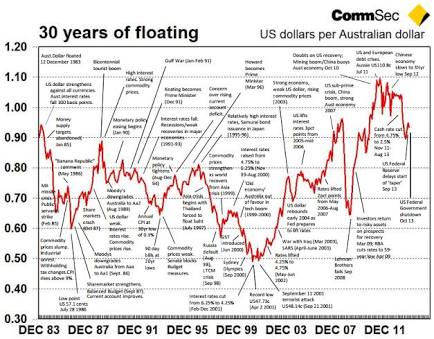
It had also been driven by the wild fluctuations in our currency, driven as it is by forex traders, which makes business and financial planning virtually impossible, especially for export where revenues are often in foreign currencies.
In fact we have one of the most fluctuating currencies on the planet.
There is a fix to this problem – little special pockets of Australia that operate solely on US currency and fully automated manufacturing.
Or we get the government to take control of the currency again, if not fully then partially, just enough to discourage the traders.
In business I have noticed that the two psychological types, the good’s and the me’s , are pretty easy to spot. Just like little kiddies.
Which is odd since the modern business environment pushes everyone to assume the demeanour of a good.
I think because of this the me’s become easy to spot; essentially they are putting on a whole false demeanour and it shows.
I find the me’s easier to deal with but the good’s more lucrative to deal with – let me explain.
The me’s are easy to deal with because it’s much easier guessing what they want. And what they want is whatever is in it for them. A raise, a bonus, more holidays, a promotion, a CV building opportunity, an ego boost, whatever. It takes a couple of minutes of conversation to out a me and their self-interests. Then any negotiation of any sort is pretty simple – you just hold out whatever they want and promote whatever they have to do to get it (if you have it to offer that is).
As an aside, people’s voting intentions are a good question to ask if you can guide the conversation around to politics; do they vote for what’s in it for them or what’s in it for society as a whole?
The goods are more motivated with everyone else’s welfare. And in business its harder to know where the ‘everyone else’ starts and stops. But they are more amenable to being negotiated into a position that suits via a discussion that spins one’s own position into one of the greater good, once you understand how they measure that. Which can be hard because often they themselves can’t articulate this.
I guess this insight makes me a bit of me.

A vertical treadmill for indoor climbers.
It only has to be about 15 feet high with no need for ropes since the drop to mats is OK from that height – it’s used for bouldering.
Each vertically treadmill could have fixed hand and foot grips, or better still these could be electrically actuated to simulate a long wall with dial-up degrees of climbing hardness.
Mechanisms for electrically actuated grips popping in and out of the treadmill wouldn’t be hard to figure out.
Then every air conditioned gym could have an indoor climbing section and the things wouldn’t be so bloody crowded and hot.

In Robert Heinlein’s ‘Time Enough for Love’ there is a sub-story entitled ‘The Tale of the Man Who Was Too Lazy to Fail’.
It’s the story of one David Lamb who was extremely smart and able but, in the face of stupidity and bureaucracy that surrounded him, decided to scam his way through life; using his intelligence and empathy to make his life easy, and in doing so, achieving no good for anyone but himself.
Dave Lamb was what I call a ‘me’ type. Someone whose base personality can be measured on one axis as someone whose basic default motivation is aimed at doing good for themselves rather than others. The opposite of a ‘me’ is a ‘good’.
If you look at little children you can immediately tell the me’s from the good’s.
As people mature, many of the me’s learn to adopt the habits of good’s, and it can be harder to tell them apart.
But this is for sure; under stress we all revert to type.
The irony of the story in the book is that it is being narrated by one Lazarus Long, 500 years later. And Lazarus was the old David, and David was the young Lazarus – even though it wasn’t explicitly stated. The characters lived a long time in this book.
If we all had 500 years to contemplate ourselves surely then even the most rigid ‘me’ might be able to work themselves into a ‘good’. As Lazarus did in the book, sort of.
But we don’t have 500 years in our lives.
So if you find yourself, for example, being gutless in the face of hypocrisy aimed at others then you might just have to face that you are a bit of a ‘me’.
That is, someone that can justify not helping others even if one could do so at relatively little cost.

It was suggested to me recently that the women of China are potentially far more usefully entrepreneurial than the men when it comes to innovating (as opposed to copying).
Maybe because they actually have some empathy whereas the men do not, and can thus imagine what annoys customers. Maybe because they weren’t spoiled as much as children. Maybe because they have female intuition. Maybe because they don’t label any new idea as absurd the minute they hear it. The options are virtually endless.
I have to accept that, although I go to China quite frequently, I don’t have enough data to test this hypothesis because women are mostly excluded from senior executive roles (of the type that I interact with).
In fact, I would say that in regards to women in the work place, China feels like Australia in the early 70’s. The men have a vague understanding that things will change but they still have absolutely no compunction about making fully chauvinistic statements in public.
Even if the women are better at strategic marketing and innovation, how in the hell are they going to get their hands on investment capital? The old blokes with their hands on the capital are truly old blokes in the youngest sense of the word.
I don’t think the Chinese have developed enough karma that warrants anyone helping them with these sorts of problems. And they won’t pay for help. And they won’t listen to anyone that knows what they are talking about.
They can sort it out themselves in their own odd but strangely effective way.

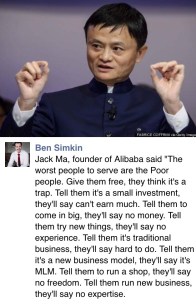
For every Jack Ma that is recorded in history there are thousands of similar characters that have been unsuccessful and are long forgotten. The bias in the narrative of the business media towards the adulation of past successful entrepreneurs doesn’t fool too many peasants. They understand statistics thanks very much!
Sturmey-Archer, I take my hat off to you. The metaphorical one that is.
I have just received my new rear wheel from cell bikes (http://bit.ly/20cT2t5) which includes the Sturmey Archer D2 hub.
This thing is a two speed freewheel hub. Internal gears. You change gears by pedalling backwards about half a turn.
I have a 46:18 tooth set up on the sprockets; good for all the hills at 1.55:1.
The first gear is 1:1 just like a normal single speed. But the overdrive on the second gear is about 1.4:1 giving me 3.58. Woo hoo.
I just did 6 km on the flat at 45 km/h and I could have gone forever.
I creamed a bunch of lycra-clad weekend warriors on their $10K carbon fibre geared bikes.
They look surprised to see a $200 fixie go past them at 45 km/h – that isn’t normal.
You see, and I’m being nice here, they can’t see the two gears. No cables. It looks like a usual single speed.
And my bike is a little more efficient than theirs. There’s a lot less friction on the chain – no tensioner, no dérailleur offset etc.
Eventually a flat tyre got me; bloody Chinese. I swear I am only ever going to buy branded tubes from now on.

Geez I get bored on planes. After reading another article on the new NZ flag debate I found myself designing a new Australian flag on my phone. As if we don’t have enough options and as if we could ever agree on a new option.

I’ve never taken much notice of the World Economic Forum at Davos.
The reason for this is one Malcolm J. Thompson, a former business colleague.
Malcolm had what could only be described as an inferiority complex.
I suspect this had driven him towards the moderate success in his career which included numerous failed startups and a stint as the head of Xerox Labs in Silicon Valley (or near equivalent; my memory doesn’t care).
Not that the failure of startups is necessarily a bad thing; just so long as they fail due to recognised and accepted risk factors outside the control of the CEO, board and investors.
Malcolm used to regale me with his memories of Davos. A full time networker, Malcolm had managed to get a Guernsey one year.
My assumption thereafter has been that Davos was full of Malcolms or near equivalents.
In which case the only function of Davos is to give the Malcolms of the world both an excuse and a reason to be a Malcolm.
So, if you notice any business leader that turns up to Davos more than once, then you’d be good to short their company.
In fact, a shit business leader is effectively a cargo-cultist – they adopt the habits of what they presume good business leaders have.
But in this replicating of circumstances associated with great outcomes they don’t realise that these circumstances are either unrelated to the causes of outcomes or insufficient to produce them by themselves.
Or they just adopt the wrong habits.
So if one wanted to figure out which companies to short, all you have to do is study the measurable habits (like being a repeat attendee at Davos) of business leaders that have failed miserably in the past .
Then you write a program to track the habits of current business leaders and use the algorithm developed from the lessons learned from the habits of past failed CEOs to get early identification of the current idiot CEOs, ahead of their certain failure.
Exhibit A below

There are only three areas of Australia that weren’t occupied by indigenous folk at the time of white occupation; parts of the Nullabor, parts of the Simpson Desert, and Kangaroo Island.
Probably a few of the smaller island weren’t occupied either, for exactly the same reason that Kangaroo Island wasn’t; the aborigines didn’t have much in the way of sea going vessels.
Kangaroo Island had been occupied for tens of thousands of years and the thinking is that it got cut off from the mainland around 6,000 years ago due to rising seas levels.
Around 2,500 years ago it looks like climate change got the better of the ‘remnant’ locals and that was that.
I have always thought that Indigenous Title should be declared over all of Australia as part of reparations. Then a minimal rent should be charged to all land holders and paid to some sort of Future Fund for Indigenous affairs.
Even if the rent was tiny (similar to current state duties or land tax so as not create an uproar) it’d add up after a while
Under this model the only useful Free Title in the whole of Australia would be Kangaroo Island. Maybe in time all the truly racist nutters would concentrate there and we could cut off transport back to the mainland (again).
Even Native Title would be junior to Indigenous Title.
Apart from the lease payments there would be no covenants in Indigenous Title on land use; these would be governed by existing titles.
The Indigenous Future Fund would be interesting beast. Who’d run it? And what would they do with the money?
The problem in Australia is that pots of money attract rent seekers, both black and white and every tone in-between. In fact, rent seeking is our number one national skill set. Stan, it’s the one set of values shared by us all!
The solution is to suggest that the Fund could only use its money to buy land and cancel the so-acquired junior titles (so it can’t be resold). Over time it would simply become a larger and larger land owner.
Of course it would continue to get rent from this so acquired land when leased, and eventually there would be no more land to buy.
So what to with the proceeds then? But that would take centuries so I don’t have to solve this problem now.
The interesting thing about this idea is that it is a complete artifice. On the surface it looks like Indigenous reparations are being effected but in fact it’s just a scheme to transfer land holdings to a constitutionally defined authority that just keeps growing (unlike Crown Land holdings that just keep shrinking) and that can’t be touched by government.
And the sneaky part of the plan?
Well, firstly, for residential land the rent to foreign nationals would be much higher.
Secondly, the fully owned land could be used by the Fund to artificially control land value by offering low rents, thereby forcing our excess wealth into more productive activities.
Lower cost housing would up add up to less stressed Australians. This type of animal would be much better at karma.
In fact, my personal belief is that the high cost of housing is the root cause of our current ethical/spiritual/economic malaise (you choose; they are all correct). If I have to explain why, I will. But I think it’s pretty obvious.
Indigenous affairs could only be improved by a model that fixes these issues and allows for Australians to be a little more ethical and spiritual, and with an improved economic situation that would allow us to throw a few more dollars at the situation.

This morning my Uber was a Ford Falcon complete with pickled-nose fat old school RSLish opinionated bogan. Now that’s Carma.


While my mate Woody seems a tad outraged by the shenanigans of footballer Mitchell Pearce, it would appear to me to be the usual drunk ravings of a very unripe young fellow.
I’ve seen many worse.
What worries me is that a public figure can be videoed in a private setting and that the video can be sold to a media outlet that then proceeds to make money out of the process.
Breach of privacy anyone? If there isn’t, then there should be harsh penalties for such actions.
At the very least Mitchell should be given leave to beat the shit out of the video artist.

Being cooped, as I am, in an air-borne submarine, I have taken to the ‘papers’.
Well. It seems that no one likes our new Australian of the Year.
Not the loopy right, the radical middle, the red left, nor even the green first world problem.
That’s my perception after reading the opinions pages, which are probably written by a bunch of people that believe they are more qualified.
The ‘independent’ panel that decides these things is being labelled ‘mediocre at best’.
The ‘states’ are also being blamed since that is where the nominations mysteriously originate (although, ha ha, you can’t self-nominate).
Other more deserving candidates are being suggested. But each looks decidedly self serving and extraordinarily narrow in their interests and achievements.
One explanation is that as a nation we are less homogenous than we’d liked to think we are.
Or maybe there simply isn’t enough collective social karma in Australia to get behind one one-hundredth of a single award winner.
Noting that the agreed ultimate goal in personal achievement shared by most in Australia is the accumulation of wealth, where does that leave the awards panel?
Those that might be nominated are either idiot savants that worry about one issue, ad nauseum.
Or very wealthy egocentrics using their money in an attempt to buy the award.
My suggestions;
1. Only give the award to former politicians, most that have trained hard to be qualified clowns (say Tony or Kevin), or
2. Make sure the award comes with a one-way ticket to Northern Canada and a one-year’s igloo experience, or
3. Give the award only to organisations or communities, and not individuals. Like when the EU laughingly got the Nobel Peace Prize.
4. Have a chook raffle.
5. Kill the whole thing. Interestingly none of the articles suggested this option.

The very best song for drowning out Qantas’s unreasonably loud safety messages.

I have to go through my spam email every day because once in awhile I find something that’s not spam in there.
After I’ve gone through it, I delete it.
What I want is an option in gmail such that once I delete spam once, emails from the same sender or with the same content are automatically deleted for ever after.
This way I don’t have to wade through reams of the same shit every day looking for something that might be useful.

Some academic has concocted up some maths that claims to calculate how long a conspiracy will last before it’s outed.
The model gives the probability of success for different conspiracies factoring in the number of conspirators, the length of time, the possibility of a leak and even the effects of conspirators dying.
It’s based on the assumption that a conspiracy will fail when it’s no longer a secret.
This is your typical academic effort that starts with entirely the wrong assumption.
It’s pretty clear these days that the best way to hide a conspiracy is to have the conspiracy theory nutters outing it in droves.
Then no one takes any notice whatsoever.
And, did you notice? This missive is a conspiracy theory.
And that means the academic maths is itself a conspiracy designed to cover up conspiracies.
But if it is, it must be purposefully incorrect and hence maybe accidentally correct.

Stan’s forgotten about ‘consumption and debt’; that’s a narrative that clearly speaks to non-indigeneous Australians.

In an article in the Harvard Business Review, Patrick Vlaskovits has decided that the quote below, attributed to Henry Ford, was actually manufactured by one Jean-Marie Dru in 2002
“If I had asked people what they wanted, they would have said faster horses.”
Often have I heard this quoted by those pedalling consulting services that will miraculously transform your employees into great innovators.
The consultant will generally float the idea that there are just two ways to innovate:
Although why you’d sell this latter message to the masses is a mystery. Very few in the audience would believe that they are the next Steve Jobs, so this message might just act to discourage them.
There is a third option, not usually coached, and that is to copy the new and sexy ideas of others shortly after early market success.
In any case, the use of the supposed Ford quote is as silly as business consulting gets. Imagine for example that Henry did ask that question and the people did say ‘faster horses’.
Had Ford been a true innovator he simply would have done a root cause assessment which assumes that a customer doesn’t know what he or she doesn’t know. In which case ‘faster horses’ is translated to ‘a faster way to get to where I am going in or on my own autonomous mode of transport.’
And then the innovator would ask a bunch more questions as to how much this autonomous mode of transport could cost, and whether there are any other constraints or desires associated with it.
This process is then dove-tailed with an assessment of readily available and potentially available technologies.
Eventually a product development process starts, one that balances risks associated with technology, market and financial factors, as per circumstances.
The irony of the Ford quote is that Ford’s only true business innovation was to make just one model of car for almost two decades, the Model T; one that was very reliable, rugged, and most of all, cheap.
Ironically, his cars were amongst the slowest of the era.
After his initial inspiration to make cheap cars, his capacity for innovation was reserved for engineering which was focused on lowering costs, evermore.
For example, in 1914, a whole 6 years after production began, Ford famously changed the colour of the T-Model to black-only in order to save costs.
Cars had been around for 23 years before the Model T came along but they were still the preserve of the wealthy. The middle classes of America did not desire faster horses, just affordable cars.
What Ford actually did say was:
“I will build a motor car for the great multitude. It will be so low in price that no man will be unable to own one.”
Whether he figured this out on his own or by talking to droves of want-to-be car owners seems to be unrecorded.
In any case it was probably quite obvious at the time that everyone would own a car if only they could. Similarly we would all own private jets and luxury yachts if we could.
The real business challenge for Ford was the creation of a financed plan to achieve this goal, along with the development of all the required novel engineering.
Many, if not most business leaders could develop such a plan but very few would be willing to execute it because the risks of failure are very high. Most business leaders quite rationally prefer lower risk and lower return activities.
For every Henry Ford that is recorded in history there are thousands of similar characters that have been unsuccessful and are long forgotten. The bias in the narrative of the business media towards the adulation of past successful entrepreneurs doesn’t fool too many business leaders. They understand statistics thanks very much!
As a historical note, Ford’s company eventually lost market share because he failed to continually consult his customers as to what they wanted.
Hence he didn’t recognise that his customers had changed; as middle class wealth increased they had started to want genuine choice between models and list options in the cars that they purchased, whereas Ford had just the one standard cheap model with very limited options.
A century later Henry’s company is inflicting Ford Falcons on Sydney’s taxi customers. This doesn’t surprise me one bit; we asked for comfort and space, and Ford brought us rattles, vinyl seats, diff whine and three-quarter rear doors.
So, Jean-Marie Dru;
“If I had asked Sydney’s taxi customers what they wanted, they would have said teleportation.”
And they got Uber instead! You see, business innovation is a tricky, tricky thing.
Today I am at a business forum and the theme is, yet again, innovation in business.
Henry Ford even got misquoted! He is probably turning in his grave.
Speaker after speaker is telling this room full of business leaders that, in these fast changing and disintermediating times, they have to innovate or risk losing their businesses.
To these business leaders I would make one point; successful business innovation isn’t motivated by fear, it is motivated by excitement.
Or to put it another way, excitement is a necessary but not sufficient driver of successful business innovation.
The excitement is needed to motivate the innovator to happily and irrationally ignore the readily-perceivable and overly high risk factors, and probable failure.
So if you are considering some serious business innovation; if your motivation is fear, then don’t bother!

I’d rather slit my wrists than be forced into an Australia Day BBQ with my usual co-passengers on Qantas.
It’d be somewhere on the North Shore. The men would be wearing polo shirts over their guts, linen shorts and leather boat shoes with no socks. The women would be wearing whatever they are told they should wear to BBQs this season and plenty of makeup over their botoxed facades. The talk would be of golf, real estate, their kids’ schools, and the next OS holiday destination.
But as a rule these guys do make the better flying companions. Better than the swill on Virgin, Jetstar or Tiger.
What makes them better is that they fly a lot, they are aware of their environment, they have manners, and there is a least some attempt to minimise the collective angst.
Except on Australia Day. Qantas had been invaded by the spouses and children of the usual professionals. It’s hell in a tin can.
Which tells me two things…
Firstly, what makes Qantas better than the rest is simply that the inmates fly a lot and have learned to collectively chill a bit.
And, secondly, that what I hate about flying is being so close to people that I really don’t want within a 10km radius of my person.

According to some (sic) academics at the (sic) University of Western Sydney, 64% of Australians want a new national flag.
The academics, hoping to get their paper into Nature, sent out a letter poll to which 8,000 individuals responded. Hardly representative of the general (sic) population I would suggest.
As much as I dislike the mini-Union Jack I would note that the most favored (31%) of the options for a new flag was the one at the top right in the image below.
Good enough for a margarine commercial, maybe. Just.
The rest are even worse, except for the Eureka flag which unfortunately has become the mascot of the racist nutters.
My guess is that this country is way too diverse in its peoples for a consensus on a new flag to develop.
From the original Australians through to Afghani asylum seekers, I suspect they are going to have to suck on the rather meaningless Union Jack for quite some time longer.

The Guardian has posted, after careful consideration by one Robert Mc(c)Rum, it’s top 100 English language novels of all time.
I can recall reading 29 of them in decades well past.
Of the 29, which is all that I’m vaguely qualified to comment upon, about 5 or so would have made any top list that I might compile.
One odd thing is the oft selection of obscure books by great authors, probably in an attempt to club the belletristic proletariat into guileless submission.
As in ‘comment not; here there be monsters.’
And then there’s the Nobels – not to be queried. Voss, exempli gratia; if ever a more pretentious toilet roll decoration were brewed I know not it’s name.
And to top it off, the Obscures. You haven’t read all one hundred, have you? Implied harrumph follows.
That McRum(c), he is a literary pensioner; scraping a living off creating the wordy impression that no effort been spared to create the impression that no impression is intended. Wordy.
C, McRum can write just fine but unfortunately he has nothing to say.
Woe be McRum. C.

The great metaphysical question that goes back to George Berkeley is whether something can exist without it being perceived.
As in, ‘if a bear shits in the woods and no one was there to see it, did it really happen?’
Of course if you walked in said bear shit sometime after the fact you’d be in the affirmative camp unless you were a metaphysical philosopher.
In which case you’d still have to scrape that shit right off your shoe while denying it’s very existence.
Now, the internet poses an entirely different form of metaphysical quandary.
Just the other day it was reported that Bill Murray had decided to run for president. This story was picked up by just about all news agencies and reported far and wide.
Bill claims he hasn’t. But if enough people think that he has then he may as well have since the impact would be similar.
He’d never win and they’d never vote. And the point is made.
The great metaphysical question of today is whether something can exist because it is perceived to do so.
I just knew it; I wasn’t wasting my time in that first year philosophy course.

Too juicy, this’ll get Roddie’s blood boiling. A ship searching for MH370 and loaded up with every sonar known to mankind as required to map what’s under it, sinks after hitting a submerged volcano…my plunger broke….LOL.

Bugger Bitcoin, it can be brought down if a few servers are taken out.
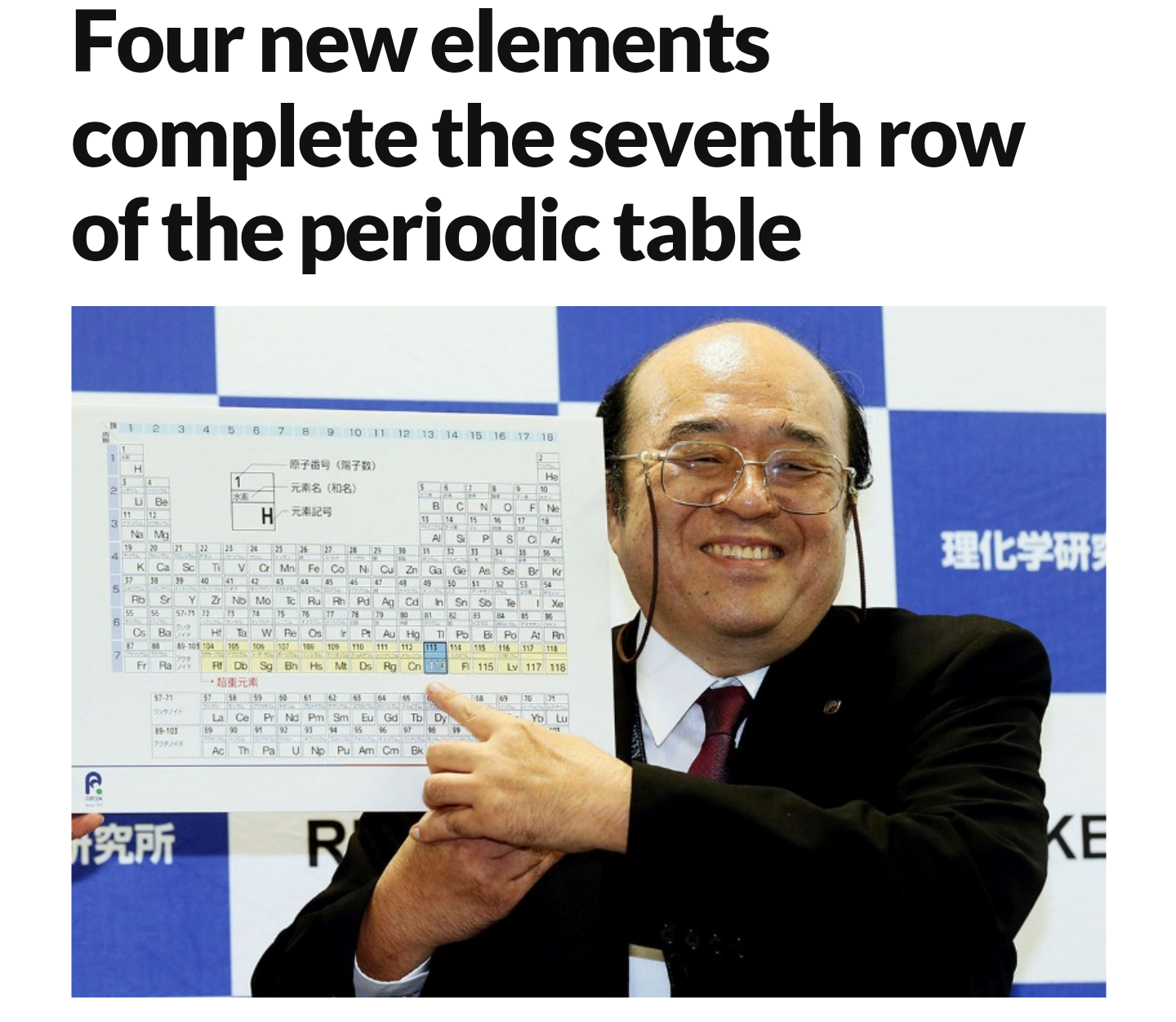
I reckon there needs to be a new virtual currency based on the fempto-second elements (ununtrium (Uut), ununpentium (Uup), ununseptium (Uus) and ununoctium (Uuo)) that can only be detected through traces of their radioactive decay.
Very virtual and yet based on real and hard to get elements, with an exchange rate of about a billion dollars per transient fempto-unit.
Jason, an American basketballer who is playing AFL for St Kilda (as a ruckman of course) said just a month ago:
“As a whole it’s amazing how properly micro-managed one country can be to another,” he says. “I think [in Australia] there’s more ownership to be a good citizen to your country-mates. You actually have to get used to it, but in the end it’s definitely a safer place to live and to be.”
I think he means pico-managed.

Apple don’t need the $1b so there’s more to this than meets the eye. I fully expect to see Apple kick Google off their platform eventually. Siri already uses Bing and nobody seems to realise it. Maybe Apple and Microsoft will team up against Google on mobile – Microsoft to license iOS for its phones and Apple to use Bing exclusively.

Just for the record:
“Dr Ian Walker, a psychologist at the University of Bath, used a bicycle fitted with a computer and an ultrasonic distance sensor to record data from over 2,500 overtaking motorists.
He found drivers twice as likely to get closer to the bike when the cyclist was wearing a helmet.”
And…
“Psychologists have discovered that people wearing cycle helmets tend to take 30% more risks than they would if they do not have one protecting their head.”
This suggests much of the protective edge provided by a helmet may be lost by making cyclists more likely to have an accident in the first place.
Or to put it another way, statistically speaking one is more likely to have an accident if one wears a helmet. But one’s head may fare better when doing so.
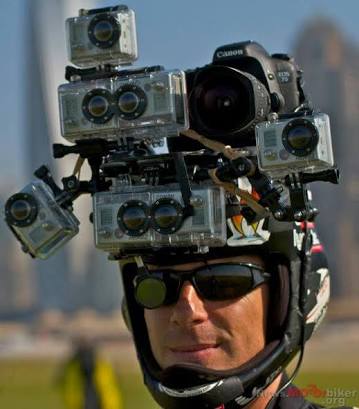
Personally I’d like to see 360 degree Go-Pro’s and radars in all bike helmets under a revenue sharing deal with the cops. This way every cyclist could be used as a roving revenue raiser.
Then you’d see drivers behaving well around cyclists and cyclists taking more care of their helmets.
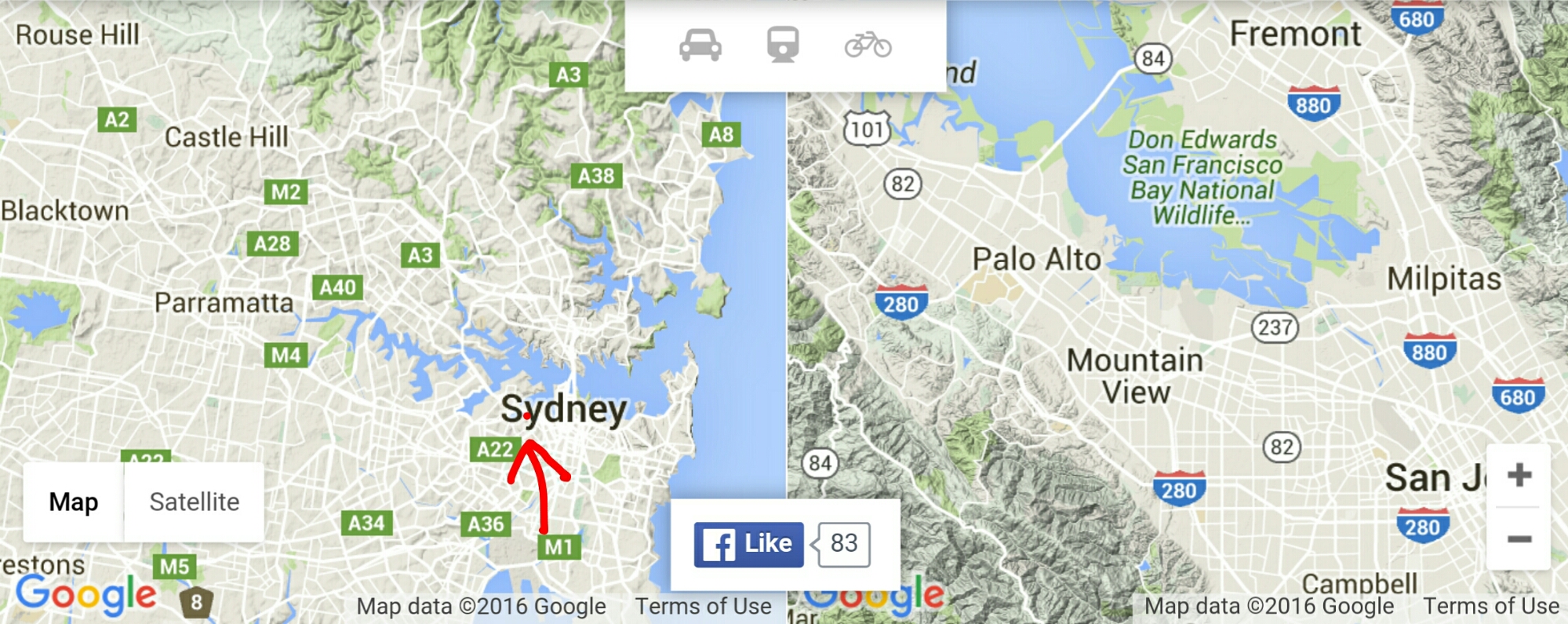
Last week some nutter was trying to convince me that Sydney’s White Bay precinct was going to challenge Silicon Valley as a tech hub.
After failing to convey to him the concepts of:
A. A cargo cult propagated by a morass of morons with the experience of gnats and the collective intelligence of a Gen Y marketing expert, and
B. A bullshit government marketing campaign designed to disguise yet another high density housing development sans infrastructure, and
C. A bullshit government marketing campaign designed to deflect criticism from the decision to redevelop an existing tech hub (the ATP) as a housing and commercial development,
I reverted to straight data. I said Silicon Valley is about 1500 square miles in area. White Bay is about 2 squares miles. See the map on the left below with the tiny red dot between the ‘S’ and ‘y’ of Sydney representing White Bay, and on the same scale on the right the whole of Silicon Valley.
Nuh. No impact. My adversary, the moron, went catatonic in order not to hear unwanted facts.
There’s something very odd about the bicycle business.
On one hand you can buy a completely new bike for $249.99.
But the cheapest front wheel on eBay or Alibaba will cost you roughly the same, and a decent one much more.
To build the $249.99 bike from parts bought online it’d cost about $1000 at a minimum.
If you ever want bike parts you’re much better off buying the $249.99 bike and pulling the one part you want off it. Which is ridiculous.
I could even pull the $249.99 bike apart and sell the bits on eBay for at least $1000. Odd.
In the old days this would have been excused away as an effect of the economies of scale in a multilayer distribution channel.
The internet was supposed to fix this problem. Supposedly…
Me thinks that this is either yet another unrecognized branch of bistromathics, or some global money laundering scheme (a la Milo Minderbinder).
In any case it’s a great business opportunity for some enterprising online Chinese distributor.
In the meantime Phil, buying the $249.99 bikes and pulling them apart is a better business opportunity than driving around an Uber.


The term “cargo cult” is used metaphorically to describe an attempt to recreate successful outcomes by replicating circumstances associated with those outcomes, although those circumstances are either unrelated to the causes of outcomes or insufficient to produce them by themselves.
I always thought innovation drove tech trends. Oh well…now it looks like we’ll be eating innovation for dinner.
Forum Question; “Salvador Dali’s two elephants; what does it mean?”
Best Answer; “it’s a surrealist painting you dill. It doesn’t mean anything.”
Love it.
A better question would have been; “why did Dali paint that particular painting?”
Because that’s what he did for a living.
Noting that this was painted before either of science fiction art or fantasy art took off, I’d say that Dali didn’t see the cliche coming.
His was a visually sophisticated mind. He seemed to excel at pulling together multiple unrelated visual inputs to create strikingly inexplicable and totally meaningless works of art.
Except of course, there was a meaning; to explore and expand the categories of visual images. Art itself was the meaning.

Do you think that farmers from West Wimmera and the Southern Grampians believe in climate change? Despite being conservative National Party voters, I bet they do.
They aren’t asking for it yet, but they should ask for a large coastal desal plant run off PV and a water pipeline also running off PV. By the way, the pipeline will use much more power than the desal plant.
Interesting politics this. National food security isn’t that important any more so that can’t be used as an argument. We don’t even have a single oil refinery in Australia; our politicians have totally decoupled their actions from old-school national security policies.
So this will require a bit of pork-barreling, mixed with a little agribusiness shenanigans, some token Chinese investment, and all spiced up with some Mac bank brown paper bag for the pollies.


I think I owe John a beer…

Last week I was coerced into writing an article for The Conversation.
The new business editor and I didn’t exactly see eye to eye, so it was trench warfare with respect to the content of the article.
I would change it. She’d change it back. And I would change it again.
Consequently the article became an abomination put together by a committee of two.
At one stage she emailed me to say:
“Just something I noticed while you’re editing, we try and steer clear of writing in the first person. So instead of say writing it as an advice style perhaps we can just weigh up the two arguments?”
And just that day I had read an article in The Conversation (http://bit.ly/1ZC15iE) which was all about good writing. It espoused offering personal opinions and not using the passive voice. Oh I enjoyed emailing that link.
Anyway, due to the battle of content and wills neither of us bothered to edit the thing for grammar (which I usually leave until the end) or typos (of which there were many, given that it was written on this phone using Swype – an approximator of what you mean to type, at best).
At least 90% of the comments were about the typos. Outrage expressed, in fact.
At least now I know how to get the attention of your average academic.


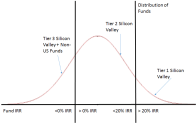
With reference to the plot below, this is how VC has worked for decades.
A small number of large funds in Silicon Valley have the best contacts, the best exits, the most money, the best reputation, hence the best deals and the consistently profitable returns.
However, these returns rely on the continued existence of the two other classes of VC that either don’t make enough profit, or even lose money (as per the plot).
What I mean is that:
In this context VC is a sot-of Ponzi scheme for those that don’t happen to get to invest in Tier 1 VC funds and manage to invest in Tier 2 and 3 VC funds.
This Ponzi scheme only works because it’s very easy to continually find new fools to fleece, like the Australian government.
And the good news; there’s enough new fools around to keep the scheme running forever. In favour of this Ponzi scheme continuing is the fact that the systematic failure of Tier 2 and 3 VC funds is often obscured by GFC’s and the like.
In NSW, from March 2016, riding a bicycle without an ID will result in a $106 fine and not wearing a helmet or holding onto a moving car will cost $319, while “running” (they mean riding) a red light will incur a $425 fine.
Thank god I still have that NZ driver’s license is all I can say, bro.
What I’d like to see is a pre-payment scheme, sort of like a phone plan. Instead of pay-as-you-go what I want is, say, a $25 per month fixed payment scheme for fines.
I’d go for that in a snitch because it’d be cheaper, State treasury could then forecast their cashflow with more certainty, and the police wouldn’t have to pull me over if I was given some sort of identifier as a pre-payer (say a hi-vis sticker for the helmet with a code on it they could check on the spot from their cars) so they could focus their efforts on the uninsured and maximise revenues – a win-win-win.
The clown responsible for all of this is the NSW minister for roads and other things – one Dunc Gay. A former trucker and shearer, he has some antipathy issues; for example it was his idea to remove the rainbow striping on Taylor Square Oxford street in 2013 and to remove the 5 million dollar cycleway on College St in 2015.
This is he, below. It looks like karma has already got the bugger – nature’s very own pre-payment scheme.

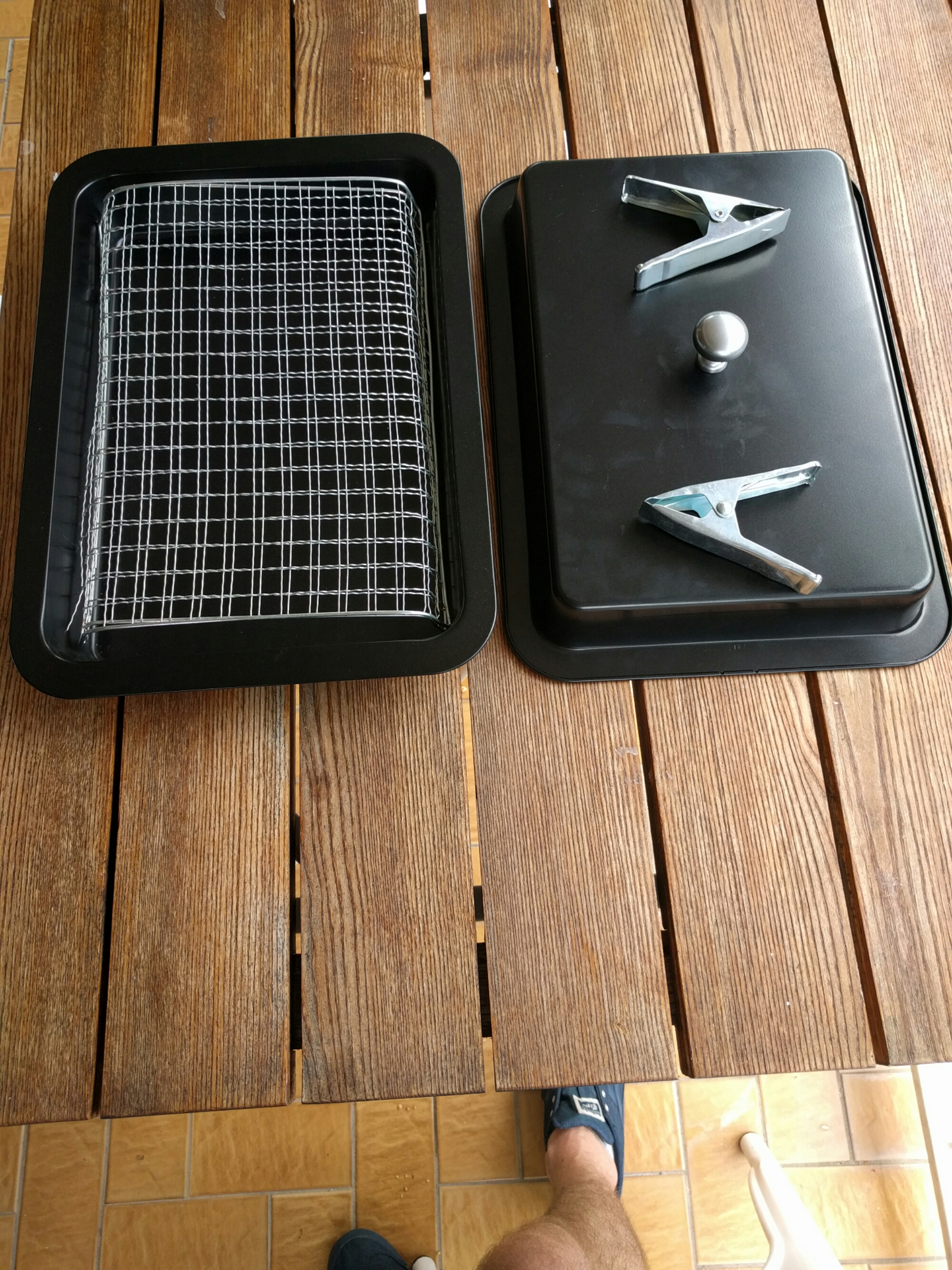
My brand new unpatented hot smoker for use with BBQs.
Discount store total bill; $22. Two oven baking dishes, one metal knob, one oven baking tray and two car battery clips with the insulation removed.
Just add aluminium foil, then smoking sawdust or woodchips from a BBQ shop.
For any meat or fish you just sprinkle with brown sugar and salt, add to the box, close with clips, and turn the BBQ on and then up to max with the BBQ lid down.
The magic number for all foods is 10-20 minutes after you turn it on, depending on your BBQ.



Take a big hard drive, give it an IP address and add an integrated modem to it.
Then develop a web-app that allows you to ‘mirror’ the data being sent to these apps – Google Drive, One Drive, DropBox and the iCloud.
And brand it as ‘your own personal micro-cloud.’ It’d be cloud storage backup for all your cloud data.
Genius!

This is worth recording…
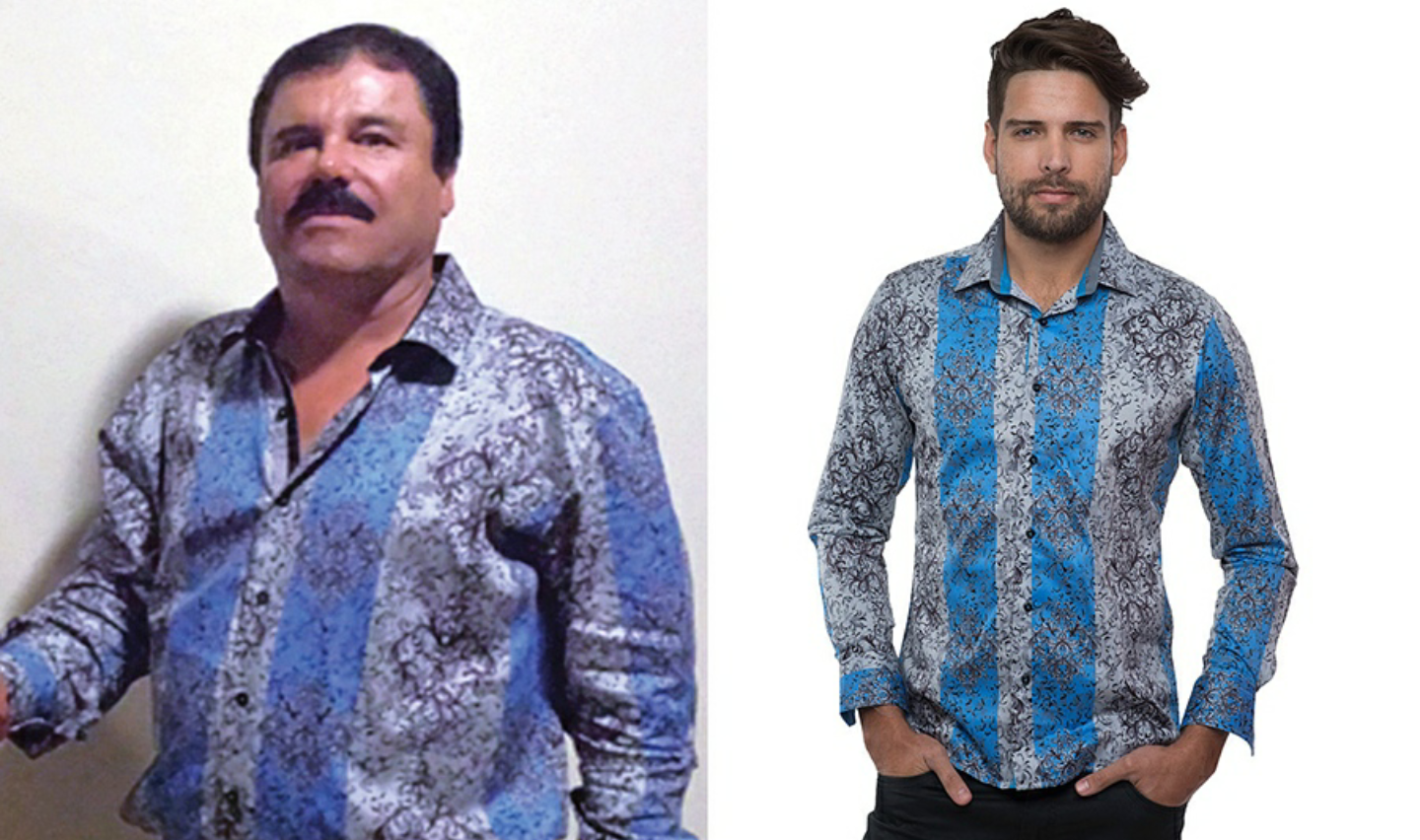
Sean Penn interviews Mexican drug lord El Chapo for Rolling Stone.
El Chapo’s sexy shirt goes viral and the Guardian reports that the clothing manufacturer ‘has seized the opportunity presented by this non-Instagram thinkfluencer.’
That’s a lot of words concocted by the Gen-Y reporter obviously very confused by an old school broadcast media phenomenon, aka a fad.
Some fallacies just aren’t worth outing.

Peter Marchand tells me that we humans are driven by the fear of not existing, in every part of our mind and body, in every chakra, and in every other way in which hippies, philosophers and doctors each dissect our reality.
This existential fear strikes me as correct since the major religions all purport to solve this problem by spinning fairy tales of life after death.
This I guess is designed to help people alleviate their fears of not existing and thereby enabling them to enjoy their brief existence a little more.
But it doesn’t seem to work too well; most people still seem very concerned about death and therefore awfully attached to people, thoughts and feelings.
This is probably because most adherents don’t truly believe the fairy tales, deep down where it matters.
As in all things, there’s no short-cuts in life or death.
Two years back I wrote that
‘Addictions have a purpose and it is central to the person and the journey.
Faced with an addiction one has three choices; to deny it, to contain it, or revel in it until it sickens you.
Unless you face the demon it will always be with you.’
Adding to this, addictions are just attachments.
Faced with attachment to the idea that detachment brings peace in the face of existential nothingness, I would counter that any attachment can be resolved through indulgence to the point of boredom.
But this approach only works if you truly accept existential nothingness and then logically decide to indulge in as many attachments as possible before you are ultimately detached from the ability to attach.
Eventually the whole process will bore you to tears and you will end up being quite content watching butterflies float by.
Or as Lou said, Oh sweet nuthin’, you ain’t got nuthin’ at all (his spelling).

GE was one of the first 12 companies in the Dow Jones industrial average. 119 years later it’s still there!
Noting that their business is a tad old-school (read – subject to rape and pillage by the Chinese) they have decided to reinvent themselves yet again.
See this article on the subject – on.ft.com/1UOgA0f
Basically they have sold off all their ‘generic’ business units, kept their profit making units with good barriers to entry, and are now focusing growth on the deployment of IT in the industrial environment, otherwise known as the Internet of Things (IoT).
The problem with IoT is that there is no universal core technology that scales into every application
Every single one of the zillions of industrial applications needs a dedicated solution with it’s own development costs.
My take on it; GE has defied gravity for longer than anyone but their time is up.
I’d short them.

Whilst at the gym today I caught whiff of a new reality TV show.
This one is called Selling Houses Australia (http://bit.ly/1ZjNtDs).
It’s sponsored by the usual suspects – Taubmans Paints, Bunnings Hardware, Luxaflex window blinds and Forty Winks bedding.
Now for sometime I have been waiting for the proper disintermediation of the real estate industry.
Granted we have websites such as realestate.com.au and domain.com.au, but these just serve the existing channel, complete with those bloody real estate agents. You guessed it, I don’t like them. They do bugger all and take a lot of money off the table.
I am waiting for the real thing, the Uber or the AirBnB of real estate, to emerge whereupon real estate agents become completely obsolete.
I know there’s quite a few emerging models around but they are all having trouble gaining traction.
One of the reasons for this is that the selling of real estate is something that we do once in a blue moon, and not daily (like booking an Uber) or monthly (like booking accommodation through AirBnB).
Hence it’s harder to get the market to adopt a a new habit.
And it occurred to me that the sponsoring of a reality TV show like Selling Houses Australia is the perfect approach to marketing of a new disintermediating business model.
In fact, it should be the only way it’s done. Bang for buck, unquestionable.
Imagine if Uber had sponsored a Uber Driver reality TV series on one of the major broadcast channels. So long as they had complete editorial veto, they couldn’t have gone wrong.

Now I like bicycles a lot.
I own about four of them, although one I have gifted away even though I am still the only one that uses it on a regular basis. Another I don’t have access to. And another has yet to be delivered to my presence.
There is a case for me having another bike for use in another city which is being added to my list of domiciles.
There’s a few options for solving this problem:
Accidentally I found myself in a bike shop last week. I was caught out with a puncture and well away from my own stash of bike tubes, tools and pumps.
Whilst waiting for my repair I was compelled into a test drive of a brand new Lekker Amsterdam Elite Nuvinci Series (http://bit.ly/1ShrRbJ).
This thing has two novel features – first, the NuVinci CVT gearing system combined with the Gates belt drive.
Now I’ve been curious about these technologies for sometime and to find them on a bike that I could test ride was an event that I couldn’t miss.
Quite unfortunately the thing was brilliant. Better than brilliant in fact. And quite affordable at $1400.
But that’s $1400 I probably don’t have to spend. I could possibly get away with a couple of hundred depending on which option I pick and it would be better for the environment.
It’s not that I am overly attached to the $1400.
It’s just that I wouldn’t want to leave a $1400 bike tied up to a sign-post. Thoughts of potential theft would ruin my Zen, just like a Pom worrying about a shark attack whilst swimming at Bondi.
So in this instance I am attached to the idea of being detached from the worry of the theft of an item that I am somewhat attached to.
Oh yeah, and it wouldn’t be too cool to ride around on a shiny new Dutch bike either. But I suppose I could scuff it up a bit and change some of the bits (like the pedals, the seat, the stem and handlebars, etc) with nice old crappy bits.
Just for completeness, the shifter on this thing shits me too. It’s designed for morons that don’t ride bikes and it stands out like dogs balls. It looks as though it belongs on a *spit* hybrid bike. I don’t think I could live with it!
So it would appear that I am also somewhat attached to detached appearances.


Carbon sequestration, o’ the irony…
Giant icebergs are carving off the polar ice caps as globally warming accelerates. We have all heard of this and it is a very bad thing.
Some good news though; researchers have discovered that as these giant icebergs melt they release trapped iron into the iron deficient waters of the high latitudes.
This iron acts as a fertilizer for photoplankton which thrives, consumes carbon dioxide and then dies, sinking to the ocean bottom thereby trapping the carbon dioxide.
Apparently this effect contributes up to 20% of all the carbon buried in the Southern Ocean, which itself contributes about 10% of the global total.
We aren’t talking about a lot of dissolved iron here by the way. Bugger all.
Here’s the calcs…
The concentration of dissolved iron in icebergs is highly variable and between 4-600 nM (source: http://bit.ly/1TTNRHf)
The total global ice melt is around 742 cubic kilometres per year (source: http://bit.ly/1Zs7n4k) much of which isn’t from icebergs, but I’ll use this number as a worst case scenario.
Taking the median of iron concentration and working through the maths, this equates to 125,140 tonnes of iron released from all ice melt, per year, globally.
Now I’d just like to point out that the largest ocean tanker in service has a gross tonnage of 234,006 tonnes (source: http://bit.ly/1RL0Hs6)
Get to it, fuckers!
‘Fair’ and ‘equal’ are both adjectives but they certainly aren’t equal.
Equality can be quantitatively measured by outcomes whereas fairness can only be qualitatively addressed by intentions.
Fairness is far more subjective and hence less useful in some circumstances than equality.
For example, the early suffragettes were pushing a cause which was designed to overcome systemic hypocrisy aimed at women, which however most people at the time thought was quite fair.
I suppose the moral to this story is that all ethical causes should start out by targeting ‘equality’ but as the battle proceeds, and as general opinion shifts as to what is fair, these causes should convert to the promotion of ‘fairness’.
In fact the enablement of this shift should be the primary focus of any ethical cause.
The problem with hanging onto the concept of equality long after the general population has accepted the principle of fairness is that a cause risks discriminating against others.
For example, there is now very little opposition to the concept of equal opportunities for women in Australia. This is considered fair.
Yet some women are still pushing for equality in outcomes. An example would be forcing the boards of public companies to have equal numbers of men and women; which runs the risk of discriminating against the more worthy.

Here’s an interesting article that explains why the value of the AUD is so unlinked to fundamentals of the Australian economy and also why it fluctuates wildly compared to other currencies – http://bit.ly/1PVUDLA
The trouble with these effects is that they impact upon the ability of Australian businesses to both export as well as to import for capital investment purposes.
That is, the over-fluctuating and weirdly valued currency removes the certainty which is required for business investment.
I believe this is a prime reason why Australian economy is so focused on the domestic services sector, simply because this is the one sector where there is more business certainty, shielded as it is from currency movements.
One potential solution to this problem would be for our governments to fund their annual deficits with newly printed currency, rather than long term bonds or foreign debt.
This would put downwards pressure on the currency and help link the value of the currency to the economy in a more first-order manner.
In fact, when there are budget surpluses the government could also destroy currency, much like a corporation doing a share buy-back. This should enhance the value of the currency.
A side benefit of funding budget deficits by quantitative easing would be that it would be a form of taxation that is biased against unwanted trade deficits. By devaluing the currency all noteholders have reduced ability to buy imports or spend money overseas.
Such an immediate and transparent impact of government budgets upon the population might even shift the political process because the voting population would realise that they, rather than future generations, will have to pay for all proposed government expenditure. This would also put government pork-barrelling under closer scrutiny.
One query I have with this plan is the relative distribution of taxation under quantitative easing. It would appear on the surface to be a relatively flat taxation lever thus disadvantaging those with less income or wealth. But then this may be ameliorated by the fact those with wealth would be more focused on buying imported goods or spending money overseas. In any case, we do have a weighted income tax system to help overcome any such measured discrepancies.
Another issue would be the ability of businesses to buy overseas capital equipment and technology for investment purposes as the currency is devalued by quantitative easing. Here I would argue that the value of exports would be concomitantly enhanced and, indeed, this whole mechanism is structured to create certainty for business wishing to export, which in the long run is in everyone’s best interests.

Clearly, Fred’s an idiot.
Industrialisation killed craftmanship and IT ain’t going to bring it back.
Email to Velosure:
“Sam
I can’t think of any occasion where I could cause damage to body or property on my bike without being charged by the police for some road offence, thus making the third party insurance policy worthless.
regards
Ian”
Email reply:
“Hi Ian,
Thank you for your email.
I agree that the wording is not clear and can appreciate that you may not want to take verbal confirmation that the intention of the wording is other than it appears.
I am sorry we were unable to keep you on policy.
Should you have any questions, please do not hesitate to contact us.
Kind regards
Sam”
Geez…he should have added ‘and please don’t tell anyone.’

The other night I heard someone say that she wasn’t a feminist. This surprised me muchly since she is a person that inherently dislikes hypocrisy. Maybe that’s the point?
Her stated view was roundly approved by my round friend who is not a feminist and probably thinks it’s just another conspiracy theory, with Hillary at the helm.
The Uber driver wisely stayed silent. As did your pondering scribe.
It got me thinking, am I a feminist?
First, to definitions….according to Wiki and the OED a concatenated definition could read;
“A feminist is a person that supports a range of movements and ideologies that share a common goal: to define, establish, and achieve equal political, economic, cultural, personal, and social rights for women.”
My italics, not theirs.
Is support simply the absence of antipathy, or do you need to be a card-carrying member? There’s a lot of daylight between these two extreme versions of support.
Equal must be an unachievable aspirational goal; they should say so. There’s no avoiding the Bell Curve in all things human.
Rights; does this mean opportunities or outcomes?
I wish there was a single word for the removal of discriminatory anti-rights, which I wholly agree with.
But I get a little squiffy when outcomes rather than opportunities start to be hardwired into our legislatures because this can cause discrimination against the more worthy.
And finally, when they say women, surely they mean any minority (such as overweight tinkers), or even any downtrodden majority?
Picking one disadvantaged group over all the others as your mission d’etat seems like a form of bigotry to me.
Especially as a woman where you could expect to be a beneficiary of your actions in this regards. Conflict of interest alert!
So, in summary I would say that, although I applaud many of the goals of feminism, I am not one.
When it comes to actions, I will happily vote in favor of the removal of discrimination in all its forms.
I might even voice this support under the influence of a couple of beers.

Hypothesis: there’s a big difference between an original thinker and a contrarian.
Facile Supporting Argument: (stating the bleeding obvious) an original thinker has thoughts that are new to mankind whereas a contrarian simply has views that are different to those around him.
Example: I am sure the ideas of this blog entry are new to some and could be labelled as original thinking. But on the contrary I am sure that these thoughts have been had before by at least one of the 107 billion people that have walked this earth.
Complication: but then you might say, what if that one person amongst the 107 billion had kept her thoughts to herself? Then she may as well have been a bear in the woods, poking and pondering her poo.
Resolution: when in doubt fabricate a Venn diagram and refer to an interesting sounding 20th century French existential philosopher – Camus for instance. That’ll silence your bog standard TV-educated Australian adversary.
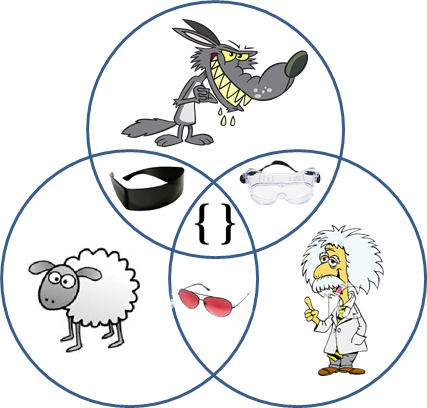
There’s a starman waiting in the sky
He’d like to come and meet us
But he’s completely forgotten why

Velosure are pushing their cycling insurance on me…
“We understand the risks you face as a cyclist, whether you’re commuting to work, on a training ride with friends or riding with your family. That’s because we’re cycling enthusiasts, just like you. We’ve put our collective cycling experiences and understanding together to create liability cover products tailored for cyclists and we back it up with service that only a specialist bicycle insurer can provide.”
“Velosure’s Cyclist Liability Cover is designed to provide you cover for potential costs in the event of a claim made against you by another person for damage to their property or personal injury, arising whilst you are cycling.”
A close perusal of their product disclosure reveals this…
“We will not pay for any claim arising from an accident where you were using the bicycle illegally or in the performance of an illegal action or in contravention of relevant state traffic and road usage laws.”
Now I can assure you that if you cause damage to property or body as a result of riding your bicycle then the police will charge you with some form of road offence and then you won’t be covered.
Now that there is good old Australian innovation in action … getting people to pay for a product that cannot possibly provide any benefit under any circumstances.


As with the souffle the thong never rises twice.

A mobile phone with an integrated push-to-talk two way radio.
Why? Why not. CES was full of reinvented analog rubbish.

Invention of the day…by Lola.
Bugger the color changing bottle, she wants the contents to change color.

Bet you there’s no elements 120 or 126 in this rock.

Although I have always disliked hypocrisy I have come to accept that it’s a natural party of the communications related to human behavior, including my own.
I find it telling that the antonyms of hypocrisy are listed as actual, authentic, forthright, honest, just, real, reliable, righteous, sincere, truthful, upright.
Not a single umbrella term that describes the antonym of hypocrisy in its broadest context. Just a bunch of words that sketch around the concept.
I mention this because I’m now pretty sure that human collaboration that is positive (my take on it) and communicated honestly, but that doesn’t have a specific word to describe it (let’s call it anti-hypocrisy), can only exist when there’s hypocrisy around as well.
It’s as though hypocrisy and anti-hypocrisy are matter and antimatter, codependent and coexisting.
My argument in support of this? Even the most honest person would have to admit that there are times when a little ‘spin’ is far more efficient than trying to teach a pig to sing.
Indeed, the person that is honest to a fault would, for example, fail to become a leader of any sort in the presence of those that know when to spin and when to sing.
Thus I have come to wonder as to the optimum ratio of hypocrisy to anti-hypocrisy.
Most likely it is very case dependent. Perhaps the question is best asked in reverse; when does hypocrisy become counter-productive?
One answer is where subsequent decisions can substitute for action, or decrease the probability of the success of the proposed action that they call for.
But often hypocrisy extends beyond such simplicities. For example, when the called-for action is not the true goal and where the hypocrisy is deemed the simplest means to garner support that would otherwise be difficult to achieve.
What I do know is that hypocrisy is counter-productive when it’s primary goal is solely the self improvement of the position of the progenitor(s).
Sometimes such self-focused hypocrisy is so ingrained that the perpetrators don’t even know they are doing it. An exemplar would be our entrenched two party political system that seems to promote such people and their actions.
The result is perpetual meanderings until a system meets a crisis after which there may be a brief spring where anti-hypocrisy flourishes and restores prosperity (or whatever else is collectively desired), after which the self-interested types will yet again come to the fore.
The only reason that hypocrisy can’t reign forever is competition. Competing countries or organisations with less hypocrisy will always be more competitive.
The hypocrisy ridden entity will always be found out eventually because competition shows people what they haven’t got.
Even the deepest monopolies such as the Chinese Empire or Sydney Rail eventually succumb to competition, or its apparition.
Thus, over an extended period, hypocrisy and anti-hypocrisy must naturally balance to some unknown and unmeasurable ratio.
But at any moment it’s very probable that what you’re listening to is hypocrisy of one sort or another.

$28m a year to advertise a marketing campaign, disguised as an innovation agenda, that is promoted as costing $250m a year but actually costs only around $100m a year of new expenditure.
I’m pretty sure that this country’s going to disappear up it’s own orifice.
Unless of course our federal government bundles up it’s advertising and marketing strategies and licenses them to foreign governments that aren’t as innovative.

I know for a fact that my mate Rob (see photo below) has two degrees that were fully paid for by the Commonwealth and State governments.
Unfortunately neither of these degrees were in economics.
Otherwise he’d know that the primary function of government is to tax us and redistribute that wealth into functions such as education.
Any argument against free education is effectively an argument against the function of government.
Those Sneetches with stars, despite all their tertiary degrees they can’t construct a rationale argument for their penchant for servants.
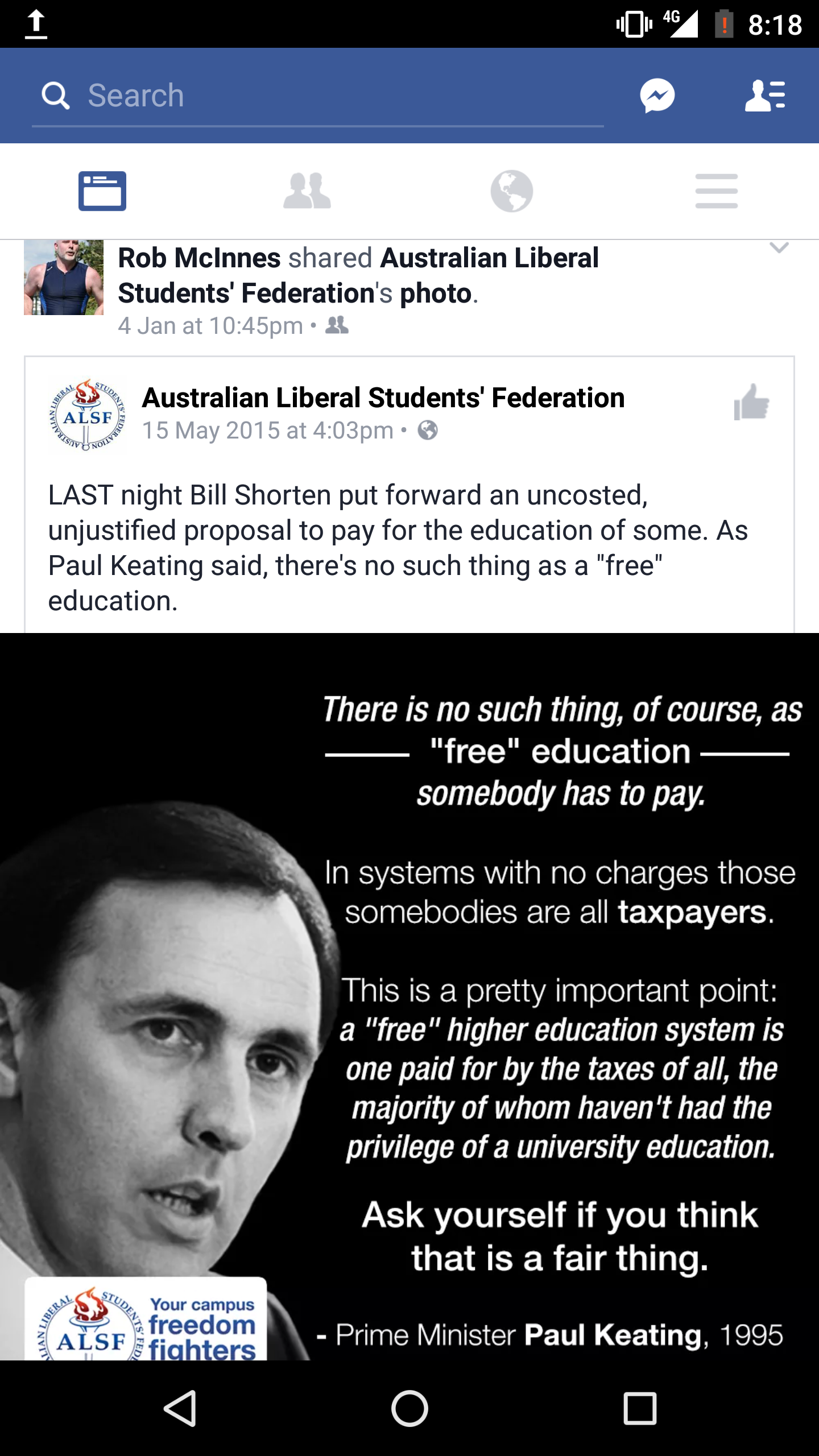
See the latest campaign from Sydney buses below….I beg to differ.
Sydney buses can stop so quickly that they have to use bullet proof windscreens to prevent standing passengers from flopping out onto the road.
In fact, getting the passengers to lurch around the bus via rapid breaking is the favorite sport of most Sydney bus drivers.
If a bus ever hits a pedestrian it’s because the driver is in a particularly grumpy mood.


Prompted by a dodgy documentary on German WW2 tanks, viewed through total boredom on a flight, I have just finished a book on Ferdinand Porsche.
Written by a Porsche-apologist German engineer and suffering from a machine translation, it should have been hard going. But I sort of liked it.
Porsche’s wife was mentioned once by her name and yet whole pages were devoted to the arrangements of cylinder valves on a specific X-configured experimental aero engine.
Before WW1 Porsche invented the combustion-electric hybrid engine transmission system. It didn’t go into any sort of production until after his death, when his son managed to get it into German tanks after WW2. It didn’t make it’s way into a production car until the late 90’s in the Prius, almost a century after Porsche first dreamt it up.
Porsche was both a businessman and an engineer. During WW1 many of his creations made their way into action. Cars, armoured vehicles, gun transport systems, airplane engines, etc.
Between the wars his major claim to fame was the development of the Volkswagen Beetle and related company.
He also developed the first diesel boxer engine which wasn’t put into production. I mention this because it means those buggers at Subaru were lying a decade back when they released the ‘world’s first diesel boxer engine.’
Porsche was very busy as Hitler’s pet engineer in WW2 but his only significant engineering success was the military version of the Beetle, which became the German ‘Jeep’.
He totally screwed up in tank development, being far too ambitious with innovation.
In fact the German tank development program prior to and during WW2 was over-focused on large tank size and continual innovation rather than tank numbers and reduced maintenance issues.
As a result the Russians ended up overwhelming the Germans tanks on the Eastern front just with the sheer numbers of their own much simpler tanks.
This thanks to the fact that Hitler was a techie at heart. He just loved new tech way more than practical tech.
Hitler had decreed that post-war all motor engines in Europe (and elsewhere in the German empire) would be air cooled.
Air cooled engines as found in the Beetle were his signature pet love. This crusade was his entry ticket into the tech community of the day.
What I found most fascinating about the book was that it gave an entirely new insight into Germany both before and during the last world war.
Written in the context of business and high-tech engineering rather than people, policy, politics and war strategy, I suspect now have a more balanced view of the era.
Primarily because I can properly calibrate business and engineering activities because that’s what I do.
One pertinent moral to the story would be this; never let a wannabe tech-head run your country. They take way too much of their advice from self-interested and self-absorbed tech entrepreneurs, scientists and engineers.

I reckon that if I was feeling suicidal and had a penchant for autoaquacide that I’d make the extra effort and steal a Maserati, or near equivalent.
Who in their right mind or otherwise would go to meet Poseidon in Australia’s very own Trabant, the Ford Falcon station wagon???
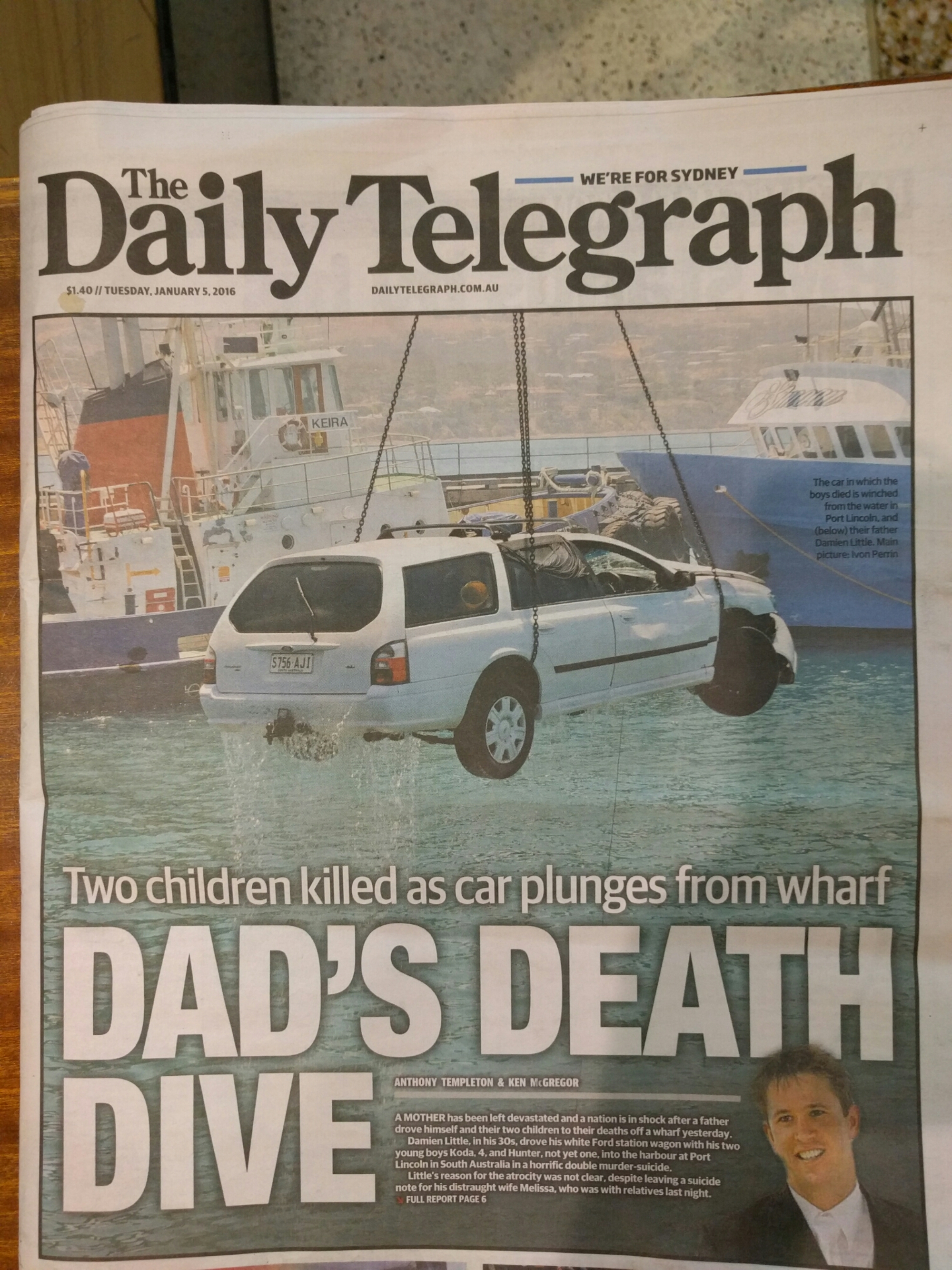
Egads, the papers are full of reports on the inclusion of four new elements into the periodic table.
“Such is the lot of the modern-day chemist: you wait ages for a new element to turn up and then four are discovered at once.”
Firstly, these elements weren’t discovered and they don’t exist in nature. They were invented very much on purpose by engineers posing as physicists.
Secondly, you’d hope that most chemists don’t give a shit because they know that these elements have a half life of around a fempto-second and will never end up in any sort of molecule.
But not to worry, there might be a pool of stability for the as yet uninvented elements 120 or 126.
Or maybe not.
My guess is that these elements would be floating around naturally if this was the case. Nature has means of focusing energy somewhat better than any bloody linear accelerator dreamt up by engineers.
But I do have to admire this great big Ponzi scheme for getting billions in research funding. Who said scientists are crap at marketing?
I just wonder why the inmates are so fixated on spending their lives and our money chasing ephemeral radioactive decay signatures?
It’s possibly true that never was so much effort expended for so little gain.
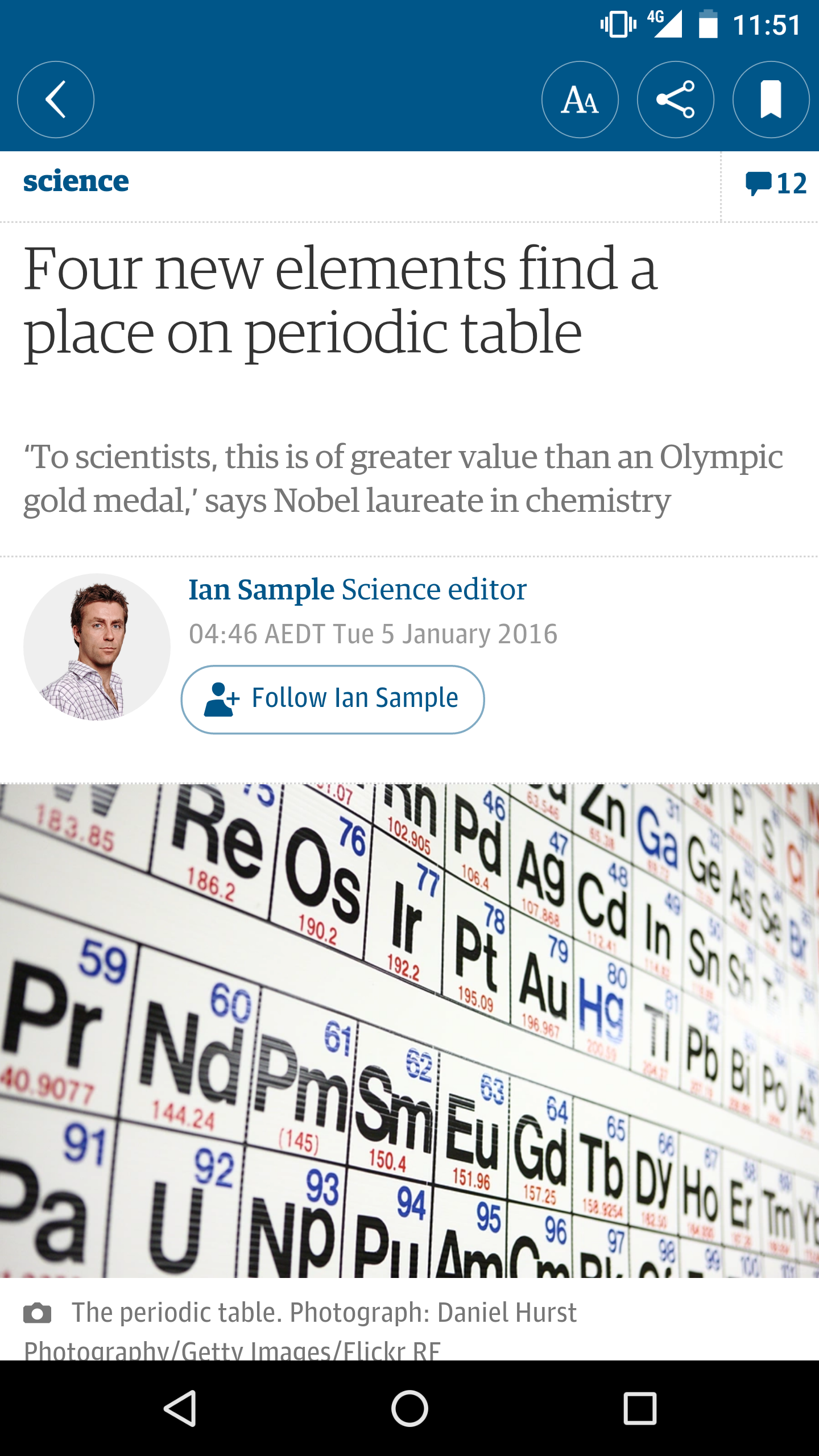
Grace is the quality of being pleasantly polite, or a willingness to be fair and polite.
That’s according to the Cambridge English Dictionary.
The Americans see it differently. According to the Webster it’s a controlled, polite, and pleasant way of behaving
The addition of the ‘controlled’ is telling. It suggests that displaying grace for an American requires an unnatural effort.
I have no idea what the Australian Macquarie Dictionary reports for the meaning of grace because the thing is quite gracelessly hidden behind a paid firewall.
One thing that I have noticed is that many people find it easier to exude grace when interacting with acquaintances and strangers.
Family though, that’s a tougher gig.
Familiarity seems not only to breed contempt but it also kills grace.
Kids; they are the masters of this.
Some of them never learn the benefits of grace as they mature. Often because their parents simply don’t value grace enough themselves and therefore don’t bother to teach it.
Which makes me think that the Americans are onto something. For most, grace may be a learned attribute, hence the addition of the ‘controlled’.
Taking much effort to learn, the payback for an education in the discipline of grace is well worth the application.
Simply stated, grace reduces a whole bunch of barriers in life at very little or no cost. It probably has highest IRR of all human behaviors.
I suspect that the closer to one’s home that one practices grace, the more content one’s soul will be.
However even the best disciples often forget to, or are never taught to, practice grace with themselves.
If you can crack this then you are well on your way to nirvana in this life.

China is the new innovation nation.
Well that’s their goal anyway.
A couple of years ago manufacturing peaked as a percentage of Chinese GDP and now it’s on its way down.
Services are rising, as they are everywhere else in the developed world, which forces manufacturing downwards in percentage terms.
Fortunately for China we are in the IT century where innovation seems to be mainly concentrated into IT, an engineering field.
What this means is that information and code can be combined to reduce the costs of the marketing and delivery of goods and services.
Innovation in this sense requires virtuality no invention. That is, it’s bloody easy. There’s more ideas than capital, so all you need is capital. And a captive market with money to blow.
It would seem to me that China is a shoe-in to innovate in this century especially as their government is pretty adept at excluding Western IT companies from operating in China, thereby giving the locals time enough to copy.
Completely new Chinese ideas? Just keep pushing money into them to buy an audience. It works just about everywhere.
Innovation. A piece of piss.
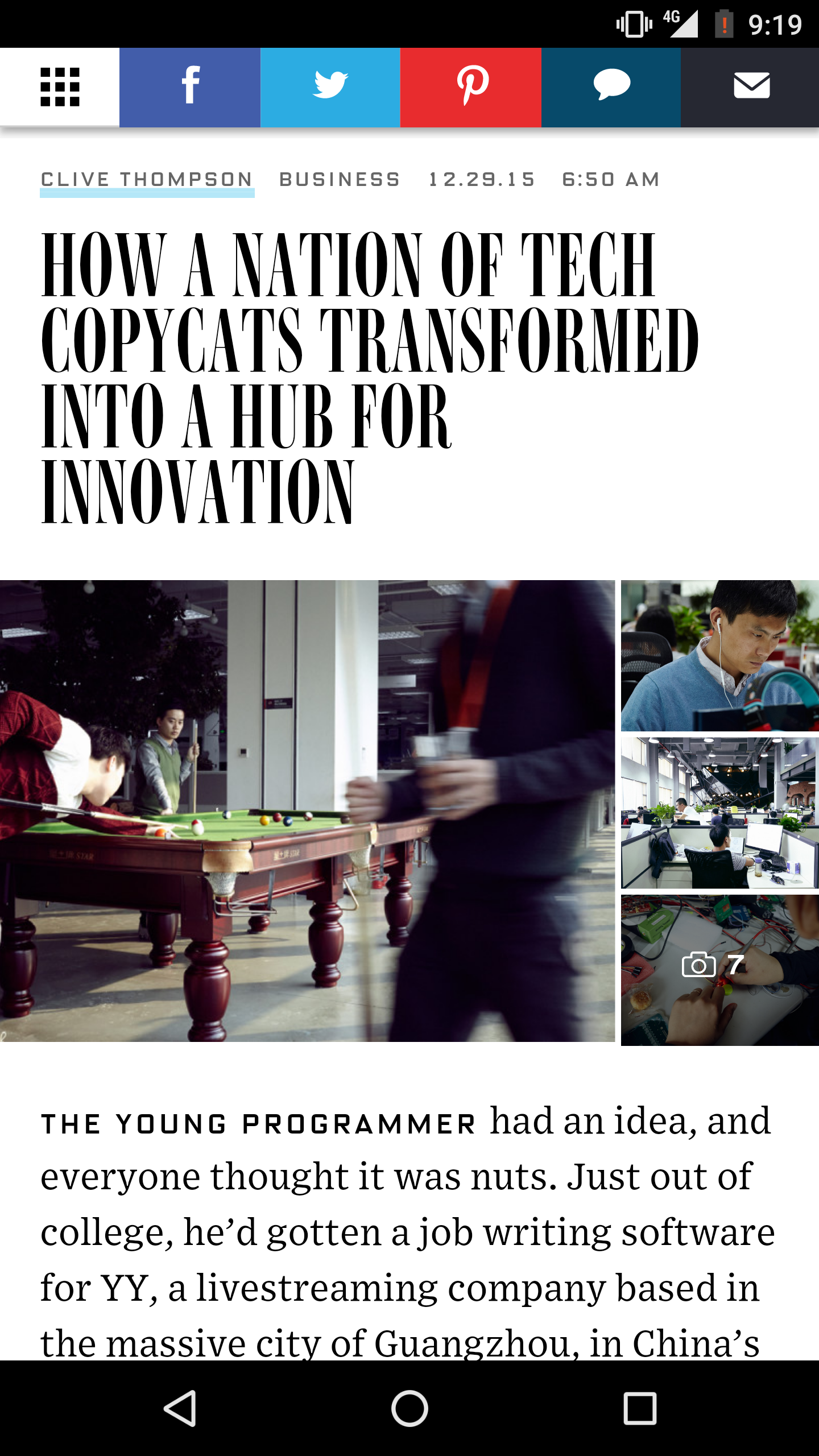
I don’t believe in multiple universes.
Which is different to saying that they can’t exist.
All I’m saying is that I can’t imagine that we could ever detect them if they did exist, nor does their existential existence have any imaginable impact on mine.
So I’m not going to waste my existence being in any way concerned about them.
I don’t believe in wasting time on time wasting. Unless it’s in this universe of course.
Now to maths; to you mad physicists and philosophers I would say the more complex your maths, the more likely it is that you’re dissembling.
Or more specifically, the gap between my reality and your dream world gets bigger as your solutions expand in length.
In fact, there’s a little known branch of bistromathics, canteenmathics, which is specifically related to the reality prescribed to mathematical solutions that defy all possible experimental confirmation.
When it comes down to matters of faith, belief craves home comforts.
And faith is nothing if not the sum of confirmation biases of all the people you know, each individually weighted by the inverse of the cube power of the degree of separation.
Of course if all the people you know are in your field and spend all their time worrying about the gap between my reality and your dream world, then knock yourself out, mate.

This is why one needs an editor…from The Guardian;
“Consistently, data shows us that around one-third of women have experienced a form of sexual harassment. Compare that to the less than 10% of men who have been victims and you can be sure that our attention on females is justified.”

 offshore westerly